
Table of Contents
Table of Contents
Searching for StreamNative Kafka pricing usually means the buying process has moved past curiosity. The team is no longer asking whether Kafka, Pulsar, or a lakehouse-native streaming engine is interesting. It is trying to decide which quote can survive a budget review, a migration review, and a production incident review. That is harder than comparing a few numbers on pricing pages, because each platform draws the boundary between vendor fee, cloud infrastructure, storage, network traffic, support, and engineering effort in a different place.
StreamNative's public pricing page lists Serverless, Dedicated, and BYOC deployment paths, with starting prices and a "contact us" motion for Dedicated. It also describes monthly billing, usage or cluster configuration, commitments, and discount discussions. That is useful, but it is not the same thing as a fully normalized Kafka quote. A Kafka workload has shape: region, availability zones, ingress, read fanout, retention, compression ratio, partition count, connector estate, security requirements, and SLO. Change one of those and the apparent ranking can change with it.
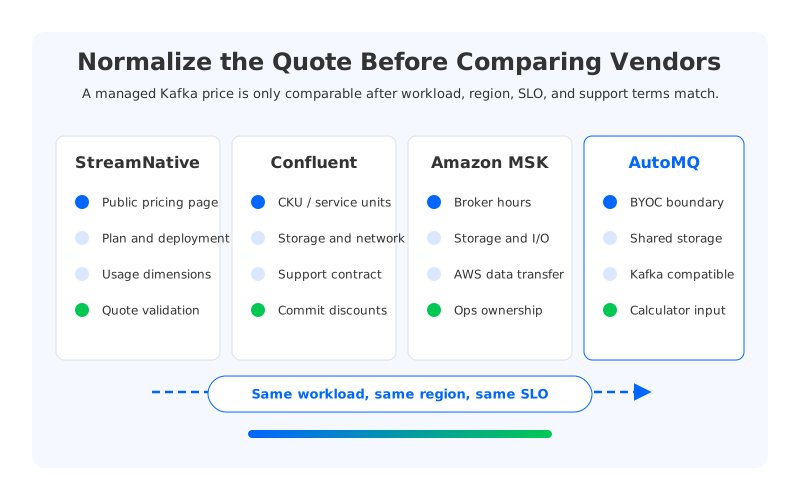
The right pricing exercise starts by forcing every option into the same scenario. StreamNative, Confluent Cloud, Amazon MSK, and AutoMQ can all be valid paths, but they are not priced through the same meter. If a quote leaves out migration work, cross-zone traffic, private connectivity, support tier, or retained data growth, the number is incomplete.
1What to Normalize Before Comparing Prices
The first mistake in managed Kafka pricing is treating "per month" as a complete unit. It is not. A monthly price becomes comparable after the workload and responsibility boundary are identical. A dedicated cluster running in one region with a modest retention window is a different economic object from a multi-AZ production platform with long retention, multiple consumer groups, private networking, and a support contract that procurement expects to enforce.
Use a worksheet before you read the quote. The worksheet should describe the workload in terms that every vendor can price without improvising:
| Input | Why it changes price | What to specify |
|---|---|---|
| Region and AZ model | Cloud infrastructure and network rules vary by location and availability model. | Region, number of AZs, private connectivity, and disaster recovery assumptions. |
| Ingress throughput | Most platforms meter capacity, usage, or resource size around write volume. | Average, peak, compression ratio, and burst duration. |
| Read fanout | Consumer traffic can dominate the real bill when many teams replay the same topics. | Number of consumer groups, replay behavior, and cross-VPC or cross-region reads. |
| Retention | Storage cost depends on hot storage, tiered storage, object storage, or local disks. | Retention by topic class, compaction needs, and replay window. |
| Operational scope | A lower platform fee can move work back to your SRE team. | Who owns upgrades, scaling, incident response, quota changes, and observability. |
| Migration work | Compatibility and cutover costs often sit outside platform pricing. | Client compatibility, connectors, schema, rollback, and dual-run period. |
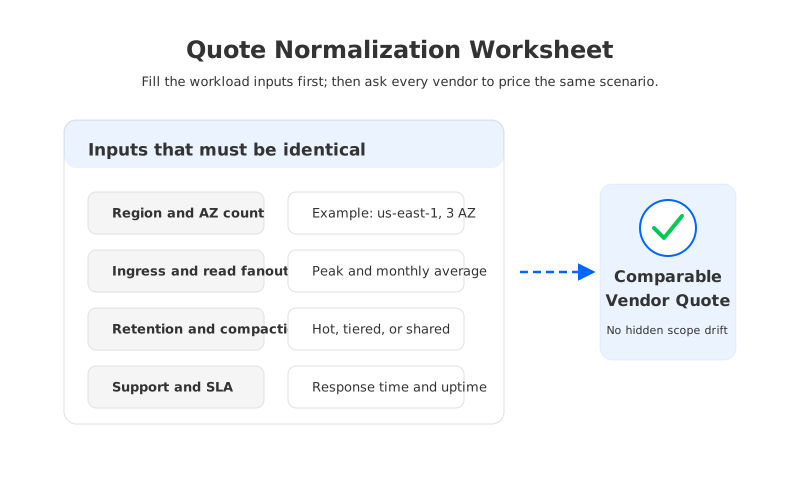
This is also where teams should separate list price from contract price. Public pages help with first-pass budgeting, but enterprise quotes often include committed spend, support tiers, discount schedules, marketplace terms, cloud credits, and workload-specific sizing. A clean comparison does not ask, "Which page shows the smallest number?" It asks, "Which vendor is pricing the same workload, with the same durability and support promise, under the same operating model?"
2StreamNative Kafka Pricing Questions
StreamNative is historically associated with Apache Pulsar, but its current positioning includes Kafka compatibility and Kafka-oriented offerings around its lakehouse-native architecture. Its pricing page presents three buying patterns: Serverless for quick starts on shared managed infrastructure, Dedicated for isolated managed clusters across major clouds, and BYOC for deployments in the customer's cloud account. The page also notes that BYOC keeps data in the customer's infrastructure and uses usage-based billing, while Dedicated has reserved capacity and can be adjusted when more capacity is needed.
That gives buyers a starting point, not the whole procurement answer. If you are evaluating "StreamNative Kafka pricing," ask the vendor to make the Kafka-specific scope explicit. Is the quote for Kafka API access on StreamNative Cloud, for Ursa, for a Pulsar deployment with Kafka compatibility, or for a broader platform contract? Does the quoted capacity assume compressed or uncompressed data? Does it include cloud infrastructure, or are you paying the cloud bill separately? Is traffic across AZs included, passed through, optimized by architecture, or billed by the underlying cloud?
The questions are concrete because the risk is concrete:
- What Kafka protocol surface is supported for your applications, including transactions, consumer group behavior, admin APIs, ACLs, Schema Registry patterns, and Kafka Connect?
- Which meters drive overage: throughput, storage, partitions, requests, egress, cluster size, or a vendor-defined unit?
- What happens during burst traffic: automatic scaling, reserved capacity expansion, throttling, or a support ticket?
- Which support response time, SLA, and service credit terms are included in the quoted price?
- In BYOC, which cloud resources are created in your account, and who pays for storage, compute, load balancers, private networking, logs, and metrics?
None of these questions imply that StreamNative is a poor fit. They prevent a common failure mode: comparing a narrow platform line item from one vendor against a broader, infrastructure-inclusive number from another. Pricing clarity is less about making every vendor look the same and more about exposing where each vendor's architecture moves cost.
3Cost Components Across Managed Kafka Platforms
Confluent Cloud, Amazon MSK, StreamNative, and AutoMQ each make a different trade-off between managed convenience and visible infrastructure. Confluent Cloud publishes prices around cluster types and cloud usage dimensions such as capacity, storage, networking, and features. Amazon MSK publishes AWS service pricing where the bill can include broker instance hours, storage, partition or throughput-related dimensions depending on the mode, data transfer, and associated AWS resources. StreamNative publishes plan-level starting points and deployment options, then pushes enterprise sizing into a vendor discussion. AutoMQ publishes a pricing calculator and documentation for BYOC billing, with a Kafka-compatible shared-storage architecture that changes the storage and scaling assumptions.
That comparison becomes clearer when you divide costs into four buckets:
| Bucket | What to include | Why it matters |
|---|---|---|
| Platform fee | Vendor service fee, cluster units, license, support, or subscription. | This is visible early, but rarely tells the full story. |
| Cloud resources | Compute, object storage, block storage, load balancers, private links, logs, and metrics. | BYOC and self-managed-like models can expose these directly. |
| Data movement | Cross-AZ replication, client egress, consumer fanout, replication, and private connectivity. | Kafka workloads often multiply traffic after the first write. |
| Engineering effort | Migration, compatibility tests, connector work, incident response, upgrades, and capacity planning. | This can decide the true cost even when the invoice looks lower. |
For Confluent Cloud, the buyer is often paying for a mature managed Kafka ecosystem, managed connectors, governance features, and a broad commercial platform. For MSK, the buyer keeps the Kafka service inside AWS, but still needs to understand AWS resource behavior and the operational work that remains. For StreamNative, the buyer should clarify whether the deal is primarily about Pulsar, Kafka compatibility, Ursa, BYOC, or a combination. For AutoMQ, the buyer is evaluating a Kafka-compatible system that keeps client semantics familiar while moving durable stream storage to object storage and making brokers more stateless.
The point is not that one cost model is universally preferable. The point is that each model should be evaluated against the workload that created the buying motion. A procurement team that only compares platform fees may miss why a storage-heavy workload behaves differently from a low-retention event bus. A platform team that only compares architecture may miss why support terms, marketplace billing, or committed spend matter to the CFO.
4Migration and Compatibility Cost
Migration cost is where pricing spreadsheets often become optimistic. A workload can look inexpensive in a vendor calculator and still be expensive to adopt if the application contract changes. Kafka estates accumulate dependencies over time: clients in multiple languages, Kafka Connect pipelines, schema conventions, consumer group assumptions, ACL patterns, dashboards, alert thresholds, runbooks, and replay workflows. Moving those safely is work, even when the target system offers compatibility.
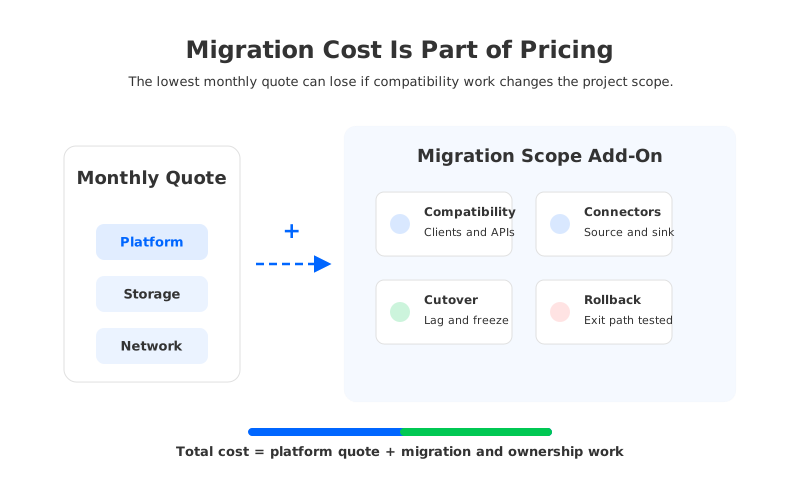
There are three levels of migration surface. The first is protocol compatibility: can existing producers, consumers, admin clients, and connectors run without code changes? The second is operational compatibility: can your team observe, secure, scale, and troubleshoot the new platform with acceptable changes to runbooks? The third is business compatibility: can the migration be rolled back if a billing, latency, or behavior issue appears during cutover?
Treat compatibility as a priced line item, not a footnote:
- Test representative clients, not only a hello-world producer and consumer. Include transactions, rebalances, large messages, ACLs, and consumer lag behavior if your estate uses them.
- Price connector migration separately. A managed connector catalog can reduce work, but missing connectors or custom SMTs can create a hidden project.
- Include the dual-run window. During migration, you may pay for both source and target platforms, plus replication tooling and extra observability.
- Require rollback criteria. A platform that is hard to exit can turn a short migration into a long stabilization phase.
This is where Kafka compatibility has measurable business value. It does not remove every migration task, but it can reduce the number of application teams pulled into the project. That is one reason buyers comparing StreamNative Kafka pricing with Confluent, MSK, and AutoMQ should avoid evaluating the monthly bill in isolation. The migration path changes the total cost.
5Where AutoMQ Fits
AutoMQ enters the comparison when the team wants to keep Kafka APIs but change the storage economics and operational shape behind the brokers. It is a Kafka-compatible cloud-native streaming system that uses shared storage on object storage, with brokers that are less tied to local disk capacity. In a pricing comparison, that matters because traditional Kafka cost is often amplified by replicated local storage, broker sizing around retention, data movement across zones, and operational work around reassignment or recovery.
The useful comparison is not "AutoMQ versus everyone" as a slogan. It is a workload-based check. If your applications already speak Kafka and the migration budget is sensitive to client rewrites, Kafka compatibility matters. If your retained data grows faster than compute demand, shared object storage matters. If your platform team wants BYOC so data and cloud resources remain in your account, the responsibility boundary matters. AutoMQ's pricing calculator is valuable because it encourages this kind of workload input instead of reducing the discussion to a single plan label.
There is also a practical procurement angle. Confluent Cloud can be the right answer when the organization values a broad managed Kafka platform and ecosystem services. MSK can be the right answer when AWS-native procurement and service ownership are the priority. StreamNative can be the right answer when a team wants Pulsar lineage, Kafka compatibility, or a lakehouse-native streaming direction and is comfortable validating that scope. AutoMQ fits when the team wants a Kafka-compatible path with object-storage-backed shared storage and a BYOC model that can be compared through workload assumptions.
The cleanest way to bring AutoMQ into the quote process is to ask for the same scenario you give every other vendor: region, throughput, retention, read fanout, SLO, support, and migration scope. If the resulting comparison shows that storage and network dominate the bill, architecture is now part of pricing. It is no longer a feature checklist.
6Pricing Comparison Checklist
Before you take any managed Kafka quote to procurement, ask every vendor for the same answers in writing. The checklist below is intentionally direct because ambiguity usually becomes cost later.
| Question | Why it matters |
|---|---|
| Is the quote based on the exact same workload profile? | Prevents one vendor from pricing average traffic while another prices peak traffic. |
| Are cloud infrastructure costs included or passed through? | BYOC and managed-service models expose different parts of the bill. |
| How are storage and retention priced? | Long retention can dominate the economics of streaming workloads. |
| How is network traffic priced or reduced? | Cross-AZ replication and consumer fanout can become material in cloud deployments. |
| What Kafka compatibility has been tested? | Compatibility claims should map to your clients, connectors, and operational behavior. |
| What support tier and SLA are included? | A low quote with weak support can move incident cost back to your team. |
| What is the rollback plan? | Exit cost is part of total cost, especially during platform migration. |
When you compare StreamNative Kafka pricing with Confluent, MSK, and AutoMQ, the winning exercise is not to crown the smallest published starting price. The winning exercise is to make every hidden assumption visible before the contract is signed. Build the workload worksheet, force the same scenario through every quote, and add migration effort as a first-class cost. If your comparison shows that Kafka compatibility and storage architecture are the decisive variables, evaluate AutoMQ's pricing calculator and BYOC documentation alongside the other vendor quotes: compare your workload with AutoMQ or talk to the AutoMQ team.
7FAQ
7.1Does StreamNative publish Kafka pricing?
StreamNative publishes a pricing page with Serverless, Dedicated, and BYOC plans, including starting prices and deployment descriptions. For Kafka-specific enterprise sizing, buyers should still request a written quote that states the exact product scope, workload assumptions, billing meters, cloud infrastructure boundary, SLA, and support terms.
7.2Is StreamNative Kafka pricing directly comparable to Confluent Cloud pricing?
Not without normalization. Confluent Cloud and StreamNative expose different product models, deployment options, and usage dimensions. Compare them using the same region, throughput, retention, read fanout, support level, private networking requirements, and migration scope.
7.3How should Amazon MSK be included in the comparison?
Amazon MSK should be priced with AWS service dimensions and the surrounding AWS resources that the workload needs. Include broker or cluster mode, storage, data transfer, private connectivity, monitoring, support, and the operational work your team still owns.
7.4Why include AutoMQ in a StreamNative Kafka pricing comparison?
AutoMQ is relevant when the buyer wants Kafka compatibility but is also evaluating cloud-native storage economics. Its object-storage-backed shared-storage architecture and BYOC model create a useful contrast against traditional managed Kafka, AWS-native managed Kafka, and StreamNative's deployment options.
7.5What is the most common pricing mistake?
The most common mistake is comparing a platform fee from one vendor with a fully loaded estimate from another. Always include cloud resources, storage, network traffic, support, and migration work before making a decision.


