
Table of Contents
Table of Contents
A Kafka migration rarely fails because a demo producer cannot send one record. It fails because a forgotten connector creates internal topics in a surprising way, an old client library negotiates a protocol version you did not test, a stateful stream job depends on transactions, or an incident runbook assumes broker-level metrics that no longer mean the same thing. That is why a StreamNative Ursa vs Kafka evaluation should start with the long tail, not the happy path.
StreamNative describes URSA as its data streaming engine for StreamNative Cloud, with Kafka and Pulsar service profiles exposed on top of the engine. That makes Ursa interesting for teams looking at cloud-native streaming economics, but it also changes the migration question. You are not only asking whether Ursa can accept Kafka traffic. You are asking whether your applications, platform automation, security controls, failure drills, and cost model still behave when the storage engine and service profile are different.
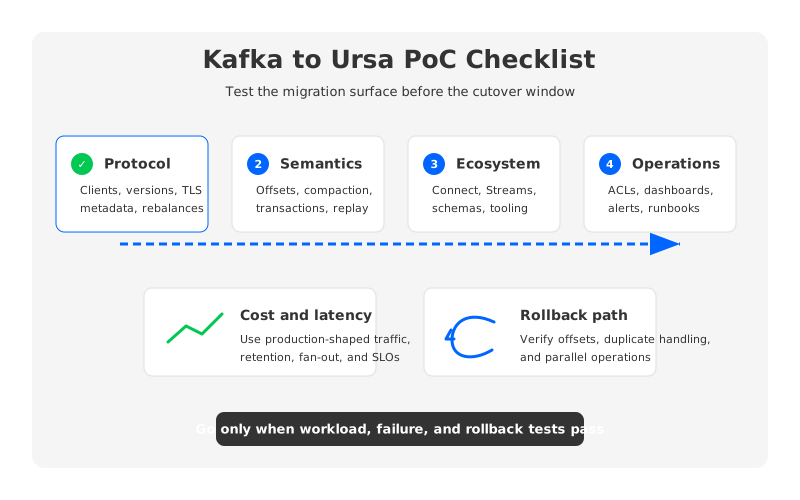
The safest way to run the evaluation is to treat it as a compatibility audit with production evidence. Official support tables matter, but they are the beginning of the work. The answer that matters is whether your own workloads pass under normal traffic, during failures, and during rollback.
1Why A Produce And Consume Test Is Not Enough
The first test most teams run is a simple producer and consumer. It is useful, because it catches authentication mistakes, endpoint configuration issues, and basic client compatibility. It is also dangerously incomplete. Kafka's value in a production estate comes from the surrounding contract: consumer group coordination, offset commits, topic configuration, Connect internal topics, Streams changelogs, transactional fencing, schema workflows, ACL automation, monitoring, alerting, and operational recovery.
That surrounding contract is where migrations become expensive. A platform team may have hundreds of applications that all "use Kafka," but those applications do not use the same slice of Kafka. One service writes append-only events with a current Java client, another uses compacted CDC topics, a third runs Kafka Streams with exactly-once processing, and a vendor connector may use Admin APIs under the hood.
The PoC should make those differences visible:
- Protocol compatibility is the entrance check. Client connection, produce, fetch, metadata lookup, offset commit, and rebalance behavior must work across the real client versions in your estate.
- Semantic compatibility is the correctness check. Transactions, compaction, tombstones, idempotence, timestamp behavior, retention, and ordering assumptions can affect application correctness even when traffic flows.
- Operational compatibility is the on-call check. Terraform modules, ACL scripts, dashboards, broker metrics, connector deployments, and incident procedures are part of the migration surface.
- Economic compatibility is the finance check. A storage design that lowers one cost line can still miss the business case if latency, recovery, support effort, or data transfer changes offset the gain.
This is also where the evaluation should stay fair. Do not turn one vendor's documented limitation into a headline while ignoring your own Kafka debt. If a workload relies on an obscure API, put it in the matrix and test it against every candidate.
2Build The Inventory Before You Pick The Tests
Most failed PoCs are under-instrumented at the beginning. The team chooses a benchmark topic, a current client, and a clean consumer group, then declares the migration promising. That approach proves almost nothing about the applications that will create the real cutover risk.
Start with an inventory that records the Kafka surface area you actually operate:
| Inventory area | What to capture | Why it matters |
|---|---|---|
| Client libraries | Language, version, security mode, producer configs, consumer configs | Kafka clients vary in protocol usage and retry behavior |
| Topic semantics | Partition counts, retention, compaction, delete policy, message size, tombstones | Topic config changes can alter correctness and storage cost |
| Consumer behavior | Group count, lag patterns, rebalance sensitivity, offset reset policy | Migrations often expose hidden assumptions about group coordination |
| Platform automation | Topic creation, ACLs, quotas, config changes, IaC modules, CI checks | Admin API gaps become platform changes, not app changes |
| Ecosystem components | Kafka Connect, Kafka Streams, schema registry, monitoring, alerting | Ecosystem tools exercise deeper protocol and operational paths |
| Failure procedures | Broker loss, zone loss, client retry storm, rollback, replay, incident runbooks | Production compatibility is decided during stress, not at idle |
The inventory should include old and awkward workloads. A better PoC brings the workloads that make people nervous and gives them a controlled place to fail.
3Compatibility Tests For Ursa And Kafka
The compatibility phase should map official documentation to executable tests. StreamNative's Kafka compatibility and Kafka protocol feature pages are the right starting points for Ursa-specific support, while Apache Kafka's documentation provides the baseline semantics for Kafka clients, Connect, Streams, and transactions. The goal is not to memorize a support table. The goal is to convert every important row into a test case with an owner, expected result, and fallback.
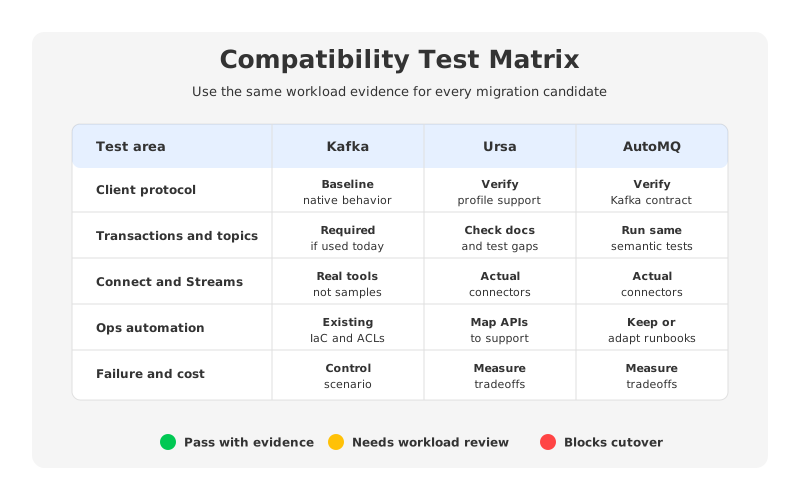
For client protocol tests, use the client versions you run in production. Include at least one current client, one older client that still matters, and one non-JVM client if your estate uses Go, Python, Node.js, .NET, C++, or Rust. Test produce, fetch, metadata refresh, offset commit, rebalance, retry behavior, compression, authentication, and TLS rotation. A clean first connection is not enough; watch what happens when brokers restart or clients receive stale metadata.
For Admin API tests, run your real platform automation. Create topics, update configs, inspect metadata, manage ACLs, change partition counts where applicable, and redeploy the IaC or CI jobs that your team uses today. If an operation must move from Kafka Admin APIs to a provider-specific API, write that down as migration work.
For semantic tests, focus on correctness before throughput. Test idempotent producers, transactions if your applications use them, compacted topics, tombstone propagation, retention boundaries, offset reset behavior, and replay from old offsets. If a feature is not supported in the chosen Ursa profile, the test result should not be "failed" and forgotten. It should become a workload classification: this application is in scope, out of scope, or requires redesign.
4Connector And Stream Processing Tests
Connectors are migration traps because they often look like infrastructure, not applications. A source connector may create offsets and status topics, rely on compaction, validate topic configs through Admin APIs, or recover from failure in a way that assumes Kafka's exact behavior. A sink connector can be even more sensitive, because duplicate writes and retry ordering leak into downstream systems.
Run your actual connectors, not a sample connector. Put at least one high-volume source, one business-critical sink, and one connector with strict recovery requirements into the PoC. Test deployment, rolling restart, task rebalance, offset recovery, dead-letter handling, schema evolution, and redeploy after configuration changes.
Kafka Streams deserves separate treatment. A stateless topology is closer to a normal producer-consumer test, but a stateful topology uses repartition topics, changelog topics, commits, restoration, and sometimes exactly-once processing. That means a Streams test should include a real state store, a repartition step, a rolling deployment, a failure during restore, and a replay from an older offset. If your topology uses exactly-once semantics, test transaction behavior directly instead of assuming it from a general compatibility claim.
The useful output is a workload map:
| Workload class | Minimum passing evidence | Go/No-Go implication |
|---|---|---|
| Basic ingestion | Real clients produce and consume through restart, retry, and rebalance | Usually low migration risk if operations also pass |
| CDC and compacted topics | Upserts, tombstones, retention, and restore behavior match expectations | Block cutover if compaction is required and unsupported |
| Kafka Connect | Actual connectors deploy, recover, and preserve offsets | Treat connector failures as platform blockers |
| Kafka Streams | Stateful topology restores, rebalances, and preserves correctness | Test as an application migration, not a broker benchmark |
| Transactional services | Idempotence, fencing, abort, retry, and commit paths are verified | Block or redesign if exactly-once assumptions cannot hold |
This map turns subjective debate into engineering work. A CTO can read it, an SRE can operationalize it, and a data engineering lead can see which pipelines need more testing.
5Performance, Failure, And Cost Tests
Performance tests should use production-shaped traffic. A single throughput number hides too much. Use your real message size distribution, compression settings, partition counts, retention window, producer concurrency, consumer fan-out, and catch-up read patterns. Measure p50, p95, and p99 latency for produce and consume paths, but also measure lag recovery, restore time, and performance during rolling changes.
Failure tests are where architecture differences become visible. Traditional Kafka operators think in leaders, replicas, ISR, broker disks, controller behavior, and reassignment. A cloud-native service profile may make some of those concepts less central, but your on-call team still needs observability and recovery evidence. Test instance loss, zone impairment where the service model allows it, client retry storms, delayed consumers, and replay after retention boundaries.
Cost tests need the same discipline. Do not compare list prices in isolation. Build a scenario with write throughput, read fan-out, retention, partition count, replication or durability model, network path, storage class, support model, and operational labor. Then compare monthly cost only after the workload passes the functional and failure tests. A lower storage bill does not help if the workload must be redesigned or if the latency profile misses the SLO.
The strongest PoC result is not "candidate X is faster." It is "candidate X meets our semantics, survives our failure tests, fits our on-call model, and changes the cost curve under this workload."
That sentence is worth putting at the top of the PoC report. It prevents the migration from becoming a benchmark contest detached from production risk.
6Rollback And Cutover Planning
Rollback is not paperwork. It is one of the most important tests in the migration. If your team cannot explain how data, offsets, producers, consumers, connectors, and downstream systems move back to Kafka, the migration plan is not ready for production.
Define rollback before the cutover window. Decide whether the migration is dual-write, mirror-and-cutover, connector-based, application-by-application, or topic-by-topic. Record how offsets will be re-established, how duplicate records will be handled, how consumer groups will restart, how schemas and ACLs will be reconciled, and how long both systems will run in parallel. Every strategy needs an explicit failure point where the team can stop and return to the previous state.
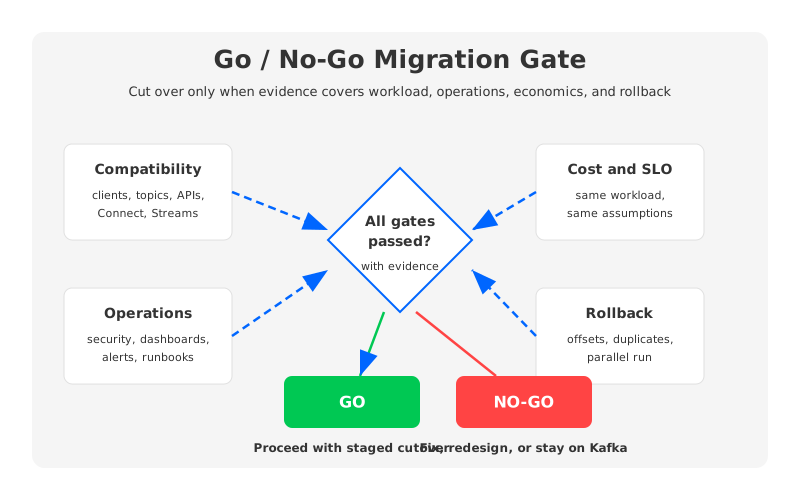
A practical Go/No-Go gate should include these conditions:
- All in-scope client versions pass connection, produce, fetch, commit, and rebalance tests.
- All required topic semantics pass, or affected workloads are marked out of scope.
- Kafka Connect and Kafka Streams workloads pass with production-like failure cases.
- Security, ACL, audit, and platform automation workflows are either compatible or replaced.
- Observability and incident runbooks give SREs enough signal to operate the service.
- Cost and latency are evaluated together under the same workload scenario.
- Rollback is tested with real offsets, data, and downstream consumers.
The last item is the one teams are most tempted to skip. It is also the item that keeps a reversible migration from becoming a one-way incident.
7Testing AutoMQ With The Same Framework
Once the test framework is in place, it should be reused. StreamNative Ursa is one answer to the pressure Kafka teams feel in the cloud: local broker disks, inter-broker replication, reassignment, and over-provisioned capacity can make traditional Kafka expensive and operationally rigid. Another answer is a Kafka-compatible shared-storage architecture that keeps the Kafka-facing contract while changing the storage layer underneath.
AutoMQ fits that second category. It is a Kafka-compatible streaming platform that uses S3Stream shared storage and object storage to reduce the amount of durable data tied to broker-local disks. The important point for this article is not that AutoMQ should bypass scrutiny. It should face the same PoC matrix: client versions, Connect, Streams, transactions where used, topic semantics, failure recovery, observability, cost, and rollback.
That comparison separates two decisions that are often blurred together: whether you want to leave Apache Kafka's operational model, and whether you want to preserve Kafka's application-facing ecosystem while changing the cloud storage architecture. Ursa, Apache Kafka, managed Kafka services, and AutoMQ make different tradeoffs across those dimensions.
For teams that want to keep Kafka compatibility as the migration constraint, AutoMQ's architecture documentation is a good next read. Use it to design a second PoC beside the Ursa test, not as a substitute for testing. A migration decision is credible only when every candidate has been asked the same uncomfortable questions.
8FAQ
8.1Is StreamNative Ursa a drop-in replacement for Kafka?
Treat it as a candidate replacement for specific Kafka workloads, not as a universal drop-in replacement. StreamNative documents Kafka-compatible surfaces for its Kafka service profiles, but the exact support depends on the engine, profile, and feature area. Your PoC should test the workload classes you actually run.
8.2What is the first thing to test when migrating Kafka to Ursa?
Start with an inventory of client versions, topic semantics, Connect usage, Streams applications, Admin API automation, security workflows, and observability. Then convert that inventory into tests. A simple producer-consumer check should be early, but it should not be the main evidence.
8.3Should Kafka Connect be tested separately?
Yes. Kafka Connect often depends on internal topics, offsets, config topics, Admin APIs, schema behavior, and recovery logic. Run your actual source and sink connectors with realistic failures, not only a sample connector.
8.4What about Kafka Streams and transactions?
Kafka Streams and transactional workloads need dedicated tests because they depend on deeper Kafka semantics. Stateful topologies, changelog topics, repartition topics, restore behavior, idempotence, fencing, abort, and commit paths should be verified directly.
8.5How should cost be compared?
Compare cost only after the workload passes functional and failure tests. Use the same workload assumptions across candidates: throughput, read fan-out, retention, partitions, network path, durability model, support, and operations. Otherwise the comparison will reward whichever platform is modeled with the friendliest assumptions.
8.6Where does AutoMQ fit in a Ursa vs Kafka evaluation?
AutoMQ is relevant when the goal is to preserve Kafka compatibility while changing the storage architecture under Kafka. It should be tested with the same migration checklist as Ursa and Kafka: clients, connectors, stream processing, operations, failure recovery, cost, and rollback.
9References
- StreamNative Documentation: Data Streaming Engine
- StreamNative Documentation: Kafka Compatibility Overview
- StreamNative Documentation: Kafka Protocol and Features
- StreamNative Documentation: Migrate to StreamNative Kafka Service
- Apache Kafka Documentation
- Apache Kafka Streams Documentation
- Apache Kafka KIP-405: Tiered Storage
- AutoMQ Documentation: S3Stream Shared Streaming Storage
- AutoMQ Documentation: Migrate to AutoMQ Cloud


