
Table of Contents
Table of Contents
Platform teams searching for strimzi kafka are usually past the question of whether Kafka can run on Kubernetes. They are asking whether Kubernetes can become a reliable operating model for Kafka without turning every broker upgrade, certificate rotation, and topic change into hand-written operational work.
Strimzi gives a strong answer. It packages Apache Kafka operations into Kubernetes-native custom resources and controllers, so a team can declare clusters, users, topics, listeners, certificates, and selected operational workflows through the Kubernetes API. For teams standardized on GitOps, admission control, namespaces, and platform automation, the Strimzi Kafka Operator can make Kafka feel less like an exception inside the cluster.
That does not mean the architecture problem disappears. Kafka remains a stateful distributed log unless the storage architecture changes. A Kafka custom resource can describe the cluster, but it does not remove the need to design persistent volumes, broker disk sizing, partition placement, rebalance strategy, cross-zone traffic, and failure recovery. Strimzi automates a large part of the control plane. It does not turn broker-local storage into shared storage.
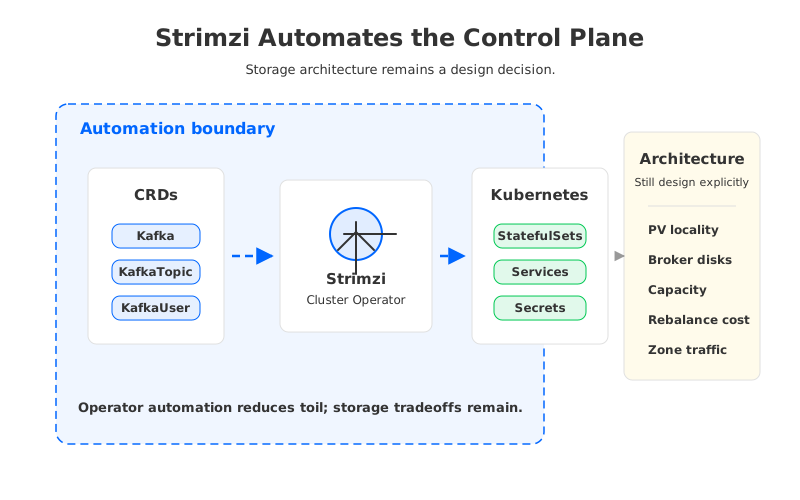
The healthiest way to evaluate Strimzi is therefore not "operator or no operator." It is: which parts of Kafka operations should be delegated to Kubernetes automation, and which parts still require architectural design?
1What Strimzi Does Well
Strimzi's value starts with declarative deployment. Instead of installing Kafka through a pile of scripts and remembering every cluster-specific flag, operators define resources such as Kafka, KafkaTopic, and KafkaUser. The Strimzi Cluster Operator watches those resources and reconciles the actual Kubernetes objects toward the desired state.
That reconciliation model matters because Kafka platforms often fail operationally through drift. One environment has a different listener setting, another uses an older certificate path, and a third has topics created out of band. A declarative kafka operator kubernetes model turns those decisions into reviewable configuration.
Strimzi also handles several workflows that are tedious and risky when performed manually:
- Kafka cluster deployment and updates through Kubernetes resources.
- Rolling updates coordinated across Kafka brokers and supporting components.
- TLS certificates and listener configuration.
- User and topic management through custom resources.
- Integration with Cruise Control through
KafkaRebalanceresources. - Kubernetes-native monitoring hooks and operational metadata.
These features are not cosmetic. A careful rolling update can be the difference between routine maintenance and an avoidable incident. Certificate, topic, and user resources also reduce imperative change requests.
Strimzi is also useful because it keeps Kafka visible to the platform team. Kubernetes events, resources, namespaces, labels, and reconciliation status become part of the operating surface rather than hiding Kafka behind an opaque VM fleet.
2What Strimzi Does Not Change About Kafka
The important boundary is storage ownership. Traditional Apache Kafka stores log segments on broker-local storage. Each broker owns data for its assigned partitions, and Kafka durability comes from replication across brokers. Kubernetes can schedule pods and attach persistent volumes, but the underlying Kafka model is still stateful and partition-oriented.
That distinction is easy to miss because operators are powerful. A controller can create a StatefulSet, attach PVCs, roll pods, update configuration, and reconcile health. But it cannot make a broker's local log data vanish. When a partition moves, data moves. When a broker disk fills, capacity or reassignment is still required. When a zone fails, recovery still follows Kafka replication, placement, and storage design.
The operator improves Kafka's operating model. It does not replace Kafka's storage model.
| Area | Strimzi helps automate | Architecture still decides |
|---|---|---|
| Deployment | Kubernetes resources, pods, services, listeners | Cluster topology and failure domains |
| Upgrades | Rolling update orchestration | Risk tolerance, replication health, maintenance policy |
| Identity | Certificates, users, authentication resources | Security boundaries and tenancy model |
| Topics | Topic custom resources | Partition count, retention, compaction, throughput model |
| Rebalancing | Cruise Control integration via KafkaRebalance | When movement is safe and what data movement costs |
| Storage | PVC configuration and broker storage declarations | PV class, disk size, locality, recovery, and expansion plan |
This boundary is not a criticism of Strimzi. It is why a serious kafka on kubernetes evaluation still needs architects and SREs in the room.
3Broker-Local Storage Still Needs Design
Running Kafka brokers as Kubernetes pods does not make the data ephemeral. In a typical Strimzi deployment, brokers are backed by persistent volumes. Kubernetes gives those volumes lifecycle, binding, and scheduling semantics, while Kafka still writes logs to the mounted storage.
The platform team still has to answer concrete storage questions:
- Which StorageClass is appropriate for Kafka write latency and throughput?
- How large should broker volumes be relative to retention, compaction, and burst growth?
- How will volume expansion work when a topic's retained data grows?
- What happens when a broker pod is rescheduled but the volume is zone-bound?
- How much local disk headroom is required before partition reassignment becomes urgent?
These are the everyday economics of kafka k8s. Kubernetes PersistentVolumes preserve data across pod restarts, but locality and attachment behavior become part of the Kafka failure model. Strimzi can declare storage configuration, but it cannot remove the consequences of broker-local durable disks.
4Partition Movement Remains Expensive
Kafka's unit of placement is the partition replica. When brokers are added, removed, replaced, or rebalanced, partitions and their data may need to move. Apache Kafka provides tooling and APIs for reassignment, and Strimzi can integrate with Cruise Control to generate and execute rebalance proposals. That is valuable automation, especially for larger clusters.
The physical reality remains: moving partition replicas means moving data. A rebalance consumes network capacity, disk throughput, broker CPU, and operational attention. If the retained data set is large, the movement window can affect maintenance planning.
This is where some strimzi kafka limitations discussions become imprecise. The limitation is not that Strimzi lacks automation. The limitation is that automation still operates inside a stateful shared-nothing Kafka architecture. For production planning, treat rebalancing as a workload with capacity budget, monitoring, throttling, and rollback thinking.
5Capacity Planning Is Still a Kafka Job
Kubernetes encourages teams to think in terms of elastic workloads, but Kafka capacity is not only pod count. Broker count, partition count, replication factor, disk size, network bandwidth, page cache, and consumer backfill patterns all interact.
Strimzi makes it easier to express the desired Kafka cluster. It does not decide whether the cluster has too many partitions, whether a topic's retention is economical, or whether cross-zone replication will dominate the network bill. Those decisions belong to Kafka architecture.
The most common planning mistake is treating broker scaling as a pure compute operation. In traditional Kafka, adding brokers can require partition reassignment before the new capacity helps. Increasing retention may require disk expansion or repartitioning. A bursty workload may need more IO headroom even if CPU is underused.
A practical capacity review should include:
- Write throughput, read fanout, and catch-up read frequency.
- Retention by topic, not only cluster-wide averages.
- Replication factor and availability-zone placement.
- Partition count growth over time.
- Broker disk utilization thresholds and expansion policy.
- Rebalance windows and throttling assumptions.
- Observability for under-replicated partitions, ISR churn, disk saturation, and consumer lag.
That list is architecture work. Strimzi gives the platform a better way to operate the decisions, but the decisions still have to exist.
6Cross-Zone Traffic and Failure Recovery Still Matter
Kubernetes makes multi-zone scheduling easier to express, but Kafka's cross-zone behavior deserves separate analysis. If brokers are spread across zones, replication traffic crosses zones. If clients are not topology-aware, client traffic may cross zones as well.
The architecture question is not only "can Kafka run in multiple zones?" It is "what is the cost and recovery behavior when the cluster is healthy, rebalancing, or degraded?"
Strimzi can help encode a multi-zone deployment through Kubernetes configuration, node pools, affinity, and storage declarations. The platform still has to design the placement model. In the cloud, cross-zone traffic is both a reliability choice and a cost factor; in private Kubernetes, the same concern appears as network capacity and failure-domain isolation.
Failure recovery is where this becomes concrete. A broker restart is usually routine. A broker replacement with a large local disk footprint is a data recovery event. The operator helps coordinate resources, but the speed and cost of returning to a healthy state are determined by storage and replication architecture.
7When Strimzi Is a Good Fit
Strimzi is a strong fit when the organization wants to run Kafka itself and has a platform team ready to own Kubernetes-native operations. It is especially compelling when Kafka needs to live close to Kubernetes applications and GitOps is already the deployment model.
Good-fit scenarios often share several traits:
- The team already operates Kubernetes for stateful workloads.
- Kafka SREs are comfortable with partitions, replicas, retention, and rebalance planning.
- Platform engineers want declarative cluster, topic, and user management.
- The organization prefers open-source infrastructure control over a fully managed Kafka service.
- The workload has predictable storage growth or enough operational headroom for reassignment.
In those environments, Strimzi can reduce toil without hiding Kafka from the people responsible for it. Kafka is still Kafka, but the day-to-day mechanics become more consistent with the platform.
Strimzi is less likely to be the complete answer when the main pain is storage-bound elasticity. If scale-out or recovery depends on moving retained bytes between disks, the operator is improving the management layer around the bottleneck rather than changing it.
8When to Evaluate Stateless Kafka on Kubernetes
The phrase "stateless Kafka" needs careful handling. Kafka semantics still require durable storage, ordering, metadata, replication or equivalent durability mechanisms, and recovery logic. The architectural shift is not that data becomes stateless. It is that brokers no longer permanently own the retained log on local disks.
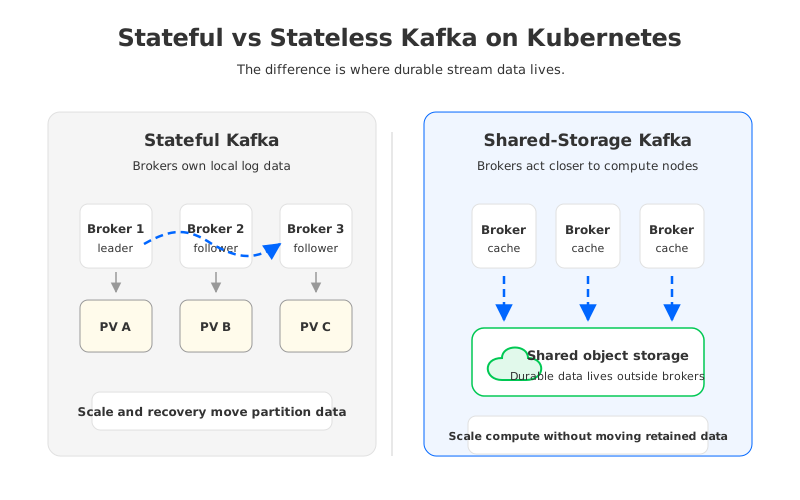
In a shared-storage Kafka-compatible architecture, brokers can behave more like replaceable compute nodes while durable stream data lives in object storage or another shared layer. The broker may still use local cache or write-ahead storage, but long-lived data is not tied to a single broker volume in the same way.
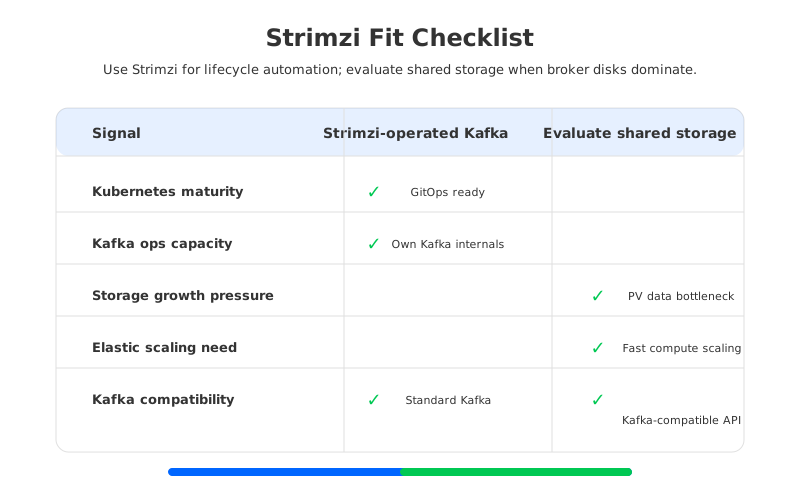
This model is worth evaluating when several signals appear together:
- Storage growth is faster than compute growth.
- Broker replacement or scale-out is dominated by data movement.
- Long retention is required for replay, CDC, audit, or recovery workflows.
- Cross-zone replication traffic is a material cost or capacity concern.
- Kubernetes elasticity is important, but PV-bound broker identity makes scaling slow.
- The team wants Kafka protocol compatibility without accepting all broker-local disk tradeoffs.
The tradeoff is that shared storage must be purpose-built for streaming. Object storage by itself is not a Kafka log; the system still needs append behavior, metadata consistency, caching, recovery, and Kafka compatibility.
9Where AutoMQ Fits
AutoMQ belongs in this conversation as a storage architecture option, not as a Strimzi replacement. Strimzi is an operator for running Apache Kafka on Kubernetes. AutoMQ is a Kafka-compatible cloud-native streaming system that separates broker compute from durable storage by using object-storage-backed shared storage.
That distinction matters. A team may choose Strimzi because it wants to operate standard Kafka through Kubernetes APIs. Another team may evaluate AutoMQ because its bottleneck is broker-local persistent data and it wants stateless brokers with shared storage. Those are different decisions and should not be collapsed into one vendor comparison.
AutoMQ's relevance appears after the storage boundary is clear. If the pain is certificate rotation, topic governance, and Kubernetes-native lifecycle management, Strimzi is aligned with the problem. If the pain is storage-bound scaling, reassignment windows, broker recovery, or retained data tied to PVs, then a Kafka-compatible shared-storage architecture is worth testing.
For Kubernetes platform teams, the evaluation should be workload-driven. Compare the current Strimzi-based Kafka model with a shared-storage alternative under the same assumptions: write throughput, read fanout, retention, failure domains, backfill reads, scaling events, and recovery objectives. The goal is to match storage architecture to the failure modes the team actually sees.
10A Practical Evaluation Checklist
A grounded strimzi kafka operator evaluation can use three layers.
First, evaluate Strimzi as an operator. Can it express the cluster shape you need? Are topic and user resources aligned with governance? Do rolling updates, certificates, listeners, and monitoring fit the platform workflow?
Second, evaluate Kafka as a stateful system on Kubernetes. Are storage classes, persistent volumes, zone placement, and broker disks suitable for the workload? Can you tolerate partition movement, broker replacement, and retention growth?
Third, evaluate whether the storage architecture itself should change. If the team wants Kafka compatibility without broker-local durable ownership, compare Strimzi-operated Kafka with a stateless shared-storage Kafka-compatible option such as AutoMQ.
That sequence keeps the conversation fair. Strimzi gets credit for its automation, Kafka gets evaluated honestly as a stateful distributed log, and shared storage enters only when the problem calls for an architectural change.
If your team is at that third layer, review the AutoMQ architecture overview alongside the Strimzi and Kubernetes storage docs, then test the options against your own broker recovery and retention model.
11References
- Strimzi Operator Documentation: Overview
- Strimzi Operator Documentation: Deploying and Managing Kafka
- Kubernetes Documentation: StatefulSets
- Kubernetes Documentation: Persistent Volumes
- Apache Kafka Documentation: Expanding a Cluster
- KIP-405: Kafka Tiered Storage
- AutoMQ Architecture Overview
12FAQ
12.1What is the Strimzi Kafka Operator?
The Strimzi Kafka Operator is an open-source Kubernetes operator for running Apache Kafka on Kubernetes. It uses custom resources and controllers to manage Kafka clusters, topics, users, certificates, listeners, and selected workflows.
12.2Does Strimzi make Kafka stateless?
No. Strimzi improves how Kafka is deployed and operated on Kubernetes, but traditional Kafka brokers still store log data on broker-local persistent storage. Stateful storage design remains part of the architecture.
12.3Is Strimzi a replacement for managed Kafka?
Not exactly. Strimzi is a way to self-manage Kafka through Kubernetes-native automation. Managed Kafka services transfer more operational responsibility to a provider. The right choice depends on control, platform skills, cost model, compliance, and workload profile.
12.4What Kafka architecture challenges remain with Strimzi?
Teams still need to design persistent volumes, storage classes, broker disk capacity, partition counts, retention, rebalance policy, cross-zone placement, and failure recovery. Strimzi automates workflows around those decisions, but it does not remove them.
12.5When should a team evaluate AutoMQ instead of standard Kafka on Kubernetes?
Evaluate AutoMQ when the main challenge is broker-local storage: slow reassignment, storage-bound scaling, long retention, high recovery cost, or PV-bound broker identity. AutoMQ should be considered as a Kafka-compatible shared-storage architecture option, not as a direct substitute for Strimzi's operator automation.


