
Table of Contents
Table of Contents
Supply chain visibility fails in the gaps between events. A purchase order changes state in an ERP system, a carrier updates a shipment milestone, and a customer-facing application still shows yesterday's promise date. Each system has a local view that is technically correct, yet the business question is cross-system: where is the order now, what changed, and can the answer survive the next spike?
That is why teams search for supply chain event visibility kafka. They are not looking for a queue in isolation. They are looking for a durable event backbone that can absorb many producers, keep event history available for late consumers, and let teams rebuild state when a downstream service misses something. Kafka is a natural fit because it treats events as durable logs rather than transient messages, but the hard part is running the backbone under supply chain conditions: bursty telemetry, regional teams, seasonal peaks, multi-tenant data products, and strict recovery expectations.
The architecture choice matters because supply chain data is adversarial to neat capacity planning. It has quiet periods, sudden spikes, and long tails of retained events. A port delay can create a flood of exception updates. A marketplace integration can double the number of order status events before the platform team gets another headcount. The streaming layer sits between these pressures and every system that depends on them.
1Why Event Visibility Is a Streaming Problem
Supply chain systems often start with request-response integrations because the first workflow is narrow. One system asks another for order status, or a nightly job reconciles inventory positions. That works while the business only needs point-in-time answers, but visibility becomes a streaming problem when teams need to understand change as it happens and replay that change after something goes wrong. A batch extract can tell you what the world looked like at 2 a.m.; an event log can explain how it got there.
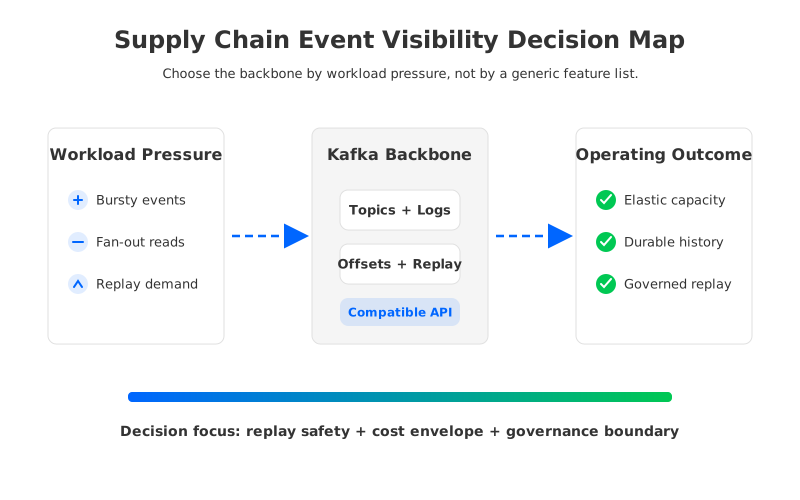
Kafka-compatible infrastructure is useful here because it separates event publication from event consumption. A warehouse management system can publish scan events once, while an ETA service, fraud model, customer notification service, and analytics pipeline consume the same stream at their own pace. Consumer groups and offsets let each application track its own progress through the log. That separation is the technical basis for visibility: the platform preserves the sequence of facts, and applications build their own read models from it.
The value disappears if the backbone cannot keep up. Visibility workloads usually combine several patterns:
- High fan-in ingestion. Events arrive from ERP systems, transportation systems, warehouse scanners, IoT devices, partner APIs, and CDC pipelines.
- Fan-out consumption. The same event stream feeds dashboards, exception workflows, lakehouse tables, fraud checks, notifications, and machine learning features.
- Late and replaying consumers. New applications often need to bootstrap from history. Existing applications need replay when a schema bug, connector outage, or deployment mistake corrupts a derived view.
- Regional operating boundaries. Supply chain teams may need data isolation by region, legal entity, customer, or partner while still sharing a common platform model.
Those patterns make the streaming backbone a production system, not a convenient integration detail. Choosing Kafka for event visibility also means choosing a storage model, a failure model, a cost model, and an operations model.
2The Production Constraint Behind the Problem
Traditional Kafka deployments bind compute and durable storage tightly to brokers. Each broker owns local log segments, serves reads and writes, and participates in replication. This design has served Kafka well, especially where disks are predictable and node-local data movement is acceptable. In cloud supply chain platforms, the same coupling becomes a constraint because demand changes faster than broker-local storage can be moved around.
The first symptom is capacity planning. If event volume grows, a platform team adds brokers or storage and waits for partition rebalancing to settle. If volume drops after a seasonal peak, the team still pays for peak capacity unless it accepts another cycle to shrink the cluster. This is normal in supply chain systems: holidays, promotions, carrier disruptions, supplier delays, weather events, and inventory corrections all create uneven traffic.
The second symptom is recovery complexity. When broker-local disks contain the durable copy of the log, broker replacement and partition movement are storage operations as much as compute operations. A failed node has data placement consequences, replica catch-up work, and network traffic side effects. If the cluster spans availability zones, replication traffic can become a visible line item in the cloud bill.
The third symptom is organizational friction. Application teams want self-service topics and predictable APIs. Data teams want durable history and lakehouse integration. Security teams want identity, encryption, and audit controls. Finance teams want a cost model that scales with use. The platform team has to satisfy all of them without turning every integration request into a custom project.
This is where architecture starts to matter more than feature checklists. A streaming backbone for supply chain event visibility should be judged by how it behaves when the business changes the shape of the workload.
3Architecture Options and Trade-Offs
The baseline option is a self-managed Kafka cluster with broker-local storage. It gives teams direct control and a mature ecosystem, but it also makes them responsible for sizing, upgrades, partition placement, storage expansion, observability, and recovery drills. For supply chain applications, the operational surface can become larger than the application problem.
Managed Kafka services reduce part of that burden, especially around provisioning and routine maintenance. They still inherit the operational implications of the underlying storage architecture. The user may no longer patch brokers directly, but they still care about throughput limits, partition scaling, retention costs, cross-zone traffic, connector operations, and the time it takes to adapt capacity.
Tiered storage changes one important part of the equation by moving older log segments to object storage. That can lower pressure on broker disks and make longer retention more practical. It does not automatically make brokers stateless. The hot path, metadata operations, local storage behavior, and scaling workflow still need to be evaluated.
The more radical option is to decouple broker compute from durable log storage. Brokers stay Kafka-compatible at the protocol layer, while durable data lives in shared cloud storage with a write-ahead log layer designed for low-latency ingestion. If brokers do not own the primary local copy of the data, scaling and recovery can look more like changing compute capacity than moving durable state around.
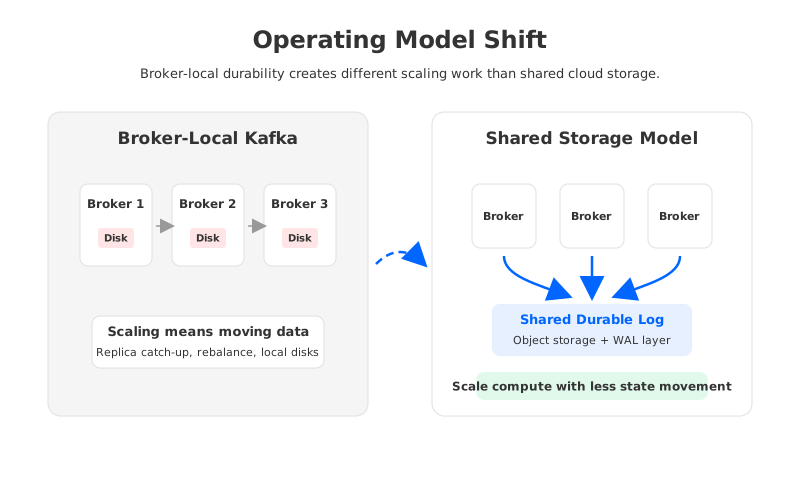
The trade-off is about matching the operating model to the workload:
| Evaluation area | Broker-local Kafka | Managed Kafka | Shared-storage Kafka-compatible design |
|---|---|---|---|
| API compatibility | Native Kafka API and ecosystem | Usually Kafka-compatible, with provider limits to verify | Must be verified against clients, tools, and semantics |
| Scaling behavior | Often tied to partition movement and broker storage | Provider simplifies operations but capacity boundaries remain | Compute and storage can be scaled more independently |
| Retention economics | Local disks sized for hot and retained data unless tiering is used | Depends on provider storage and retention pricing | Object storage can carry durable retained data |
| Recovery model | Broker replacement can involve replica catch-up and data movement | Provider absorbs some work; user still plans for service limits | Stateless brokers can reduce node recovery coupling |
| Governance boundary | Full customer control, full customer operations | Shared responsibility with provider | Depends on deployment model and cloud account boundary |
This table is deliberately cautious. A supply chain platform should choose an event backbone because the architecture removes a real operational constraint without breaking compatibility, governance, or recovery expectations.
4Evaluation Checklist for Platform Teams
The most useful evaluation starts with failure and growth scenarios rather than vendor claims. Imagine a holiday peak doubles event volume, a warehouse connector writes malformed payloads, and a downstream ETA service has to rebuild from the last known good offset. The question is whether the platform team can absorb the incident without making every application team coordinate a manual recovery.
Use this checklist when evaluating Kafka-compatible infrastructure for supply chain event visibility:
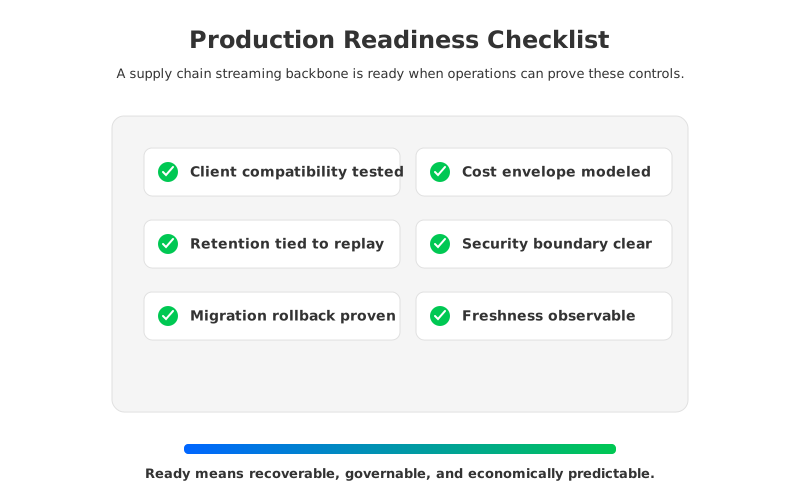
- Compatibility. Test the actual producers, consumers, Schema Registry workflow, Kafka Connect connectors, ACL model, transactions if used, and client versions. Compatibility is a workload property.
- Durability and replay. Define how long operational events must be retained, how replay is authorized, and how a team can rebuild a derived view after a bad deployment. Retention should be an explicit product decision, not leftover disk capacity.
- Elasticity. Model peak ingestion, fan-out reads, long retention, and regional expansion separately. A platform that scales only by moving broker-local state may still work, but the operational cost should be visible.
- Cost ownership. Include storage, compute, cross-zone traffic, private connectivity, observability, connector runtime, and operational labor. Supply chain visibility often looks inexpensive at pilot scale and expensive after broad adoption.
- Governance. Decide who can create topics, publish sensitive events, replay historical data, and export data into analytics systems. The streaming layer becomes a control point for operational truth.
- Rollback and migration. Plan how topics, consumers, offsets, schemas, and downstream derived state move if the initial architecture needs to change. Migration risk is lower when the platform preserves Kafka protocol compatibility and avoids proprietary application changes.
The checklist separates "can this platform run Kafka workloads?" from "can this platform become the durable event backbone for a supply chain organization?"
5How AutoMQ Changes the Operating Model
If the evaluation points toward decoupled compute and storage, AutoMQ is one Kafka-compatible implementation of that architecture. It keeps the Kafka protocol surface that application teams already use, while redesigning the storage layer around shared cloud storage and stateless brokers. That combination targets the pressure discussed above: uneven workload growth, retained event history, node recovery, and cloud cost control.
The important shift is where durable responsibility lives. In a traditional broker-local model, brokers are both serving processes and durable storage owners. In AutoMQ's shared-storage architecture, brokers can be treated more like compute nodes, while the durable log is backed by object storage and a WAL layer. This changes the recovery conversation. Replacing or scaling brokers does not require the same mental model as relocating local topic-partition copies.
It also changes cost conversations. Object storage is not magic, and teams still need to verify pricing for their cloud, region, traffic pattern, and retention period. But object-storage-backed durability makes it possible to reason about retained event history separately from broker disk sizing. Replay value often outlives the hot ingestion window.
AutoMQ's cloud-native design also fits teams that want Kafka compatibility without making every supply chain application care about infrastructure internals. Producers and consumers keep using Kafka clients, while platform teams focus on deployment boundaries, capacity policy, observability, and governance. Customer-controlled deployment boundaries can matter when network, identity, and data residency are part of the review.
The right way to introduce AutoMQ into an architecture review is not to start with the product. Start with the operating constraints:
- Does the platform need Kafka-compatible APIs because existing clients, connectors, and skills already depend on them?
- Does event history need to be durable and replayable without forcing brokers to carry all long-term storage pressure?
- Does the team need capacity to move with business events rather than broker-local data placement projects?
- Does governance require customer-controlled deployment boundaries and clear ownership of data access?
When those answers are yes, a shared-storage Kafka-compatible system becomes a serious candidate. AutoMQ is designed for that category: Kafka semantics at the application boundary, cloud storage economics at the durability boundary, and a more elastic broker layer in between.
6Migration Without Turning Visibility Off
Many supply chain teams do not start from a greenfield design. They already have Kafka clusters, managed services, point-to-point integrations, CDC tools, warehouse jobs, and dashboards. The migration question is how to introduce a more durable backbone without interrupting systems that keep orders moving.
The safest migration pattern is incremental. Start with a bounded event domain such as shipment milestones, inventory adjustments, or order status changes. Mirror or dual-write carefully, validate schemas, and run consumers in shadow mode before switching ownership. Preserve offsets and replay procedures as migration artifacts.
Kafka compatibility lowers migration risk because applications can keep using familiar clients and semantics. It does not remove the need for testing. Platform teams should validate producer idempotence settings, consumer group behavior, offset reset policies, transaction usage, connector semantics, and failure recovery.
The same principle applies to AutoMQ. Its Kafka-compatible interface can reduce rewrite risk, but production adoption should still begin with a workload-specific readiness review.
If your team is evaluating Kafka-compatible infrastructure for event visibility, start with your retention, replay, and peak traffic assumptions. Then compare the operating model against those assumptions. AutoMQ's pricing and deployment information is available at AutoMQ pricing.
7References
- Apache Kafka Documentation
- Apache Kafka Connect Documentation
- Apache Kafka Message Delivery Semantics
- AutoMQ Architecture Overview
- AutoMQ Compatibility with Apache Kafka
- AWS S3 Pricing
8FAQ
8.1Is Kafka a good fit for supply chain event visibility?
Kafka is a strong fit when teams need durable event history, multiple independent consumers, replay, and near-real-time updates across operational systems. It is less compelling if the use case is only a small number of synchronous lookups with no replay requirement. The practical question is whether the business needs a shared event log that many applications can trust.
8.2What is the biggest Kafka architecture risk in supply chain visibility?
The biggest risk is underestimating operations. Supply chain workloads have bursty ingestion, many consumers, governance requirements, and replay scenarios. A pilot cluster can become difficult to operate when many teams depend on it.
8.3How long should supply chain events be retained?
Retention should be based on recovery and audit needs rather than a default cluster setting. Operational serving views may need enough history to rebuild after bad deployments or connector outages. Analytical and compliance workflows may require longer retention, but those requirements should be evaluated against storage cost, access policy, and privacy constraints.
8.4Does tiered storage solve the problem?
Tiered storage can help by moving older log data to object storage, which can make longer retention more practical. It does not necessarily make brokers stateless or remove all data movement from scaling and recovery workflows. Teams should evaluate the specific implementation and its behavior under their replay, retention, and failure scenarios.
8.5Where does AutoMQ fit?
AutoMQ fits when a team wants Kafka-compatible APIs with a cloud-native shared-storage operating model. It is especially relevant when broker-local storage makes capacity planning, recovery, or retained history harder than the application problem itself. The evaluation should still be workload-specific: test clients, connectors, governance, observability, and migration procedures before production cutover.


