
Table of Contents
Table of Contents
Support teams are no longer asking for another dashboard that counts tickets after the fact. They want the AI copilot, triage bot, escalation workflow, and quality review queue to see what happened in the last few seconds: a frustrated reply, a refund request, a product outage signal, a VIP account tag, or an agent override that should be audited. That is the real production intent behind customer support ai events kafka. The search is not about adding AI to a help desk. It is about building a streaming context layer that can feed AI decisions while keeping those decisions reviewable.
The hard part is that support data is messy in a very specific way. It mixes human conversation, account metadata, operational events, policy decisions, and personally identifiable information. Some events are high-volume and disposable, such as typing indicators or UI telemetry. Others have legal or business weight, such as refund approvals, compliance escalations, and manual overrides. A streaming platform has to move both kinds of events without pretending they have the same retention, governance, or replay requirements.
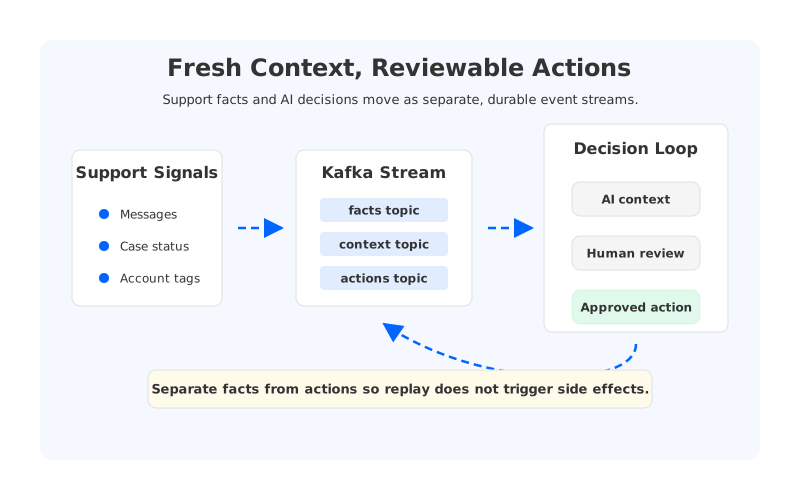
That is why a support desk intelligence stream should be designed as an operational system, not a prompt pipeline. Kafka-compatible infrastructure gives teams a familiar event backbone for producers, consumers, ordering, retention, and replay. The architecture question is whether that backbone can stay elastic, governable, and cost-aware when support AI becomes part of the live workflow instead of a side project.
1Why teams search for customer support ai events kafka
The phrase usually appears after a team has already built a first version of support automation. Maybe ticket summaries work in a batch job. Maybe a chatbot can answer common questions from a knowledge base. Maybe managers receive a daily report about sentiment and SLA breaches. Those systems can be useful, but they often fail at the moment support actually needs intelligence: while the conversation is still active and the next action still matters.
Once AI moves into the live path, the event model changes. A ticket update is no longer an object in a database waiting for a nightly export. It becomes a fact that multiple consumers may need at once: the routing service, the agent copilot, the fraud model, the review queue, the data warehouse, and the customer experience analytics pipeline. Kafka is a natural fit because it lets those consumers process the same event stream independently without forcing the help desk application to call every downstream system.
The design goal is not to let an AI agent act without oversight. Support teams usually need the opposite: faster context with clearer accountability. A well-designed stream lets the system generate a recommended action, attach the evidence that influenced it, and send both to a human reviewer when the action is sensitive.
Three requirements show up quickly:
- Fresh context. The copilot needs recent messages, account state, incident status, and policy changes before it recommends a reply or escalation.
- Reviewable actions. AI-generated suggestions, tool calls, overrides, and approvals need durable event trails so supervisors can reconstruct what happened.
- Independent consumers. Analytics, compliance, quality review, and customer-facing workflows should not block each other or depend on one shared batch export.
Those requirements sound like application concerns, but they become infrastructure concerns as soon as the stream carries production decisions.
2The production constraint behind the problem
Traditional support systems are usually built around transactional applications: a ticket database, a CRM record, a knowledge base, and a reporting warehouse. Each system stores its own view of reality. Integration jobs copy data between them, and support leaders accept some delay because the workflow was originally human-paced. AI changes that tolerance. When a recommendation uses stale incident status or misses a recent account warning, the error is visible to the customer.
Kafka helps by turning updates into durable streams, but the support desk use case stresses the platform in uneven ways. Conversation events are bursty during incidents. Quality review consumers may replay days of interactions after a policy change. AI feature extraction may fan out to several model-serving or embedding services. Audit consumers may retain compact action records longer than raw conversation text. The same cluster may need to handle low-latency routing and slower compliance replay without one path starving the other.
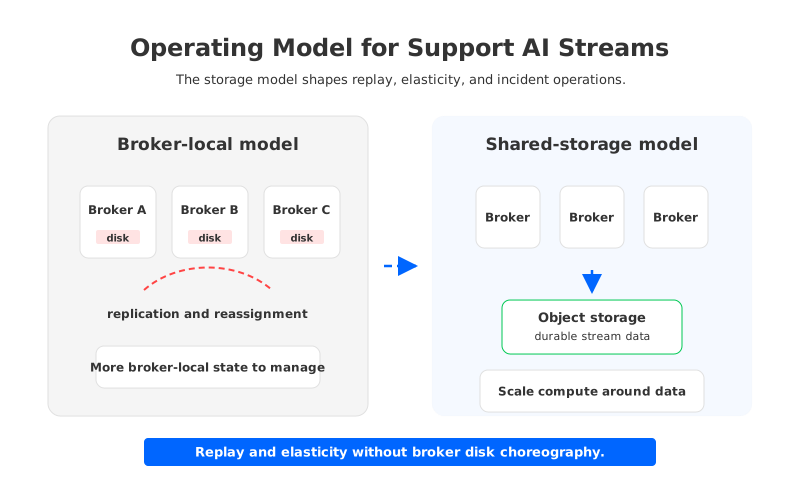
That mix exposes a familiar Kafka operating problem. In broker-local architectures, compute, storage, and data placement are tied together. A spike in support events can create broker pressure, local disk growth, partition movement, and cross-zone replication work at the same time. The team then has to decide whether to overprovision for rare incidents or accept operational risk during the exact periods when support quality matters most.
The cloud cost angle often appears late in the design review. Support data fans out: one event may be read by routing, AI context assembly, analytics, review, and audit services. In a multi-zone deployment, replication and consumer traffic can turn a modest ingest stream into a larger networking bill. Cost is not separate from reliability here. If validation, replay, or retention becomes expensive, teams will shorten the very windows that make AI decisions explainable.
3Architecture options and trade-offs
A practical architecture starts by separating the support event stream from the AI decision stream. The support event stream contains facts: messages, case status changes, customer attributes, incident signals, SLA updates, and agent actions. The AI decision stream contains outputs: suggested replies, classification labels, escalation recommendations, tool-call requests, approvals, rejections, and reviewer comments. Keeping those streams distinct makes it easier to replay facts without accidentally re-executing actions.
The next decision is where context assembly happens. Some teams enrich events before they enter Kafka. Others publish raw events and let stream processors build materialized context for the copilot. The second model is usually more flexible because consumers can evolve independently, but it requires stronger schema governance and clearer retention rules. Raw text, account metadata, and AI outputs do not have the same privacy profile.
The platform evaluation should cover more than throughput. Support desk intelligence touches customer trust, so the architecture has to answer operational questions that proof-of-concept builds often leave unanswered.
| Evaluation area | What to inspect | Why it matters for support AI |
|---|---|---|
| Kafka compatibility | Producer and consumer behavior, client libraries, ACLs, consumer groups, and offset handling | Existing support services and data pipelines should not need rewrites to join the stream. |
| Freshness under fan-out | How the platform behaves when several consumers read the same hot topics | AI context, analytics, and audit consumers need independent progress without blocking each other. |
| Storage model | Broker-local disks, tiering, or shared object storage | Replay, retention, and incident bursts should not force constant broker storage planning. |
| Governance | Topic boundaries, schema rules, audit events, identity, and network controls | Support data can contain sensitive text and regulated customer attributes. |
| Recovery | Broker failure behavior, consumer restart, retention policy, and rollback paths | AI recommendations must be explainable after an incident, not only during the happy path. |
| Cost model | Compute scaling, object storage, cross-zone traffic, and replay cost | Review and compliance windows become fragile when they are too expensive to keep. |
The table points to a broader requirement: the streaming layer should preserve Kafka semantics while reducing the amount of broker-local operational work surrounding support AI. Teams need to reason about event contracts and action review, not emergency disk expansion during a customer incident.
4A reviewable action model
AI in customer support should not be modeled as a single output field on a ticket. It is a sequence of events. The model reads context, produces a recommendation, possibly requests a tool call, receives approval or rejection, and records the final action. Each step should be represented as an event with a stable identity, timestamp, actor, policy version, and correlation ID back to the conversation.
This approach gives engineering and operations teams a better failure model. If the model-serving path is unavailable, the ticket can continue without a recommendation. If the tool-call approval service is delayed, the recommendation can wait in a review topic. If a policy changes, the team can replay recommendations and reviewer decisions to understand which cases were affected. A database update alone cannot provide that kind of reconstruction without extensive custom audit logic.
The event contract should be explicit about authority. A suggested reply is not the same as a sent reply. A recommended refund is not the same as an approved refund. An escalation prediction is not the same as an escalation ticket. When these states are distinct topics or event types, automated consumers and human reviewers can move at different speeds without confusing recommendation with execution.
The same distinction helps with governance:
- Raw conversation events can have strict retention and access controls because they may contain sensitive text.
- Derived features can be retained separately when they are useful for model monitoring but should not expose full conversation content.
- AI recommendations can carry model version, prompt template version, and evidence references.
- Approved actions can become the durable business record that downstream systems trust.
This design does not make support AI risk-free. It makes risk visible enough for a platform team to operate.
5How AutoMQ changes the operating model
By this point, the platform requirement is clear: keep Kafka-compatible APIs and stream semantics, but make storage, scaling, recovery, and cloud cost less dependent on broker-local data placement. That is where AutoMQ belongs in the discussion. AutoMQ is a Kafka-compatible cloud-native streaming system that separates compute from storage and uses shared object storage as the durable data layer.
In a support desk intelligence architecture, that separation changes the operating model in several concrete ways. Stateless brokers make compute capacity more elastic because adding or replacing broker instances is less tied to moving durable stream data across local disks. Object-storage-backed durability can make retention and replay planning feel closer to cloud storage management than broker disk management. Independent compute and storage scaling also fits the uneven workload pattern of support AI: bursty ingest during incidents, fan-out during live routing, and replay during review or model evaluation.
The important point is not that AutoMQ removes the need for good event design. It does not. Teams still need schema governance, privacy boundaries, model audit trails, and rollback discipline. AutoMQ is relevant after those requirements are understood, because the platform can reduce the incidental operational work around Kafka-compatible streaming in the cloud.
For support AI, the most useful test is a production-like slice rather than a synthetic benchmark. Pick one ticket domain, publish conversation facts and AI recommendations as separate streams, connect one reviewer workflow, and measure the operational burden. Watch how the platform behaves during fan-out, replay, consumer restart, and broker replacement. Then compare how much work is spent on support-specific correctness versus Kafka infrastructure management.
6Evaluation checklist for platform teams
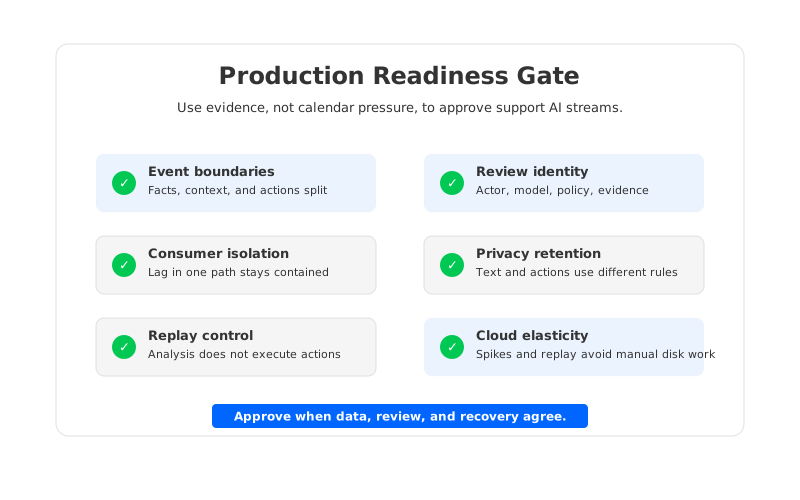
A customer support AI stream is ready for production when the team can explain how a decision was made, how it can be reviewed, and how the system behaves when one consumer falls behind. The checklist should be stricter than a normal analytics pipeline because the stream may influence live customer outcomes.
Use the following questions before turning the stream into a production dependency:
- Event boundaries: Are raw facts, derived context, AI recommendations, human approvals, and final actions represented as separate event types?
- Ordering and identity: Can a reviewer connect an action back to the conversation, account, model version, prompt version, and policy version that influenced it?
- Consumer isolation: Can analytics, AI context assembly, audit, and review consumers fall behind independently without blocking the support application?
- Privacy and retention: Are raw text, derived features, and approved business actions governed by different access and retention policies?
- Replay behavior: Can the team replay facts for analysis without re-executing tool calls or customer-visible actions?
- Cost and elasticity: Does the platform absorb incident spikes and review replays without excessive manual capacity work?
- Recovery: After a broker, consumer, or model-serving failure, can the team identify the last safe event and resume from there?
The strongest architectures make these answers observable. Dashboards should show stream freshness, consumer lag, model-output volume, reviewer backlog, failed tool-call requests, and policy-version distribution. Audit logs should not be an afterthought; they are part of the product behavior when AI participates in support.
7Bringing it together
The support desk is a harsh environment for vague AI architecture. Customers are waiting, agents are under time pressure, and a wrong recommendation can create visible business cost. Streaming infrastructure helps when it treats support context and AI actions as first-class event flows with ordering, replay, retention, and consumer isolation.
Kafka-compatible systems provide a strong foundation for that model, but the production question is broader than whether events can be published. The team has to decide how much broker-local storage work, cloud networking cost, and operational coupling it is willing to carry while the support workflow becomes more real-time. Shared-storage Kafka-compatible architecture is compelling because it moves the platform closer to the elasticity pattern support AI actually needs.
If your team is evaluating Kafka-compatible infrastructure for customer support AI, fresh context, or reviewable action streams, review AutoMQ's architecture and deployment model or talk with the AutoMQ team: contact AutoMQ.
8References
- Apache Kafka documentation: Introduction
- Apache Kafka documentation: Consumer configuration and consumer groups
- Apache Kafka documentation: Kafka Connect
- Apache Kafka documentation: Security
- AutoMQ documentation: AutoMQ overview
- AutoMQ documentation: Technical advantage overview
- AWS documentation: Amazon S3 user guide
9FAQ
9.1Why use Kafka for customer support AI events?
Kafka is useful when several services need the same support events at different speeds. A ticket service can publish conversation and case updates once, while AI context assembly, routing, analytics, review, and audit consumers process those events independently.
9.2What should be streamed for a support desk AI system?
Stream facts and actions separately. Facts include messages, ticket status changes, customer attributes, incident signals, and SLA updates. Actions include AI recommendations, tool-call requests, human approvals, rejections, and final customer-visible outcomes.
9.3How do you keep AI support actions reviewable?
Give each recommendation and action a stable event identity, correlation ID, actor, timestamp, model version, prompt or policy version, and evidence reference. Keep suggested actions distinct from approved actions so replay and audit do not trigger customer-visible side effects.
9.4Where does AutoMQ fit in this architecture?
AutoMQ fits after the team has defined event contracts, governance, retention, and review requirements. Its Kafka-compatible shared-storage architecture can reduce broker-local storage coupling and make cloud elasticity, replay, and recovery easier to operate for support intelligence streams.


