
Table of Contents
Table of Contents
Searches for kafka support handoff workflow usually come from teams that already have Kafka in production. The cluster works, the client libraries are familiar, and the platform team has run enough incidents to know the obvious failure modes. The problem is no longer whether Kafka can move events. The problem is whether support responsibility can move cleanly between application engineers, SREs, platform engineers, security reviewers, and vendor or cloud support teams when something changes at 2 a.m.
That handoff breaks down in specific ways. An application team sees consumer lag but cannot tell whether the root cause is client processing, partition skew, broker disk pressure, connector failure, or a network path. An SRE sees broker saturation but does not know which topic owner can approve retention changes. A platform engineer sees a migration window but lacks a rollback owner for every consumer group. A security team asks who approved access to a stream, and the answer is buried in a chat thread.
A shared streaming platform needs a support model as deliberate as its data model. Kafka topics, consumer groups, connectors, schemas, ACLs, and deployment boundaries are runtime resources and support boundaries. When those boundaries are unclear, every operational event becomes an ownership investigation before it becomes a system investigation.
1Why Teams Search for kafka support handoff workflow
The search intent behind kafka support handoff workflow is operational, not academic. Teams want a repeatable way to route incidents, migrations, access reviews, cost investigations, and post-incident actions across a Kafka-compatible platform. A generic escalation chart is not enough; the workflow must understand partitions, offsets, retention, broker capacity, consumer lag, connector state, network placement, and cloud cost.
The hardest part is that Kafka support does not fit into a single team boundary. Application engineers own producer behavior, consumer processing, schemas, and business correctness. Platform engineers own cluster design, capacity, quotas, topic policy, upgrades, and client enablement. SREs own incident response, alert routing, runbooks, and recovery discipline. Security and governance teams own access review, audit trails, encryption, and data classification. FinOps teams care about retained data, cross-zone traffic, replay demand, and utilization. A useful handoff workflow must let each group act without forcing every issue through the same platform queue.
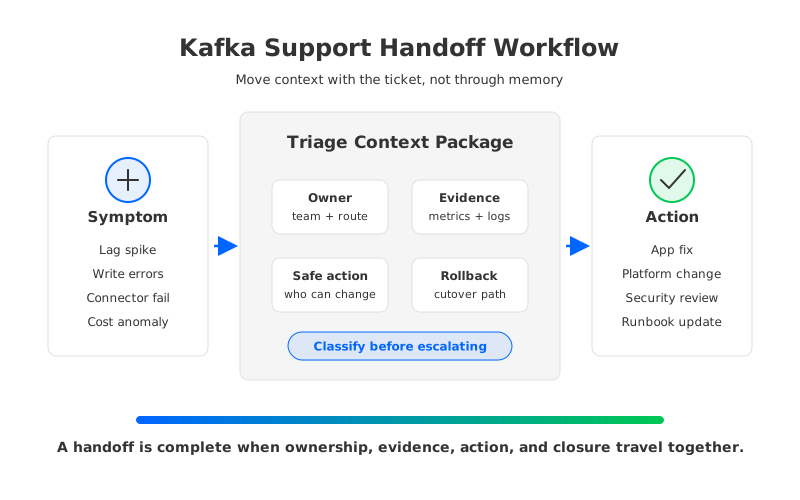
The workflow also has to account for time pressure. A clean ownership model is straightforward during architecture review; it is harder when a high-priority consumer group is falling behind and the application team says nothing changed. The support path needs to answer three questions quickly:
- Who owns the symptom? Consumer lag may belong to an application, a connector, a broker, or a network path. The first handoff should classify the symptom before assigning blame.
- Who can change the system safely? Some actions are local, such as restarting a connector task. Others are platform-level, such as changing retention, quotas, or partition count. The workflow should make approval and rollback explicit.
- What evidence travels with the ticket? A handoff without offsets, topic names, consumer group IDs, client versions, recent deployment markers, and relevant metrics creates a second incident inside the first one.
The goal is not to remove human judgment. The goal is to stop wasting the first hour reconstructing the ownership graph. Shared platforms scale when support context is attached to the resource, not held in one engineer's memory.
2The Production Constraint Behind the Problem
Traditional Kafka deployments make support handoff harder because runtime state and support responsibility are tightly coupled to broker-local resources. Topics are split into partitions, partitions are replicated across brokers, and retained log data lives on broker-attached storage. This shared-nothing model is mature and well understood, but it turns many support questions into physical placement questions: broker hot spots, disk pressure, replica state, and availability-zone traffic.
That physical coupling matters during handoff. If an application team requests longer retention, the platform team must evaluate broker disk capacity and replication impact. If a broker fails, support has to reason about data movement, leader election, in-sync replicas, client retry behavior, and restore time. If a cluster needs migration, support must track producer cutover, consumer offsets, topic configuration, ACLs, and rollback paths. None of these are unusual Kafka operations, but each operation crosses team boundaries.
Cloud deployment adds another layer. Compute, block storage, object storage, private connectivity, and network transfer are priced and operated through separate mechanisms. A support case that begins as "consumer lag" may become a question about cross-zone traffic, connection limits, disk throughput, or replay cost. The Kafka resource name alone is not enough support context. The workflow needs infrastructure metadata, cloud placement, and cost ownership alongside Kafka metadata.
Many support models stop at priority levels, paging rules, and escalation contacts. They do not encode the streaming-specific facts that determine the next action. A Kafka handoff workflow needs enough context for the next team to continue the investigation without reopening discovery.
3Architecture Options and Trade-offs
The first option is to improve the support workflow around the existing Kafka architecture. This is often the fastest step. Add required owner metadata to topics, consumer groups, connectors, service accounts, schema subjects, and alert routes. Standardize runbook fields for lag, produce latency, request errors, partition skew, broker disk pressure, and connector failures. Make every handoff include the resource name, owning service, deployment marker, client version when available, metric snapshot, and proposed next action.
The second option is to make support ownership part of provisioning instead of documentation. Terraform modules, internal developer portals, GitOps repositories, and service catalogs can require support fields before a topic or connector reaches production. That changes the support path from "find the owner" to "read the owner and verify the incident class." It also makes audit review less manual because resource intent is captured at creation time.
The third option is to evaluate whether the data-plane architecture itself is creating support churn. If recurring handoff failures come from broker-local disk pressure, manual partition movement, capacity buffers, or cross-zone replication costs, better metadata will expose the issue but not remove it. A Kafka-compatible shared-storage architecture changes the support model by decoupling durable log storage from individual broker lifecycle.
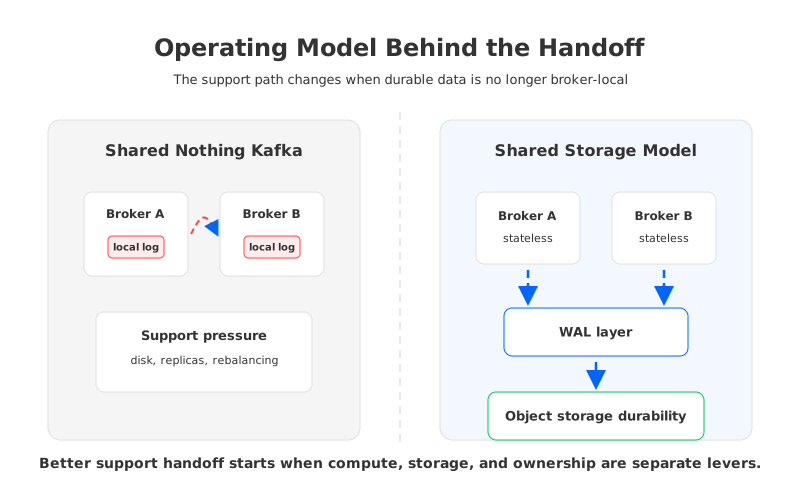
These options solve different layers of the problem. Workflow design improves routing. Provisioning discipline improves context quality. Architecture changes can reduce support cases caused by local storage coupling. Mature platform teams usually need all three, but the sequence matters: understand where handoffs fail before choosing the most expensive lever.
| Support concern | Traditional Kafka question | Shared-storage question | Handoff implication |
|---|---|---|---|
| Retention growth | Which brokers have enough local disk for the retained partitions? | Which storage class, lifecycle, and workload owner apply to retained data? | Support can separate policy approval from broker placement work. |
| Broker replacement | How much partition data needs to move or catch up? | Can compute capacity be replaced without treating the broker as the long-term data home? | Recovery can focus more on service capacity and less on historical log locality. |
| Cost investigation | Which cluster, disks, replicas, and network paths created the bill? | Which workload drove compute, storage, object requests, and network paths? | FinOps handoff becomes workload-oriented instead of cluster-only. |
| Migration | Which producers, consumers, offsets, ACLs, and topic configs move together? | Which compatibility and cutover steps prove workload readiness? | The workflow can score readiness by application boundary. |
| Governance | Who owns this topic or connector today? | Who owns the stream, data class, access scope, and support action? | Support metadata becomes part of platform policy. |
The table is not an argument to redesign every cluster. It makes the support burden visible. If most handoff failures are ownership failures, start with metadata and provisioning. If support repeatedly stalls on broker-local storage and capacity operations, evaluate the architecture layer directly.
4Evaluation Checklist for Platform Teams
A strong Kafka support handoff checklist begins with incident classes. Most platform teams can reduce ambiguity by defining a small set of support paths: producer write failure, consumer lag, connector failure, broker health, access failure, schema issue, cost anomaly, migration risk, and governance review. Each path should name the first responder, required evidence, safe local actions, platform actions, rollback owner, and escalation trigger.
The checklist should be strict because shared platforms hide weak boundaries. A topic can have traffic without an accountable owner. A consumer group can be business-critical without an alert route. A connector can restart while replaying data into a downstream system that no one on call understands. A cluster can be healthy while one regulated stream lacks access-review evidence. The workflow must catch these gaps before the incident does.
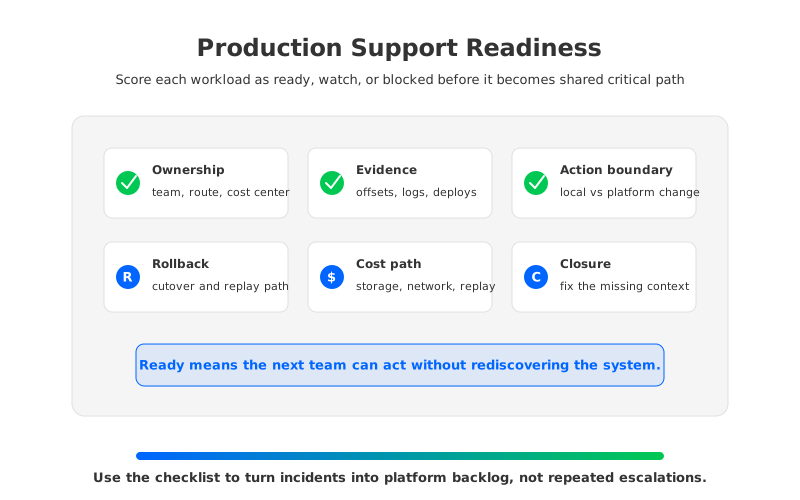
Use the checklist as a readiness scorecard, not a static document. For each production stream, mark each dimension as "ready," "watch," or "blocked." Ready means the ownership, evidence, action path, and rollback path are current. Watch means the path exists but depends on manual lookup or incomplete metadata. Blocked means the next support team cannot act without finding missing context during the incident.
The most useful dimensions are practical:
- Ownership and routing. Every topic, connector, service account, schema subject, consumer group, alert, and cost center should map to a team that can respond.
- Evidence package. Handoffs should carry current offsets or lag, error samples, topic configuration, recent deploy markers, client or connector version, and relevant broker or cloud metrics.
- Safe action boundary. The workflow should distinguish actions the application team can take from actions requiring platform approval, security review, or a migration window.
- Rollback and replay. Every cutover, connector restart, schema change, and retention change should have a known rollback or replay path.
- Cost and cloud placement. Support should know whether the workload depends on cross-zone traffic, private connectivity, object storage, block storage, or special network paths.
- Post-incident closure. The incident is not closed until the missing metadata, alert route, runbook, or automation gap is corrected.
This is where support handoff becomes platform engineering instead of ticket routing. The workflow creates a feedback loop: every incident teaches the platform which metadata, automation, or architecture assumption was missing. Over time, handoffs should become faster and less ambiguous.
5How AutoMQ Changes the Operating Model
Once the support checklist identifies data-plane coupling as a repeated blocker, the architecture target becomes more concrete. Platform teams still need Kafka-compatible APIs, client behavior, and operational semantics, but they also need a model where durable stream storage is not tied as tightly to individual broker lifecycle. AutoMQ fits this category as a Kafka-compatible, shared-storage streaming platform: it keeps the Kafka protocol surface while shifting durable storage toward object storage and stateless broker operation.
AutoMQ's shared-storage architecture separates compute from storage. Brokers serve Kafka-compatible traffic, while durable stream data is backed by object storage through the S3Stream layer and protected by a WAL design. In support terms, the broker is less of a long-term data owner and more of a compute participant in the streaming service. A broker issue no longer implies the same local-disk recovery path. A retention request is not only broker disk pressure. A scaling event can be discussed through compute, storage, and network dimensions instead of using broker count as the main capacity proxy.
This architectural shift is useful for shared platforms because support boundaries become explicit. Application teams still own producer and consumer behavior. Platform teams still own quotas, governance, compatibility, observability, and upgrades. SREs still need incident discipline. The difference is that fewer routine support actions revolve around moving historical log data between stateful brokers.
AutoMQ gives platform teams a precise cloud-cost handoff model. Object storage, compute capacity, WAL placement, private networking, and availability-zone traffic can be treated as separate operational levers. When a workload grows, support can ask which lever changed rather than treating the broker fleet as the main capacity unit.
That does not make support handoff automatic. A shared-storage Kafka-compatible platform still needs owner metadata, runbooks, alert routing, migration plans, access review, and rollback discipline. The practical advantage is that the data plane is less likely to turn every support case into a broker-local storage project. For teams scaling Kafka as a shared internal product, that is the difference between faster escalation and a smaller escalation surface.
The conservative path is to score the support workflow first. If the scorecard shows that ownership and evidence are missing, fix provisioning and metadata. If the scorecard shows that broker-local storage, partition movement, and capacity buffers are recurring support blockers, evaluate AutoMQ Cloud with the workloads that create the most handoff pressure.
6References
- Apache Kafka Documentation
- Apache Kafka Consumer Configuration
- Apache Kafka Connect Documentation
- Apache Kafka Tiered Storage
- AutoMQ Architecture Overview
- AutoMQ Native Compatibility with Apache Kafka
- AutoMQ WAL Storage
- AutoMQ Stateless Broker
- AWS Amazon S3 Data Durability
- AWS PrivateLink Documentation
7FAQ
7.1What is a Kafka support handoff workflow?
A Kafka support handoff workflow is the process for transferring incident, migration, governance, or cost-investigation ownership between teams that operate a Kafka-compatible platform. It should define the incident class, owning team, required evidence, safe actions, rollback path, and escalation trigger.
7.2Why do Kafka handoffs fail on shared platforms?
They usually fail because runtime resources do not carry enough support context. A topic, consumer group, connector, or service account may be active in production without current owner metadata, alert routing, access-review evidence, cost ownership, or rollback instructions.
7.3What evidence should travel with a Kafka support ticket?
At minimum, include the affected topic, partition or consumer group when relevant, current lag or error samples, topic configuration, recent deploy marker, client or connector version, owner and escalation contact, related broker or cloud metrics, and the proposed next action.
7.4How does architecture affect Kafka support handoff?
Traditional shared-nothing Kafka ties durable log data to broker-local storage, so support often has to reason about broker placement, disk pressure, partition movement, and replica catch-up. Shared-storage architectures can reduce the number of support paths that depend on moving historical log data between brokers.
7.5Where does AutoMQ fit in a support handoff strategy?
AutoMQ is relevant when a platform team wants Kafka-compatible behavior but sees recurring support pressure from broker-local storage, capacity buffers, partition movement, or cloud network cost. Its shared-storage architecture and stateless broker model help separate application ownership, platform policy, and data-plane capacity decisions.


