
Table of Contents
Table of Contents
Searches for table format governance kafka usually come from teams that have outgrown a clean separation between streaming and analytics. Kafka is still the system of record for in-flight events, but the lakehouse is where more consumers query facts. Data engineers need those facts fresh, discoverable, schema-managed, and cost-effective while SREs keep the streaming side reliable.
The uncomfortable part is that none of those requests is unreasonable. Fraud detection wants fresh events, product analytics wants replayable history, AI feature pipelines want consistent entity updates, and security wants auditability. The problem is that the workload spans two operating models historically managed by different teams.
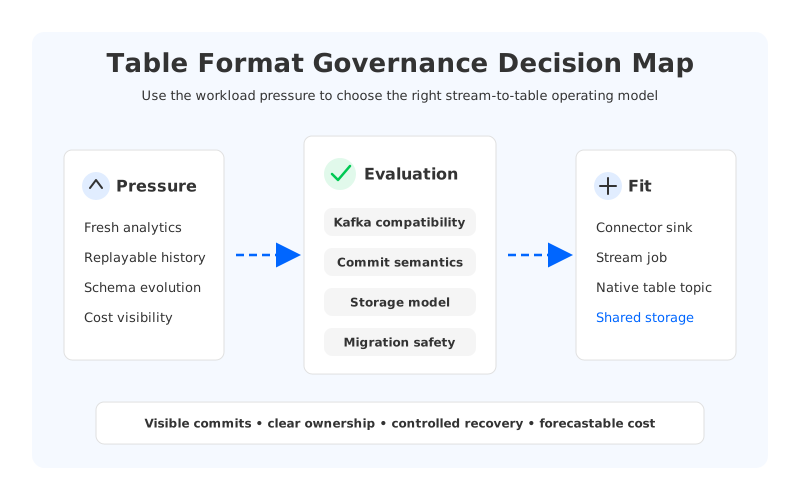
Kafka governance starts with topics, ACLs, consumer groups, offsets, schemas, and retention policies. Table format governance starts with snapshots, manifests, catalogs, partition specs, file sizing, and query engine compatibility. When a streaming data product writes into Apache Iceberg or another table format, these two governance systems meet at the most operationally sensitive point in the platform: the write path.
1Why teams search for table format governance kafka
A team rarely starts with the phrase "table format governance." It starts with a concrete failure mode: a late streaming table, a connector falling behind, a schema update that is valid for a producer but awkward for a table, or a replay that restores offsets while the table needs snapshot-level rollback. Each incident is solvable in isolation, yet the combined system becomes hard to reason about.
That is why platform teams need a governance framework before they choose tooling. The decision is not only whether Kafka can feed a table format. It is whether the combined architecture can preserve Kafka semantics, expose table semantics, and remain operable under bursty traffic, failures, cloud billing pressure, and team boundaries.
Three questions separate serious platform design from a connector checklist:
- What is the commit boundary? Kafka clients reason about records and offsets, while table readers reason about snapshots and metadata commits. Governance must define where a streaming write becomes an analytically visible table update.
- Who owns recovery? A Kafka team may own topic retention and consumer lag, while a lakehouse team may own compaction and catalog health. Production incidents cross that boundary, so rollback and replay responsibilities must be explicit.
- How does cost scale with freshness? The more often a stream materializes into tables, the more the platform pays for storage operations, file management, connector compute, and sometimes cross-zone or cross-service network movement.
The governance conversation becomes easier when teams stop treating the table writer as a sidecar. It is part of the streaming product. It needs the same production discipline as the topic itself.
2The Lakehouse Freshness Constraint Behind the Workload
The lakehouse promise is attractive because table formats make object storage behave more like an analytical storage layer. Table metadata tracks snapshots, query engines can plan reads without listing every object, and schema or partition evolution lets data products change over time. The same storage layer can serve Spark, Flink, Trino, Presto, Athena, or other engines depending on the environment.
Freshness changes the design pressure. A daily batch table can tolerate large files, scheduled compaction, and delayed governance checks. A streaming table needs small commits to reduce latency, but small commits can create too many files. It needs schema checks before data lands, and replay can duplicate table writes if idempotency and commit tracking are weak.
This is where Kafka's strengths and table-format strengths can work against each other. Kafka is excellent at ordered, replayable streams with consumer groups and offset management. Table formats are excellent at consistent analytical snapshots. The bridge must translate between those worlds without weakening either one.
| Governance object | Kafka side | Table format side | Platform risk |
|---|---|---|---|
| Identity | Topic, producer, consumer group | Table, namespace, catalog principal | Ownership becomes unclear when a stream writes many tables. |
| Position | Offset and committed consumer progress | Snapshot ID and metadata commit | Replay and rollback can point to different recovery targets. |
| Compatibility | Client protocol, producer config, schemas | Table schema, partition spec, engine support | A valid stream change can still break analytical readers. |
| Retention | Topic retention and compaction policy | Snapshot expiration and object lifecycle | Data can disappear from one side before recovery completes. |
| Operations | Broker health, lag, throughput | File size, manifest growth, compaction | Teams debug symptoms in different systems. |
The table shows why governance must include both semantics and operations. A design that writes records correctly but leaves ownership, recovery, and cost ambiguous will fail the first time a high-value data product misses its freshness SLO.
3Stream-to-Table Architecture Options
Most teams choose one of three architectures. The first is the classic connector path: Kafka topics feed Kafka Connect or a custom sink, and that sink writes to object storage and commits table metadata. This fits teams with an existing connector operations model and keeps the Kafka cluster independent from lakehouse write logic. The tradeoff is another moving part on the critical path, with its own scaling, checkpointing, schema handling, and retry behavior.
The second option is a stream-processing job. Flink, Spark Structured Streaming, or another engine consumes from Kafka, performs transformations, and writes table commits. This is often the right choice when the pipeline joins, aggregates, deduplicates, or enriches data before publication. The governance burden moves into job deployment, state management, checkpointing, and exactly-once behavior across source and sink.
The third option is a native stream-to-table path, where the streaming platform itself provides a table-oriented topic or managed table output. This can reduce integration sprawl when the data product is a direct table representation of a Kafka-compatible stream. The important question is whether the native path preserves the Kafka API and operational expectations, or whether it creates a special ingestion mode that only works for a narrow set of workloads.
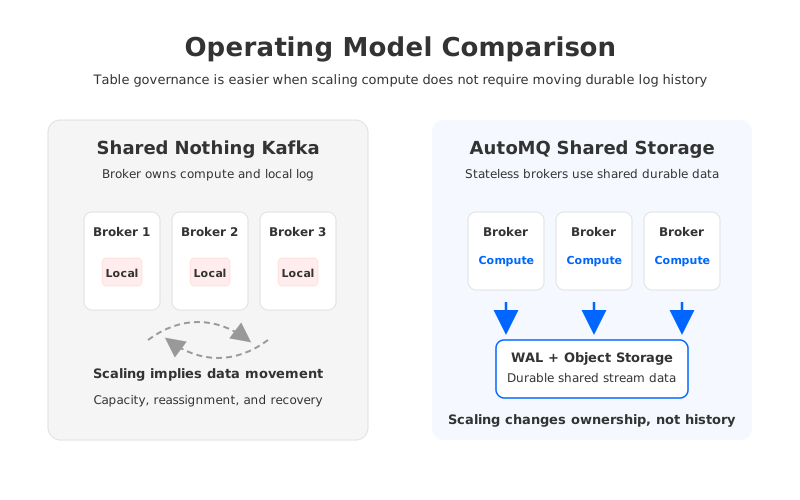
Traditional Kafka's shared-nothing architecture adds another layer to this choice. Each broker owns local log segments, and partitions must move when brokers scale, fail, or rebalance. This design is deeply proven, but it ties compute changes to data movement. When streaming-to-table workloads increase retention, throughput, and replay pressure, broker-local storage can turn governance into capacity planning: how long will reassignment take, how much network traffic will replication create, and is connector lag a data-product problem or a cluster-sizing problem?
Tiered storage helps with long retention by moving older log data out of broker-local disks, but it does not make the broker fully stateless. Hot data, leader placement, local storage sizing, and reassignment mechanics still matter. For table governance, that distinction is practical. If the stream side still needs careful broker-local capacity work during growth or recovery, the table side inherits the operational delay.
4Evaluation Checklist for Platform Teams
A useful evaluation framework starts with the workload, not the vendor. The platform team should classify which data products need direct table materialization, which need stream processing first, and which should remain event streams only. From there, the architecture can be judged on concrete operational properties.
| Evaluation area | What to check | Strong signal |
|---|---|---|
| Kafka compatibility | Producer, consumer, admin client, transactions, ACLs, consumer groups, and ecosystem tools | Existing applications keep their client behavior and operational controls. |
| Commit semantics | How offsets, checkpoints, and table snapshots are correlated | Recovery can prove which records are visible in which table snapshot. |
| Storage model | Broker-local disks, tiered storage, or shared object storage | Scaling and failover do not require long data movement on the hot path. |
| Cost model | Storage, requests, compute, inter-zone traffic, PrivateLink or networking charges | Freshness targets can be met without surprise cloud bills. |
| Governance controls | Schema evolution, catalog integration, RBAC, encryption, audit logs | Data product ownership maps to actual access and change controls. |
| Migration safety | Dual writes, mirroring, cutover, rollback, and lag visibility | Teams can move incrementally instead of betting on a single event. |
| Observability | Broker metrics, connector metrics, table commit metrics, lag, file health | Incidents show whether the stream, writer, catalog, or table is at fault. |
The cost model deserves special attention because freshness hides a compounding effect. A stream that was acceptable as an event log can become expensive when it drives frequent table commits, object storage operations, metadata maintenance, and repeated reads by analytical engines. Cloud teams should check object storage pricing pages, network pricing, and private connectivity costs in the workload region. A governance plan that ignores cloud bill dimensions is incomplete.
Compatibility is equally non-negotiable. Kafka APIs are the control surface used by producers, consumers, security tooling, monitoring, and migration utilities. Apache Kafka's own documentation spans producer and consumer APIs, transactions, consumer group behavior, Kafka Connect, KRaft operations, and tiered storage because these are the interfaces operators depend on. A Kafka-compatible platform should be evaluated against those day-2 behaviors, not only against a happy-path produce-and-consume test.
5How AutoMQ Changes the Operating Model
Once the evaluation framework is clear, AutoMQ becomes relevant as an architectural category: a Kafka-compatible streaming platform that separates broker compute from durable stream storage. AutoMQ's shared-storage design stores stream data in object storage through S3Stream, while brokers become largely stateless compute nodes. The write-ahead log absorbs low-latency persistence requirements, and object storage provides the durable shared data layer.
That design changes table-format governance because the stream side no longer has to treat broker-local disks as the center of the operating model. Scaling broker compute does not imply moving large amounts of partition data between brokers, and failure recovery does not depend on rebuilding a broker's local log before the partition can become serviceable. Rebalancing can focus on ownership and traffic rather than copying durable history from one machine to another.
For a streaming data product, this matters in four practical places:
- Freshness scaling: If a table-producing topic grows into a sustained burst, the platform can scale broker compute with less storage relocation work. The table writer still needs capacity, but the Kafka-compatible substrate is less likely to turn scale-out into a long partition movement event.
- Governance locality: AutoMQ supports customer-controlled BYOC and software deployment models, which matters when table data, catalog access, keys, and network boundaries must stay inside a customer's cloud account or Kubernetes environment.
- Cost discipline: Shared object storage changes retention and replay economics. AutoMQ also documents ways to eliminate inter-zone traffic through its storage architecture and client or broker configuration.
- Native table path: AutoMQ Table Topic writes Kafka-compatible topic data into Iceberg tables on object storage. For direct materialization, this can remove a connector layer while keeping the topic as the application-facing abstraction.
None of this removes lakehouse governance. Table schemas still need owners. Catalog permissions, compaction, snapshot expiration, and query behavior still need policy. The difference is that streaming infrastructure can stop adding avoidable broker-local storage work to every governance decision.
6Migration and Readiness Scorecard
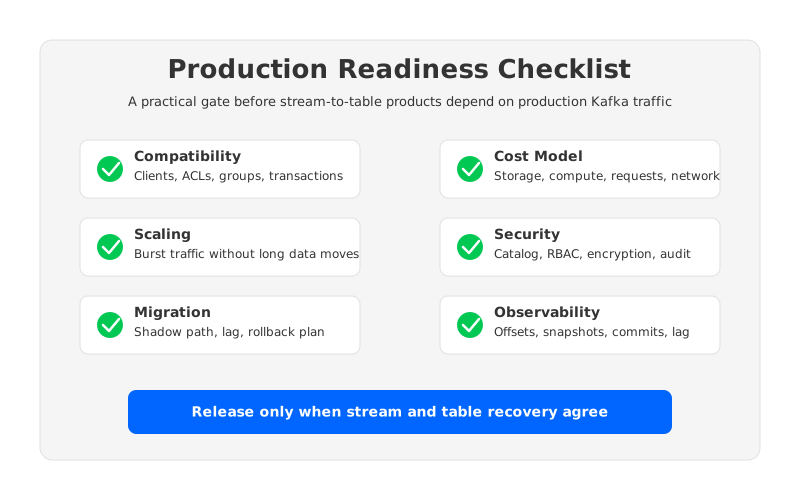
A safe migration plan makes every assumption observable before production traffic depends on it. For table-format governance, the readiness scorecard should include both Kafka-side and table-side evidence.
Start with a shadow path. Mirror or replay a representative topic into the candidate table path without exposing it to production readers. Compare record counts, schema outcomes, snapshots, file sizes, commit frequency, and query results. For a native table topic, validate table layout and catalog integration; for a connector or processing job, validate checkpoint recovery and idempotent writes.
Then test operational failure, not only throughput. Kill the writer during a commit, pause the catalog, force replay, trigger broker scale-out, rotate credentials, and change a schema that is legal for producers but risky for analytical consumers. These tests reveal whether the architecture has governance or only a data path.
A simple readiness score works well:
| Readiness question | Pass condition |
|---|---|
| Can every table snapshot be traced to source offsets or a documented commit range? | Operators can answer "what data is visible?" without guessing. |
| Can the team replay without duplicating committed table data? | Recovery has an idempotency or rollback procedure. |
| Can schema changes be blocked, staged, or rolled back? | Governance controls exist before the producer rollout. |
| Can the platform scale during peak table writes? | Scaling does not create unbounded broker reassignment or connector lag. |
| Can cloud cost be forecast from workload inputs? | Storage, compute, requests, and network dimensions are modeled. |
| Can ownership be audited? | Topic, table, catalog, and access-control owners are documented. |
Teams that pass this scorecard usually find the implementation choice clearer. Heavy transformations point toward stream processing, broad connector ecosystems toward Kafka Connect, and direct event-to-table products with strong freshness requirements toward native table materialization.
If your team is evaluating a direct stream-to-Iceberg path and wants to test the operating model, review the AutoMQ Table Topic configuration guide with the scorecard above next to your Kafka runbook.
7References
- Apache Kafka Documentation
- Apache Kafka Kafka Connect documentation
- Apache Kafka operations documentation for KRaft and tiered storage
- AutoMQ architecture overview
- AutoMQ compatibility with Apache Kafka
- AutoMQ S3Stream shared storage overview
- AutoMQ Table Topic overview
- AutoMQ Table Topic configuration
- AWS Amazon S3 pricing
- Amazon S3 User Guide
8FAQ
8.1Is table format governance a Kafka problem or a lakehouse problem?
It is both. Kafka owns the source stream, client behavior, offsets, and retention. The lakehouse owns table snapshots, schema evolution, catalog policy, and analytical visibility. Governance must define how those controls work together.
8.2When should a team use Kafka Connect instead of a native table topic?
Kafka Connect fits teams that already operate connectors well, need a broad connector ecosystem, or want the sink independent from the streaming platform. A native table topic is more attractive for direct stream-to-table materialization.
8.3Does shared storage replace table compaction and catalog governance?
No. Shared storage changes the streaming infrastructure operating model; it does not remove table-format responsibilities. Teams still need table compaction policy, snapshot expiration, schema ownership, catalog permissions, and query engine validation.
8.4What should be tested before migrating production topics?
Test offset-to-snapshot traceability, replay idempotency, schema changes, writer restarts, catalog outages, credential rotation, broker scaling, cloud cost dimensions, and observability. A migration that only proves records can be written to a table has not proven production readiness.
8.5Why does cross-zone traffic matter for streaming table products?
Fresh table writes create continuous movement among producers, brokers, writers, object storage, catalogs, and analytical readers. In cloud environments, network placement can affect both latency and cost, so zone locality and object storage access patterns belong in the architecture review.


