
Table of Contents
Table of Contents
A table freshness incident rarely starts with a table. It starts with a dashboard that is late, a search index that missed the last hour of events, or an ML feature set whose timestamp is behind the business clock. The first query from the analytics team is usually simple: “Why is this table stale?” The answer is not simple when Kafka, stream processing, connectors, object storage, catalog metadata, and warehouse jobs all sit between the source event and the final table.
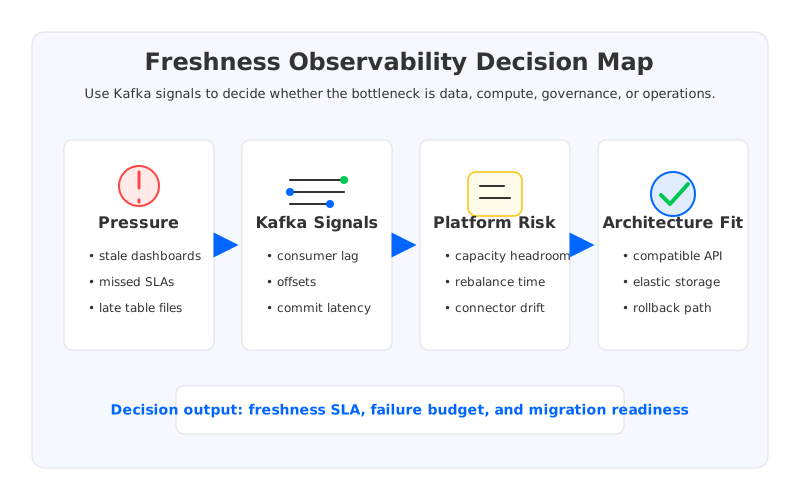
That is why teams search for table freshness observability kafka. They are not looking for another graph of broker CPU. They are trying to connect streaming platform signals to a table-level service expectation: how old is the data, where did the delay enter the path, and which team owns the next action? Kafka can show lag, offsets, producer latency, and connector status. Table systems can show commit time, partition availability, snapshot age, and query freshness. The production problem is the gap between those worlds.
For platform owners, freshness observability is not a single metric. It is a control loop across ingestion, buffering, processing, table commits, and recovery. If the loop is weak, every stale table turns into a cross-team investigation. If it is strong, the team can tell whether the delay came from source backpressure, Kafka retention pressure, slow consumers, connector failure, table writer throughput, object storage throttling, or catalog contention.
1Why teams search for table freshness observability kafka
Kafka sits in the uncomfortable middle of the freshness chain. It is close enough to source systems to know when events arrived, and close enough to downstream consumers to know whether those events were read. But Kafka does not know whether an Iceberg, Delta, or warehouse table is queryable at the freshness target the business promised. A consumer group can be caught up while a table commit path is stuck, and a table can be fresh while one low-priority consumer group is far behind.
The practical starting point is to define freshness as an end-to-end age, not as a component-local symptom. For a table fed by Kafka, the freshness clock often has four timestamps: event time, Kafka append time, processing or connector write time, and table snapshot availability time. A good observability model preserves those timestamps and maps the gaps to the platform boundary that can act on them.
This changes how the operations team reads Kafka metrics. Consumer lag is still useful, but it becomes one input in a larger diagnosis. Lag measured in offsets needs context from partition throughput, record size, processing concurrency, and downstream commit cadence. The same lag can be harmless on a high-throughput compact stream and serious on a low-volume compliance table.
The team should separate three classes of freshness signals:
- Data arrival signals show whether source events reached Kafka within the expected time window. Producer errors, append latency, topic throughput, and timestamp skew belong here.
- Consumption signals show whether downstream jobs are reading and acknowledging records. Consumer group lag, commit rate, rebalance frequency, and connector task health belong here.
- Table availability signals show whether records became queryable in the analytical system. Snapshot age, file commit latency, catalog commit errors, partition completeness, and query-visible watermark belong here.
The important move is not collecting more graphs. It is joining signals into a timeline that names the owner of the delay. When the source event arrived late, Kafka cannot fix freshness. When a connector is failing commits, broker scaling is a distraction. When broker scale-out triggers partition movement and slows catch-up, the streaming platform architecture has become part of the freshness problem.
2The lakehouse freshness constraint behind the workload
Lakehouse teams like table formats because they give analytical engines a stable contract: schema evolution, snapshots, partition pruning, replayable history, and governance over object storage files. Those features make table freshness harder than stream freshness. A Kafka consumer can process one record at a time, but an analytical table becomes useful only when a coherent commit is visible.
That boundary creates an operational tradeoff. Small, frequent commits improve freshness but increase metadata pressure, small-file risk, and catalog churn. Larger commits improve file layout and query efficiency but increase the age of visible data. Clickstream dashboards, fraud features, CDC-backed dimension tables, operational search indexes, and compliance exports tolerate different commit cadences and failure modes.
Kafka adds another constraint: replay is both a strength and a liability. Replay helps when a table writer fails or a schema bug corrupts downstream output, but only if the cluster retained the required window and consumers can catch up without starving live ingestion. A lakehouse freshness design that ignores recovery throughput is incomplete.
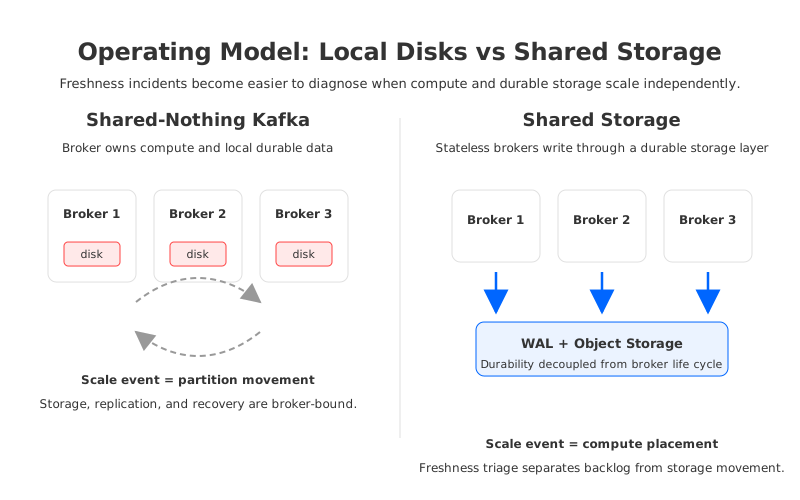
This is where shared-nothing Kafka deployments can surprise teams. Traditional brokers bind compute, storage, replication, and recovery to broker-local disks. Scaling for a freshness recovery event may require moving partitions, expanding disk capacity, rebalancing replicas, or over-provisioning idle headroom. The architecture works, but the operational cost becomes visible when freshness depends on rapid catch-up after a downstream pause.
3Stream-to-table architecture options
There are several valid ways to feed fresh tables from Kafka. The right option depends on how much control the platform team wants over latency, file layout, schema enforcement, and failure recovery. A connector-first path is often the fastest way to operationalize a common sink. A stream processor gives better control over transformation, watermarks, and state. A platform-native path can reduce moving parts, but it has to be evaluated against compatibility, governance, and maturity.
The options are easier to compare by commit ownership:
| Pattern | Commit owner | Freshness strength | Main operational risk |
|---|---|---|---|
| Kafka Connect sink | Connector task | Good for standard pipelines | Task failures, upgrades, schema mismatch, and sink tuning |
| Stream processor | Flink, Spark, or similar job | Strong control over watermarks and state | State recovery, checkpoint tuning, and mixed ownership |
| Custom table writer | Application or platform service | Maximum control over file layout | More code to own, test, and govern |
| Platform-native stream-to-table path | Streaming platform capability | Fewer moving parts when the table contract fits | Must verify compatibility, recovery, catalog behavior, and rollback |
No pattern removes the need for observability. A connector can hide table commit problems behind a “running” task state. A stream processor can be healthy while its watermark is delayed by a skewed partition. A custom writer can produce good files while losing the lineage needed for rollback. A platform-native path helps only when it exposes enough signals for freshness, governance, and recovery.
Kafka’s own semantics matter here. Consumer groups, committed offsets, and transactional behavior define what a downstream job can claim about progress. Kafka Connect provides a common framework for moving data between Kafka and external systems, but production behavior depends on the connector, sink, and deployment model. Tiered storage can change retention economics, but it does not automatically make brokers stateless or remove all data movement from scaling events.
4Evaluation checklist for platform teams
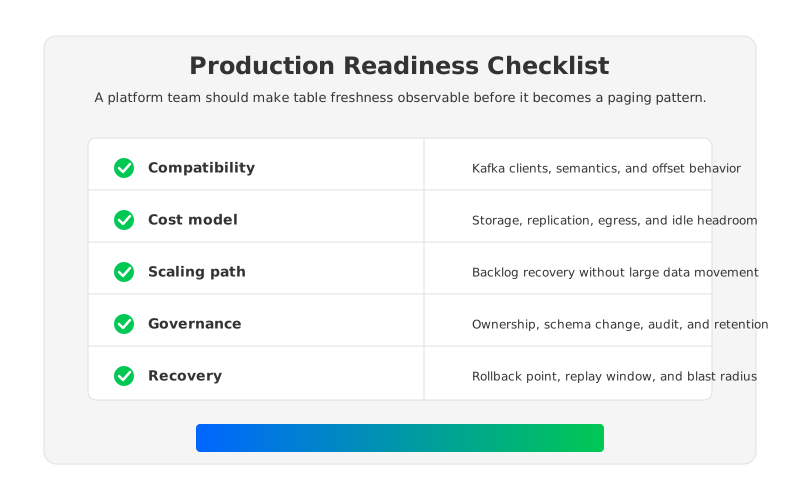
A useful table freshness checklist starts with production failure modes. Can the platform prove which records are included in the latest table snapshot? Can it replay the missing window without blocking live ingestion? Can it scale consumers or writers without triggering broker-local storage movement? Can it preserve Kafka client behavior so applications do not need a rewrite? Can the team roll back a bad table commit without losing the Kafka recovery point?
The checklist below is vendor-neutral. It focuses on questions that should be answerable before choosing a Kafka-compatible streaming platform or changing the stream-to-table architecture.
| Evaluation area | What to verify | Freshness implication |
|---|---|---|
| Kafka compatibility | Producers, consumers, transactions, offsets, and client versions | Migration risk stays bounded when applications keep familiar semantics |
| Retention and replay | Retention window, storage economics, fetch performance, and recovery throughput | A stale table can be rebuilt before the delay violates the target |
| Scaling behavior | Whether adding compute requires partition movement or long rebalancing | Catch-up capacity can be added without worsening the incident |
| Cost model | Broker disks, replicated storage, cross-AZ traffic, object storage requests, and idle headroom | The freshness SLA is not funded by permanent over-provisioning alone |
| Governance | Schema ownership, catalog integration, audit trail, and commit ownership | Teams can trace who changed the data contract and when freshness changed |
| Observability | Event-time, append-time, consume-time, commit-time, and query-visible freshness | The platform can isolate delay without opening a war room |
| Rollback | Offset checkpoint, table snapshot rollback, and dual-run migration path | Bad writes can be corrected without losing the replay source |
The cost row deserves special attention because freshness work often starts as an SRE problem and becomes a FinOps problem. Traditional Kafka replication writes multiple copies across brokers, and multi-AZ deployments can add network transfer depending on cloud topology. Object storage changes retained-data economics, but request patterns, WAL choices, and network paths still need to be checked against workload shape.
The governance row is equally important. Freshness incidents often expose unclear ownership. The Kafka team owns topics and retention, the processing team owns jobs and checkpoints, the data platform team owns table formats and catalogs, and the analytics team owns the dashboard that paged everyone. A good design makes those handoffs observable.
5How AutoMQ changes the operating model
Once the evaluation framework is clear, the architectural requirement becomes more specific: keep Kafka-compatible behavior for applications, but remove broker-local storage coupling from freshness recovery and capacity planning. AutoMQ fits into that category as a Kafka-compatible, cloud-native streaming system that separates broker compute from durable storage on object storage. Storage separation does not magically solve table freshness, but it changes the failure and scaling model.
In AutoMQ’s shared storage architecture, brokers are designed to be stateless relative to durable log data, with a WAL and object storage layer behind the Kafka-compatible API. Adding or replacing broker compute does not have to mean moving large volumes of broker-local log data before the cluster is useful. During a freshness incident, the team can reason about compute pressure, retained data, and table writer throughput separately.
AutoMQ’s docs describe deployment patterns aimed at reducing cross-AZ traffic in supported cloud environments. For table freshness workloads, this is not only a cost point. Cross-AZ traffic can couple availability design, replay behavior, and cloud networking bills. If a platform keeps Kafka protocol compatibility while using shared storage and locality-aware traffic paths, the team has more room to set freshness SLAs without sizing every broker for the worst recovery hour.
The migration question is still practical. A platform owner should validate the Kafka APIs, client versions, security model, connector behavior, and failure semantics used in production. They should also test table freshness under replay, not only under steady-state throughput. A credible proof of concept includes a downstream writer pause, a schema change, a broker replacement, a catch-up period, and a rollback exercise.
That is the right place for AutoMQ to be evaluated. It is not a replacement for good table design, watermark discipline, or catalog governance. It is an infrastructure choice that can reduce broker-local storage work on the freshness path.
6A readiness scorecard you can use this week
Start with one table that matters: a visible owner, a real freshness target, and enough traffic to expose operational behavior. Avoid the easiest pipeline, because it teaches little about recovery. Avoid the most politically sensitive pipeline, because every observability gap will become a governance argument before the team has a working model.
Score the current design on five questions:
- Can you compute table age from source event time to query-visible commit time? If not, freshness is a complaint, not a metric.
- Can you map each delay segment to one owner? Shared ownership by default slows incidents.
- Can Kafka replay the required window at recovery speed? Retention without catch-up throughput is only an archive.
- Can the platform add capacity without large broker-local storage movement? Freshness recovery often needs compute before it needs more durable bytes.
- Can you roll back the table and replay from a known offset? A freshness design that cannot recover from a bad write is incomplete.
Score each answer from 0 to 2: 0 for not observable, 1 for partially observable with manual work, and 2 for observable and tested. Below 6 points to instrumentation and ownership gaps. Between 6 and 8, recovery drills should drive investment. Above 8, compare platform choices under realistic failure and replay tests.
Back where the incident started, the dashboard is late and someone wants to know why. The mature answer is not more Kafka metrics. It is a timeline: when the event arrived, when Kafka appended it, when the consumer read it, when the table committed it, and which system is outside budget. If you are evaluating whether Kafka-compatible shared storage can simplify that model, review the verified AutoMQ documentation.
7References
- Apache Kafka documentation: Consumers, Kafka Connect, and Transactions
- Apache Kafka documentation: Tiered Storage
- AutoMQ documentation: What is AutoMQ
- AutoMQ documentation: Architecture overview
- AutoMQ documentation: WAL storage
- AutoMQ documentation: Eliminate inter-zone traffic
- AWS documentation: Amazon S3 pricing
8FAQ
8.1Is table freshness the same as Kafka consumer lag?
No. Consumer lag is a useful streaming signal, but table freshness measures whether data is visible in the target table within the expected time window. A consumer can be caught up while table commits are delayed, and a consumer can be behind without violating a relaxed table SLA.
8.2Which timestamp should define table freshness?
Most teams need more than one. Event time explains business age, Kafka append time explains ingestion delay, processing time explains pipeline delay, and table commit time explains query-visible freshness. The useful metric is the gap between timestamps.
8.3Does tiered storage solve table freshness problems?
Tiered storage can help with retention economics and historical reads in some Kafka deployments, but it does not automatically solve downstream table commit latency, connector failures, or governance ownership. It also should not be confused with a fully stateless broker operating model.
8.4Where does AutoMQ fit in a stream-to-table architecture?
AutoMQ fits at the Kafka-compatible streaming layer. Its shared storage architecture is relevant when teams want Kafka protocol compatibility while reducing broker-local storage coupling during scaling, replay, and recovery. Table format design, schema governance, and downstream job behavior still need explicit validation.
8.5What should a proof of concept test?
Test steady-state freshness, a downstream writer pause, replay catch-up, broker replacement, schema change handling, and rollback from a bad table commit. The proof of concept should produce a freshness timeline, not only throughput numbers.


