
Table of Contents
Table of Contents
A lakehouse team rarely wakes up wanting another streaming subsystem to operate. The request is usually specific: the fraud dashboard needs fresher records, the ML feature pipeline cannot wait for a nightly batch, or analysts want to query operational events without asking the Kafka team for a replay. Search queries such as table topic operations kafka come from that pressure point. The team already has Kafka-compatible streams. The question is whether those streams can become governed, query-ready tables without turning the platform into fragile one-off ingestion jobs.
That question is operational before it is architectural. Kafka topics have producers, partitions, offsets, consumer groups, retention policies, and failure semantics. Lakehouse tables have schemas, snapshots, catalogs, object storage layouts, and access controls. The hard part is deciding who owns the line between them when traffic spikes, a schema evolves, a broker is replaced, or a catalog permission changes.
The right answer depends on workload shape. Some teams should keep Kafka Connect or Flink in the middle because they need transformations, joins, enrichment, event-time processing, or custom sink logic. Other teams are mostly doing stream-to-table materialization: take selected topic data, enforce a schema policy, write it into a governed table format, and make it queryable with predictable freshness. Those are different operating models, and treating them as the same problem is how lakehouse ingestion becomes expensive to own.
1Why Teams Search for table topic operations kafka
The phrase is awkward, but the intent is clear. Platform teams want Kafka topics that also behave like table feeds. They are not asking whether Kafka can move bytes. They are asking whether the streaming layer can participate in a lakehouse contract without forcing every application team to become an expert in connector tasks, table commits, object storage failure modes, and replay boundaries.
The pressure usually comes from three places. First, analytical users want freshness measured in minutes or seconds, while the existing lake ingestion path was built around batch windows. Second, application teams want to retain Kafka's producer and consumer model because it is already embedded in services and operational runbooks. Third, governance teams want the lakehouse output to have table-level semantics, not a loose directory of files that only one job understands.
That combination creates an ownership problem. The Kafka team owns the stream, the data platform team owns the table, and the application team owns the schema. When a record is present in the topic but missing from the Iceberg table, all three teams may be involved.
The practical goal is not "Kafka to Iceberg" as a slogan. The goal is an operating model where stream freshness, replay, schema evolution, table visibility, and rollback can be tested as one path. That is why the evaluation should start with failure and ownership, not with a feature checklist.
2The Lakehouse Freshness Constraint Behind the Workload
Real-time lakehouse systems are constrained by two clocks. The stream clock advances as producers append records and consumers commit offsets. The table clock advances when data files and metadata commits become visible through a catalog. A healthy platform keeps those clocks close enough for the business requirement, but it also keeps them understandable when they diverge.
For a dashboard, divergence may show up as stale data. For an ML feature pipeline, it may show up as inconsistent training and serving windows. For compliance review, it may show up as an audit question: did the record never arrive, did it arrive late, or did the table writer fail after consuming it? Kafka offsets are excellent for replaying streams, but table readers do not naturally think in offsets. They think in snapshots, partitions, timestamps, and query results.
This is where table topic operations become more than sink configuration. A production path needs answers to questions that cut across both systems:
- What is the authoritative recovery point when the topic and table disagree?
- Which schema change is allowed to pass automatically, and which one requires review?
- How long can the table output lag the topic before an alert fires?
- Can the team replay from a known offset without duplicating table records?
- Who can change catalog permissions, namespace mapping, and table retention?
These questions determine whether real-time lakehouse adoption scales beyond the first demo. A platform that cannot answer them will push each data product team to build its own workaround, which is the opposite of a shared platform.
3Stream-to-Table Architecture Options
There are three common ways to connect Kafka-compatible streams to lakehouse tables. None is universally correct. The right choice depends on transformation needs, operational ownership, and how much of the table path should be standardized by the platform team.
| Option | Good fit | Operational trade-off |
|---|---|---|
| Kafka Connect sink | Standard connector-driven movement into external systems | Connector workers, task failures, plugin versions, and sink-specific behavior become part of the runbook |
| Flink or Spark streaming job | Stateful processing, joins, enrichment, event-time logic, or custom table writes | More control, but the team now operates job state, checkpoints, resource scaling, and deployment pipelines |
| Platform-integrated table topic path | Direct materialization of selected topic data into table storage where supported | Simpler ingestion surface, but schema, catalog, and table behavior must fit the platform's supported model |
The table makes the first decision obvious: do not use a table topic path to hide real transformation logic. If a pipeline needs event-time computation, deduplication, or custom business rules, a processing engine is the right place to make those decisions visible. A direct table path is most useful when the stream record is already close to the table record.
The less obvious decision is storage architecture. Traditional Kafka's Shared Nothing architecture ties partitions and retained segments to broker-local storage. That model is mature and well understood, but it makes capacity planning and scaling a broker problem. Longer retention, catch-up reads, and partition movement all interact with local disk, replica placement, and data movement. When the same cluster feeds a lakehouse, the pressure increases because the stream becomes both an operational buffer and an analytical source.
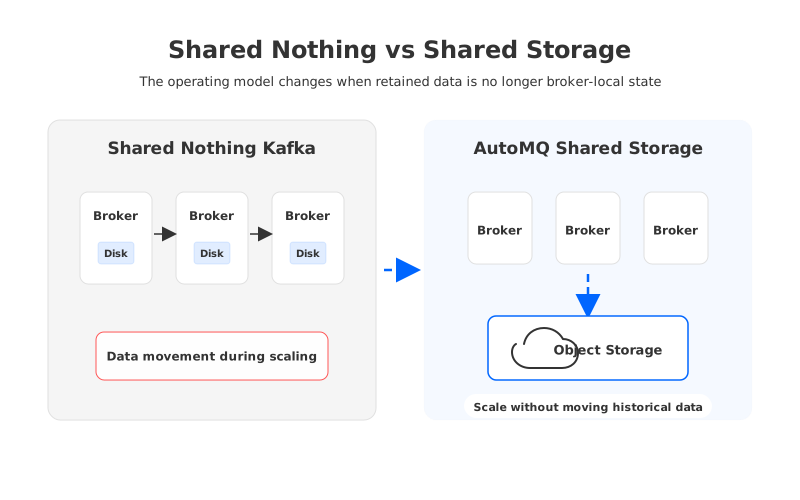
A Shared Storage architecture changes that premise. If historical stream data lives in object storage and brokers are closer to stateless compute nodes, scaling and recovery no longer require the same amount of broker-local data movement. That does not remove all operational concerns. It changes which concerns dominate: object storage policy, write-ahead durability, metadata correctness, network routing, and table commit behavior become central.
For lakehouse teams, that shift matters because the table path already depends on object storage and a catalog. If the streaming layer is also designed around cloud storage primitives, the platform can reason about retention, replay, and table materialization with fewer artificial boundaries. The evaluation can focus on whether the shared operating model is coherent, not whether two separate storage systems can be glued together indefinitely.
4Evaluation Checklist for Platform Teams
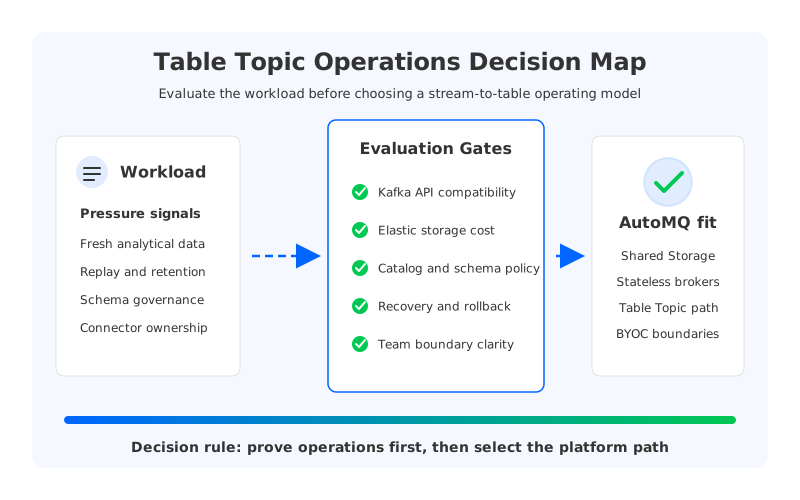
A neutral evaluation should start before any product name appears. The platform team needs to decide what "production ready" means for both the stream and the table output. Otherwise the decision collapses into isolated claims: connector count, broker count, table format support, or a single benchmark number. Those facts matter, but they do not define operability.
Use these gates as a practical review:
- Compatibility: Existing producers, consumers, client libraries, authentication patterns, offsets, and consumer groups should remain understandable. A table path is not useful if it forces application teams to rewrite stable Kafka-facing code without a strong reason.
- Cost model: Separate compute, storage, retention, cross-AZ traffic, catalog, object storage request, and connector or job runtime costs. Lakehouse freshness can quietly multiply infrastructure cost when every stream keeps both hot Kafka replicas and separate table ingestion capacity.
- Elasticity: Test scale-out, scale-in, partition movement, catch-up reads, and burst writes. The platform should explain what data moves, what metadata changes, and what remains stable during each operation.
- Governance: Define schema ownership, namespace mapping, catalog permissions, table naming, retention, and deletion policy. Governance cannot be an afterthought bolted onto a stream once the table is already queryable.
- Recovery: Document how to recover from broker failure, writer failure, catalog failure, bad schema deployment, and accidental table corruption. Recovery should include replay and rollback, not only restart behavior.
- Migration risk: Prove that existing workloads can move gradually. For a Kafka-compatible platform, migration review should include topic data, offsets, consumer group progress, ACLs, observability, and rollback.
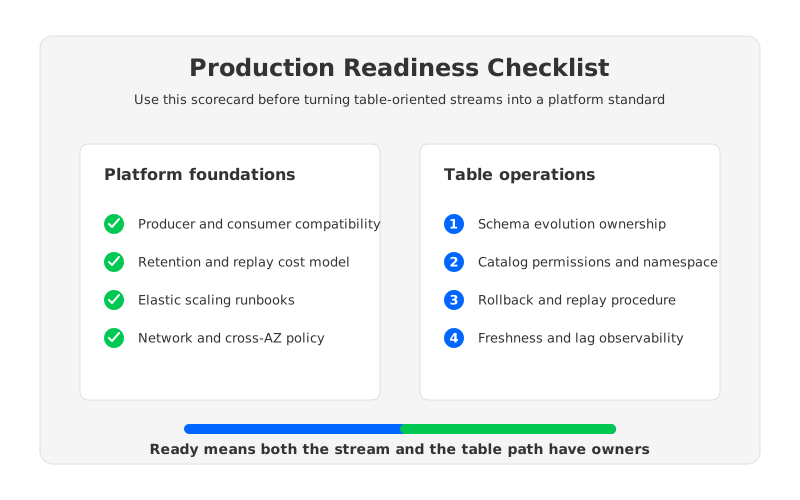
The most useful result is a scorecard, not a yes-or-no answer. Some workloads need a processing engine. Some need a connector path. Some need direct table materialization. A mature platform allows more than one path but keeps ownership explicit.
5How AutoMQ Changes the Operating Model
Once the evaluation gates are clear, AutoMQ becomes relevant as a Kafka-compatible cloud-native streaming platform built around Shared Storage architecture. The important point is not that every lakehouse workload should use one integrated path. The important point is that broker-local storage no longer has to be the center of the operating model.
AutoMQ reimplements Kafka's storage layer on object storage through S3Stream while preserving Kafka protocol compatibility for clients and upper-layer Kafka behavior. Brokers can be treated more like stateless compute because durable stream data is stored outside broker-local disks, with WAL storage used to absorb writes before data is uploaded to object storage. That architecture changes the day-2 mechanics that matter to table topic operations: scaling does not have to imply large historical segment movement, long retention does not have to be planned as broker disk capacity, and failure recovery can focus on restoring compute access to shared durable data.
For lakehouse teams, AutoMQ Table Topic is the adjacent capability to evaluate. It is designed to write topic data into Apache Iceberg tables and integrate with catalog services such as AWS Glue, AWS S3 Tables, or Hive Metastore depending on deployment requirements. The feature is useful when a topic's data can be materialized directly into a table with the supported schema and catalog model. It is not a replacement for Flink, Spark, or Kafka Connect when the pipeline needs complex processing. That boundary is healthy. It keeps Table Topic positioned as an operating-model simplifier, not as a universal data processing engine.
AutoMQ BYOC also matters for teams that treat data boundary as a first-class requirement. In a BYOC deployment, the data plane runs in the customer's cloud account and VPC, which can simplify reviews around network boundaries, object storage ownership, catalog permissions, and operational access.
There is also a cloud networking angle. Multi-AZ Kafka deployments can generate cross-AZ traffic through replication and client access patterns. AutoMQ documents a zero cross-AZ traffic approach for supported AWS and GCP multi-AZ configurations by using shared storage and locality-aware routing. The exact savings depend on region, traffic shape, and cloud pricing, so model your own workload. The architectural point remains: if a stream-to-table platform runs in the cloud, network movement is part of the design.
6A Practical Migration and Readiness Path
The safest way to evaluate table topic operations is to begin with a narrow data product, not a platform-wide mandate. Pick a topic family where the record is already close to analytical form, the schema owner is available, and consumers can tolerate a controlled parallel run.
A useful pilot has five stages. First, baseline the current path: throughput, retention, lag, failures, freshness, and recovery steps. Second, define the table contract: schema rules, catalog namespace, partitioning, quality checks, and owner escalation. Third, run a parallel write path and compare query freshness against the existing output. Fourth, rehearse failure: pause writers, introduce a schema change, replay a known offset range, and test catalog access changes. Fifth, decide whether the direct table path should become the standard, remain workload-specific, or be rejected.
The decision matrix should be blunt:
| If the workload requires... | Prefer... | Reason |
|---|---|---|
| Heavy transformations or joins | Flink or Spark | Processing semantics belong in an explicit compute engine |
| Many external systems with existing sink plugins | Kafka Connect | Connector ecosystems are built for heterogeneous integration |
| Direct Kafka-to-Iceberg materialization with supported schemas | Table Topic-style operation | Fewer moving parts can improve ownership and recovery |
| Long retention with elastic Kafka-compatible operations | Shared Storage streaming platform | Storage and compute can scale along different axes |
This matrix prevents a common platform mistake: using one successful ingestion path as proof that every future workload should use the same mechanism. Standards work only when they describe fit and non-fit conditions.
7Closing Thought
The search for table topic operations kafka is really a search for a cleaner boundary between streams and tables. Kafka-compatible topics are already the nervous system of many operational systems. Lakehouse tables are increasingly the shared surface for analytics, AI, governance, and audit. The platform team's job is to make the path between them boring in production.
If your team is reviewing whether selected Kafka-compatible topics should flow directly into Iceberg tables, AutoMQ is worth testing after you define the operating gates. Start with the AutoMQ Table Topic documentation and validate it against one real topic family, one catalog, one schema policy, and one rollback drill.
8References
- Apache Kafka documentation
- Apache Kafka Connect documentation
- Apache Iceberg documentation
- Apache Iceberg table specification
- AWS S3 Tables user guide
- AWS Glue Iceberg documentation
- AutoMQ Table Topic overview
- AutoMQ S3Stream shared storage overview
- AutoMQ Shared Storage architecture overview
9FAQ
9.1Is a table topic the same thing as Kafka Connect?
No. Kafka Connect is a general framework for moving data between Kafka and external systems through connectors. A table topic path is narrower: it is useful when selected topic data should be materialized into table storage with a platform-defined operating model.
9.2Does Table Topic replace Flink or Spark?
No. Flink and Spark are still the right tools for complex transformations, joins, event-time processing, and stateful computation. Table Topic-style operation fits records that are already close to the desired table record.
9.3What should teams test before adopting table topic operations?
Test producer and consumer compatibility, schema evolution, catalog permissions, replay from known offsets, rollback behavior, freshness, observability, and burst cost. The pilot should include at least one planned failure drill.
9.4Why does Shared Storage architecture matter for lakehouse ingestion?
Shared Storage architecture reduces the operational coupling between broker compute and retained stream data. For lakehouse teams, that can simplify scaling, long retention, and recovery discussions because historical stream data is not tied as tightly to broker-local disks.
9.5When should a team avoid a direct table topic path?
Avoid it when the pipeline contains substantial business logic, cross-stream joins, custom deduplication, or complex event-time semantics. In those cases, make the processing layer explicit and operate it as part of the data product.


