
Table of Contents
Table of Contents
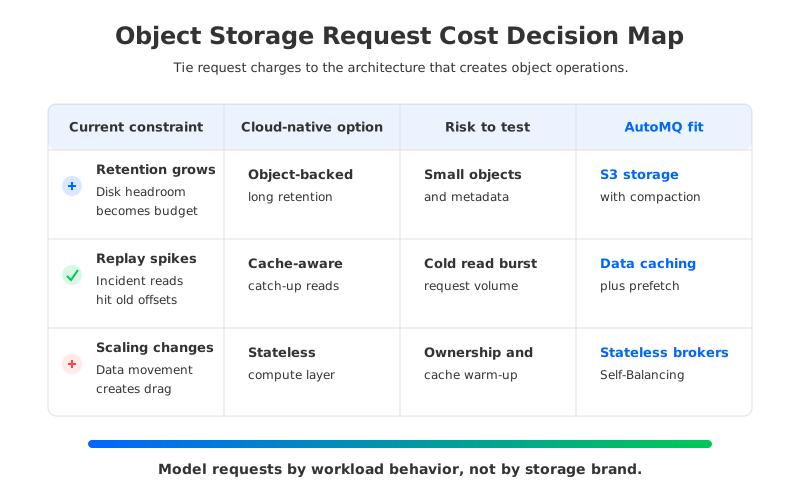
Someone searching for object storage request cost kafka is usually past the first architecture debate. They already know object storage can change the economics of retention, replay, and cloud elasticity. The harder question is whether request charges, API call patterns, network paths, and operational side effects will turn that idea into a different kind of bill. Kafka teams usually meet this question in a FinOps review, a capacity plan, or a migration design review, when a topic that looked small at 24 hours of retention becomes expensive at weeks of retention. The thesis is simple: object storage request cost matters, but it only becomes useful in Kafka planning when it is tied back to the storage architecture that creates those requests.
1Why teams search for object storage request cost kafka
Object storage pricing is not one line item. AWS S3, for example, publishes separate pricing dimensions for storage, requests, data retrievals, data transfer, management features, and optional services. Other cloud providers use different names and SKUs, but the FinOps pattern is similar: the bill has a capacity component and an activity component. Kafka adds pressure because streaming workloads append continuously, read recent data frequently, replay older data during incidents, and move ownership when the cluster changes shape.
That combination is why a naive comparison between local disk and object storage can mislead both sides of the table. Storage teams may focus on lower object-storage capacity cost and miss request amplification. Kafka operators may focus on broker-local SSD behavior and miss the cost of replicas, rebalancing, over-provisioned disks, and network transfer. The useful question is not "Is object storage lower cost than disk?" It is: "Which architecture controls the number, size, locality, and timing of object operations while preserving Kafka semantics?"
For Kafka-compatible streaming, request cost belongs in TCO (Total Cost of Ownership) alongside compute, storage, network, operational labor, migration risk, and governance. It is the part of the answer that forces teams to examine the write path and read path instead of stopping at the storage medium.
2The production constraint behind the problem
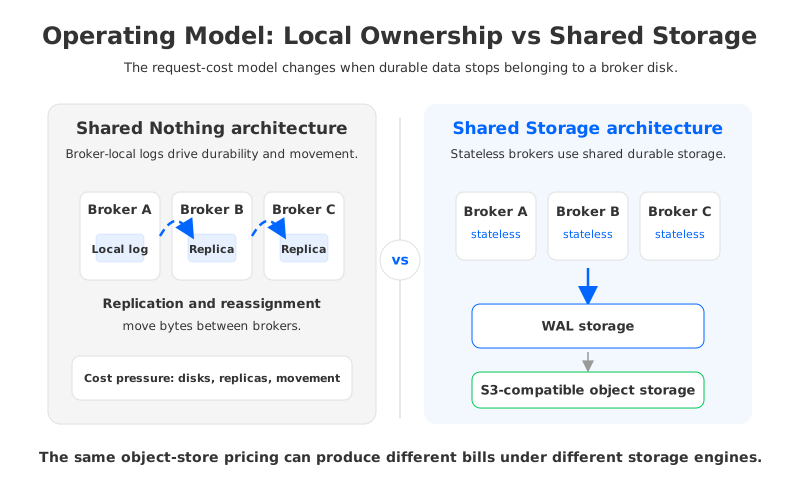
Traditional Kafka was designed around a Shared Nothing architecture. Each broker owns local log segments, each partition has a leader, followers replicate from that leader, and durability comes from keeping replicas in sync across brokers. The model works well when hardware, network, and disk are controlled as a unit.
Cloud infrastructure changes the cost boundary. Local disks or cloud block volumes must be sized for retention, peak write rate, and failure headroom. Replication consumes network capacity, and partition reassignment moves data from broker to broker. The cluster can be over-provisioned because storage and compute are coupled: you may need more brokers for disk even when CPU is not the bottleneck.
Tiered Storage helps by offloading older log segments to remote storage while brokers keep local storage for active data. It is a practical Apache Kafka feature for teams extending retention. But tiering does not fully remove broker-local ownership: the local tier still exists, and the request profile depends on how segments are offloaded, fetched, cached, and compacted.
Object storage request cost becomes interesting at this boundary. If remote storage is a cold extension of broker-local logs, request cost follows tiering behavior. If object storage is the primary durable layer behind a Kafka-compatible system, request cost follows the streaming storage design itself. Those operating models should not share one spreadsheet row.
3Architecture options and trade-offs
Platform teams usually have three broad options when Kafka cost pressure reaches object storage planning: tune traditional Kafka, adopt Tiered Storage, or evaluate a Kafka-compatible Shared Storage architecture. None is universally correct. The right option depends on workload shape, compatibility requirements, operational ownership, and the risk the organization is trying to reduce.
Traditional Kafka tuning is still valid when the estate is stable and the main issue is waste. Teams can right-size brokers, tune retention, compact low-value topics, rebalance partitions, and improve quota discipline. These changes can reduce waste, but they do not change the coupling between broker compute and broker-local storage.
Tiered Storage is a stronger fit when retained historical data dominates the bill and local hot data remains manageable. It can reduce pressure on broker disks and support longer replay windows, but teams still have to model remote reads, cache behavior, segment lifecycle, and failure-mode testing.
Shared Storage architecture changes the premise. The Kafka-compatible broker is no longer the long-term owner of durable local log data. Durable data lives in shared object storage, and brokers focus on protocol handling, routing, cache, leadership, and scheduling. The request-cost question moves from "How often does Kafka spill to remote storage?" to "How efficiently does the storage layer batch writes, compact objects, cache reads, and coordinate recovery?"
That shift creates a more useful decision matrix:
| Evaluation area | Traditional Kafka | Tiered Storage | Shared Storage architecture |
|---|---|---|---|
| Storage ownership | Broker-local logs and replicas | Broker-local hot tier plus remote historical tier | Shared object storage as the durable data layer |
| Request-cost driver | Limited direct object requests unless external tools are used | Segment offload, remote fetches, and cache misses | WAL, object compaction, tail reads, catch-up reads, and metadata design |
| Scaling behavior | Add brokers and move partition data | Add brokers, still manage local tier and remote tier behavior | Add or remove stateless brokers with less data movement |
| Main risk to test | Disk headroom and reassignment windows | Remote read latency and tier lifecycle | Object request amplification, cache design, and WAL recovery |
The table does not pick a winner. It prevents a common mistake: evaluating object storage as if it were the same component in every architecture. The same pricing page can produce different costs depending on object size, batching, metadata operations, cache hit rate, and whether brokers move data during scaling.
4Evaluation checklist for platform teams
A practical checklist starts with compatibility because savings that require application rewrites are rarely first-year savings. Apache Kafka applications often depend on consumer groups, offsets, producer idempotence, transactions, Kafka Connect, schema tooling, ACLs, monitoring conventions, and client library behavior. Before modeling object request cost, confirm which Kafka semantics and tools must keep working.
After compatibility, model the request path in workload language. A pricing page can tell you that requests are metered. It cannot tell you whether the platform writes one object per tiny flush, batches many partitions into larger objects, prefetches cold reads, or compacts small objects before metadata becomes a problem. Ask for the path from produce acknowledgment to durable storage, and from consumer fetch to cache miss recovery.
Use this checklist in architecture review:
- Write path: What happens before a produce request is acknowledged? Identify whether data is written to local disk, block storage, file storage, a WAL (Write-Ahead Log), object storage, or a combination.
- Object shape: How large are objects under normal write load, low write load, and many-partition workloads? Small objects often reveal request and metadata cost.
- Read locality: Which reads come from broker memory, local cache, WAL-adjacent data, or object storage? Separate tail reads from catch-up reads.
- Replay behavior: What changes during a consumer backfill, offset reset, disaster recovery test, or compliance export? Rare reads can dominate incident-week costs.
- Network path: Does data cross AZs, VPC boundaries, NAT gateways, PrivateLink endpoints, or internet egress paths? Request cost is only one part of data movement.
- Scaling path: When brokers change, does the platform copy retained data or switch ownership and metadata? Data movement changes both risk and cost.
- Governance boundary: Who owns the bucket, encryption keys, IAM policies, audit logs, lifecycle rules, and deletion controls? The cost model must be enforceable in the billed account.
The strongest signal is whether the platform can explain these mechanics without hiding behind a cost-reduction slogan. Request cost is manageable when the architecture makes it observable and controllable.
5How AutoMQ changes the operating model
Once the evaluation framework is clear, AutoMQ becomes relevant as a Kafka-compatible Shared Storage architecture rather than as a generic managed Kafka alternative. AutoMQ keeps the Kafka protocol and ecosystem surface while replacing broker-local log storage with S3Stream, a storage layer that writes durable data through WAL storage and stores the main data in S3-compatible object storage.
The important distinction is how AutoMQ uses object storage for streaming. AutoMQ writes data to WAL storage for durable acknowledgment, uploads data to S3 storage as the primary storage layer, uses data caching for tail and catch-up reads, and keeps brokers stateless so replacement and scaling are less tied to retained local data. Public AutoMQ documentation describes WAL storage as addressing the latency and write-efficiency problems that appear when object storage is used for streaming workloads. In S3 WAL mode, WAL and primary storage both use S3-compatible storage, with optimizations intended to reduce API calls; in AutoMQ commercial editions, WAL options vary by environment.
Stateless brokers change the scaling conversation. In traditional Kafka, adding brokers usually creates a second task: move partition data so the added capacity is useful. In AutoMQ, durable data is already in shared storage, so scaling is more about ownership, leadership, cache warm-up, and traffic distribution. Capabilities such as Self-Balancing and seconds-level partition reassignment reduce the operational work associated with capacity changes.
The network side is equally important. AutoMQ documents a Zero cross-AZ traffic design for reducing inter-zone data transfer in multi-AZ deployments. This does not make every cloud-network charge disappear; teams still need to model endpoint, NAT, PrivateLink, and provider-specific traffic charges. But it removes a major Kafka cost pressure: application-layer replica traffic crossing AZ boundaries to keep broker-local copies synchronized.
Deployment boundary matters for governance. AutoMQ BYOC (Bring Your Own Cloud) is designed so the control plane and data plane run in the customer's cloud account and VPC, while AutoMQ Software targets private data centers. For teams evaluating object storage request cost, that boundary determines who owns the bucket, IAM policy, encryption key, network route, observability data, and cost allocation tags.
6Migration and readiness scorecard
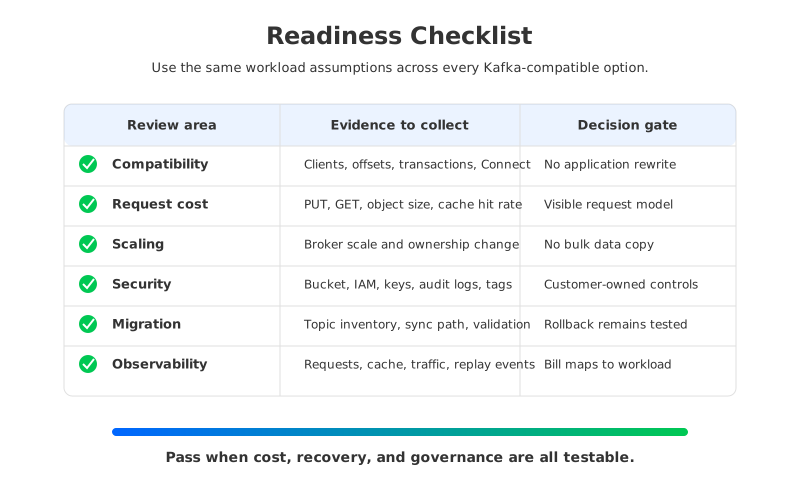
A migration plan should prove that the cost model survives production behavior. Start with one representative topic family: high-throughput short retention, long-retention audit logs, fan-out analytics topics, or replay-heavy incident topics. Capture produce throughput, partition count, retention, consumer group count, replay frequency, and expected backfill window, then run the same assumptions through the current estate and the candidate architecture.
Score each candidate from 1 to 5 in these areas:
| Area | What to verify | Why it matters |
|---|---|---|
| Compatibility | Clients, offsets, transactions, Connect, ACLs, and monitoring | Avoids hidden application migration cost |
| Request efficiency | Object size, PUT/GET pattern, cache hit rate, and compaction | Controls the activity side of object storage cost |
| Scaling model | Broker add/remove behavior and partition ownership changes | Separates elasticity from data-copy operations |
| Network cost | AZ locality, VPC path, endpoint charges, and internet egress | Prevents request optimization from hiding traffic cost |
| Recovery path | WAL recovery, oldest-offset replay, and failed-broker replacement | Tests the system under the moments that create surprise bills |
| Governance | Bucket ownership, IAM, encryption, audit, and tagging | Makes FinOps controls enforceable |
The score is less important than the conversations it forces. A low compatibility score means cost modeling should pause. A low request-efficiency score means the architecture needs deeper proof. A low governance score means the platform may be attractive but hard to approve. This is how object storage request cost kafka becomes a decision framework instead of a search phrase.
If your team is evaluating Kafka-compatible streaming with object-storage-backed durability, use the checklist against your traffic and retention profile. For an AutoMQ-specific evaluation, start a BYOC architecture review through AutoMQ Cloud and bring your current Kafka bill, topic inventory, and replay assumptions. The answer is clearer when the request model is tied to the storage engine that creates it.
7FAQ
7.1Does object storage request cost make Kafka on object storage too risky?
No. It makes architecture review necessary. Request cost is manageable when the platform batches writes, controls object size, caches reads, compacts small objects, and exposes metrics. It becomes risky when object operations are invisible or amplified by many small writes and unplanned replays.
7.2Is Tiered Storage the same as Shared Storage architecture?
No. Tiered Storage offloads older Kafka log data to remote storage while keeping a local broker-owned tier. Shared Storage architecture makes shared object storage the durable data layer and changes how brokers scale, recover, and own data. Both can use object storage, but their request patterns and operating models differ.
7.3Which metrics should FinOps teams request from platform teams?
Ask for object PUT/GET/LIST counts, object size distribution, cache hit rate, tail-read versus catch-up-read volume, cross-AZ traffic, endpoint data processing, broker disk utilization, reassignment activity, and replay events. These metrics connect cloud billing dimensions to Kafka workload behavior.
7.4Where does AutoMQ fit in a Kafka cost optimization project?
AutoMQ fits after the team has confirmed that Kafka compatibility still matters and the main constraint is broker-local storage, scaling, cross-AZ replication, or long-retention economics. It should be evaluated with the same workload assumptions as the current Kafka estate, including compatibility, request efficiency, recovery, and governance.


