
Table of Contents
Table of Contents
Searches for peak traffic capacity planning kafka usually start after a platform team has been burned by a peak. A seasonal campaign ran hot, a replay collided with production traffic, a fraud pipeline lagged for hours, or procurement noticed that the Kafka cluster is sized for a few dangerous days but paid for every day. The technical question looks like capacity planning. The real question is whether your Kafka operating model makes peak capacity a permanent cost.
Kafka-compatible streaming systems make this question harder and more useful. Producers, consumers, offsets, Consumer groups, transactions, Kafka Connect jobs, and observability tools are already woven into the application estate. But the cost of serving a peak is determined by more than the API. It depends on where durable data lives, how brokers recover, how partitions move, how much inter-zone traffic the design creates, and whether compute and storage can scale separately.
That is the thesis of this checklist: peak traffic planning should model the cost of state, not only the cost of throughput. Throughput tells you how many brokers you need at the high-water mark. State tells you how long you keep paying for that decision.
1Why Teams Search for peak traffic capacity planning kafka
Kafka clusters need enough headroom for producer throughput, consumer fan-out, and retention. Most mature teams already track bytes in, bytes out, partitions, request rate, disk usage, and consumer lag. They search because the arithmetic stops matching the business reality: the cluster has to survive a peak that is short, irregular, and politically impossible to miss.
A realistic peak plan has to account for several overlapping pressures:
- Burst traffic. Promotions, product launches, telemetry spikes, model backfills, and operational replays can all push traffic above the normal daily envelope.
- Retained state. The cluster does not shrink cleanly after the burst if disks, replicas, and partition placement remain tied to broker-local storage.
- Recovery demand. The same headroom used for live traffic may be needed for catch-up reads, failed consumers, or large replay after an outage.
- Cloud network paths. Multi-Availability Zone deployments improve availability, but broker replication, producer routing, and consumer reads can create data transfer charges that are not visible in a simple broker count.
- Organizational boundaries. FinOps wants a forecast, SRE wants failure tolerance, security wants cloud-account control, and application teams want the Kafka contract to stay boring.
These pressures make peak traffic capacity planning a TCO problem. If the plan only asks, "How many brokers handle peak MiB/s?" it will miss the costs that appear after the peak: over-provisioned disks, slow reassignments, replication traffic, manual balancing, and migration risk.
2The Production Constraint Behind the Problem
Traditional Apache Kafka runs on a Shared Nothing architecture. Each broker owns local log storage, and partitions are replicated across brokers for availability. The model is well understood and operationally proven, which is why many teams still prefer it for workloads where local disk performance and explicit control are more important than elastic infrastructure behavior. The constraint is that broker compute and durable state are coupled.
That coupling turns a short peak into a long-lived planning decision. If you add brokers to absorb traffic, you also have to think about partition reassignment and data movement. If you increase disk capacity for retention or replay, you may keep paying for storage that is not needed for normal traffic. If a broker fails, the cluster has to restore leadership and replica health while protecting the same local-state layout that made the cluster reliable in the first place.
Cloud deployments add one more layer. A three-zone Kafka cluster often sends data across Availability Zone boundaries for producer routing, follower replication, or consumer access. AWS prices data transfer separately from compute and storage, and S3 has its own storage and request model. Billing separates these lines; architecture connects them.
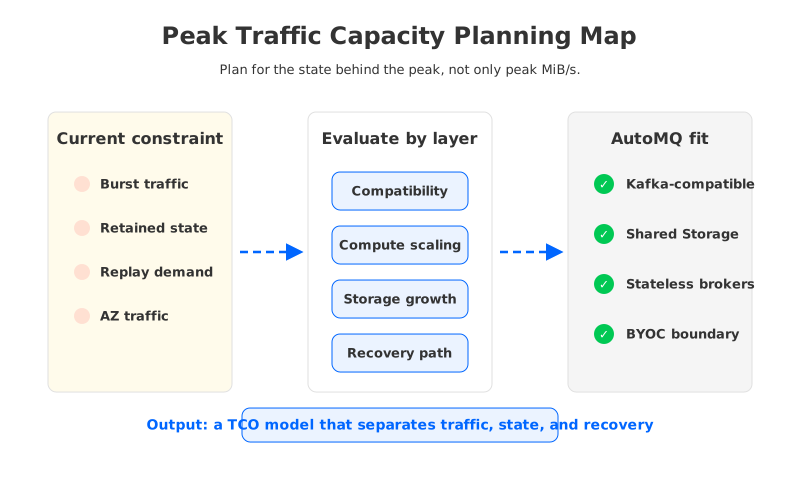
Capacity planning cannot stop at maximum ingress. A production plan needs separate lines for steady traffic, peak traffic, replay traffic, retained data, zone-level resilience, and operational labor. When those lines are tied to the same stateful broker layer, the safe plan is often to over-provision and explain the bill later. That should be an explicit decision rather than an accident.
3Architecture Options and Trade-Offs
There is no universal architecture for peak traffic. Strict low-latency workloads with predictable peaks may stay on broker-local storage. Long-retention workloads may add Tiered Storage for older segments. Teams that want a managed operational boundary may choose a cloud Kafka service. Teams whose pain is stateful elasticity may evaluate Kafka-compatible Shared Storage architecture.
The useful distinction is not "managed versus self-managed." It is what each option makes elastic, and what remains coupled.
| Architecture option | What helps peak planning | What still needs scrutiny |
|---|---|---|
| Self-managed Kafka with broker-local disks | Full operational control, familiar tooling, explicit performance tuning | Broker count, disk size, partition movement, replication traffic, and operations remain tightly coupled |
| Managed Kafka service | Less cluster administration and a clearer service contract | Pricing dimensions, feature compatibility, private networking, retention limits, and provider boundary still shape TCO |
| Kafka with Tiered Storage | Lower pressure from historical retention on local disks | Hot data, partition leadership, local recovery, and broker sizing remain stateful concerns |
| Kafka-compatible Shared Storage architecture | Broker compute can be treated more elastically because durable data is in shared storage | WAL choice, object storage behavior, cache strategy, migration testing, and governance boundaries must be validated |
Tiered Storage deserves special attention because it is often mistaken for a full answer. It can help when historical retention dominates disk growth, but it does not make brokers stateless. Recent data still lives in the primary broker storage layer, and partition movement still follows the broker-local operating model. For rapid scale-out, failure recovery, or cross-zone replication cost, Tiered Storage only solves part of the equation.
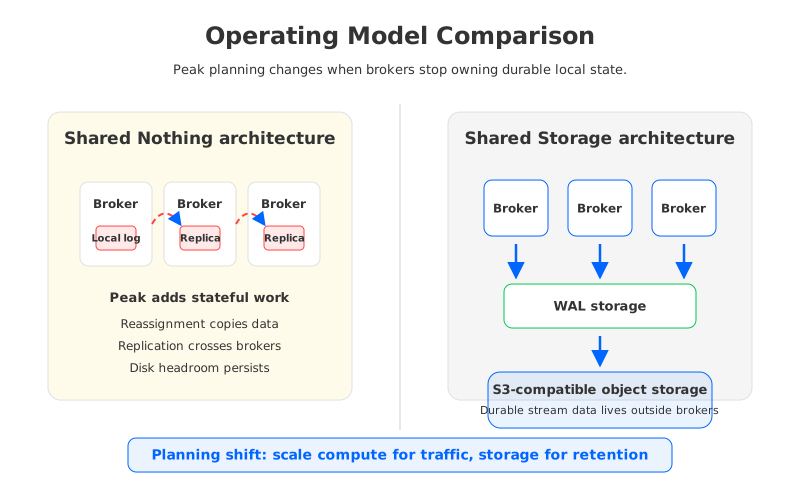
Shared Storage architecture changes the planning boundary. Durable data is placed in S3-compatible object storage, while brokers focus on Kafka protocol handling, leadership, caching, and request processing. The hot write path still needs a WAL (Write-Ahead Log) so the system can acknowledge writes without pretending that object storage is a local disk. But once durable state is no longer owned by a broker's local disk, broker replacement, scale-out, and reassignment become metadata and traffic-routing problems rather than bulk data-copying projects.
That shift changes the TCO conversation. Compute can be planned around traffic, storage around retention, and recovery around ownership transfer. Object storage request patterns, WAL durability, cache hit rate, and cold-read behavior still matter, but they can be measured independently.
4Evaluation Checklist for Platform Teams
Start with a baseline workload model. Use four traffic profiles: steady state, expected peak, replay or backfill, and degraded-mode recovery. For each profile, record ingress, egress, fan-out, partition count, retention, largest Consumer group lag, and the recovery time objective. Do not average these into one "typical" cluster size.
Then turn the workload into a TCO review. The goal is not to prove that one architecture wins every row. The goal is to expose which rows dominate your cost and risk.
| Checklist area | Questions to answer | Evidence to collect |
|---|---|---|
| Compatibility | Which Kafka clients, transactions, idempotent producers, Consumer groups, Kafka Connect jobs, and admin tools must work unchanged? | Client matrix, protocol tests, migration rehearsal, offset validation |
| Peak compute | Which brokers or workers must scale during peak, replay, and failure recovery? | Throughput tests, CPU and network saturation, partition hot-spot analysis |
| Storage growth | Is storage sized for retention, peak write rate, replay, or failure buffer? | Retention policy, disk or object storage usage, compaction and deletion behavior |
| Inter-zone traffic | Which writes, replications, reads, and private connectivity paths cross zones? | Cloud billing dimensions, VPC flow logs, broker and client placement |
| Failure recovery | What happens when a broker, zone, WAL path, object storage path, or client group fails? | Runbooks, chaos tests, recovery timing, data integrity checks |
| Governance | Where do data, metadata, credentials, logs, metrics, and control operations live? | Architecture diagrams, IAM policies, encryption settings, audit requirements |
| Migration and rollback | How are topics, offsets, ACLs, producers, consumers, and observability moved and verified? | Dual-run plan, rollback trigger, lag threshold, data comparison process |
This table should be owned jointly by platform engineering, SRE, security, and FinOps. Kafka capacity planning fails when each group optimizes its own spreadsheet. A shared checklist makes the trade-off visible before the peak arrives.
5How AutoMQ Changes the Operating Model
Once the neutral checklist is clear, AutoMQ becomes relevant as a specific architecture option: a Kafka-compatible streaming platform that keeps the Kafka protocol contract while replacing broker-local durable storage with Shared Storage architecture. AutoMQ uses S3Stream, object storage, and WAL storage for the hot write path. Brokers are designed as stateless brokers rather than machines that own irreplaceable local log segments.
For peak capacity planning, that changes three parts of the model. Compute and storage can be planned independently. Partition reassignment is no longer dominated by copying retained data between brokers. Object-storage-backed durability also changes the economics of retained data and cross-zone replication because broker-to-broker ISR traffic is no longer the durability mechanism.
AutoMQ also addresses a cost line that many Kafka plans understate: inter-zone traffic. Its zero cross-AZ traffic design uses shared storage and routing so producers and consumers can avoid unnecessary cross-zone broker paths, while broker durability relies on S3 rather than inter-broker replica traffic. This does not remove the need to read the cloud provider's network and storage pricing pages. It gives the platform team a different architecture to model against those pages.
The deployment boundary matters as much as the storage boundary. AutoMQ BYOC is designed for customer-controlled cloud environments, while AutoMQ Software is aimed at private data centers. For teams evaluating peak capacity under governance constraints, that means the review can include VPC ownership, object storage ownership, IAM, monitoring, and operational access instead of treating "managed" as a black box.
A credible AutoMQ evaluation should still include producer behavior, Consumer group movement, transaction semantics, Kafka Connect, schema workflows, observability, and rollback. It should also test WAL choice, object storage latency, cache behavior, cold reads, and failure recovery under the workload profiles defined earlier.
6A Readiness Scorecard for Peak Traffic Planning
The most useful output is a scorecard that procurement and engineering can both read. It should show where the current architecture is strong, where the cost is structural, and where a platform change would reduce operational coupling.
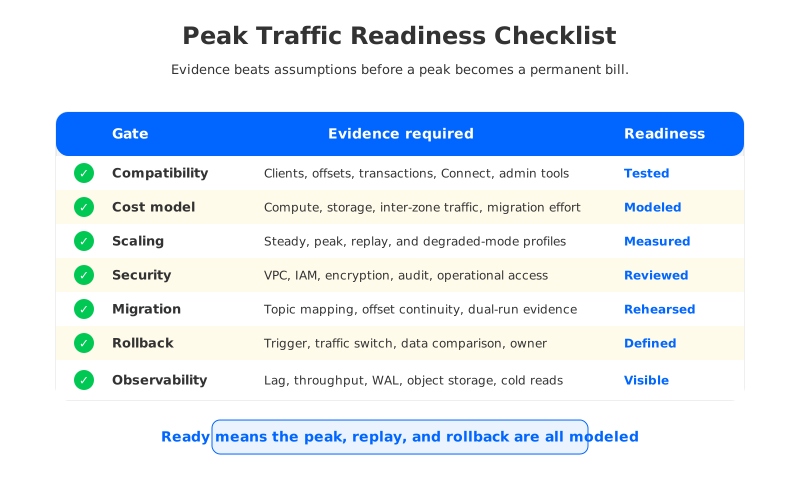
Use the scorecard in three passes. First, mark every row with evidence you already have. Second, mark every row where you are relying on belief rather than a test. Third, decide which beliefs deserve a proof of concept. That turns a vague mandate to "reduce Kafka cost" into a bounded experiment.
For example, if your dominant cost is over-provisioned broker compute, test scale-out and scale-in under replay. If the dominant cost is retained data, compare local disk, Tiered Storage, and Shared Storage architecture against your retention policy. If the dominant cost is inter-zone traffic, map producer, replication, and consumer paths before changing instance types. If the dominant risk is migration, test offset continuity and rollback before debating steady-state price.
The key is to keep peak traffic and retained state separate in the model. A platform that treats both as broker-local capacity will tend to turn rare peaks into permanent infrastructure. A platform that separates compute from durable storage gives you more room to pay for the peak when it happens and stop paying for it when it is gone.
If your next capacity review is really a TCO review, bring the workload model, the governance boundary, and the migration constraints into the same conversation. To evaluate AutoMQ against your own Kafka peak profile, start with the project and deployment materials at AutoMQ on GitHub.
7FAQ
7.1What is peak traffic capacity planning for Kafka?
It is the process of sizing Kafka or Kafka-compatible infrastructure for the highest expected production, consumption, replay, and recovery load. A good plan includes broker compute, storage, partitions, replication, retention, network paths, and operational recovery rather than only maximum ingress throughput.
7.2Why does peak traffic planning affect Kafka TCO?
Kafka capacity often has to be provisioned before traffic arrives. If compute, storage, and replication are tied to stateful brokers, temporary peaks can lead to permanent cost in broker count, disk capacity, inter-zone traffic, and operational labor.
7.3Does Tiered Storage solve peak capacity planning?
Tiered Storage can reduce pressure from long historical retention by moving older data to object storage. It does not make brokers stateless, so hot data, broker-local recovery, partition leadership, and some reassignment work still need capacity planning.
7.4When should teams evaluate a Kafka-compatible Shared Storage architecture?
Evaluate it when your main constraint is storage-coupled operations: slow scale-out, expensive retained data, cross-zone replication cost, heavy replay, or a need to separate compute scaling from storage growth while keeping Kafka clients and ecosystem tools.
7.5How should FinOps and SRE collaborate on Kafka capacity planning?
They should use the same workload model and scorecard. FinOps should see the technical causes of cost, and SRE should see which safety buffers become recurring spend. The best review treats reliability, cost, governance, and migration risk as one design problem.


