
Table of Contents
Table of Contents
A kafka tco model review usually starts after the first cost spreadsheet has already failed. Finance sees a line item growing faster than traffic. The platform team sees a cluster that needs more brokers than expected. SREs see partition movement, broker replacement, and incident recovery consuming the capacity that was meant for product work. Procurement asks which Kafka-compatible platform is lower cost, but the real question is sharper: which operating model makes the cost curve predictable under production pressure?
That distinction matters because Kafka cost is not a single bill component. It is a coupling problem. Compute, storage, network traffic, retention, replication, operational labor, connector management, and migration risk all interact through the architecture of the streaming platform. A model that compares broker hourly rates without modeling data movement is incomplete. A model that compares storage prices without modeling hot-path durability is incomplete. A model that ignores offset preservation and rollback risk can be financially attractive on paper and expensive in production.
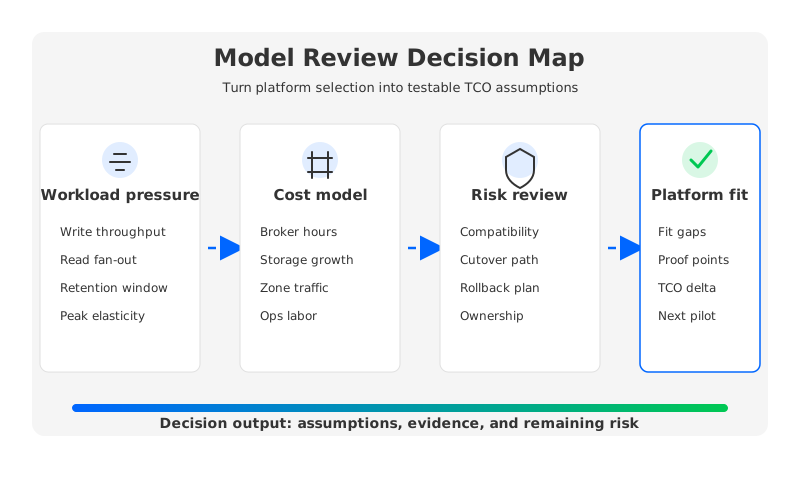
The practical way to review Kafka-compatible TCO is to separate assumptions from evidence. Start with workload pressure, translate it into cost drivers, review the risks that can invalidate the model, and then test platform fit against the same workload. This keeps the conversation grounded. It also prevents teams from treating cost as a vendor claim rather than an architecture outcome.
1Why teams search for kafka tco model review
The search intent behind kafka tco model review is rarely academic. Teams are usually deciding between self-managed Apache Kafka, a managed Kafka service, a cloud-native Kafka-compatible platform, or a migration path from one of those to another. The cluster may already run critical workloads: fraud decisions, telemetry, CDC, AI feature pipelines, observability, order events, or real-time personalization. The cost review has to respect that production reality.
Kafka also has a long tail of compatibility requirements. Producers and consumers depend on client behavior, consumer groups, offset commits, transactions, ACLs, topic configuration, and operational tools. Apache Kafka's own documentation covers these semantics across clients, consumers, producers, Connect, transactions, and KRaft metadata management. A TCO review that treats "Kafka-compatible" as a checkbox misses the real work: proving which compatibility surfaces are required by the workload and testing them before any commercial decision.
The first review question should be: what would make the migration or platform change fail? The blocker may be a connector plugin, consumer offset handling during cutover, or read fan-out during replay after an outage. The cost model should include those failure modes because they determine how much parallel running, rollback capacity, and operational supervision the team needs.
2The cloud cost drivers behind the workload
Traditional Kafka was designed around brokers that own local log storage. That design has aged well in many environments because it is explicit, battle-tested, and deeply understood. The cost challenge appears when this shared-nothing architecture runs in cloud infrastructure where every copy of data, every reserved disk, every cross-zone transfer, and every idle broker has a price boundary.
The cost drivers worth modeling are consistent across most Kafka estates:
- Compute headroom. Brokers are sized for peak throughput, partition count, page cache, background replication, and recovery, not average traffic alone. The cost review should separate steady-state utilization from headroom held for incidents and growth.
- Storage growth. Retention multiplies the effect of broker-local storage because retained data remains tied to broker capacity and replica count. Tiered storage changes part of this curve, but it does not automatically make brokers stateless.
- Network movement. Multi-AZ or multi-zone deployments can generate traffic from producer placement, broker replication, consumer reads, rebalancing, catch-up reads, and migration. Cloud provider pricing pages are the source of truth for the current rates, but the model should first count the paths.
- Operational labor. Partition reassignment, capacity planning, broker replacement, version upgrades, connector operations, and incident response are real costs. They are often invisible in invoices and obvious in on-call calendars.
Those categories are not independent. Increasing retention can force more storage, which can force larger brokers, which can slow reassignment, which can increase recovery headroom. A useful TCO model shows those relationships instead of hiding them behind one blended monthly estimate.
3Storage, network, and compute trade-offs
The most important architectural question is whether durable stream data is tied to broker-local disks. In a shared-nothing Kafka cluster, each broker owns partitions and stores local log segments. Replication provides durability and availability by copying partition data among brokers. This is a clean model, but it means scaling and recovery involve data movement because the broker is both compute node and storage owner.
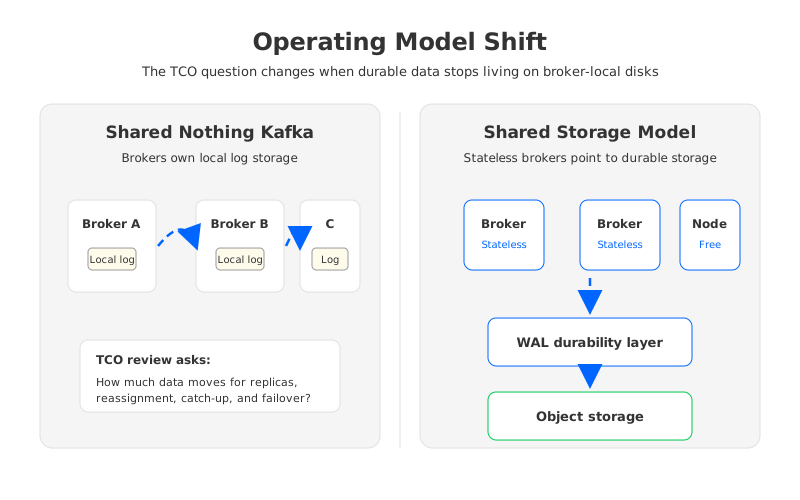
Shared storage changes the operating model. Brokers can focus on Kafka protocol handling, network I/O, and coordination, while durable data lives in shared storage. The write path still needs a low-latency durability layer; sending every hot write directly into cold object storage is not a complete answer for latency-sensitive workloads. That is why the WAL layer matters in any serious review. It defines the point at which a write is durable, how hot data is acknowledged, and how data later lands in object storage.
This is the point where AutoMQ becomes relevant to the evaluation. AutoMQ is a Kafka-compatible streaming platform built around shared storage, stateless brokers, WAL-backed durability, and object storage for scalable stream data. Its public documentation describes the architecture as a separation of compute and storage: brokers are made nearly stateless, data is written through a WAL layer, and object storage provides the large durable storage tier. The benefit is not "object storage is lower cost" by itself. The benefit is that storage growth, broker count, partition movement, and cross-zone data movement can be modeled differently.
The distinction between tiered storage and shared storage is worth making explicit. Tiered storage can offload older log segments from broker-local disks to remote storage, which helps retention economics. The broker still owns active partitions and local storage behavior remains part of the operating model. In a shared-storage design, the goal is more fundamental: durable data is not anchored to a specific broker's local disk, so scaling and replacement can avoid large broker-to-broker data migrations.
That architecture still needs scrutiny. A good review asks how the WAL is deployed, what latency profile it supports, how object storage request patterns behave under catch-up reads, how metadata is managed, and how clients are routed across zones. AutoMQ's documentation on inter-zone traffic describes zone-aware routing and S3-based storage patterns for reducing cross-zone data transfer in supported deployments; the buyer still has to validate that against its own cloud, VPC, client placement, and workload shape.
4Evaluation checklist for FinOps and platform teams
A TCO model should become a review artifact that FinOps, platform engineering, SRE, security, and procurement can all inspect. The goal is not to make every stakeholder read Kafka internals. The goal is to make sure the model has enough technical fidelity that the final number can survive production reality.
| Review area | Questions that should be answered | Evidence to request |
|---|---|---|
| Compatibility | Which Kafka APIs, clients, consumer group behaviors, transactions, ACLs, Connect flows, and admin operations are required? | Client test matrix, protocol support statement, migration dry run |
| Cost | Which line items grow with throughput, fan-out, retention, partition count, network placement, and requests? | Workload-based cost model, cloud pricing references, sensitivity analysis |
| Elasticity | How does the platform scale brokers, partitions, storage, and connectors under peak and post-incident load? | Load test, scaling runbook, reassignment or balancing evidence |
| Recovery | What happens when a broker, zone, storage dependency, connector, or control plane component fails? | Failure drills, RPO/RTO assumptions, rollback procedure |
| Governance | Who owns network boundaries, encryption, identity, audit logs, cloud accounts, and operational access? | Security architecture, RBAC model, audit evidence |
| Migration | How are topics, offsets, ACLs, schemas, producers, consumers, and rollback handled during cutover? | Migration plan, offset validation, parallel-run plan |
The table is intentionally operational. It keeps the buyer from reducing the decision to storage price or broker count. For example, a platform with a promising storage curve may still be risky if it cannot preserve offsets during migration. A platform with strong Kafka semantics may still be expensive if it requires large idle capacity for rebalance windows. A managed service may reduce labor but introduce networking, data residency, or control-plane ownership questions that security teams need to review.
5How AutoMQ changes the operating model
AutoMQ should be evaluated after the neutral checklist is filled out, not before it. The architecture is interesting because it attacks several cost drivers at their coupling point. By using shared storage and stateless brokers, AutoMQ changes the relationship between retained data and broker-local capacity. By using WAL storage in front of object storage, it separates the hot durability path from the long-term storage tier. By supporting Kafka protocol compatibility, it gives teams a way to test the target operating model without rewriting producers and consumers.
That does not remove the need for proof. It changes what proof should look like. Instead of asking whether a vendor claims lower TCO, ask whether the platform can show:
- Existing Kafka clients and tooling running against the target cluster.
- Produce and consume latency under the team's own payload size, ack policy, compression, and partition count.
- Catch-up reads from recent and older offsets without distorting steady-state traffic.
- Broker replacement, scale-out, and scale-in without long data movement windows.
- Zone-aware traffic behavior with the actual VPC, subnet, and client placement.
- Migration behavior for topics, offsets, ACLs, and rollback under a parallel-run plan.
AutoMQ's BYOC model also changes the governance review. In a customer-controlled deployment, the data plane can run in the customer's cloud account and network boundary, while AutoMQ provides managed operations around that environment. For teams with strict data residency, private networking, marketplace procurement, or cloud-account ownership requirements, this can be as important as raw infrastructure cost. The review should still document which resources are created, who has operational access, how logs and metrics flow, and how emergency support is authorized.
Connectors and downstream data products deserve their own section in the model. Kafka platform cost often moves to the edges: CDC tasks, sink connectors, schema workflows, lakehouse ingestion, and observability exports. AutoMQ has documentation for managed Kafka Connect and Table Topic, which can materialize Kafka topic data into lakehouse tables. Those capabilities can reduce separate pipeline operations in some workloads, but they should be modeled as workload-specific options rather than assumed savings.
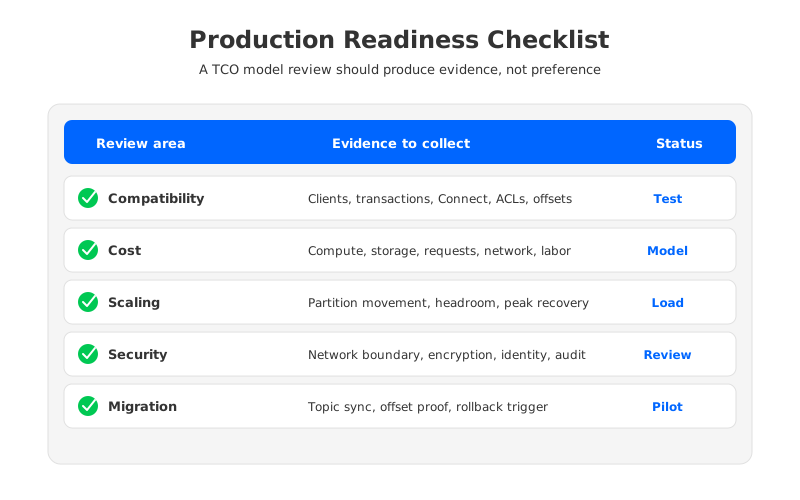
The strongest TCO review produces a decision matrix, not a winner by assertion. It should state where the current platform is acceptable, where shared storage changes the curve, where migration risk remains, and which pilot would disprove the business case. The pilot is especially important for Kafka-compatible systems because the buyer is not testing a generic queue. The buyer is testing a production contract built from client behavior, ordering, offsets, backpressure, observability, and operational response.
6Migration and readiness scorecard
A practical scorecard uses a small set of pass/fail gates before any final commercial comparison. If a gate fails, the team either fixes the gap, narrows the migration scope, or rejects the platform for that workload. This is stricter than a feature checklist because it ties the cost model to production readiness.
Use these gates during review:
- Compatibility gate. Run the real client versions, common admin operations, representative topics, consumer groups, and connector paths. The result should be a test record, not a verbal claim.
- Cost sensitivity gate. Recalculate the model at average load, peak load, retention growth, replay, and failure recovery. The platform should remain defensible across plausible scenarios.
- Network placement gate. Map producer, broker, consumer, connector, and storage placement across zones or regions. Count the data paths before attaching cloud pricing to them.
- Recovery gate. Simulate broker replacement, zone impairment, storage dependency disruption, and rollback. The review should know which component becomes the bottleneck.
- Ownership gate. Confirm who controls cloud resources, encryption, identity, network access, observability data, and operational escalation.
This scorecard gives procurement a cleaner commercial conversation. The platform team can say which assumptions are proven, which are pending, and which are outside scope. Finance can see whether the cost reduction comes from fewer brokers, less replicated storage, lower network movement, less idle headroom, reduced labor, or a combination. SREs can see whether the operating model reduces toil or moves it to a different subsystem.
The closing question is the same one that started the review: which operating model makes the cost curve predictable under production pressure? If broker-local storage and cross-zone data movement dominate your Kafka cost model, shared storage deserves a serious pilot. If migration risk, compliance boundaries, or connector operations dominate the model, those gates should lead the evaluation. To model your own workload against AutoMQ's architecture, use the AutoMQ pricing calculator and pair the estimate with a compatibility and migration proof-of-concept.
7References
- Apache Kafka Documentation
- AutoMQ Architecture Overview
- AutoMQ WAL Storage
- AutoMQ Native Compatibility with Apache Kafka
- AutoMQ Inter-Zone Traffic Overview
- AutoMQ BYOC Installation on AWS
- AutoMQ Migration from Apache Kafka
- AutoMQ Managed Kafka Connect Overview
- AutoMQ Table Topic Overview
- Amazon S3 User Guide
- Amazon S3 Pricing
- Amazon EC2 On-Demand Pricing
- AWS PrivateLink Pricing
8FAQ
8.1What is a Kafka TCO model review?
A Kafka TCO model review is a structured evaluation of the costs and risks behind a Kafka or Kafka-compatible streaming platform. It should include compute, storage, network movement, retention, operational labor, migration risk, governance, and recovery behavior.
8.2Why is broker-local storage important in Kafka cost modeling?
Broker-local storage ties durable data to specific broker capacity. That affects retention cost, broker sizing, partition reassignment, failover, and recovery. Shared storage architectures change this relationship by separating broker compute from durable stream storage.
8.3Is Kafka compatibility enough to choose a platform?
No. Compatibility is a gate, not the whole decision. Teams should test real clients, consumer groups, offsets, transactions, connectors, ACLs, admin operations, observability workflows, and migration behavior before relying on a TCO estimate.
8.4How should teams evaluate AutoMQ in a TCO review?
Evaluate AutoMQ after defining a neutral framework. Test Kafka compatibility, WAL latency, object storage behavior, inter-zone traffic, scaling, migration, rollback, and cloud-account ownership against your own workload. The value case is strongest when broker-local disk, replicated storage, cross-zone traffic, and idle headroom are major cost drivers.
8.5What should be included in a Kafka-compatible platform pilot?
A pilot should include representative producers and consumers, production-like partition counts, retention settings, read fan-out, connector flows, broker failure drills, scale-out and scale-in tests, offset validation, and a rollback plan. The output should be evidence that confirms or disproves the TCO model.


