
Table of Contents
Table of Contents
A telco Customer 360 program usually starts with a familiar promise: give service teams, fraud systems, care agents, digital channels, and network operations a shared view of the subscriber. The hard part is not collecting a profile table. The hard part is keeping that view fresh while call detail records, device events, charging updates, roaming signals, trouble tickets, app clicks, and consent changes arrive from systems that were never designed to move at the same rhythm.
That is why searches for telco customer 360 feeds kafka tend to come from teams that already know batch integration is too slow. They are not asking whether Kafka can move events. They are asking how to build a feed architecture that can survive production conditions: uneven peaks, strict data boundaries, long replay windows, regional deployment constraints, and service workflows that depend on data freshness. In telecom, a delayed event can mean a missed churn intervention, a fraud model working from stale behavior, or a care agent making a promise with half the customer context missing.
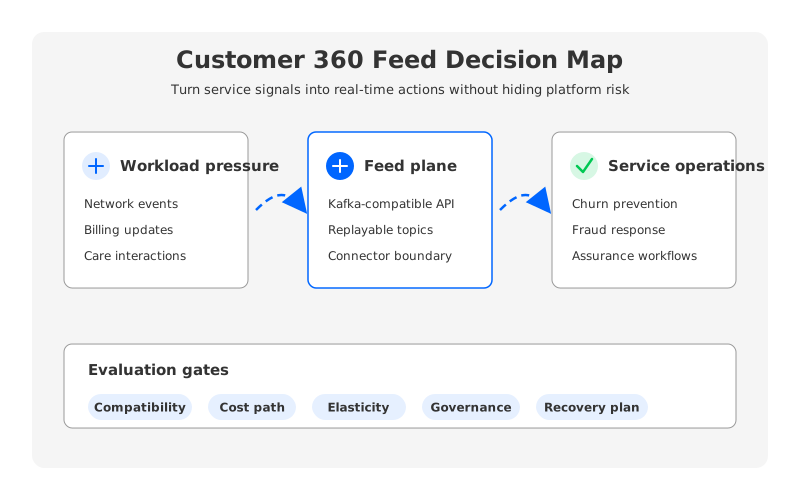
The useful framing is to treat Customer 360 as an operational feed plane, not as a reporting project. Reporting systems optimize for historical completeness. A service operations feed optimizes for ordered change, replay, freshness, and controlled fan-out. Those properties make Kafka-compatible infrastructure attractive, but they also expose platform decisions that batch systems often hide until the bill or the incident review arrives.
1Why Customer 360 Feeds Become a Streaming Problem
Customer 360 is a loaded phrase because different teams mean different things by it. Marketing may mean audience segmentation. Care may mean a consolidated account view. Network operations may mean a correlation between subscriber experience and cell-site events. Fraud teams may mean a rolling risk profile. These views overlap, but their freshness and failure tolerance are different enough that a single nightly merge cannot serve them all.
Kafka fits the problem because it gives teams a shared event backbone with durable topics, consumer groups, offsets, and replay. A billing enrichment service can consume charging events at its own pace while a fraud feature pipeline reads the same topic with different logic. A downstream system can recover by resuming from committed offsets instead of asking every source system to resend data. That independence matters when the same customer signal feeds many applications.
The catch is that a telco Customer 360 feed is not one topic. It is a mesh of feeds with different shapes:
- High-volume network and device telemetry, where spikes follow incidents, events, and regional mobility patterns.
- Commercial and care events, where correctness and auditability matter more than raw volume.
- Identity resolution and consent updates, where a late correction can change which systems are allowed to act on a customer record.
- Model and decisioning outputs, where operational teams need a traceable path from input signal to action.
These feeds turn Kafka from a transport choice into a platform contract. The contract has to say how long data is retained, who can replay it, where personally identifiable information is stored, how schemas evolve, and how the platform behaves when a broker, connector, or consumer group falls behind.
2The Production Constraint Behind the Problem
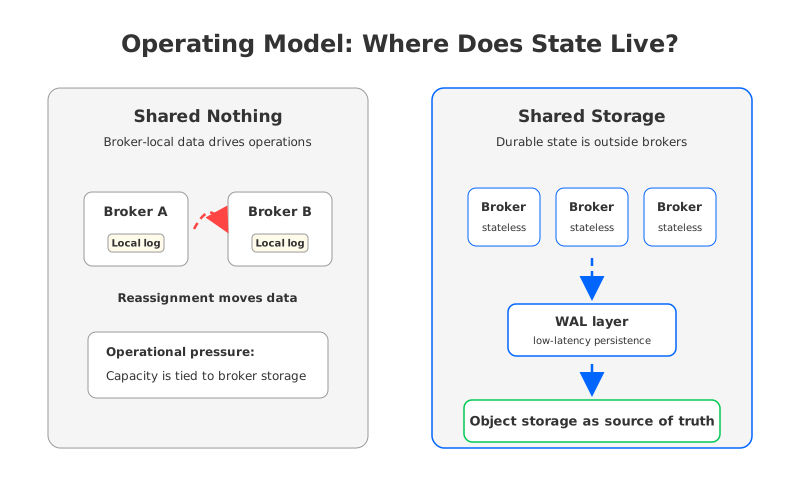
Traditional Kafka deployments are excellent at making ordered logs available to many consumers, but their operating model was shaped by broker-local storage. Partitions live on brokers. Replicas are copied between brokers. Capacity planning blends compute, disk, network, and replication into one unit of work. That model is mature, yet it creates a specific tension for Customer 360 feeds: the more valuable the feed becomes, the more teams want longer retention, broader fan-out, and faster scaling.
Those requirements stress different parts of the system at the same time. Longer retention increases storage pressure. Broader fan-out increases read traffic and consumer lag risk. Faster scaling asks the platform to move partitions or rebalance traffic when load changes. Multi-AZ deployment improves availability, but replica traffic and client routing can add network cost. None of these constraints means Kafka is the wrong abstraction. They mean the platform team has to evaluate the storage and operating model behind the Kafka API.
A Customer 360 feed also has a governance shape that generic event pipelines often underestimate. The platform may carry phone numbers, device identifiers, account status, location-derived signals, payment events, and service interactions. Some signals are safe to distribute broadly after transformation. Others require masking, tokenization, access controls, regional residency, or strict audit paths. The streaming platform cannot solve governance by itself, but it can either make the boundary visible or scatter it across connector code and downstream services.
For platform teams, the question becomes concrete: can the feed plane absorb growth without turning every change into a storage migration, a network cost surprise, or a governance exception?
3Architecture Options and Trade-Offs
There are three common patterns for telco Customer 360 feeds. The first keeps the warehouse or lake at the center and uses streaming only for ingestion. This gives analytics teams a strong historical store, but service operations still wait for transformation jobs, table refreshes, or serving-layer updates. It works for dashboards and slow-changing attributes. It is weak for workflows that need to react while the customer is still on a call, in a session, or moving through a network condition.
The second pattern is a traditional Kafka cluster with carefully engineered topics, connectors, stream processors, and serving stores. This is often the practical starting point because the Kafka ecosystem is broad and familiar. The trade-off is operational: the team must own broker sizing, partition placement, replication, retention, upgrades, rebalancing, and cost modeling.
The third pattern is a Kafka-compatible platform that keeps Kafka semantics at the client boundary while changing the storage architecture underneath. The feed plane still exposes Kafka-compatible topics and consumer behavior, but durable state is moved into shared storage. Brokers become less tied to local disk, and scaling becomes closer to a compute operation than a data movement project.
| Decision area | Traditional broker-local Kafka | Kafka-compatible shared storage approach |
|---|---|---|
| Client boundary | Native Kafka clients and ecosystem tools | Kafka-compatible clients and ecosystem tools |
| Storage growth | Planned through broker disk and partition layout | Planned through object storage capacity and WAL design |
| Scaling event | Often coupled with reassignment or data movement | More focused on adding or removing broker capacity |
| Replay window | Increases broker storage pressure | More naturally tied to object storage economics |
| Multi-AZ cost model | Replica and client traffic require close modeling | Architecture can reduce inter-zone replication pressure |
| Operational risk | Mature, but storage-heavy operations are common | Requires validation of compatibility, WAL behavior, and cloud boundaries |
The table is not a universal ranking. A smaller feed with limited retention and stable load may run well on a conventional Kafka deployment. A large Customer 360 program with long replay windows, elastic peaks, and many consuming teams has a different risk profile. For that program, judge the architecture by how it behaves during change: a campaign spike, a network incident, a customer-care rollout, a regulatory review, or a migration.
4Evaluation Checklist for Platform Teams
The strongest Customer 360 designs are boring in the right places. Producers do not know which downstream application will consume the event. Consumers can fail and recover without negotiating with source systems. Schemas evolve without breaking every service at once. Sensitive fields have clear handling rules. Operators can explain the cost path before launch.
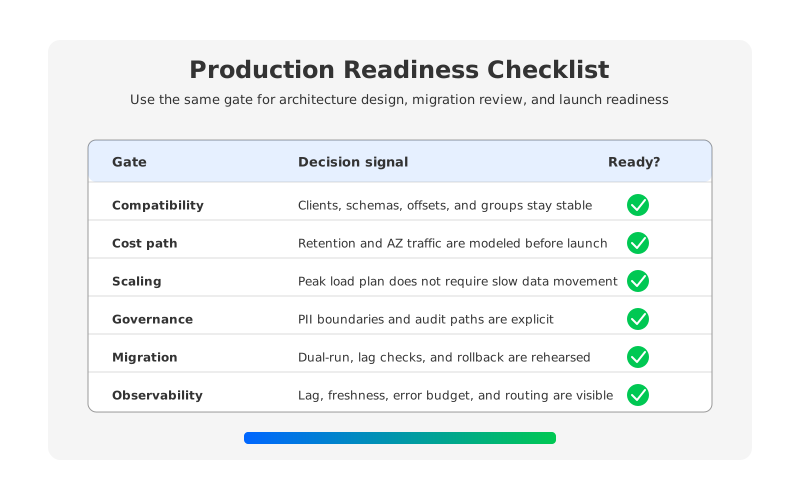
Use the checklist below as a design review, not as a procurement form.
- Compatibility: Confirm that the platform supports the Kafka protocol level, client libraries, consumer groups, offsets, connectors, schema tooling, and observability integrations your teams already use. A Customer 360 migration should not become an application rewrite hidden inside an infrastructure project.
- Freshness target: Define the acceptable delay for each feed class. A care-agent context update, a fraud risk signal, and a marketing segment update do not need the same service-level objective.
- Retention and replay: Decide which topics need long replay windows and which should be compacted, reduced, or pushed into a lakehouse. Retention should be attached to a business recovery or model-training requirement.
- Cost path: Model storage, broker capacity, read fan-out, cross-AZ traffic, connector compute, and observability volume. The largest surprise is often replication, replay, or downstream fan-out.
- Governance boundary: Identify which topics contain regulated attributes, where masking happens, which teams can replay them, and how access is audited.
- Failure and rollback: Rehearse consumer lag, connector failure, schema rollback, broker replacement, and regional degradation. A design that cannot be rehearsed is not ready for service operations.
This checklist exposes a useful pattern. Most failed Customer 360 feed projects do not fail because Kafka cannot deliver events. They fail because nobody owned the operating contract between customer data, streaming infrastructure, and the teams acting on that data.
5How AutoMQ Changes the Operating Model
Once the evaluation reaches the storage and scaling layer, AutoMQ becomes relevant as a Kafka-compatible streaming platform built around shared storage. Application teams keep the Kafka-facing contract while the platform team changes the operational mechanics behind it.
AutoMQ replaces Kafka's broker-local log storage layer with S3Stream, a shared streaming storage layer backed by object storage and a write-ahead log. Durable data is no longer trapped inside a specific broker's local disk. Brokers become stateless from an operating perspective, while the platform still presents Kafka-compatible behavior to clients. For Customer 360 feeds, that matters because growth is rarely smooth: events spike, care workflows expand, a model team asks for a longer replay window, and compliance changes retention rules.
The second-order effect is cost visibility. Object storage has an elastic capacity model, while broker-local disks require reservation and headroom. Multi-AZ Kafka deployments also need careful modeling of replica and client traffic. AutoMQ's shared storage architecture is designed to reduce inter-zone data movement by avoiding the same broker-to-broker replication pattern used in local-disk Kafka deployments.
The third effect is operational recovery. If a broker failure does not mean the durable log is stuck on that broker's disk, replacement and reassignment become less storage-bound. The platform still needs observability, quotas, backpressure handling, and careful topic design. Shared storage changes the starting point for those operations.
6Migration Pattern: Move the Feed Plane, Not Every Application at Once
A Customer 360 migration should be staged around feed ownership. Start with a topic inventory and classify feeds by sensitivity, volume, retention, and downstream criticality. Then choose a narrow slice with clear business value and enough operational complexity to validate the design.
The safer pattern is dual-running. Mirror or link selected topics, validate producer compatibility, compare consumer lag, verify schema handling, and run a subset of consumers against the target platform before shifting operational ownership. The goal is to prove offsets, replay, connector behavior, and observability under real traffic.
During the dual-run period, write down the rollback trigger before launch. Examples include sustained consumer lag, schema registry mismatch, connector error rates, unexpected cross-zone traffic, or failed audit checks on sensitive topics. A rollback plan keeps customer-facing systems stable while the platform evolves.
7Launch Readiness Scorecard
Before production launch, turn the design into a scorecard with owners and evidence. A platform diagram is not enough. Every critical feed should have an owner, a freshness objective, a retention class, an access policy, and an incident path.
| Gate | Evidence to collect | Owner |
|---|---|---|
| Client compatibility | Producer and consumer tests with real libraries and configurations | Platform engineering |
| Data contract | Schema evolution test and rollback record | Data platform |
| Governance | Topic-level sensitivity classification and replay permissions | Security and data governance |
| Cost | Storage, compute, fan-out, and inter-zone traffic estimate | Platform and FinOps |
| Resilience | Broker failure, connector failure, and consumer lag drill | SRE |
| Migration | Dual-run comparison and rollback trigger | Application and platform owners |
The scorecard should be reviewed after launch as well. Customer 360 feeds rarely stay still. A program that begins with care-agent context may expand into retention offers, fraud decisions, network assurance, and AI-assisted support. The feed plane should support that expansion without turning every downstream idea into a new point-to-point integration.
If your team is evaluating Kafka-compatible infrastructure for Customer 360 service operations, review AutoMQ's architecture and compatibility model in the AutoMQ documentation. The right next step is not a broad migration. It is a focused compatibility and operations proof around one feed family that matters.
8References
- Apache Kafka documentation: https://kafka.apache.org/documentation/
- Apache Kafka consumer concepts: https://kafka.apache.org/documentation/#intro_consumers
- Apache Kafka Connect documentation: https://kafka.apache.org/documentation/#connect
- AWS Amazon S3 user guide: https://docs.aws.amazon.com/AmazonS3/latest/userguide/Welcome.html
- AutoMQ architecture overview: https://docs.automq.com/automq/architecture/overview?utm_source=blog&utm_medium=reference&utm_campaign=rpb-0189
- AutoMQ compatibility with Apache Kafka: https://docs.automq.com/automq/what-is-automq/compatibility-with-apache-kafka?utm_source=blog&utm_medium=reference&utm_campaign=rpb-0189
- AutoMQ stateless broker documentation: https://docs.automq.com/automq/architecture/technical-advantage/stateless-broker?utm_source=blog&utm_medium=reference&utm_campaign=rpb-0189
- AutoMQ inter-zone traffic documentation: https://docs.automq.com/automq/eliminate-inter-zone-traffics/overview?utm_source=blog&utm_medium=reference&utm_campaign=rpb-0189
- AutoMQ S3Stream and WAL storage documentation: https://docs.automq.com/automq/architecture/s3stream-shared-streaming-storage/wal-storage?utm_source=blog&utm_medium=reference&utm_campaign=rpb-0189
9FAQ
9.1Is Kafka required for a telco Customer 360 architecture?
Kafka is not the only possible transport, but Kafka-compatible streaming is a strong fit when many teams need independent consumption, replay, offsets, and integration with an established ecosystem. If the use case is limited to periodic analytics, a warehouse or lakehouse pipeline may be enough. If service operations depend on fresh events and multiple downstream consumers, Kafka becomes a more natural boundary.
9.2What is the biggest mistake in Customer 360 feed design?
The common mistake is treating the feed as an ingestion pipeline rather than an operating contract. The architecture needs explicit decisions about freshness, retention, access, replay, schema evolution, cost, and failure handling. Without those decisions, downstream teams still cannot trust the feed during incidents.
9.3Where should AutoMQ enter the evaluation?
AutoMQ should enter after the team has defined the Kafka-facing requirements and exposed the storage, scaling, and cost constraints. It is relevant when teams want Kafka compatibility while reducing the operational coupling between brokers and local storage. A proof should validate real clients, connectors, observability, retention, and rollback behavior before production migration.
9.4How long should Customer 360 events be retained?
Retention should follow business recovery and replay requirements, not a single global default. Some operational feeds need short retention because downstream systems act immediately. Identity, consent, billing, or model-training feeds may need longer replay windows. Attach each retention class to a reason and a cost model.
9.5How should teams handle sensitive customer data in streaming feeds?
Classify topics by sensitivity before launch. Decide where masking, tokenization, or filtering happens, who can replay sensitive topics, how access is audited, and which regions can store or process specific attributes. Streaming makes data more useful because it moves faster; the same property makes governance boundaries more important.


