
Table of Contents
Table of Contents
A shared Kafka-compatible platform starts as a practical compromise. One team needs payment events, another needs feature telemetry, a third wants CDC feeds, and the platform group would rather operate one hardened service than a cluster for every application. The trouble begins when security, compliance, and SRE teams ask a sharper question: can a noisy tenant, misconfigured connector, or rushed migration change the blast radius for everyone else?
That is the real search intent behind tenant isolation scorecard kafka: can a Kafka-compatible platform share infrastructure without sharing failure, cost, identity mistakes, or operational surprises? A useful scorecard inspects Kafka protocol semantics, network boundaries, storage ownership, scaling behavior, access control, observability, and migration rollback.
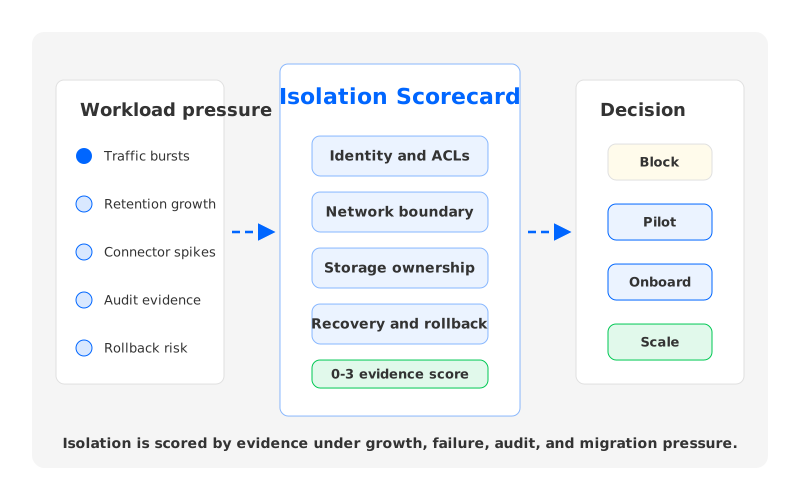
Kafka makes this question especially interesting because it already separates many application-level concepts: topics, partitions, consumer groups, offsets, ACLs, transactional IDs, and quotas. Those primitives matter, but they do not automatically create tenant isolation. A tenant can be separated at the topic namespace and still compete for broker disk, controller attention, connector workers, network egress, or incident response capacity. The scorecard below treats isolation as an operating property, not a configuration checkbox.
1Why tenant isolation is hard in Kafka-compatible systems
The first trap is assuming that Kafka compatibility and tenant isolation are the same requirement. Compatibility asks whether existing clients, producers, consumers, tools, and operational workflows can keep using Kafka APIs and semantics. Isolation asks whether one tenant's behavior can affect another tenant's confidentiality, availability, cost allocation, or recovery path. A platform can pass compatibility tests and still fail isolation tests if the shared resource model is not visible enough.
Apache Kafka's security model gives teams important building blocks. Kafka supports authentication mechanisms, encryption in transit, and authorization through ACLs that control operations on resources such as topics, groups, clusters, and transactional IDs. Those controls are necessary because they define who can read, write, administer, and commit offsets. They are not sufficient because a production platform also has to answer questions around the Kafka API.
The practical isolation questions are usually more uncomfortable:
- Can tenant A's retention growth force broker expansion that tenant B has to pay for?
- Can tenant B's connector burst consume worker capacity or cross-zone bandwidth needed by tenant C?
- Can a broker replacement, partition reassignment, or controller event create a platform-wide recovery window?
- Can platform operators prove which identities, network paths, and storage locations were involved in a regulated data stream?
- Can the team roll back a migration for one tenant without creating offset ambiguity for another?
These questions sound like governance questions, but they are also architecture questions. If durable state is tied to broker-local disks, tenant isolation depends on partition placement, spare capacity, data movement speed, and failure-domain clarity. If shared services such as connectors and observability pipelines are not scoped by tenant, operational isolation can leak even when Kafka ACLs are correct.
2The production constraint behind the scorecard
Multi-tenant streaming platforms tend to be judged twice. The first judgment happens during onboarding, when application teams ask whether they can connect with existing Kafka clients and ship quickly. The second judgment happens during an incident, audit, or cost review, when platform owners must show that shared infrastructure did not blur accountability.
The second judgment is where traditional Kafka operations become expensive. Broker-local storage couples compute placement, data durability, and recovery behavior. When a tenant's traffic grows, the platform may need more broker capacity even if the immediate pressure is only storage, network, or write throughput. When a broker fails, recovery is not just a process restart; operators must consider leader movement, replica catch-up, disk pressure, and foreground traffic.
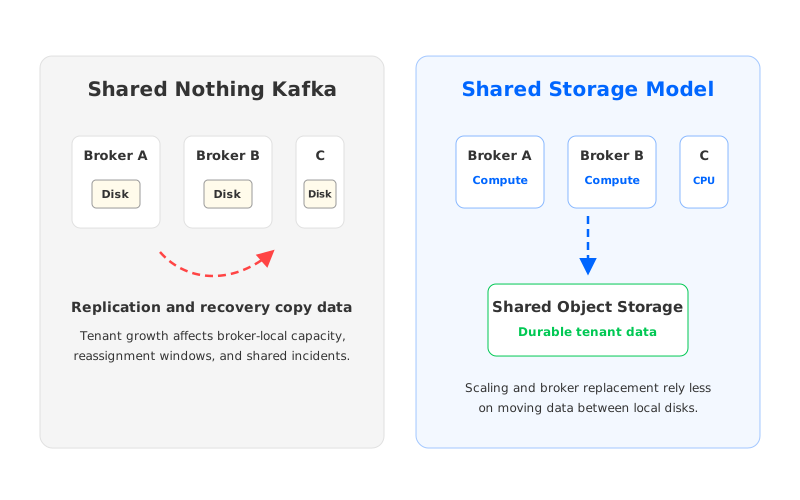
Tiered Storage can reduce the pressure of long retention by moving older log segments to remote storage, and it is useful when retention economics are the main constraint. It is not the same thing as making brokers stateless. The hot path still depends on local broker state, and operational changes can still involve partition movement, broker-local capacity planning, and careful balancing. Tenant isolation scorecards should make that distinction explicit because it changes how teams reason about recovery and elasticity.
Shared storage changes the operating model by moving durable log storage away from individual brokers. In a Kafka-compatible shared storage architecture, brokers can become closer to compute nodes serving Kafka protocol traffic while durable data lives in cloud storage. Teams still need authentication, authorization, network controls, and operational discipline, but broker replacement, scaling, and workload growth no longer have to be dominated by copying large amounts of tenant data between local disks.
3A neutral tenant isolation scorecard
A good scorecard should be boring enough to run in procurement and concrete enough to drive architecture decisions. Use a 0 to 3 scale for each dimension: 0 means no credible answer, 1 means manual or incomplete control, 2 means production-ready procedures, and 3 means automated, observable, and failure-tested. The absolute score matters less than the weak dimensions, because one weak boundary can dominate the real blast radius.
| Dimension | What to Score | Questions That Expose Weak Isolation |
|---|---|---|
| Identity and authorization | Kafka users, service accounts, ACLs, RBAC, admin boundaries | Can each tenant be granted least-privilege access without shared admin credentials? Are group, topic, and transactional ID permissions scoped separately? |
| Network boundary | VPC, subnet, private connectivity, ingress and egress paths | Does tenant traffic stay inside the intended private network path? Are public endpoints, peering, and PrivateLink-style patterns governed consistently? |
| Storage ownership | Data location, encryption at rest, retention, deletion, audit trail | Can the platform prove where tenant data is stored and which key or cloud account boundary protects it? |
| Resource fairness | Broker capacity, connector workers, quotas, partition growth | Can one tenant's burst, retention policy, or connector backlog starve another tenant? |
| Failure isolation | Broker replacement, controller stability, partition movement, recovery | Can the platform recover a failed node without turning data movement into a shared incident? |
| Migration and rollback | Client cutover, offset continuity, connector state, fallback plan | Can one tenant move in or out without ambiguous offsets, mixed ACL state, or shared downtime? |
| Observability and evidence | Metrics, logs, audit records, SLOs, cost allocation | Can platform teams explain who used what, when, and with which operational impact? |
This table is intentionally not vendor-specific. A feature list says "supports ACLs" or "runs in your VPC." A scorecard asks whether those controls survive the real conditions that break isolation: growth, migration, failure, audit, and cross-team operations.
4Architecture options and trade-offs
The strictest answer is one cluster per tenant. It gives clean blast-radius boundaries, simple cost attribution, and fewer arguments during audits. It also creates duplication: more clusters to patch, more capacity buffers, more connector environments, more monitoring surfaces, and more migration work. This model can be right for regulated tenants, but the operational overhead grows quickly.
The opposite answer is a shared cluster with topic-level isolation. This model is efficient and familiar when tenants trust the same platform team and share similar SLOs. It relies heavily on Kafka ACLs, quota policy, namespace conventions, and disciplined operations. The weakness appears when tenant workloads diverge: a high-retention analytics stream, a bursty fraud pipeline, and a low-latency payment stream do not stress the same resources in the same way.
A middle path is a shared Kafka-compatible platform with stronger deployment and resource boundaries. The platform may use separate environments, private network paths, scoped identity systems, isolated connector pools, or dedicated clusters for the highest-risk tenants. The important part is whether the platform team can map each tenant to a clear isolation contract.
| Pattern | Isolation Strength | Operating Cost | Best Fit |
|---|---|---|---|
| Cluster per tenant | High | High | Regulated workloads, strong data residency, strict blast-radius limits |
| Shared cluster, logical namespace | Medium | Low | Similar tenants, internal workloads, mature ACL and quota discipline |
| Shared platform, segmented environments | Medium to high | Medium | Enterprise platform teams balancing governance and efficiency |
| Kafka-compatible shared storage platform | Medium to high | Medium | Cloud teams needing elastic scaling, customer-controlled deployment, and lower data movement risk |
The shared storage pattern is worth separating from generic "managed Kafka" because the storage model affects isolation economics. When durable data is no longer pinned to broker-local disks, the platform can scale compute and storage more independently.
5How AutoMQ changes the operating model
Once the evaluation reaches storage and recovery boundaries, AutoMQ becomes relevant as a Kafka-compatible cloud-native streaming platform built around shared storage and stateless brokers. The key point is not that a product replaces governance. The architecture changes which operational problems governance has to compensate for.
AutoMQ keeps Kafka protocol compatibility as a first-order requirement, so platform teams can evaluate it with familiar Kafka clients, consumer groups, topics, ACL-oriented access patterns, and migration workflows. Its shared storage architecture moves durable log data to object storage and uses brokers primarily for compute and Kafka protocol serving. That separation matters because storage growth, broker replacement, and compute scaling can be handled with less dependence on broker-local data movement.
For tenant scorecards, the practical AutoMQ questions are:
- Does the deployment model keep the data plane inside the customer's cloud account, VPC, or Kubernetes boundary when required?
- Can Kafka client compatibility be verified with the tenant's actual producers, consumers, admin tools, and connector flows before cutover?
- Are encryption, authentication, ACL management, and identity workflows aligned with the organization's cloud and security standards?
- Can platform teams observe tenant-level traffic, consumer groups, connector behavior, and cross-zone network patterns with enough granularity to allocate cost and diagnose incidents?
- Does the migration path preserve offsets, ACL intent, and rollback options for one tenant at a time?
AutoMQ BYOC is especially relevant when the buyer wants managed operations but needs customer-controlled deployment boundaries. The architecture discussion moves away from "Do we trust a shared service?" and toward "Which control plane, data plane, cloud account, network, and storage boundaries are contractually and operationally clear?" That turns isolation into an explicit design review.
6Production readiness checklist
The scorecard should end with a readiness decision, not a spreadsheet that nobody owns. Before a shared Kafka-compatible platform accepts a tenant, the platform team should answer six questions in writing.
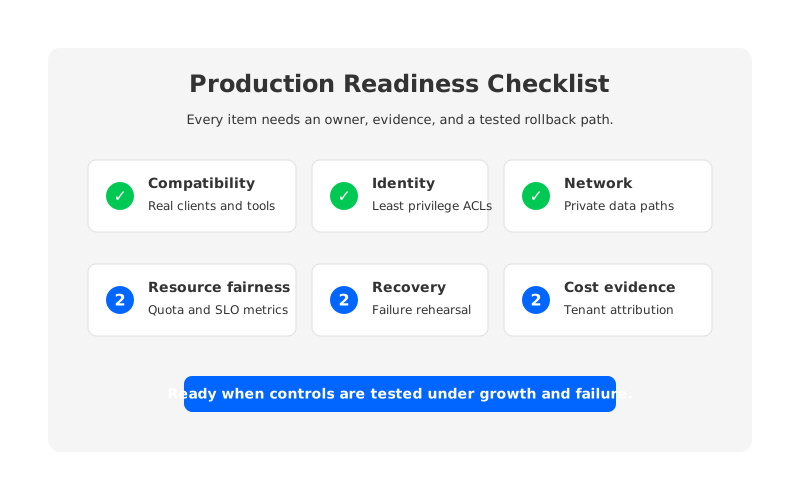
First, compatibility must be tested with the tenant's real client versions and behaviors. Kafka client compatibility is not only about producing and consuming records. It includes consumer group behavior, offset reset operations, transactions if used, admin APIs, connector dependencies, monitoring tools, and failure handling.
Second, identity boundaries must be explicit. Tenant identities should map to the smallest useful set of Kafka and platform permissions. Shared admin credentials and broad wildcard ACLs are early signs that the platform is relying on trust instead of isolation.
Third, network and deployment boundaries must match the data classification. Some tenants can use shared private connectivity. Others need a dedicated VPC, a dedicated environment, or a customer-owned cloud account. The scorecard should make that exception path visible.
Fourth, resource fairness must be measurable. Quotas, partition limits, connector worker capacity, retention policies, and SLOs need operational metrics. Without metrics, "fair sharing" becomes an incident-time argument, and the loudest tenant often wins.
Fifth, recovery must be rehearsed. Broker failures, bad deployments, connector backlog, ACL mistakes, and migration rollback should be tested with tenant boundaries in mind. The most valuable rehearsal shows exactly which tenants are affected and which are not.
Sixth, cost attribution must be tied to architecture. Tenants generate cost through writes, reads, retention, connector throughput, cross-zone traffic, and operational support. If the platform cannot explain those costs, finance teams will treat the shared service as a black box.
7A scoring rubric you can use in design review
Use the following rubric after a platform team has filled in the dimension table.
| Result | Interpretation | Recommended Action |
|---|---|---|
| Any 0 in identity, network, storage, or recovery | Isolation boundary is not credible for production | Block onboarding until the missing control exists and is tested |
| Mostly 1s with no 0s | Controls exist but depend on manual discipline | Onboard only low-risk tenants; create a remediation plan with owners |
| Mostly 2s | Production-ready for typical enterprise tenants | Proceed with documented SLOs, runbooks, and tenant-level observability |
| Several 3s in high-risk dimensions | Strong candidate for regulated or business-critical tenants | Add periodic audit evidence and failure-game-day reviews |
The scoring model is deliberately conservative. A single missing boundary can invalidate the rest of the design. Strong ACLs do not compensate for unclear storage ownership, and private networking does not compensate for uncontrolled connector execution.
If your team is building a shared Kafka-compatible platform and wants to validate compatibility, deployment boundaries, and tenant-level operating assumptions, test the scorecard against a real workload in AutoMQ Cloud.
8References
- Apache Kafka documentation: security
- Apache Kafka documentation: consumer configuration
- AutoMQ documentation: Shared Storage architecture overview
- AutoMQ documentation: Native Compatible with Apache Kafka
- AutoMQ documentation: Stateless Broker
- AutoMQ documentation: Manage Kafka ACLs
- AutoMQ documentation: Deploy to AWS EKS
- AWS PrivateLink
- Kubernetes documentation: namespaces
9FAQ
9.1What is a tenant isolation scorecard for Kafka?
A tenant isolation scorecard is a structured review of whether a Kafka-compatible platform can share infrastructure across teams without sharing unacceptable risk. It scores identity, network, storage, resource fairness, failure isolation, migration, observability, and cost attribution.
9.2Are Kafka ACLs enough for tenant isolation?
Kafka ACLs are necessary, but they are not enough. They control who can perform Kafka operations on resources such as topics and consumer groups. Tenant isolation also depends on broker capacity, network paths, connector execution, storage ownership, recovery behavior, monitoring, and rollback procedures.
9.3Is one Kafka cluster per tenant always the safest option?
It is often the cleanest isolation boundary, but it can be expensive to operate at scale. The right answer depends on tenant risk, data classification, SLOs, workload shape, and automation maturity. Many organizations combine dedicated clusters for high-risk tenants with shared environments for lower-risk workloads.
9.4How does shared storage help tenant isolation?
Shared storage does not replace security controls, but it changes the operational model. When durable log data is not pinned to broker-local disks, broker scaling and replacement can involve less tenant data movement. That can make compute, storage, and retention easier to reason about independently.
9.5Where does AutoMQ fit in a tenant isolation review?
AutoMQ fits after the neutral scorecard has identified storage, scaling, and deployment-boundary requirements. As a Kafka-compatible platform with shared storage and stateless brokers, AutoMQ helps teams evaluate customer-controlled deployment, Kafka compatibility, elastic operations, and reduced broker-local data movement.


