
Table of Contents
Table of Contents
Teams search for multi tenant kafka governance when Kafka has stopped being a cluster and has become a shared product surface. One tenant wants longer retention for audit streams. Another wants aggressive throughput for real-time personalization. A finance team wants chargeback by application. A security team wants proof that customer data, credentials, and network paths stay inside approved boundaries. The Kafka API may be common, but the policies behind each workload are not.
That is where many shared event platforms get uncomfortable. Kafka topics, consumer groups, ACLs, quotas, schemas, connectors, and network access rules all carry pieces of tenant policy. None of those pieces alone proves that a tenant is isolated, compliant, or cost-accountable. The evidence exists across broker configuration, IAM, object storage, audit logs, CI/CD approvals, schema workflows, and observability. A governance model that cannot assemble those signals into a coherent record leaves platform teams arguing from screenshots during every review.
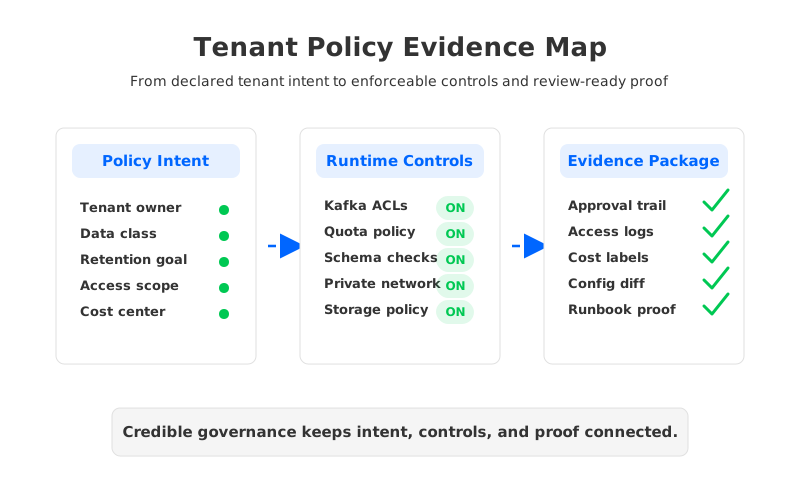
Tenant policy evidence is the discipline of turning shared event infrastructure into something auditable. It does not mean every tenant gets a separate Kafka cluster. It means every tenant has a declared boundary, an enforcement path, and a repeatable evidence package that can survive production incidents, security reviews, and budget negotiations.
1Why teams search for multi tenant kafka governance
Multi-tenant Kafka usually starts as an efficiency decision. A central platform team can operate one Kafka-compatible service, define a common onboarding path, and reduce duplicated cluster work across application teams. That model is attractive until the shared platform absorbs workloads with different regulatory exposure, traffic shape, retention policy, and incident tolerance. The platform team then owns the contradiction: shared infrastructure must still produce tenant-specific answers.
The common failure mode is treating governance as a naming convention. Topic prefixes, labels, and owner fields are useful, but they do not prove who can publish, who can consume, which schema versions are allowed, where data is stored, or how costs are attributed. Those facts come from enforcement points. In Kafka, the enforcement points are distributed across protocol authentication, ACLs, quotas, consumer group ownership, schema compatibility checks, connector permissions, network controls, and deployment boundaries.
The search intent behind the keyword is therefore not academic. Buyers and operators are trying to answer practical questions:
- Can a platform tenant prove its data boundary? A regulated workload may need cloud-account, VPC, bucket, key-management, and private-connectivity evidence in addition to Kafka ACLs.
- Can policy changes be reviewed before they reach production? Topic creation, retention changes, ACL grants, connector credentials, and schema updates should leave a workflow trail.
- Can usage be mapped to ownership? Storage, network transfer, partition count, request rate, connector tasks, and consumer lag need tenant labels that finance and operations can trust.
- Can one tenant fail without turning the shared platform into a blame game? Quotas, backpressure, isolation, and incident runbooks matter because tenant boundaries are tested under stress.
Those questions explain why governance work belongs in the platform architecture, not in a spreadsheet after deployment.
2The governance pressure behind shared streaming platforms
Traditional Kafka deployments often couple tenant policy to cluster boundaries. A high-risk workload gets its own cluster. A noisy workload gets a separate set of brokers. An application team with unusual retention needs gets a dedicated capacity plan. That approach is easy to reason about, but it is expensive to operate at scale because isolation is purchased with duplicated infrastructure and duplicated operational work.
Shared event infrastructure tries to move the boundary upward. Instead of giving every team a cluster, the platform gives tenants a controlled slice of a common Kafka-compatible surface. This can work, but it requires evidence that the slice is real. A tenant label on a topic is weak evidence. A tenant label connected to ACLs, quotas, schema policy, object storage paths, network routes, audit logs, and owner metadata is stronger evidence.
The hard part is that Kafka's original operating model was not designed around cloud-account evidence or FinOps reporting. Kafka gives strong primitives for topics, consumer groups, offsets, security, and operational metrics. Cloud infrastructure adds IAM, private connectivity, object storage policies, encryption keys, billing tags, and audit trails. Multi-tenant governance lives between those layers. If the platform team does not design that join, each review has to reconstruct it manually.
| Governance question | Weak answer | Production-grade evidence |
|---|---|---|
| Who owns this stream? | Topic prefix or wiki page | Owner metadata tied to topic lifecycle, ACLs, schema policy, alerts, and cost labels |
| Who can access it? | Manual ACL export | Reviewed grants, authentication logs, private network path, and role ownership |
| What changed? | Deployment ticket | Versioned policy, schema history, config diff, approval trail, and rollback rule |
| What did it cost? | Cluster-level bill | Tenant-tagged storage, traffic, connector, request, and operational metrics |
| Can it be isolated? | Separate topic name | Quotas, failure-domain plan, network controls, and incident evidence |
This table is intentionally stricter than a feature checklist. A shared platform can support ACLs and still fail governance if no one can connect a grant to a tenant owner, a change request, or an audit log. Governance is not the existence of controls; it is the ability to prove that controls were applied to the right workload at the right time.
3Contracts, ownership, access, and audit trade-offs
A useful tenant policy model starts with contracts. The contract should define what a tenant can request, what the platform guarantees, and what evidence both sides need later. For Kafka-compatible platforms, the contract usually spans topic lifecycle, retention, replication or durability policy, schema compatibility, producer authentication, consumer group ownership, connector access, throughput limits, and operational notifications.
The contract cannot remain a document. It has to become platform state. Topic templates should encode retention and partition limits. ACL and quota workflows should map to identity groups rather than individual operators. Schema checks should run before incompatible changes reach production. Connector credentials should have clear ownership and rotation rules. Observability should show tenant-level health without forcing every application team to become Kafka administrators.
Access control is where the trade-offs become visible. Strict isolation is easier when each tenant gets a separate environment, but that model sacrifices the economic and operational benefits of a shared event platform. Dense sharing is efficient, but it raises the evidence bar. The more workloads share brokers, networks, storage, and control-plane workflows, the more the platform must show that tenant policy is enforced by design rather than by operator memory.
Audit evidence has a similar tension. Teams often want a simple yes-or-no answer: is this Kafka environment compliant? The better question is narrower: can the platform produce evidence for a specific tenant, topic, time window, identity, schema version, and network path? That framing avoids vague compliance language and gives SREs something testable.
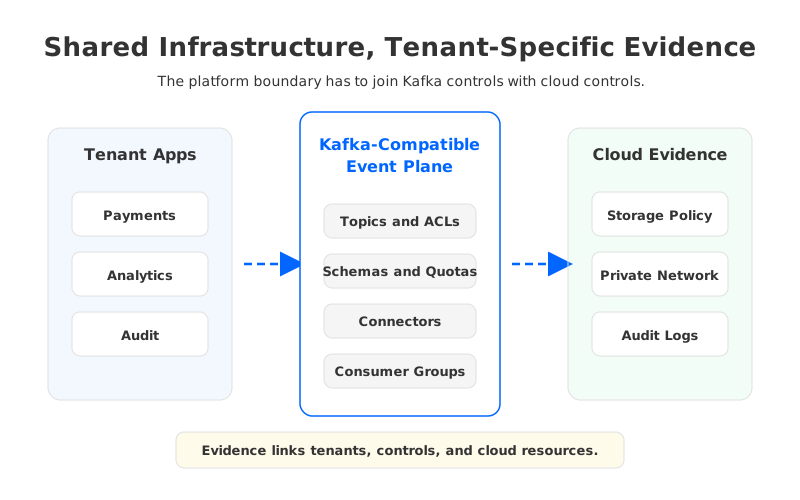
The boundary model matters because event infrastructure crosses organizational lines. Application teams own producers and consumers. Platform teams own service-level controls. Security teams own identity, network, and audit policy. Finance teams own allocation logic. The shared platform becomes credible when those groups can inspect the same evidence trail instead of asking for separate exports from separate systems.
4Evaluation checklist for platform teams
The most useful multi-tenant Kafka governance checklist is not a giant list of features. It is a set of evidence gates. Each gate should be answered with a working artifact: a policy file, an audit query, a dashboard, a runbook, a sample incident record, or a migration rehearsal result.
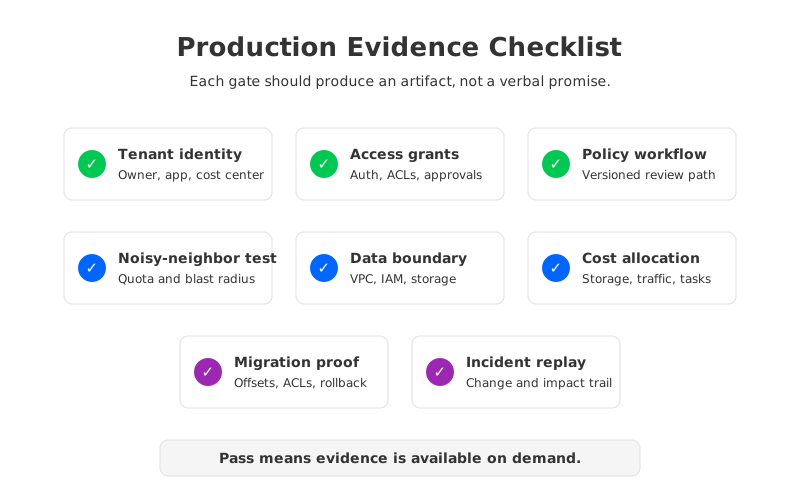
1. Tenant identity and ownership. Every topic, consumer group, connector, schema subject, and alert should have an owner that maps to a real team or service. Owner metadata should survive automation, import workflows, and migration. If ownership disappears during a cutover, chargeback and incident routing disappear with it.
2. Access and authentication evidence. Kafka security documentation covers authentication, authorization, and encryption mechanisms, but the platform still has to prove how those mechanisms are applied. Reviewers need to see which identities can publish, consume, administer topics, manage connectors, or update schemas. They also need to see how grants are approved and removed.
3. Policy-as-code workflow. Topic creation, ACL updates, schema compatibility rules, connector configuration, quota changes, and retention changes should be reviewable before production. A console-only workflow can be usable, but governance evidence is stronger when the platform can export or version the resulting policy state.
4. Quotas and noisy-neighbor controls. Multi-tenancy fails when one workload can exhaust broker CPU, network bandwidth, storage request capacity, or connector worker resources without clear containment. Quotas should be tested with realistic producer and consumer behavior, not only configured on paper.
5. Data boundary and network path. Cloud deployments need evidence beyond Kafka protocol settings. IAM, object storage policy, encryption keys, VPC endpoints, PrivateLink or Private Service Connect paths, and audit logs all help show where tenant data and credentials travel. A SaaS data plane, a BYOC data plane, and a self-managed deployment create different evidence packages.
6. Cost and capacity allocation. Tenant-level cost evidence should include storage growth, retention, network transfer, broker or compute usage, connector tasks, and operational headroom. Chargeback that starts from the monthly cluster bill is usually too late. The platform should collect allocation signals while traffic is flowing.
7. Migration and rollback evidence. Governance gaps often appear during migration because the team focuses on data movement and forgets policy movement. A readiness plan should include topic metadata, ACLs, quotas, schema subjects, connector credentials, consumer group offsets, alert routing, and rollback rules.
8. Incident and audit replay. The platform should be able to answer what changed before an incident, which tenant was affected, which identities were active, which controls fired, and whether rollback restored the approved state. This is where governance becomes operational rather than ceremonial.
5How AutoMQ changes the operating model
After the evidence gates are clear, architecture becomes easier to evaluate. A platform team can ask whether the underlying Kafka-compatible system makes tenant evidence easier or harder to assemble. AutoMQ fits this discussion as a Kafka-compatible cloud-native streaming platform that separates broker compute from durable stream storage through a Shared Storage architecture. That identity matters because tenant governance is partly a control-plane problem and partly a data-plane boundary problem.
In broker-local Kafka, retained data lives with brokers, so tenant cost and failure evidence often follows broker placement, disk capacity, partition movement, and replica traffic. A shared-storage architecture changes that operating model. Brokers serve Kafka requests while durable data is stored through a storage layer backed by object storage and WAL components. The platform still needs Kafka-level governance, but it can reason about durable data, serving capacity, and storage growth as separate dimensions.
That separation is useful for multi-tenant governance in three practical ways. First, elastic compute can be evaluated without treating every scaling event as a large data movement project. Second, object-storage-backed durability gives platform teams a clearer place to connect cloud-native policies such as bucket access, encryption, and audit trails. Third, tenant cost evidence can be modeled across compute, storage, and traffic rather than hidden inside broker-local disk expansion.
AutoMQ's deployment boundary also matters. AutoMQ Cloud supports BYOC mode where services run in the user's cloud account and VPC, according to the AutoMQ Cloud documentation. For governance-heavy teams, that is not a magic compliance answer, but it changes the evidence package: reviewers can inspect customer-owned cloud accounts, network boundaries, IAM policies, and storage resources while still evaluating a managed Kafka-compatible operating model.
The right way to introduce AutoMQ into a governance review is not to replace your checklist with a vendor claim. Use the checklist to build a tenant policy evidence package, then test whether AutoMQ's Kafka compatibility, Shared Storage architecture, stateless broker model, and BYOC deployment boundary reduce the operational friction in that package. The product belongs after the evidence model because governance buyers care less about architecture diagrams than about what they can prove during review.
If your team is turning Kafka into shared event infrastructure, start by writing down the evidence you would need for one regulated tenant and one high-throughput tenant. Then map those evidence requirements to your current platform. To evaluate AutoMQ against that model, open the AutoMQ Cloud console and compare the deployment boundary, Kafka compatibility, and storage architecture against the gates above.
6References
- Apache Kafka documentation: security
- Apache Kafka documentation: consumer group configuration
- Apache Kafka documentation: Kafka Connect
- Apache Kafka documentation: KRaft mode
- AutoMQ compatibility with Apache Kafka
- AutoMQ S3Stream Shared Streaming Storage overview
- AutoMQ Cloud overview
- AWS S3 identity and access management
- AWS PrivateLink documentation
- Google Cloud Private Service Connect documentation
- Azure Private Link overview
7FAQ
7.1Is multi-tenant Kafka governance only about ACLs?
No. ACLs are one enforcement point, but governance also includes ownership, schema policy, quotas, network boundaries, object storage permissions, connector credentials, audit logs, incident routing, and cost allocation. A mature model connects those controls into tenant-level evidence.
7.2Should every tenant get a separate Kafka cluster?
Separate clusters can simplify isolation, but they also multiply operational work and cost. Shared event infrastructure can work when tenant identity, access, quotas, policy workflow, data boundaries, and audit evidence are designed into the platform from the start.
7.3What evidence should a regulated tenant ask for first?
Start with ownership metadata, authentication and authorization grants, network path, encryption and key ownership, storage location, schema change history, retention policy, audit logs, and incident rollback procedures. Those artifacts show whether governance is operationally real.
7.4How does shared storage affect governance?
Shared storage does not replace Kafka-level policy. It changes the data-plane model by separating durable stream data from broker-local disks. That can make storage growth, data boundary review, and compute scaling easier to reason about, provided the platform exposes the right evidence.
7.5Where does AutoMQ fit in a governance evaluation?
AutoMQ fits when a team wants Kafka compatibility, Shared Storage architecture, stateless brokers, and deployment boundaries that can be evaluated against tenant policy evidence. It should be tested with real tenant workflows rather than treated as a diagram-only decision.


