
Table of Contents
Table of Contents
Teams usually search for terraform kafka platform after Kafka has crossed an organizational line. A single cluster has become a shared platform. More application teams want topics, service accounts, ACLs, connectors, private networking, observability exports, and environment-specific changes. The platform team is still expected to keep production reliable, but every request now carries governance, cost, and migration risk.
Terraform is attractive because it gives that work a reviewable form. Infrastructure changes become code. Plans can be reviewed before apply. Modules can encode approved patterns. State can reveal drift between what the platform team intended and what actually exists. Yet Kafka makes the boundary harder than ordinary compute provisioning. A Kafka platform is not only a cluster. It is a set of runtime contracts: topics and partitions, producer and consumer behavior, identity, authorization, retention, replication, network paths, operational runbooks, and ownership rules.
That is why Terraform should be treated as the control surface for a Kafka platform, not only as a cluster installer. The useful question is not "Can we create a Kafka cluster with Terraform?" The useful question is "Which parts of the Kafka operating model should be declared, reviewed, enforced, and safely changed through code?"
1Why terraform kafka platform becomes a platform question
The first Terraform module for Kafka often provisions compute, storage, networking, and a managed service instance or self-managed cluster. That is a good start, but it covers only the foundation. Production pressure arrives when multiple teams ask for changes that affect each other: one application needs longer retention, another needs more partitions, a security review asks for tighter ACLs, a data team needs replay for backfill, and finance asks why cross-zone traffic or broker storage keeps growing.
At that point, the platform team needs a declarative model that connects infrastructure to data-plane behavior. A topic is not a harmless string in a configuration file. Partition count affects parallelism and future scaling. Retention affects storage cost and replay capability. ACLs affect incident blast radius. Private endpoints affect who can reach the platform and from where. If those decisions live in tickets and console clicks, the platform eventually becomes difficult to audit.
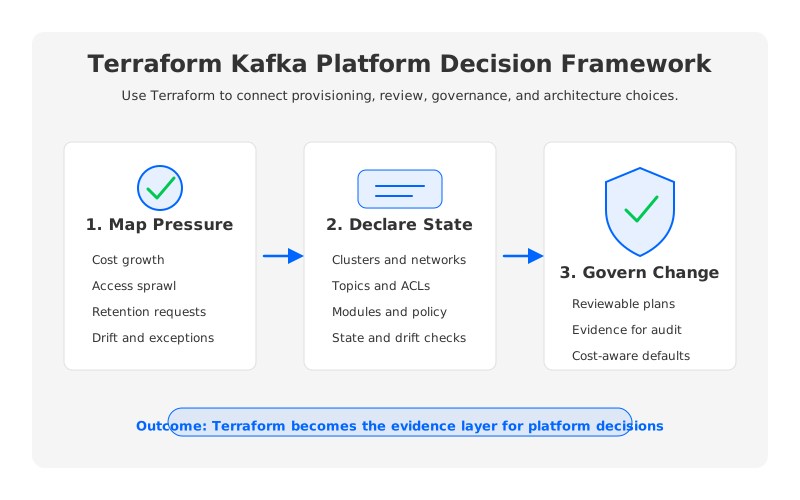
Terraform helps when it becomes the workflow for change, evidence, and ownership:
- Provisioning defines clusters, networks, storage, service accounts, topics, and platform dependencies in a versioned repository.
- Review exposes intended changes through plans, pull requests, policy checks, and environment promotion.
- Governance maps ownership, naming, access, retention, and data residency into code-level controls.
- Operations uses state, drift detection, and reusable modules to reduce snowflake clusters and undocumented exceptions.
This does not mean every Kafka operation belongs in Terraform. Runtime events such as consumer lag response, partition leadership movement, incident remediation, or short-lived operational toggles may be better handled by platform automation and observability tools. Terraform is strongest when the desired state should be stable, reviewed, and reproducible.
2The production constraints behind the Terraform model
Kafka is a durable log with client-facing semantics, not a generic pool of machines. A Terraform design that ignores those semantics can provision resources correctly while still producing an unsafe platform. The declaration boundary should be shaped by the contracts Kafka exposes to applications and operators.
| Constraint | Why it matters | What Terraform should help control |
|---|---|---|
| Compatibility | Producers, consumers, stream processors, and connectors depend on Kafka protocol behavior. | Provider choice, version policy, client connectivity, and migration guardrails. |
| Access | Kafka topics often carry sensitive operational or customer data. | Principals, ACLs, network boundaries, secrets references, and review workflow. |
| Retention | Replay and audit needs can expand storage faster than compute. | Topic retention classes, environment defaults, and exceptions with owners. |
| Elasticity | Traffic bursts and partition growth change capacity needs. | Cluster sizing inputs, scaling limits, module outputs, and environment promotion. |
| Cost | Broker disks, replicas, object storage, and cross-zone traffic can become invisible until the bill arrives. | Tagging, storage class decisions, network topology, and cost-aware defaults. |
| Drift | Console changes can bypass review and weaken governance. | State, drift detection, policy checks, and reconciliation procedures. |
The strongest Terraform repositories make these constraints visible. A reviewer should be able to look at a change and understand whether it alters data access, retention, network exposure, capacity, or ownership. Without that visibility, Terraform becomes a deployment script with nicer syntax.
3Architecture patterns teams usually compare
Platform teams usually end up comparing three patterns for Kafka infrastructure as code.
The first is cluster-only Terraform. It provisions infrastructure, but topics, ACLs, connectors, and operational settings are managed elsewhere. This pattern is fast to start and can work for small environments, but it leaves governance spread across consoles, scripts, and tickets. The risk is not immediate failure. The risk is losing the evidence trail that explains why a topic exists, who owns it, and which applications can use it.
The second is platform-module Terraform. The repository defines reusable modules for environments, networks, Kafka clusters, topics, ACLs, service identities, observability exports, and approved defaults. This is often the right step for teams building an internal Kafka platform. It lets application teams request standardized resources without turning every request into bespoke infrastructure work.
The third is Kafka-compatible cloud-native streaming with declarative platform resources. In this pattern, Terraform still manages the desired state, but the streaming architecture underneath may separate broker compute from durable storage and make deployment boundaries more explicit. This matters when the pain is not only "we need repeatable provisioning" but also "broker-local storage, replication traffic, and capacity changes are shaping every platform decision."
The pattern choice should follow the operating bottleneck. If the main problem is inconsistent environments, modules and policy checks may be enough. If the main problem is that every retention or scaling decision triggers broker storage planning and data movement concerns, the team should evaluate whether the Kafka architecture itself needs to change.
4Designing modules around platform contracts
A useful Terraform module is opinionated about the contract it owns. For Kafka platforms, that usually means separating low-level infrastructure modules from product-facing platform modules.
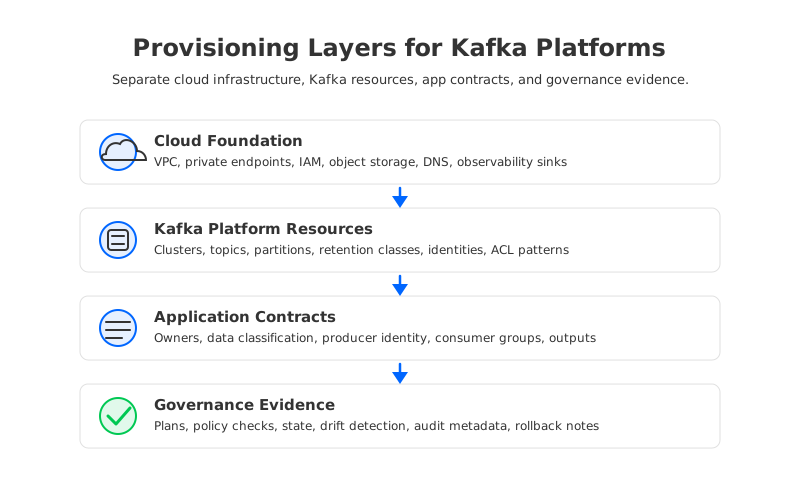
Infrastructure modules might define VPCs, private endpoints, Kubernetes clusters, storage buckets, IAM roles, DNS records, and observability sinks. These modules are owned by platform or cloud infrastructure teams. Their consumers should not need to understand every subnet or policy document.
Kafka platform modules sit closer to the application contract. They define environments, clusters, topic classes, retention tiers, partition defaults, service identities, ACL patterns, and outputs that applications can consume. A module might expose an input such as topic_class = "regulated_audit" rather than asking every application team to choose retention, replication, and access controls from scratch.
That design gives reviewers a better vocabulary. Instead of reviewing dozens of low-level arguments, they can review intent:
- Is this topic an operational event stream, an audit stream, or a transient integration topic?
- Which service owns the producer identity, and which consumer groups are allowed to read?
- Does the retention period match the business purpose and compliance boundary?
- Does the environment promotion path preserve the same contract from development to production?
- Is the rollback path clear if a topic, ACL, or network change breaks a consumer?
The same principle applies to provider selection. A Terraform provider can expose cloud resources, managed Kafka resources, or platform-specific resources. The provider is less important than the boundary it creates: reviewers should know which account, VPC, service, topic, and access model a change touches.
5Governance: from pull request to runtime evidence
Terraform governance is often described as policy-as-code, but Kafka governance needs more than rejecting a bad plan. It needs a chain of evidence from request to runtime behavior.
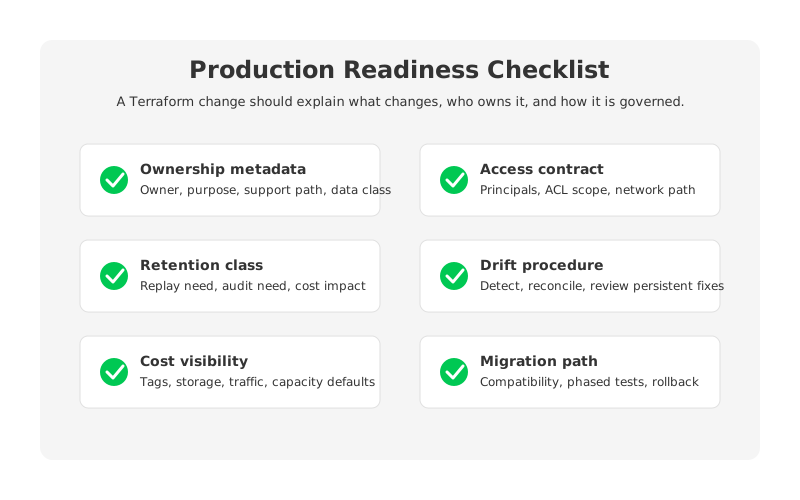
Start with naming and ownership. Every topic should have an owner, business purpose, data classification, retention class, and support path. Those labels should not be only documentation. They should appear in Terraform variables, tags, outputs, or adjacent metadata that can be validated and exported.
Then define access as a reviewed contract. Kafka authorization commonly depends on principals, ACLs, groups, and resource names. Terraform is useful when access changes move through pull requests and policy checks instead of ad hoc console edits. The platform can require least-privilege defaults, deny broad wildcard access, and make production exceptions visible to security reviewers.
Retention and deletion need the same treatment. Many incidents are caused by treating retention as a local team preference. Longer retention may be necessary for replay, audit, or AI backfill, but it changes cost and data exposure. A Terraform workflow should require stronger ownership and review for topics that retain sensitive records or long history.
Finally, governance has to account for drift. A platform that allows emergency console changes needs a reconciliation process. Drift detection should not be a blame mechanism; it is how the platform team sees whether the declared contract still matches reality. The important habit is to bring persistent changes back into code after an incident, then review whether a module or policy should change for everyone.
6Where AutoMQ changes the operating model
Once the Terraform control surface is clear, the architecture underneath becomes easier to evaluate. Some teams only need cleaner modules and stricter review. Others discover that the recurring pain is storage-coupled scaling: broker disks, partition reassignment, replication traffic, long retention, and capacity buffers keep appearing in every Terraform discussion.
AutoMQ is relevant at that point as a Kafka-compatible, cloud-native streaming option rather than as a replacement for Terraform discipline. AutoMQ keeps the Kafka-facing API and ecosystem path while using Shared Storage architecture: stateless brokers serve Kafka protocol traffic, S3Stream places durable stream data on S3-compatible object storage, and WAL storage provides the low-latency write path before data is uploaded.
For Terraform-managed platforms, that changes the shape of the declared state. Instead of every scaling decision being tightly bound to broker-local durable data, the platform can model brokers more like elastic compute and durable streams more like governed shared storage. The Terraform repository still needs to manage environments, cloud accounts, networks, storage buckets, identities, topics, ACLs, observability, and policy. The difference is that retention and broker capacity can be reasoned about with a cleaner separation.
AutoMQ's deployment models also matter for governance. BYOC and software deployment options are designed for teams that need customer-controlled cloud accounts, VPCs, storage, networking, and operational boundaries. That is relevant when Terraform is already the source of evidence for cloud infrastructure ownership. The platform team can evaluate Kafka compatibility and shared storage while keeping data-plane placement aligned with internal governance requirements.
There is still validation work to do. A shared-storage architecture should be tested with the same producer behavior, consumer groups, failure drills, backfill patterns, retention classes, and Terraform promotion workflow used by the existing platform. The point is not that Terraform becomes less important. It becomes more valuable because it can describe a cleaner platform boundary.
7Decision table for platform teams
The right next move depends on where the friction appears. A team should not replace a working Kafka estate because the Terraform repository is messy. It also should not keep adding Terraform wrappers around an architecture whose storage and scaling model no longer matches the workload.
| Situation | Best next move | Why |
|---|---|---|
| Environments differ because resources are created by hand. | Build platform modules and import persistent resources into state. | The main problem is reproducibility and review. |
| Topic and ACL requests are slowing every application team. | Add self-service modules with policy checks and ownership metadata. | Standardization reduces ticket volume without giving up governance. |
| Security reviews repeatedly ask where data, keys, and access decisions live. | Model network, identity, storage, and audit boundaries explicitly. | Terraform should produce evidence, not only resources. |
| Retention and replay needs keep increasing broker storage and reassignment work. | Evaluate Kafka-compatible Shared Storage architecture. | The bottleneck may be the coupling between broker compute and durable data. |
| Migration risk is high because Kafka clients and tools are deeply embedded. | Prioritize Kafka compatibility and phased workload tests. | Infrastructure changes should not force a broad application rewrite. |
The practical starting point is a platform inventory. List clusters, environments, topics, principals, ACLs, retention classes, network paths, ownership metadata, and non-code changes. Then decide which items belong in Terraform, which belong in runtime automation, and which indicate an architectural constraint. If storage-coupled scaling and governance boundaries are part of the same problem, review AutoMQ as a Kafka-compatible shared-storage option using your existing Terraform workflow as the evaluation frame.
8References
- Terraform Documentation
- Terraform Modules Documentation
- HCP Terraform Policy Enforcement
- Apache Kafka Documentation
- Apache Kafka Security Documentation
- Apache Kafka Authorization and ACLs
- AutoMQ Architecture Overview
- AutoMQ S3Stream Shared Streaming Storage
- AutoMQ WAL Storage Documentation
- AutoMQ Terraform Provider
9FAQ
9.1Should Kafka topics be managed with Terraform?
Topics should be managed with Terraform when they are long-lived platform resources that need review, ownership, access control, retention policy, and reproducibility. Short-lived operational topics or emergency changes may need separate automation, but persistent changes should usually return to code after the incident is resolved.
9.2What should a Terraform module for Kafka include?
A Kafka platform module should expose the contract that application teams need: environment, topic name, owner, data classification, retention class, partition default, producer identity, consumer access, and observability outputs. Low-level cloud details should be hidden behind infrastructure modules unless the application team is responsible for them.
9.3How does Terraform help Kafka governance?
Terraform helps governance by making desired state reviewable before it changes production. Pull requests, plans, policy checks, state, and drift detection can show who changed access, retention, networking, storage, or ownership metadata. That evidence is useful for security, compliance, cost control, and incident review.
9.4Does Terraform replace Kafka operations tooling?
No. Terraform manages desired state for stable resources. Kafka operations still need monitoring, consumer lag response, incident automation, rolling changes, capacity analysis, and runtime remediation. A mature platform uses Terraform for declared contracts and operational tooling for live system behavior.
9.5Where does AutoMQ fit in a Terraform-managed Kafka platform?
AutoMQ fits when the team wants Kafka compatibility but the current operating model is constrained by broker-local storage, partition data movement, retention growth, cross-zone replication cost, or customer-controlled deployment boundaries. Terraform remains useful for declaring the cloud resources, networking, identities, topics, and governance metadata around that architecture.


