
Table of Contents
Table of Contents
Teams usually search for Aiven Kafka before they have written a final platform decision record. The early question is simple: can a managed Apache Kafka service remove enough operational work without changing the application contract? Aiven is a credible option in that category, with documentation for creating a service, connecting standard Kafka clients, managing topics, and expanding into governance or integrations.
The production question is harder. Once a team likes the managed-service experience, the next decision is whether Kafka should become a Terraform-managed platform surface rather than a collection of console-created services and manually edited topics. The platform team is no longer asking only whether Aiven Kafka works; it is asking whether provisioning, networking, access, ACLs, topic policy, schemas, Connect, observability, cost ownership, migration gates, and rollback can be expressed as reviewable infrastructure changes.
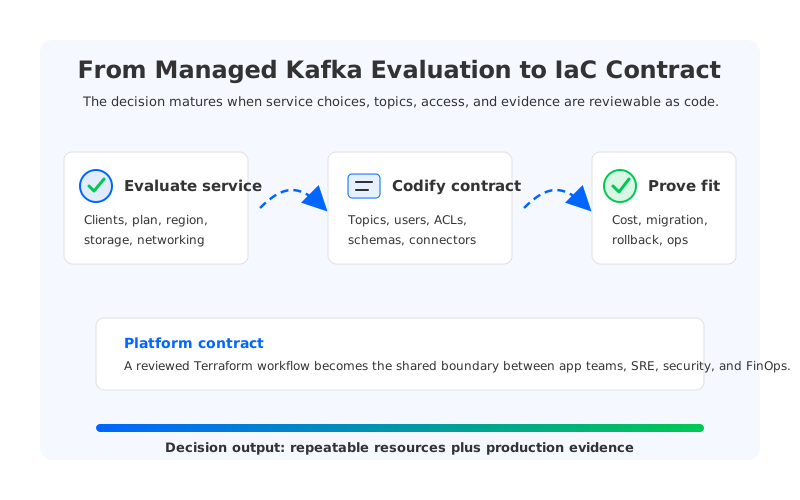
This article treats Aiven respectfully as a managed Kafka candidate and uses it as the evaluation trigger. The framework is broader than one vendor. It is for platform teams that want a clean answer to a practical question: after evaluating a managed Kafka service, what should be codified in Terraform before production traffic moves?
1Why Aiven Kafka evaluations quickly become IaC discussions
A managed Kafka proof of concept often begins with developer convenience. A small team wants a cluster for event-driven testing, CDC experiments, or a planned streaming application. Aiven's Kafka free tier is positioned for learning, prototyping, and evaluation. That is useful because it lets teams test client connectivity and workflows before they commit to a paid service tier.
The moment the cluster represents a shared platform, the proof of concept changes shape. A topic becomes a contract between producers and consumers. A service user becomes an identity that may need rotation, auditability, and least privilege. A schema becomes part of a compatibility policy. Terraform enters the conversation because these decisions need review, version control, repeatability, and drift detection.
Aiven supports this direction through its Terraform provider, including resources for Kafka services, topics, users, ACLs, Kafka Connect, schemas, service integrations, and governance workflows. That does not mean every organization should manage every resource the same way. It means the evaluation can move from "can we create Kafka?" to "can our platform rules be represented as code?"
The highest-signal Terraform boundary usually includes:
- Service lifecycle. Cluster type, cloud, region, service plan, storage choices, version policy, and environment separation should be visible in code because they shape cost, capacity, and change risk.
- Topic governance. Topic creation, partition count, replication expectations, cleanup policy, retention, ownership, and approval flow need a single source of truth.
- Identity and access. Service users, ACLs, secret handling, and application ownership should be reviewable before credentials reach production.
- Integration surface. Connect workers, schemas, service integrations, logging, metrics, and private connectivity should not be configured as one-off console state.
- Operating evidence. Dashboards, alerts, cost tags, runbooks, and migration gates need enough metadata to prove who owns the platform after cutover.
This is where a managed Kafka evaluation becomes more serious than a feature checklist. The question is whether Terraform captures the decisions that would otherwise be trapped in screenshots, chat threads, and tribal memory.
2What to evaluate before writing the Terraform module
The tempting move is to start with a reusable module. That is usually premature. A module freezes assumptions, and Kafka platform assumptions are expensive to unfreeze later. Before writing the module interface, decide which operating model it standardizes.
The first decision is the cluster boundary. Aiven documents multiple Kafka paths, including free tier for evaluation, Classic Kafka, tiered storage options, BYOC deployment for supported scenarios, and Inkless Kafka. Each path implies different production questions around cost ownership, data location, scaling behavior, and security review.
The second decision is the ownership model. Some organizations let application teams own topics through pull requests. Others require a central platform team to approve all topic changes. Aiven Kafka Governance can support approval workflows for topic changes using Terraform and GitHub Actions, but the tool is only useful when the organization has defined who can request, approve, and operate a topic.
The third decision is migration scope. Greenfield adoption mostly validates client standards, topic defaults, and access. Migration validates more: offsets, lag, replay, compaction, retention, ACLs, schema compatibility, dashboards, incident response, and rollback. The Terraform design should reflect which path the team is taking.
| Evaluation area | Terraform question | Production evidence |
|---|---|---|
| Service shape | Which cluster type, plan, region, storage mode, and version policy are allowed? | Architecture review, cost estimate, capacity model, and change window policy |
| Topic policy | Which topic settings can application teams request, and which require platform approval? | Pull request workflow, owner metadata, defaults, and drift detection |
| Access control | How are users, ACLs, secrets, and group ownership represented? | Least-privilege review, rotation path, and audit trail |
| Integrations | Which schemas, connectors, logs, metrics, and service integrations are code-managed? | Deployment plan, runtime dashboard, and failure runbook |
| Migration | Which resources are created before shadow traffic, cutover, and closeout? | Validation checklist, rollback procedure, and post-cutover ownership |
The table is deliberately vendor-neutral in shape. Aiven-specific resources can implement many of these controls, but the design goal is not to mirror a provider's resource list. The design goal is to make Kafka operations reviewable before they become production incidents.
3A practical Terraform workflow for managed Kafka
A Terraform-managed Kafka workflow should have separate layers. Putting every resource into one module makes the first demo look clean, but it couples unrelated change cycles. Cluster provisioning, topic onboarding, credentials, schemas, connectors, and observability often have different owners.
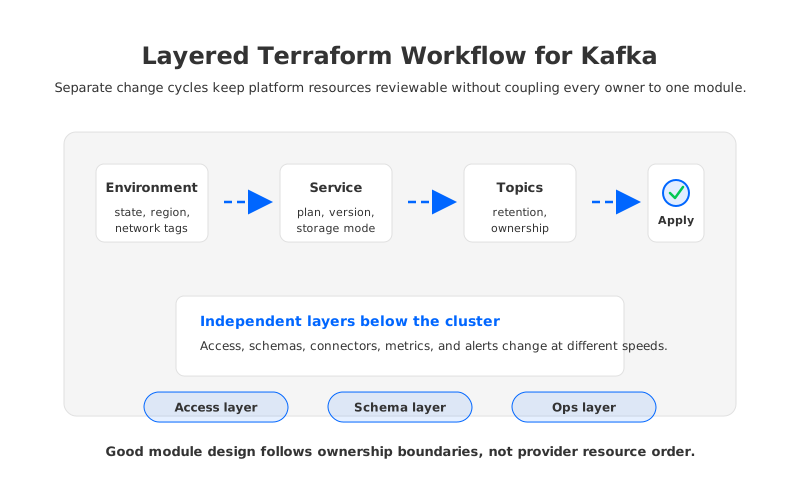
Start with an environment layer. This is where the platform team defines provider configuration, naming, region, account boundaries, network assumptions, billing tags, and remote state. The output is not a working application; it is a controlled place where Kafka resources can exist.
Then define the service layer. For Aiven, this may include the Kafka service resource and related settings. For another managed service, it may be an equivalent cluster or instance resource. The service layer should change less often than topics. It carries blast radius, because plan, storage, networking, and version choices can affect every workload.
The topic layer should be optimized for application-team pull requests. A request should state ownership, purpose, partition count rationale, retention policy, cleanup behavior, schema expectations, producer and consumer groups, and expected traffic shape. Platform teams can enforce defaults and guardrails through module variables, policy-as-code, or CI checks.
The access layer deserves its own treatment because secrets and ACLs age differently from topics. A service user may rotate credentials without changing a topic. An ACL may be narrowed after an application split. When access is mixed into topic creation, teams tend to delay security cleanup because every change feels like a platform change.
The integration layer covers schemas, Kafka Connect, service integrations, log routing, metric exports, and alert hooks. This layer often reveals whether the managed service is becoming the production platform. A Kafka cluster without operational telemetry is a demo; a workflow that creates the cluster, topics, ACLs, connectors, schema controls, and dashboards is much closer to a platform.
4Cost and architecture checks Terraform cannot solve by itself
Terraform can make infrastructure repeatable, but it cannot make a weak architecture decision good. Kafka cost is driven by byte paths as much as by service prices. Platform teams should model produce traffic, durability behavior, read fan-out, catch-up reads, retained data, remote storage, private networking, cross-zone data transfer, observability, and migration overlap.
This matters when comparing managed Kafka options. Aiven's docs distinguish local broker storage, tiered storage, and customer cloud costs in BYOC setups. AWS pricing pages separate data transfer, S3, PrivateLink, and service-specific meters. These meters are not interchangeable, so a Terraform plan should not be mistaken for a cost model.
A useful cost review asks four questions:
- Which bytes move during normal writes and reads? Producer ingress, consumer egress, replica or durability paths, and cross-zone routing have different cost consequences.
- Which bytes move during abnormal events? Broker replacement, consumer catch-up, replay jobs, migration backfill, and disaster recovery often dominate the surprise bill.
- Which storage layer grows with retention? Local disks, tiered storage, object storage, and cached hot data do not scale the same way.
- Who pays for underlying cloud resources? A managed service, BYOC model, marketplace subscription, and self-managed deployment can place different charges in different accounts.
The architecture review should also separate tiered storage from object-storage-primary designs. Tiered storage commonly keeps the active write path broker-centric while moving older segments to remote storage. Object-storage-primary designs make shared storage central to durability and use WAL and cache layers to preserve Kafka-facing behavior. They expose similar client surfaces but create different operating models.
5Migration gates for teams moving from evaluation to production
The first production move should not be "apply Terraform and switch clients." A safer path uses gates. Each gate produces evidence that the next step is reasonable and that rollback remains possible.
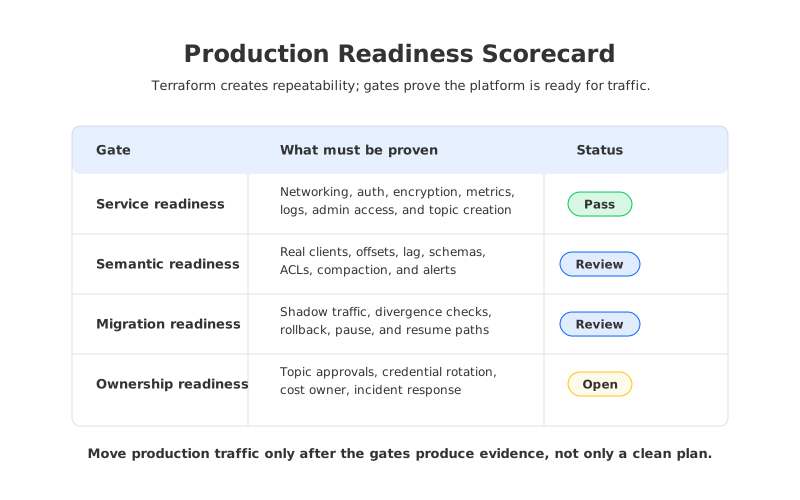
Gate one is service readiness. The Terraform plan creates the target environment, but no application depends on it. The team verifies networking, authentication, encryption, metrics, logs, topic creation, ACL behavior, and administrative access. This gate catches environment mistakes while the blast radius is still small.
Gate two is semantic readiness. Real clients produce and consume with production-like settings. The team validates retries, batching, compression, idempotence or transactions if used, consumer groups, offset commits, lag behavior, schema compatibility, topic retention, compaction if relevant, and alerts. The outcome is not "Kafka works"; the outcome is "our Kafka usage works."
Gate three is migration readiness. Shadow traffic, replication, dual writes, or backfill exercises prove data movement and observability. The team records how to detect divergence, pause, resume, and choose the source of truth at each step. Terraform makes destination resources reproducible, but rollback logic still has to be rehearsed.
Gate four is ownership readiness. The platform team documents who approves topic changes, rotates credentials, responds to lag alerts, pays for growth, changes service plans, and decides when migration is complete. A platform without ownership is a shared liability. Terraform can encode parts of ownership, but humans still need the operating agreement.
6Where AutoMQ fits after the framework is clear
Once the team has separated lifecycle, governance, access, integrations, cost paths, and migration gates, AutoMQ becomes relevant for a specific architecture question: what changes if Kafka-compatible brokers no longer treat broker-local disks as the long-term home of stream data?
AutoMQ is a Kafka-compatible cloud-native streaming platform built around S3Stream Shared Storage architecture. It keeps the Kafka protocol and ecosystem contract while replacing the traditional broker-local log storage layer with object-storage-backed shared storage, WAL storage for low-latency persistence and recovery, and cache mechanisms for read behavior. Brokers act more like stateless compute and cache nodes than permanent owners of large local logs.
That difference matters for Terraform-managed workflows because the module boundary can represent a different operating assumption. Instead of encoding ever-growing broker-local storage as the center of the platform, teams can evaluate independent compute and storage scaling, object-storage-backed durability, Self-Balancing behavior, BYOC deployment boundaries, AutoMQ Software, and configurations designed to reduce cross-zone traffic in supported multi-AZ deployments.
AutoMQ should still be tested with the same discipline used for Aiven or any other Kafka-compatible platform. The fair evaluation keeps the checklist unchanged: client compatibility, topic semantics, ACLs, schema and Connect workflows, observability, migration rollback, cost model, and ownership. AutoMQ is most relevant when the evaluation is not only "managed Kafka versus self-managed Kafka" but "what storage architecture should our Kafka-compatible platform use next?"
The Aiven Kafka evaluation that starts with convenience should end with an engineering record. Name the Kafka behaviors that must not change, the resources that Terraform will own, the byte paths that drive cost, the migration gates that protect rollback, and the team that will operate the platform after launch. If shared-storage Kafka compatibility belongs in that review, explore the AutoMQ Cloud Console and run one representative workload through the same Terraform, cost, migration, and governance scorecard.
7References
- Aiven documentation: Aiven for Apache Kafka
- Aiven documentation: Free tier for Aiven for Apache Kafka
- Aiven documentation: Create a Classic Kafka service
- Aiven documentation: Kafka Governance with Terraform and GitHub
- Terraform Registry: Aiven provider
- Terraform Registry: aiven_kafka resource
- Apache Kafka documentation
- AWS EC2 On-Demand data transfer pricing
- AWS Amazon S3 pricing
- AutoMQ documentation: Compatibility with Apache Kafka
- AutoMQ documentation: S3Stream Shared Streaming Storage
- AutoMQ documentation: WAL Storage
- AutoMQ documentation: Eliminate Inter-Zone Traffics
- AutoMQ documentation: Service Accounts for API and Terraform access
8FAQ
8.1Is Aiven Kafka a good starting point for managed Kafka evaluation?
Yes, Aiven Kafka is a credible managed Apache Kafka option, especially for teams that want a guided service experience and Terraform support. The production decision should still validate architecture, cost, Kafka semantics, networking, governance, and migration rollback with workload-specific evidence.
8.2What should Terraform manage for Kafka?
Terraform should manage the resources that need review, repeatability, and drift control: service lifecycle, topics, users, ACLs, schemas, connectors, integrations, network assumptions, ownership metadata, and environment policy. Some emergency operations may remain outside Terraform, but the steady-state platform contract should be code-managed.
8.3Should application teams create their own Kafka topics through Terraform?
Often yes, with guardrails. Application teams know the purpose, retention needs, consumers, and ownership of their topics, while platform teams should enforce approved defaults, naming rules, security policy, and review gates. A pull-request workflow keeps both sides visible.
8.4Does Terraform eliminate Kafka migration risk?
No. Terraform makes the destination environment reproducible, but migration risk comes from data movement and Kafka semantics: offsets, consumer lag, duplicate handling, schema compatibility, ACLs, dashboards, and rollback. Those behaviors need test gates in addition to infrastructure code.
8.5Where does AutoMQ fit compared with Aiven Kafka?
Aiven is a managed Kafka service option with Terraform support. AutoMQ fits when the evaluation also asks whether Kafka-compatible workloads should move to a shared-storage architecture with stateless brokers, object-storage-backed durability, WAL and cache design, BYOC or software deployment boundaries, and reduced cross-zone traffic paths in supported deployments.


