
Table of Contents
Table of Contents
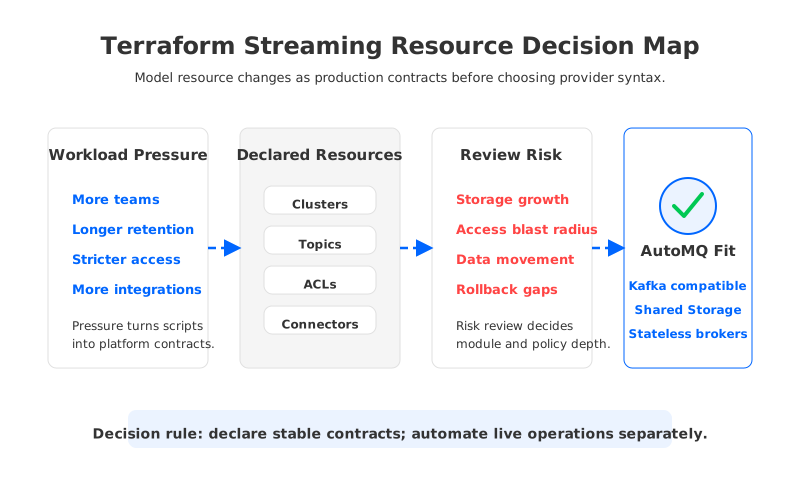
A search for terraform streaming resources kafka usually starts after the first wave of Kafka automation has already happened. The cluster can be created from code. Networking has a module. A few topic definitions may live in Git. The hard part is what comes next: production teams want clusters, topics, ACLs, service identities, connectors, private endpoints, observability exports, and ownership metadata to behave like one governed platform instead of a collection of scripts.
That pressure is not caused by Terraform. Terraform exposes it. Streaming platforms carry application contracts that are more sensitive than ordinary infrastructure resources. A topic change can alter consumer parallelism. An ACL change can widen data access. A connector change can start moving regulated records into a downstream system. A cluster scaling change can trigger storage planning, partition movement, and network cost review. The useful question is not whether Kafka resources can be declared in Terraform. The useful question is which streaming decisions deserve a reviewed desired state, and which decisions still belong in runtime operations.
1Why Teams Search for terraform streaming resources kafka
Teams rarely search this phrase because they need a syntax tutorial. They search it because the platform boundary has become unclear. Cloud infrastructure teams own VPCs, IAM, buckets, and private connectivity. Kafka operators own broker behavior, topic defaults, upgrades, and incident response. Application teams own producers, consumers, schemas, and replay expectations. Security owns access review and audit evidence. Terraform sits in the middle because it can turn that shared boundary into code that people can inspect before production changes.
The first design mistake is treating every resource as equal. A cluster, a topic, an ACL, and a connector are all "resources" in Terraform language, but they do not carry the same operational risk. A cluster defines failure domains, network exposure, compute capacity, storage paths, and upgrade policy. A topic defines durability, retention, partitioning, and replay boundaries. An ACL defines who can read, write, create, alter, or describe resources. A connector defines a continuous data path between systems that may have different security and latency assumptions.
This is why a mature Terraform repository for streaming infrastructure looks less like a bag of provider resources and more like a contract catalog. Some resources are low-level infrastructure. Some are Kafka-facing application contracts. Some are integration contracts. Some are evidence for security and finance. When all of them use the same review workflow but different risk controls, Terraform becomes a platform interface rather than a deployment wrapper.
2The Production Constraint Behind the Problem
Traditional Kafka was designed around brokers that own local durable data. That architecture is well understood, and many teams run it successfully. The challenge appears when Terraform becomes responsible for repeated production changes in a cloud environment. Broker-local storage turns many logical requests into physical planning work: more retention means more disk, more partitions can mean more broker pressure, scaling can mean data movement, and multi-AZ durability can mean replication traffic across zones.
Those mechanics leak into Terraform decisions. A request for a longer retention class is no longer a topic metadata change; it may require broker storage headroom. A request for more partitions is no longer a parallelism setting; it may affect placement, balancing, and future reassignment. A request for a cross-zone deployment is no longer a reliability checkbox; it may create network transfer paths that finance will see later. The infrastructure-as-code workflow did not create these couplings, but it makes them visible in pull requests.
For platform teams, the practical result is a split-brain operating model. Terraform declares the desired state, while operators still need separate tools and runbooks to make the state safe at runtime. That split is healthy when each side has a clear role. It becomes fragile when Terraform cannot explain the storage, access, integration, and recovery consequences of a change.
3A Resource Taxonomy for Streaming Platforms
A cleaner design starts by grouping resources according to the contract they represent. The provider resource type is implementation detail; the platform contract is what reviewers should reason about. A topic module should not force every application team to choose low-level defaults from scratch. An ACL module should not hide broad privileges behind a friendly variable name. A connector module should not treat source and sink credentials as incidental strings.
The following taxonomy is a useful starting point.
| Resource layer | Examples | Primary reviewer question |
|---|---|---|
| Environment foundation | Accounts, VPCs, subnets, buckets, KMS keys, private endpoints | Does the deployment boundary match security, region, and ownership requirements? |
| Streaming cluster | Kafka-compatible cluster, broker pools, bootstrap endpoints, observability sinks | Does the cluster have the capacity, isolation, upgrade path, and failure-domain model required for this workload? |
| Topic contract | Topic name, partitions, retention, cleanup policy, ownership, data class | Does this log contract support replay and scale without creating unmanaged storage or governance risk? |
| Access contract | Principals, service accounts, ACLs, RBAC bindings, secrets references | Does the permission change follow least privilege and leave a reviewable audit trail? |
| Integration contract | Kafka Connect, CDC sources, sinks, schema dependencies, network routes | Does this continuous data path respect latency, security, schema, and failure-recovery boundaries? |
This table is intentionally not provider-specific. A team may use a cloud provider, a managed Kafka provider, a self-managed Kafka provider, or a platform-specific provider. The review problem is the same: each declared resource needs an owner, a blast radius, and a clear relationship to runtime behavior.
4Architecture Options and Trade-Offs
There are three common ways to organize Terraform for Kafka-compatible streaming resources. The first is cluster-first provisioning. Terraform creates infrastructure and clusters, while topics, ACLs, and connectors are handled through consoles, scripts, or application pipelines. This approach is fast to start, but it leaves the most application-sensitive contracts outside the main review path.
The second is platform-module provisioning. Terraform modules expose approved patterns such as standard_topic, regulated_topic, producer_identity, consumer_access, or cdc_sink. This is usually the right step for organizations that need self-service without losing control. The module layer gives application teams a vocabulary that matches how they request resources, while platform teams keep the low-level defaults consistent.
The third is architecture-aware provisioning. Here the Terraform model is designed around the streaming architecture underneath it. A shared-nothing Kafka deployment, a managed Kafka service, and a Kafka-compatible shared-storage system may all expose clusters and topics, but their scaling, storage, and failure-recovery behavior differ. Terraform cannot erase those differences. It should make them visible enough that reviewers can decide whether a change is a resource update or an architectural risk.
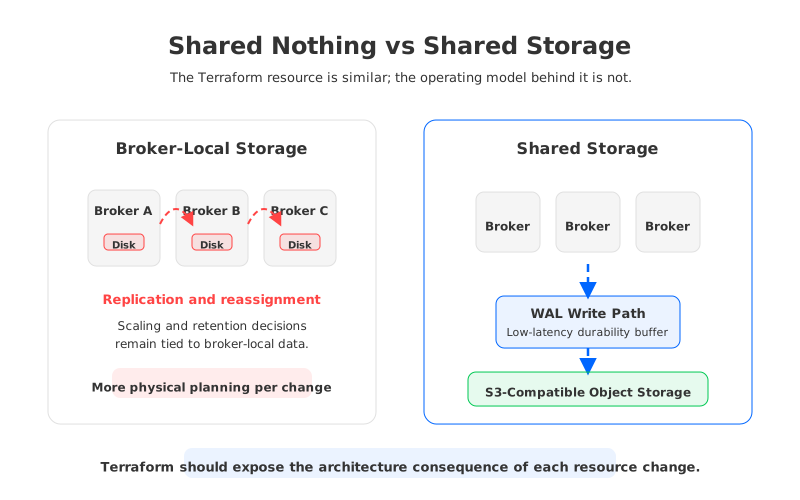
The distinction matters most when a logical contract grows faster than broker capacity. A long-retention audit topic may be a business requirement, not an operator preference. A high-fanout consumer pattern may be product behavior, not an accidental spike. A CDC connector may require sustained throughput, retries, and replay. If each of these requests forces the team to re-plan broker-local storage and data movement, the Terraform repository will accumulate guardrails around an architecture constraint instead of removing the constraint.
5Evaluation Checklist for Platform Teams
The evaluation should begin before provider selection. Provider capability matters, but a provider cannot compensate for an unclear platform contract. Start with a list of production resources, then decide which ones are stable desired state, which ones are runtime operations, and which ones represent policy.
A useful checklist covers seven areas:
- Compatibility: Producers, consumers, stream processors, and connectors should continue to rely on Kafka protocol behavior, client configuration patterns, consumer groups, offsets, and security expectations.
- Cost model: The design should expose storage growth, replication paths, cross-zone traffic, private connectivity, and observability export costs in a way reviewers can reason about before apply.
- Elasticity: Cluster sizing, topic growth, partition count, retention, and workload bursts should have a safe change path that does not depend on undocumented operator judgment.
- Governance: Topics, ACLs, identities, data classes, retention exceptions, and connector ownership should be declared with enough metadata for audit and incident review.
- Failure recovery: The platform should define what happens when a zone, broker, connector, credential, or downstream system fails, including replay and rollback boundaries.
- Migration risk: Existing clients, connector configurations, authentication models, and operational runbooks should be tested before switching workloads.
- Team boundaries: Terraform modules should match the responsibilities of cloud, platform, security, application, and data teams rather than exposing every knob to every requester.
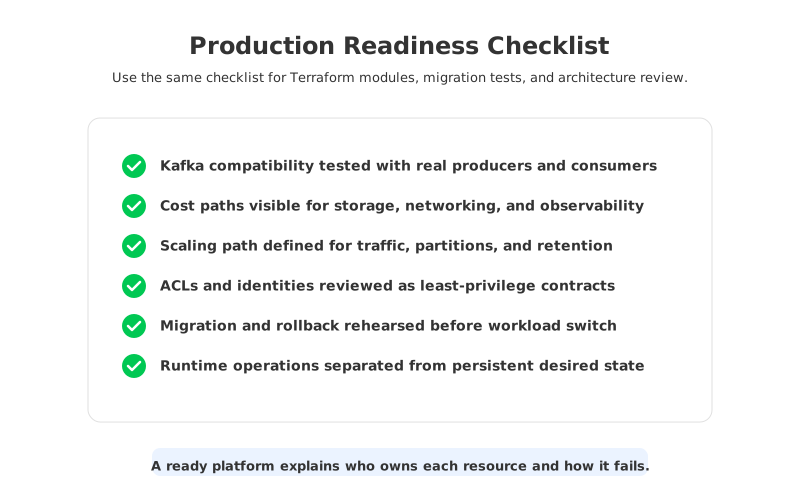
This checklist also helps decide what does not belong in Terraform. Consumer lag response, temporary throttling, emergency broker remediation, and incident-time traffic routing often require operational automation. Terraform should declare the persistent contract that remains after the incident, not every transient action taken during the incident.
6How AutoMQ Changes the Operating Model
Once the resource contract is clear, the underlying architecture becomes easier to evaluate. Some teams need better modules and stricter policy checks. Others discover that the repeated friction comes from storage-coupled scaling: broker disks, partition reassignment, replica traffic, retention growth, and cross-zone placement keep shaping every Terraform review.
AutoMQ fits that second case as a Kafka-compatible, cloud-native streaming system built around Shared Storage architecture. AutoMQ keeps Kafka protocol compatibility for client and ecosystem continuity, while its stateless brokers serve traffic and durable stream data is stored in S3-compatible object storage through S3Stream. WAL storage provides the low-latency write path before data is uploaded to shared storage.
That architecture changes what Terraform has to carry. In a broker-local storage model, a topic contract and a broker capacity plan are tightly linked. In a shared-storage model, Terraform can still declare clusters, cloud resources, networks, topics, ACLs, and integrations, but compute and durable storage can be reasoned about with a cleaner separation. The platform team still reviews retention, data access, and placement. The difference is that every retention discussion does not automatically become a broker disk and data movement discussion.
AutoMQ's deployment models also matter for teams that already use Terraform as their control plane for cloud ownership. AutoMQ BYOC and AutoMQ Software are relevant when the data plane needs to run inside customer-controlled cloud accounts, VPCs, storage boundaries, and network policies. For these teams, the architecture question is not "Can Terraform create a Kafka-like resource?" It is "Can our declared infrastructure, streaming contracts, and runtime operations describe the same boundary?"
The answer still needs workload testing. A platform team should validate producer behavior, consumer groups, offset handling, transactions if used, ACL patterns, connector behavior, failure drills, observability, and rollback paths. Kafka compatibility is a requirement, not a slogan. A clear Terraform model gives the migration test a precise inventory: what must be recreated, imported, phased, or kept operational during the transition.
7A Practical Readiness Scorecard
Before changing the provider or architecture, score the current platform against the resource taxonomy. The goal is not to produce a decorative maturity model. The goal is to find the parts of the platform where Terraform has enough authority, too much authority, or not enough context.
| Question | Green signal | Risk signal |
|---|---|---|
| Are topics declared with ownership and data class? | Every persistent topic has owner, purpose, retention class, and access metadata. | Topic names exist in code, but business meaning lives in tickets or memory. |
| Are ACL changes reviewable? | Principal, operation, resource, and environment are visible in pull requests. | Broad wildcard permissions are hidden behind generic variables. |
| Are integrations treated as data paths? | Source, sink, credentials, schemas, retry behavior, and network route are reviewed together. | Connectors are provisioned like isolated compute jobs. |
| Is cost visible before apply? | Storage, network, private connectivity, and observability impacts are part of review. | Finance sees the result after workloads grow. |
| Is the architecture constraint explicit? | Terraform modules document whether scaling is storage-coupled or storage-decoupled. | Reviewers approve logical changes without knowing the physical consequence. |
This scorecard often exposes an uncomfortable fact: many Kafka platforms are automated but not governed. Automation means a resource can be created from code. Governance means the code contains enough intent for another engineer to understand why the resource exists, who can use it, how it fails, and what it costs to keep. Terraform helps when it carries that intent.
Back at the original search query, terraform streaming resources kafka is not a tooling problem by itself. It is a platform design problem wearing a tooling name. If your current Terraform model already captures clusters, topics, ACLs, integrations, ownership, and cost boundaries, the next step may be incremental module hardening. If the same reviews keep circling around broker-local storage, retention buffers, cross-zone movement, and migration risk, evaluate whether a Kafka-compatible shared-storage architecture belongs in the design. To test that path with a live control plane, start with AutoMQ Cloud and use your existing Terraform inventory as the evaluation checklist.
8References
- Terraform Resource Blocks
- Terraform Modules
- AutoMQ Terraform Provider
- Apache Kafka Documentation
- Apache Kafka Authorization and ACLs
- Apache Kafka Connect Documentation
- AutoMQ Architecture Overview
- AutoMQ S3Stream Shared Streaming Storage
- AutoMQ WAL Storage
- AWS EC2 On-Demand Pricing and Data Transfer Notes
9FAQ
9.1What are Terraform streaming resources for Kafka?
They are the declared resources that define a Kafka-compatible streaming platform: clusters, cloud infrastructure, topics, ACLs, service identities, connectors, private endpoints, observability exports, and ownership metadata. The exact provider resources differ by platform, but the production contracts are similar.
9.2Should Kafka topics and ACLs be managed in Terraform?
Persistent topics and ACLs usually belong in Terraform when they need review, ownership, auditability, and reproducibility. Short-lived incident actions may happen through operational tooling, but lasting access or topic changes should return to code after the incident.
9.3How should teams model Kafka connectors in Terraform?
Treat connectors as continuous data paths, not background jobs. The Terraform module should make source, sink, credentials, network route, schema dependency, retry behavior, owner, and failure handling visible enough for platform and security review.
9.4Does a Kafka-compatible shared-storage architecture remove the need for Terraform?
No. It changes what Terraform has to manage. Terraform still declares cloud resources, clusters, networks, topics, ACLs, integrations, and governance metadata. Shared storage can reduce the coupling between broker compute and durable data, which may make the declared platform boundary cleaner.
9.5Where does AutoMQ fit in a Terraform-managed streaming platform?
AutoMQ fits when a team wants Kafka compatibility while reducing the operational coupling among broker-local storage, scaling, retention, and cross-zone data movement. It should be evaluated after the team has defined its Terraform resource taxonomy, compatibility requirements, and migration tests.


