
Table of Contents
Table of Contents
Someone searching for kafka failover testing is usually carrying a production worry, not a lab curiosity. The next incident may involve an overloaded consumer group, a full disk, an unhealthy availability zone, or a migration cutover happening while an AI feature waits for fresh events. Many Kafka failover tests prove the cluster can restart a process; the business needs proof that the data path keeps its contract under stress.
That contract is bigger than broker availability. Producers care about acknowledgments, retries, idempotence, and ordering. Consumers care about group coordination, offset commits, lag recovery, and replay boundaries. SREs care about whether the failover path creates an alert storm, a hidden cost spike, or a manual reassignment job that keeps running after the incident is declared over. The first useful failover test is the one that states which contract is being tested.
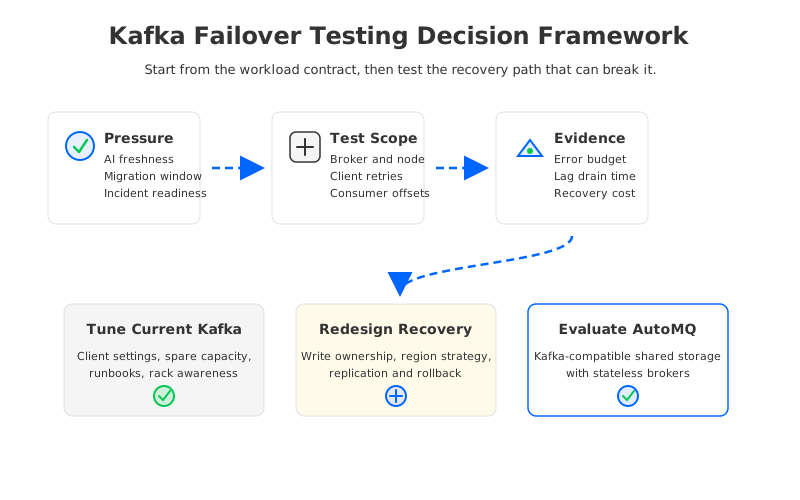
The mistake is treating failover as a single event. In production Kafka, failover is a sequence: fault injection, detection, leadership or ownership change, client retry behavior, recovery of under-replicated or unavailable partitions, consumer catch-up, and post-incident capacity restoration. Each stage can pass while the total system still fails the workload. A broker may come back quickly while a hot partition remains throttled, or consumers may resume while downstream state stores reprocess too much history.
1Why kafka failover testing matters now
Kafka sits closer to revenue paths than many teams expected when the first cluster was created. It feeds fraud scoring, personalization, logistics, usage metering, observability, and real time AI data pipeline workloads that lose value as data gets stale. A failover test for nightly analytics may be too weak for a streaming feature that makes decisions while the user is still in session.
This pressure changes the test design. A platform team does not need another generic checklist that says "kill a broker and observe recovery." It needs a failover model that accounts for the specific promises Kafka makes to applications:
- Write availability: Producers should know whether they can continue writing, whether retries preserve ordering expectations, and which errors are safe to treat as transient.
- Read continuity: Consumers should resume with predictable group membership, committed offsets, and lag behavior that matches the recovery objective.
- State consistency: Stream processors and connectors should not silently duplicate, skip, or reorder records beyond the application's tolerance.
- Operational boundedness: The failover path should have known alert thresholds, manual intervention points, rollback windows, and cost exposure.
Those promises are workload-specific, which is why failover testing should start from the application contract rather than the broker process. For telemetry, a short lag spike may be fine if no data is lost. For payments, duplicate delivery may be acceptable if the consumer is idempotent, while missing a record is not. For feature pipelines behind AI applications, freshness can dominate even when durability is intact.
2The production constraints behind the search
Traditional Apache Kafka uses a Shared Nothing architecture. Each broker stores partition replicas on broker-local or attached storage, and Kafka maintains availability by replicating partition data across brokers. This architecture is mature and well understood, but it couples failover with data placement. When a broker fails, the cluster must reason about leader election, in-sync replicas, recovery traffic, disk capacity, and partition balance at the same time.
That coupling is why a small failover test can be misleading. A three-broker development cluster can survive a broker restart and still teach little about a production cluster with uneven traffic, large retention, stateful stream processors, private networking, and strict change windows. The real question is whether the platform can absorb ownership and recovery work without violating the workload contract.
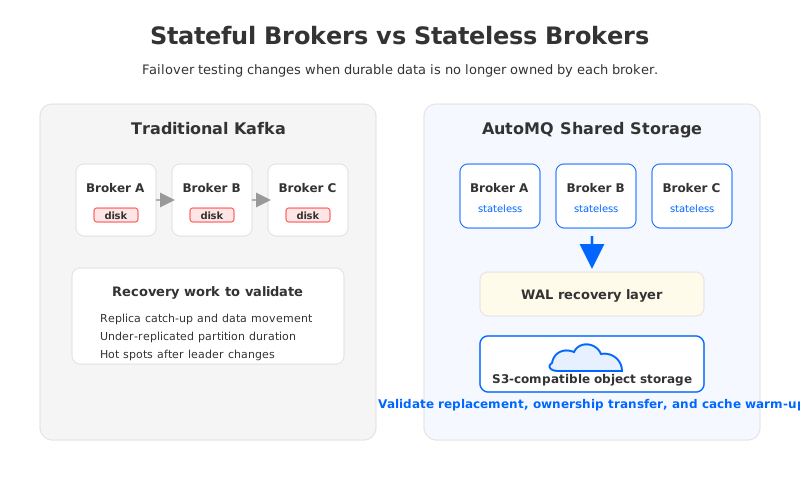
Replication adds another testing dimension. With replication factor 3, a partition may continue serving traffic after one broker fails, but the cluster may also accumulate under-replicated partitions, throttle catch-up, and consume network bandwidth while replicas recover. If the test ends as soon as the producer succeeds again, it misses the recovery window, when the next broker issue can become a cascading incident.
Kafka failover tests should also include the client layer. Producer retries, acks, idempotence, transaction timeouts, consumer session timeouts, and rebalance behavior can decide how the incident feels to applications. A cluster-side failover that looks clean in broker metrics can still cause duplicate processing, task restarts, or stuck consumers if client settings were never tested under the same conditions.
3Architecture patterns teams usually compare
The architecture behind the cluster determines what failover testing needs to prove. A self-managed Kafka deployment on VMs, a managed Kafka service, a Kafka-on-Kubernetes deployment, and a Kafka-compatible shared-storage platform can expose the same Kafka APIs while producing different failure modes. The test plan should compare those operating models before it compares dashboards.
| Architecture pattern | What failover testing must prove | Common blind spot |
|---|---|---|
| Self-managed Kafka on VMs | Broker, disk, network, controller, and partition reassignment behavior under realistic load | Recovery work depends heavily on operator runbooks and spare capacity |
| Managed Kafka service | Client continuity, service limits, network path, upgrade behavior, and support escalation boundaries | Managed lifecycle does not remove all storage and traffic coupling |
| Kafka on Kubernetes | Pod disruption, volume attachment, node replacement, controller quorum, and scheduling constraints | Kubernetes can restart pods faster than Kafka can recover data placement |
| Cross-region replication | Write ownership, offset mapping, consumer cutover, and rollback after divergence | Replication lag becomes a business recovery variable |
| Shared Storage architecture | Broker replacement, ownership transfer, WAL recovery, object storage access, and cache warm-up | Teams may test broker statelessness but forget client and governance checks |
The point is not to declare one pattern universally correct. It is to prevent a false comparison. If the workload's biggest risk is duplicate processing, a managed service does not remove the need to test idempotence. If the risk is long partition reassignment after scaling, broker-local storage may still dominate recovery. If the risk is data-plane control in a regulated cloud account, the test must include IAM, private connectivity, audit logs, and deployment boundaries.
A good architecture test asks what must be true after the failure, not what product category the cluster belongs to. Can producers continue with bounded errors? Can consumers resume from known offsets? Can the platform restore redundancy before the next fault? Can operators explain where data moved, who had access, and what costs were created by the recovery path?
4A practical failover test matrix
Failover testing becomes useful when it is organized as a matrix of fault type, workload behavior, and recovery evidence. The table below is a compact starting point, not a substitute for a runbook.
| Test scenario | Evidence to collect | Pass condition |
|---|---|---|
| Broker process crash | Produce error rate, leader election timing, unavailable partitions, under-replicated partitions, client retry behavior | Application SLO stays within the agreed error and lag budget |
| Node or disk loss | Replica recovery traffic, disk saturation, partition balance, controller actions, operator steps | Redundancy is restored without manual data surgery or prolonged hot spots |
| Availability zone impairment | Producer and consumer reachability, rack-aware routing behavior, cross-zone traffic, degraded capacity | Service remains within reduced-capacity assumptions documented before the test |
| Controller quorum disruption | Metadata operation latency, topic and partition operations, leadership stability | Existing traffic continues, and metadata operations recover predictably |
| Consumer group disruption | Rebalance duration, duplicate processing, offset commits, lag drain rate | Consumers resume from expected offsets and drain lag within the recovery objective |
| Migration or endpoint cutover | Bootstrap resolution, ACL parity, offset continuity, rollback decision point | Clients can move forward or back without ambiguous write ownership |
Run the matrix under load that resembles production. That does not require a perfect clone of the production cluster, but it does require realistic partition counts, message sizes, consumer fan-out, retention shape, and peak-to-average traffic. A failover test with empty topics is mainly a control-plane test. A failover test with real topic density is a data-plane and client-contract test.
The most useful metric is often not the first recovery time. It is the time until the system returns to stable redundancy and capacity. A broker can fail over in seconds while replica recovery takes far longer. A consumer group can rejoin quickly while lag drains slowly. A cloud route can recover while clients keep stale DNS or exhausted connection pools. The test should capture that tail, because the second incident usually lands there.
5Where AutoMQ changes the operating model
Once the evaluation framework is clear, AutoMQ enters as an architectural option rather than a product shortcut. AutoMQ is a Kafka-compatible cloud-native streaming platform that keeps Kafka protocol and ecosystem compatibility while replacing Kafka's broker-local log storage with S3Stream, a shared streaming storage layer backed by WAL (Write-Ahead Log) storage and S3-compatible object storage. In practical terms, the broker is no longer the durable home of long-lived partition data.
That distinction changes what failover testing focuses on. In traditional Kafka, broker failure recovery is tied to local replica placement and data movement between brokers. In AutoMQ's Shared Storage architecture, durable data is stored in shared storage, while brokers act as stateless compute nodes that can be replaced or rescheduled with less partition data movement. The test still needs to prove client behavior, WAL recovery, cache warm-up, object storage access, controller decisions, and consumer catch-up, but it is testing a different recovery path.
This is especially relevant for cloud-native Kafka teams that want failover testing to cover elasticity, not only failure. Production incidents often come with traffic shifts: one zone degrades, consumers fall behind, a backfill starts, or a deployment sends more load to fewer brokers. AutoMQ's stateless broker model and Self-Balancing capabilities are designed to reduce the operational burden of scaling and partition movement in those moments. The right test is to verify how quickly capacity can be added, how traffic rebalances, and whether applications continue to see Kafka-compatible behavior.
Migration testing deserves the same discipline. AutoMQ Kafka Linking supports migration from Apache Kafka and other Kafka distributions to AutoMQ, with byte-to-byte replication, synchronized consumer progress, and a producer proxy path for rolling producer switchovers. Those capabilities are not a reason to skip failover testing. They are a reason to include cutover, rollback, offset continuity, and producer endpoint movement before production traffic depends on the target platform.
6Evaluation checklist for platform teams
The final failover plan should be specific enough that an on-call engineer can run it and a product owner can understand the risk. Some teams will optimize their current Kafka deployment with better client settings, rack awareness, capacity buffers, and runbooks. Others will redesign cross-region recovery or evaluate Kafka-compatible Shared Storage architecture because the root problem is broker-local state.
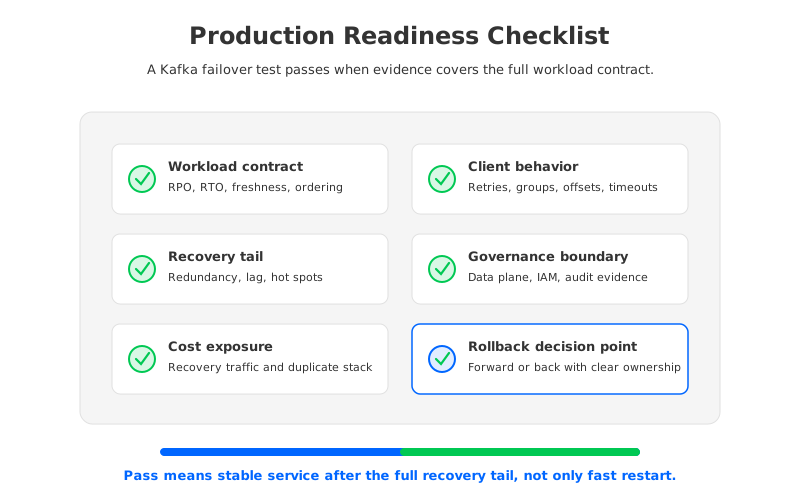
Use this checklist before calling a Kafka platform production-ready:
- Define the contract first. Name the topics, producers, consumers, stream processors, RPO, RTO, freshness SLO, ordering expectations, and duplicate-handling rules.
- Test the full recovery tail. Keep measuring until redundancy, lag, controller stability, and capacity return to the documented baseline.
- Include client behavior. Broker metrics are necessary, but producer retries, consumer rebalances, offset commits, and transaction timeouts decide application impact.
- Make costs visible. Recovery traffic, cross-zone movement, object storage access, monitoring, and temporary duplicate infrastructure should be part of the test report.
- Prove governance boundaries. For BYOC and regulated deployments, verify where the data plane runs, where Kafka records are stored, and how access is audited.
- Practice rollback. A failover test without a rollback decision point is a demonstration, not an incident rehearsal.
The decision is rarely binary. If the main risk is client misconfiguration, tighten client and runbook tests. If recovery is dominated by data movement, storage growth, or scaling friction, scrutinize the architecture. If migration is already planned, compare the current operating model with the target before cutover becomes urgent.
7Decision table
| If the test shows... | Likely next step |
|---|---|
| Producer and consumer behavior fail before broker recovery does | Fix client configs, idempotence assumptions, timeout settings, and consumer group strategy |
| Recovery succeeds but redundancy restoration takes too long | Revisit partition placement, spare capacity, storage throughput, and reassignment procedures |
| Zone tests create high network or operational exposure | Evaluate rack-aware access, topology changes, or architectures that reduce broker-to-broker recovery movement |
| Migration cutover creates offset or write-ownership ambiguity | Strengthen migration tooling, producer switch choreography, consumer progress sync, and rollback rules |
| Scaling pressure appears during failover | Compare broker-local Kafka with Kafka-compatible shared-storage platforms such as AutoMQ |
Failover testing turns architecture claims into evidence and makes trade-offs visible before the incident clock starts. If your Kafka platform has to support elastic cloud infrastructure, real time AI data pipelines, strict governance, and migration without application rewrites, evaluate the recovery path at the storage, broker, client, and operating-model layers. AutoMQ is worth considering when the test keeps pointing back to the same constraint: durable data is too tightly coupled to broker-local state.
8References
- Apache Kafka documentation: replication
- Apache Kafka documentation: KRaft
- Apache Kafka documentation: tiered storage
- AutoMQ documentation: Architecture overview
- AutoMQ documentation: Compatibility with Apache Kafka
- AutoMQ documentation: Kafka Linking migration overview
9FAQ
9.1What is Kafka failover testing?
Kafka failover testing is the practice of injecting realistic faults into a Kafka environment and measuring whether producers, brokers, controllers, consumers, stream processors, and operators can preserve the workload contract. A useful test covers more than broker restart time; it measures client errors, lag, offset continuity, redundancy restoration, and recovery cost.
9.2How often should a Kafka team run failover tests?
Run failover tests before production launch, before major topology or version changes, before migration cutovers, and after meaningful workload growth. Many teams also schedule periodic game-day exercises so runbooks, alerts, and ownership stay current.
9.3Is broker failover enough for production readiness?
No. Broker failover is one layer. Production readiness also requires controller behavior, client retry settings, consumer group recovery, storage and network capacity, governance boundaries, monitoring, and rollback discipline.
9.4How does Shared Storage architecture affect Kafka failover?
Shared Storage architecture separates durable Kafka data from broker-local disks. In AutoMQ, stateless brokers use S3Stream with WAL storage and S3-compatible object storage, so broker replacement and scaling are less tied to moving partition data between brokers. Teams still need to test client behavior, WAL recovery, cache warm-up, and object storage access.
9.5Can failover testing help with Kafka migration?
Yes. Migration cutover is a failover scenario with extra constraints. It should test producer endpoint movement, offset continuity, consumer progress, rollback windows, ACL parity, and observability across both source and target platforms.


