
Table of Contents
Table of Contents
You are reviewing a managed Kafka quote. The headline rate looks simple: a cluster or capacity unit, a storage allowance, and perhaps a line for data transfer. The first budget estimate fits. Then someone asks what happens when the topic count doubles, retention moves from days to weeks, a connector fleet is added, or consumers sit in another Availability Zone. The quote has not changed, but the workload has multiplied the meters behind it.
That is the problem with treating managed Kafka pricing as a number to compare. A pricing page tells you the unit price and the service boundary. It does not know how many partitions you will operate, how often historical data will be read, which network paths your clients will take, or how many workers an integration needs. A defensible estimate therefore starts with workload behavior and maps each behavior to a billing dimension.
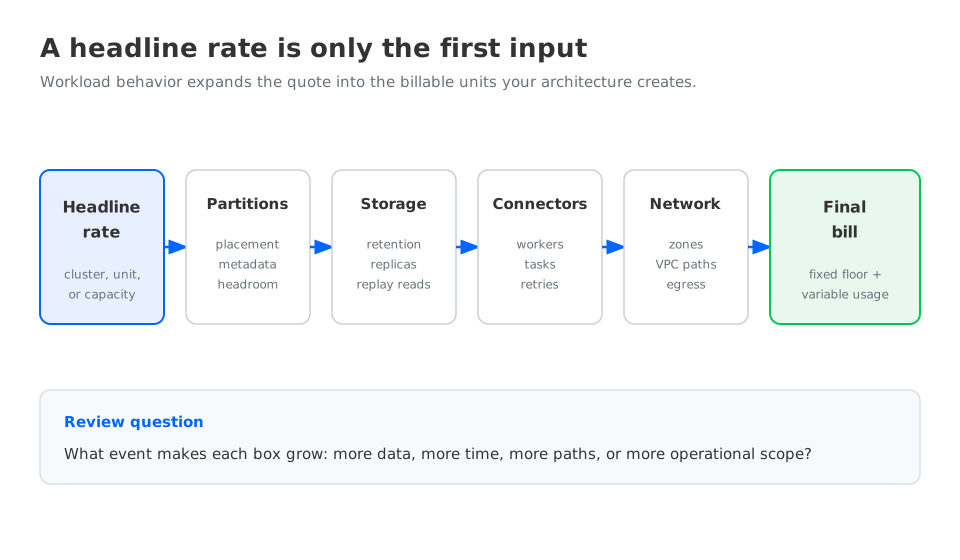
1The headline rate is a door, not the room
Start with the event that makes each line on the final bill grow. That turns a vendor comparison into a systems model.
For production, separate these drivers:
- Capacity and partitions. A service may price a cluster, throughput unit, or partition envelope, but partition count still affects broker memory, request scheduling, metadata, and the amount of headroom you need.
- Retained data. Retention turns write volume into a durable footprint. Replication, compaction, free space, and tier boundaries determine how much storage the platform must keep available.
- Integration work. A connector is a running data path. Worker capacity, task parallelism, source or sink throughput, and retry behavior can all create additional usage.
- Network paths. Producer traffic, consumer fan-out, replication, private connectivity, NAT, and cross-region movement may be billed by different services or under different exceptions.
- Commercial and operational scope. Support tiers, minimum commitments, observability, backup or export jobs, and engineering time may sit outside the Kafka line item while still belonging in the decision.
The exact meters vary by service and cloud. AWS, for example, publishes separate pages for Amazon MSK pricing, EC2 data transfer, and Amazon S3 pricing. That separation is a useful warning: a Kafka workload can touch several billing systems even when users experience it as one platform.
2Multiplier by multiplier: partitions, storage, connectors, and zones
2.1Partitions multiply placement decisions
Partitions are logical units in the Kafka model, but they also create placement and scheduling work. More partitions can require more leader assignments, replicas, metadata, open files, memory, and balancing activity. A pricing page may not charge "per partition" in the same way across services, but partition count can still push you into a larger capacity tier or force more broker headroom.
This is why a capacity estimate based only on average megabytes per second is incomplete. Write rate must be considered alongside partition count, peak-to-average ratio, consumer fan-out, message size, and the recovery work required after a broker or network interruption. If a quote is based on a single throughput number, ask which of those variables are fixed and which are allowed to grow.
2.2Retention multiplies durable bytes
Kafka retention is a cost control as much as a data lifecycle setting. Suppose a workload writes 2 TiB of logical data per day and retains it for 7 days. Before compression, replication, compaction, and provider-specific overhead, the retained logical footprint is 14 TiB. If the topic uses a replication factor of three, a rough storage planning model starts from 42 TiB of broker-log copies, then adds headroom and accounts for compaction and compression. This is an illustration, not a quote; the inputs must be replaced with measured workload values.
The Apache Kafka topic configuration reference makes the relevant controls explicit: retention time, retention bytes, cleanup policy, and segment behavior shape what the cluster keeps. The important budgeting habit is to model both logical retained data and physical storage work. A service that exposes an object or tiered storage option may change where those bytes live, but it does not make retention or replay behavior irrelevant.
Historical reads are the other half of the storage multiplier. A long-retention topic that is rarely read has one cost shape. The same topic used for weekly backfills, consumer recovery, or analytics replay creates a different request, retrieval, and network profile. Storage class alone cannot answer that question.
2.3Connectors multiply data paths
Connectors make Kafka useful beyond the cluster, but they also make the bill less local. A source connector can add ingress. A sink connector can add egress, worker capacity, serialization work, retries, and traffic to a different VPC or region. Multiple tasks may be necessary for throughput or availability even when the topic itself is unchanged.
Treat every connector as a small architecture review. Record the source and destination, expected bytes, task count, retry behavior, worker sizing, and network boundary. Then ask whether it is bundled, separately billed, or a self-managed workload whose compute and network appear elsewhere. The Apache Kafka Connect documentation is a useful boundary reference, but provider service terms decide the actual meter.
2.4Zones multiply movement
Availability Zones are a reliability boundary and a billing boundary. A cluster that spreads replicas across zones may move replication traffic between them. Clients in a different zone may fetch from a remote leader. A connector, private endpoint, NAT gateway, or cross-region replicator can add another path. The right question is not whether a service advertises multi-zone availability; it is which bytes cross which boundary during steady state, rebalance, catch-up, and failure recovery.
The AWS data transfer pricing page shows why a generic "network cost" line is not enough. Rates and exceptions depend on service, direction, region, and path. Draw the traffic topology before applying a price. This prevents a common mistake: assuming that eliminating one internal replication path eliminates client egress or connector traffic as well.
3What the pricing page leaves out
Pricing pages have to describe a service generically. The buyer's job is to turn omitted context into questions before approving a forecast.
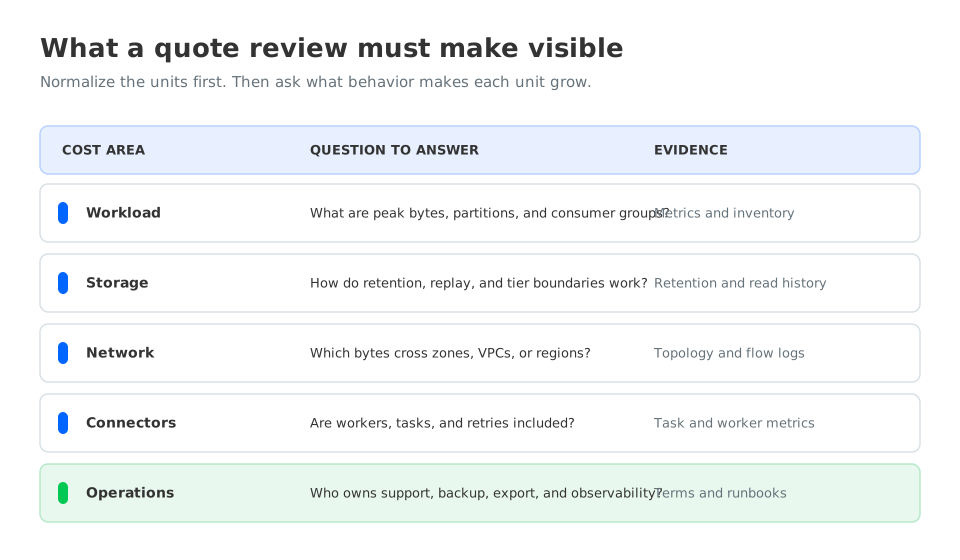
Use this checklist during a quote review:
| Area | Question to answer | Evidence to request or measure |
|---|---|---|
| Workload shape | What are the steady, peak, and burst rates? How many partitions and consumer groups exist? | Producer and consumer metrics, partition inventory, peak window |
| Storage | Is storage provisioned, used, tiered, or object-backed? How are requests, retrieval, and compaction treated? | Retention policy, compression ratio, storage class, replay history |
| Network | Which paths cross AZ, VPC, region, or the public internet? Which paths are exempt? | Placement map, endpoint design, flow logs, transfer report |
| Connectors | Are workers and tasks included? What happens during retry, backfill, or scaling? | Connector inventory, task counts, destination rates, retry metrics |
| Operations | Who pays for observability, backups, exports, upgrades, and incident response? | Support terms, monitoring plan, runbooks, staffing estimate |
| Commercials | Is there a minimum spend, commitment, or tier boundary? What happens at the next threshold? | Contract schedule, rate card, renewal and overage terms |
The table also exposes a failure mode in cost comparisons: two quotes can use "storage" for different economic objects. One may mean provisioned block capacity; another may mean bytes in an object tier or bundled capacity with retrieval metered separately. Normalize the units before comparing them.
Do the same for connectors and support. A bundled line is not necessarily free; it may move the cost into a larger minimum tier or a separate commitment. A separate line is not automatically a problem; it may make a workload easier to measure. What matters is whether the bill follows behavior closely enough for the team to forecast and control it.
4Reverse-engineer the real rate from a pilot
When a workload is unfamiliar, a short pilot can be more useful than a spreadsheet full of assumptions. The goal is to measure the coefficients that make the invoice move, not predict an exact invoice from a small test.
Start by choosing a representative slice: realistic message sizes, a known partition count, the intended replication and retention policy, one or more real consumer groups, and the connectors that matter to the production path. Record the region, Availability Zones, network endpoints, storage class, and test duration. A pilot that leaves out the expensive path only proves that the expensive path was absent.
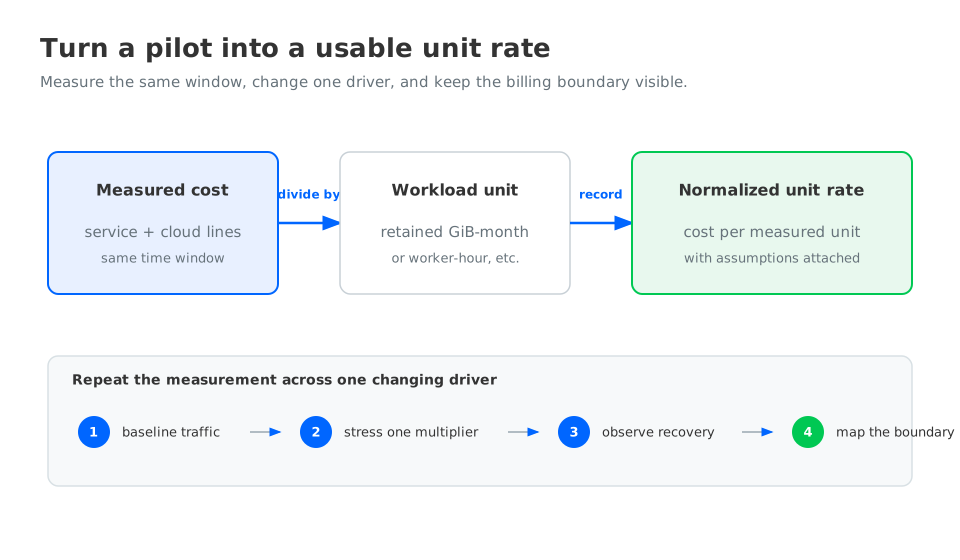
For each billing dimension, calculate a normalized unit rate:
normalized cost = measured cost for the period / measured workload unit
The workload unit must match the driver. Examples include retained GiB-month, produced GiB, consumer GiB, connector worker-hour, or cross-zone GiB. Do not divide the whole bill by ingress volume if the bill includes a fixed cluster floor and a large historical replay; that produces a number that is easy to quote and hard to use.
A practical pilot worksheet has four passes:
- Baseline. Run the expected traffic pattern without replay or failure activity. Capture service usage and cloud billing exports for the same time window.
- Stress the multiplier. Increase one variable at a time: partitions, retention, consumer fan-out, connector tasks, or cross-zone traffic. Keep the other inputs stable.
- Observe recovery. Perform a controlled rebalance, restart, catch-up, or backfill if the production design requires it. Recovery traffic is part of the system's economics, even if it is not steady-state traffic.
- Map the boundary. Assign every observed line to the platform, the cloud account, the network service, or internal labor. Record which items are included, excluded, or conditional.
This method produces a model with assumptions that can be challenged. It also makes negotiations more concrete: instead of asking for "a better Kafka price," you can ask which partition tier, retention allowance, connector worker class, or network path changes the unit rate.
5The architecture can change the multiplier shape
The arithmetic above is useful even when you keep the same platform. It also shows when a different architecture deserves evaluation. If every broker owns local durable data, then scaling, replacement, and rebalancing can couple compute decisions to disk capacity and data movement. A design that separates compute from shared storage changes that coupling, but it does not make storage, requests, or network disappear. It changes which meter grows with which behavior.
That is the rationale for evaluating a Kafka-compatible Shared Storage architecture. AutoMQ, a Kafka-compatible cloud-native streaming platform, keeps the Kafka protocol and ecosystem while using an object-storage-backed storage layer; its Shared Storage documentation describes the separation between broker compute and durable storage. In an AutoMQ BYOC (Bring Your Own Cloud) deployment, the relevant cloud storage, compute, and network resources remain visible in the customer's account, so Financial Operations (FinOps) can inspect them.
The cost implication is conditional. Stateless or less storage-bound brokers can make elastic compute and partition movement easier to model, while object storage introduces its own storage, request, retrieval, and network dimensions. AutoMQ's documentation on reducing inter-zone traffic explains one architectural change that can remove a class of broker-replication movement. Client placement, connector traffic, object-storage access, WAL (Write-Ahead Log) choice, and retention still need to be modeled for the actual deployment.
That distinction matters in procurement. A different architecture is not a license to replace measured costs with a marketing percentage. Redraw the dependency graph, identify which multipliers moved, and run the same workload assumptions through the chosen design. Kafka compatibility can reduce application change, but client behavior, operational fit, and cloud-account ownership still need validation.
6A negotiation checklist that starts with engineering
Before signing, ask for a worked example that uses your workload rather than a generic "typical cluster." Request the assumptions in writing and keep the model with the architecture record. At minimum, pin down:
- the fixed capacity floor and the threshold for the next tier;
- how partitions, throughput, storage, and retention are measured;
- whether compressed or uncompressed bytes drive a meter;
- how connector workers, tasks, retries, and backfills are charged;
- which inter-zone, cross-region, private-connectivity, and internet paths are included;
- how support, observability, backup, and export work are scoped; and
- what happens when traffic, retention, or partition count exceeds the quote.
Then compare architectures using the same evidence. A good decision record contains workload shape, topology, retention, replay behavior, connector inventory, unit rates, fixed costs, exclusions, and refresh triggers. A region change, consumer group, retention policy, or connector is a pricing event.
The most reliable managed Kafka pricing comparison is therefore not a ranking of headline rates. It is a map from system behavior to billable units. Once that map is visible, a higher advertised rate may be rational for one workload, while a lower rate may become expensive after retention, network, or integration multipliers are applied.
7FAQ
7.1What is the biggest hidden cost in managed Kafka pricing?
There is no universal biggest cost. For a replicated, long-retention workload, storage and network movement may dominate. For a small cluster with many integrations, connector workers and fixed capacity may matter more. Measure the workload units instead of assuming the broker line is the answer.
7.2Does object storage automatically reduce Kafka cost?
No. Object storage can change the relationship between broker compute and retained data, but requests, retrieval, storage class, WAL, and network paths still have to be priced. Compare the full workload model, including recovery and historical reads.
7.3How should I compare two managed Kafka pricing pages?
Normalize both offers into fixed capacity, produced data, consumed data, retained data, connector work, network paths, and operational scope. Use the same region, retention, partition count, consumer fan-out, and failure assumptions. If a provider bundles a dimension, document where the threshold or commitment appears.
7.4What should a Kafka pricing pilot measure?
Measure producer and consumer bytes, partitions, retention footprint, connector worker-hours, object-storage requests where applicable, cross-zone or cross-region bytes, and the fixed service floor. Run the measurements over a window that includes the traffic pattern you intend to budget.
7.5When is a shared-storage Kafka architecture worth evaluating?
Evaluate it when storage retention, broker scaling, partition movement, or cross-zone replication makes the local-disk model difficult to forecast. Keep the evaluation honest: check Kafka compatibility, latency requirements, WAL and storage choices, client locality, connector paths, and who owns each cloud resource.
8References
- Apache Kafka topic configurations
- Apache Kafka replicated log design
- Apache Kafka Connect documentation
- Amazon MSK pricing
- AWS EC2 data transfer pricing
- Amazon S3 pricing
If you want to test a Kafka-compatible shared-storage design with your own workload assumptions, start with AutoMQ.


