
Table of Contents
Table of Contents
Kafka teams rarely search for throughput elasticity because life is calm. They search for it when a traffic curve has stopped matching the shape of the cluster. A payment event stream runs hot during business hours, an AI feature pipeline needs a short burst of fresh data, a customer-facing workload suddenly doubles read fan-out, or a backfill turns a quiet topic into the loudest thing in the region. The business asks for more throughput. The platform team hears a more specific question: can the cluster absorb that load without moving data, overprovisioning brokers, or opening a risky maintenance window?
That question matters because throughput is not an abstract number in a Kafka environment. It is tied to partitions, broker placement, page cache, disk bandwidth, replication, consumer lag, network routing, and the operational history of the cluster. When these pieces are bound to broker-local storage, scaling compute often means reshaping where data lives. The painful part is not adding a broker. The painful part is the data movement that follows, and the cost, time, and risk that come with it.
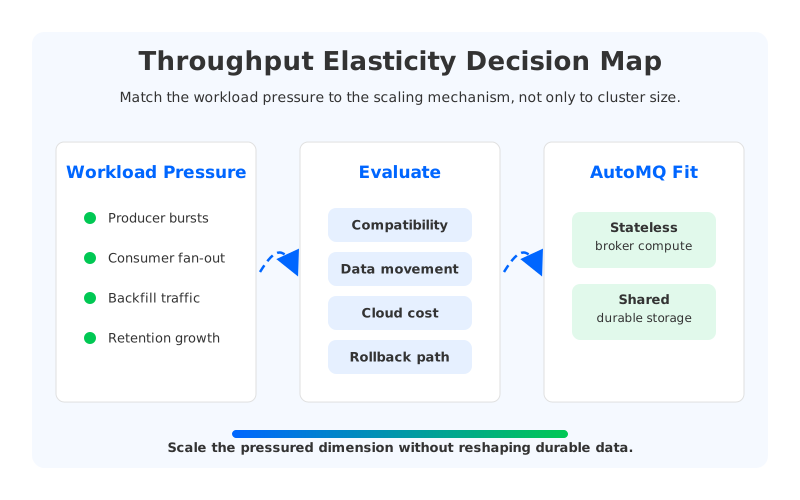
Elasticity is easy to claim and hard to operate. A useful evaluation starts by separating the workload pressure from the mechanism used to answer it. Some teams need more producer ingress. Others need catch-up reads after an outage, higher fan-out for analytics, or a safer way to run periodic backfills. These pressures look similar on a dashboard because they all show up as throughput, but they stress the system in different places. A platform that scales one dimension while creating hidden pressure in another is not elastic in the operational sense.
1Why teams search for throughput elasticity Kafka
The common trigger is a mismatch between demand and the cluster's fixed capacity envelope. Kafka operators can plan steady-state throughput with reasonable confidence, but the trouble often lives outside the steady state. A large customer onboarding can add sustained write volume. A fraud model can introduce high-priority consumers with strict freshness goals. A lakehouse ingestion job can turn one topic into many downstream reads. A retention policy change can increase storage pressure while the producer rate stays unchanged.
In traditional Kafka operations, the answer is usually a blend of capacity planning and partition reassignment. You add brokers, change partition placement, rebalance load, and monitor the cluster until the revised shape settles. That process works, but it is not free. It consumes network bandwidth, competes with foreground traffic, and creates a period where the cluster is doing two jobs at once: serving production traffic and copying data to repair its own topology.
The real search intent behind throughput elasticity kafka is therefore not "how do I add capacity?" It is "how do I add capacity without turning scaling into a storage migration?" That distinction is important for FinOps and SRE teams because a scaling event is no longer a purely technical action. It becomes a cost event, a reliability event, and sometimes a governance event if data placement or cloud boundaries change during the operation.
2The cloud cost drivers behind the workload
Cloud Kafka deployments make the storage-coupled model more visible because every resource boundary has a billable shape. Broker instances carry compute and local storage capacity together. Replication consumes network bandwidth. Cross-zone traffic can become material when replicas, consumers, and brokers sit in different availability zones. Object storage has its own pricing model, and cloud providers publish storage and request pricing separately from compute and data transfer. The architecture decides which pricing surfaces your workload touches.
For a platform team, the cost model is easier to reason about when each throughput pressure maps to a specific resource. Producer ingress should primarily stress write path bandwidth and durability. Consumer fan-out should primarily stress read serving and network egress. Retention should primarily stress storage. Backfills should primarily stress catch-up reads. When those pressures are entangled inside broker-local disks, the team often buys a larger broker footprint to cover the worst combination, even if the peak is brief.
| Workload pressure | What the team needs | What often becomes expensive |
|---|---|---|
| Producer burst | More durable write throughput | Broker headroom and replication traffic |
| Consumer fan-out | More read serving capacity | Broker CPU, network egress, and lag recovery |
| Longer retention | More durable storage | Attached disk growth and rebalance time |
| Backfill or replay | Temporary catch-up bandwidth | Hot brokers and degraded foreground latency |
| Regional growth | Capacity in more zones | Cross-zone routing and data placement risk |
The table is not a pricing calculator. It is a diagnostic tool. If a platform can scale the resource that is actually under pressure, the team can make a precise change. If the platform scales by reshaping broker-local data, the team has to budget for the secondary effects too. That is where many Kafka cost surprises come from: the cluster was sized for throughput, but the bill reflects replication, storage duplication, network locality, and operational slack.
3Storage, network, and compute trade-offs
The core architectural trade-off is whether a broker owns the durable log locally or serves as a stateless compute node over shared durable storage. In the broker-local model, the broker is both the serving process and the place where data resides. That design was reasonable for data center hardware because disks, network, and failure domains were operated as part of one infrastructure stack. In cloud environments, the same design inherits a different set of constraints. Storage, compute, and network are independently priced and independently elastic, but the streaming platform can still bind them together.
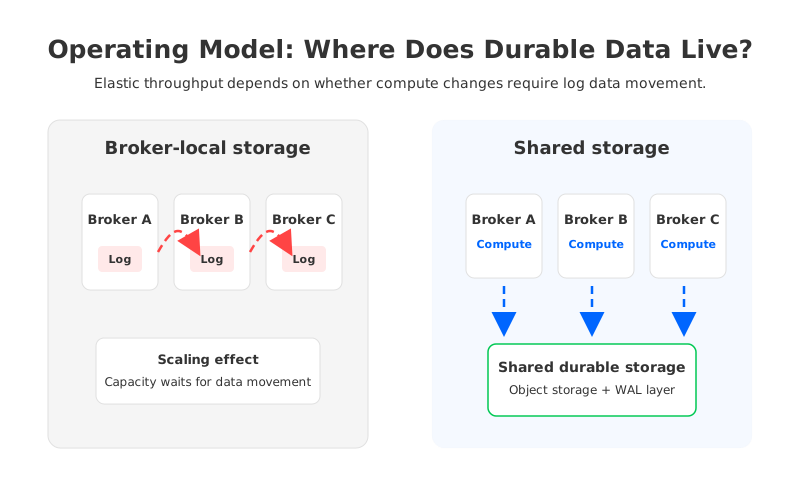
Data movement is the symptom of that binding. When an added broker joins, partitions must move if the added node is going to help with existing load. When a broker leaves, replicas must be rebuilt elsewhere. When a hot partition needs relief, leadership and replica placement become part of the scaling action. Each operation has operational controls, but the mechanism is still moving log data across the cluster so the resulting topology can become useful.
Shared storage changes the operating model by making durable data independent from broker lifetime. Brokers can be treated more like compute capacity: they attach to metadata and shared durable storage, serve reads and writes, and scale in or out with less dependence on copying historical log segments between brokers. The storage system still has to solve hard problems, especially low-latency durability and recovery semantics, but the scaling path no longer needs to start with moving broker-local data.
This is the point where evaluation should become concrete. A Kafka-compatible platform built on shared storage must prove more than "it uses object storage." It has to preserve Kafka protocol expectations, support familiar clients, handle write durability through an appropriate write-ahead log design, expose observable operational states, and recover cleanly when compute nodes change. Without those pieces, separating storage and compute can reduce one problem while creating another.
4Evaluation checklist for FinOps and platform teams
The most useful checklist is not a generic feature matrix. It asks whether a platform can absorb a specific throughput event while keeping cost, governance, and rollback boundaries understandable. The evaluation should include benchmark data where available, but it should also include the operational path: who changes what, how long the cluster remains in a transitional state, and what happens if the change is rolled back.
Start with compatibility because it defines migration risk. A Kafka-compatible system should support the clients, protocol behavior, and operational tooling your teams already depend on. Apache Kafka's own documentation is the baseline for concepts such as producers, consumers, consumer groups, offsets, transactions, and KRaft. Compatibility does not remove the need for testing, but it reduces the surface area of application changes during a platform migration.
Then test the elasticity mechanism directly. Add compute under load and observe whether useful capacity appears without large-scale data movement. Reduce compute after the burst and verify that the system does not strand data, break locality assumptions, or leave the cluster in a state that requires manual cleanup. Run the same test for write-heavy traffic, read fan-out, and catch-up reads because each path stresses a different part of the system.
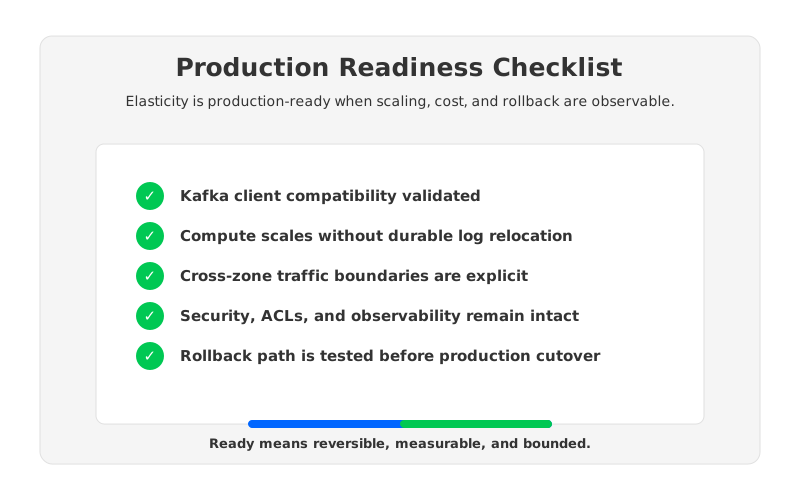
A practical readiness review should cover these questions:
- Can compute scale independently from durable storage, or does the system need partition data to move before added capacity helps?
- How does the write path acknowledge durability, and what storage layer is responsible for recovery after broker loss?
- Which traffic crosses availability-zone boundaries during steady state, scaling, and recovery?
- Can existing Kafka clients, security settings, ACL workflows, observability tools, and migration processes remain mostly intact?
- What is the rollback path if a migration, scale-out event, or workload test exposes a hidden application assumption?
The last question is often the one that separates a lab benchmark from a production decision. Elasticity is valuable because traffic is unpredictable. A rollback plan is valuable for the same reason. If scaling is reversible, observable, and bounded, the team can respond to demand without treating every capacity change as a project.
5How AutoMQ changes the operating model
Once the evaluation framework is clear, AutoMQ fits into a specific architectural category: it is a Kafka-compatible streaming platform that separates broker compute from shared durable storage. AutoMQ keeps Kafka protocol compatibility as the application-facing contract while moving the storage layer to an object-storage-backed architecture. That combination is meant to change the scaling operation itself, not merely the storage medium.
In AutoMQ's shared storage model, brokers are designed to be stateless from the perspective of durable log ownership. The write path uses a WAL layer for low-latency durability, while object storage provides the durable shared storage foundation. Because historical log data is not tied to a broker's local disk in the same way, adding or removing broker capacity can focus more directly on serving throughput instead of copying partitions across a broker fleet.
The operational implication is straightforward: capacity planning moves closer to workload planning. If a team needs more compute for a burst, the platform can add broker capacity without first turning the event into a large storage relocation. If the team needs longer retention, durable storage can grow through the object storage layer rather than attached disks sized for peak compute. If the team wants to reduce cross-zone traffic, AutoMQ's documentation describes zone-aware client and broker configurations intended to avoid unnecessary inter-zone data transfer in supported deployments.
AutoMQ still needs to be evaluated like any production infrastructure. Teams should validate client compatibility, tail latency, catch-up behavior, security controls, observability, and cloud-specific deployment boundaries in their own environment. The advantage is that the architecture gives the evaluation a cleaner question: does shared storage plus stateless broker compute let the platform scale the dimension that is actually under pressure?
That is also why AutoMQ should not be assessed only as a replacement for a Kafka cluster. It should be assessed as a way to change the operational economics of streaming workloads. The core value is not that object storage exists; it is that durable storage, compute capacity, and network locality can be managed with fewer forced trade-offs.
For teams that want to test that model, start with the AutoMQ documentation and run a workload that resembles a real scaling event rather than a steady-state benchmark. A useful first trial is a producer burst followed by a consumer catch-up window, with compute scale-out and scale-in in the middle. Review the architecture and deployment guidance here: AutoMQ overview.
6References
- Apache Kafka Documentation
- Apache Kafka KRaft Documentation
- AutoMQ: What Is AutoMQ
- AutoMQ Architecture Overview
- AutoMQ Scale-out/in in Seconds
- AutoMQ Inter-Zone Traffic Overview
- AWS S3 Pricing
- AutoMQ GitHub Repository
7FAQ
7.1What does throughput elasticity mean for Kafka workloads?
Throughput elasticity means the platform can add or remove useful serving capacity as workload demand changes. For Kafka environments, the important detail is whether that capacity becomes useful without a long partition movement cycle, degraded foreground traffic, or a large increase in operational risk.
7.2Is partition reassignment always a problem?
No. Partition reassignment is a normal Kafka operation, and many teams run it successfully. It becomes a problem when scaling events are frequent, urgent, or large enough that data movement competes with production traffic. The goal is not to avoid operational controls; it is to avoid making every throughput change depend on moving durable log data.
7.3How is shared storage different from tiered storage?
Tiered storage usually keeps the broker-local log as the hot serving layer and moves older data to a remote tier. Shared storage architectures go further by making durable log ownership less dependent on broker-local disks. That distinction matters because elasticity depends on whether compute can change without reshaping where durable data lives.
7.4Does Kafka compatibility remove migration testing?
No. Compatibility reduces application change, but it does not replace workload validation. Teams should test client behavior, security configuration, consumer groups, offset handling, observability, failure recovery, and rollback paths before production migration.
7.5Where should a team start when evaluating AutoMQ for elasticity?
Start with a workload that creates real pressure: producer burst, consumer fan-out, catch-up reads, or retention growth. Measure whether compute, storage, and network behavior scale independently enough for your operating model. Then compare the result with your current Kafka runbook, not only with a steady-state throughput number.


