
Table of Contents
Table of Contents
Teams usually search for connector secrets management kafka after Kafka Connect has stopped being a small integration utility. The first few source and sink connectors feel manageable: a database password here, a warehouse token there, a service account for object storage, and a few connector configs with values pulled from a secret store. Then the connector fleet grows into dozens of pipelines, each with its own task count, retry behavior, credentials, network route, offset state, and incident path. At that point, secrets management becomes part of throughput planning because every credential rotation, worker restart, and external dependency can affect how fast records move from source to sink.
The mistake is to treat secret handling as a security checklist that sits beside capacity planning. In a production data integration platform, the two are tied together. A connector worker that cannot fetch a rotated credential stops tasks. A source connector that stalls during a database password update creates lag. A sink connector that retries with an expired token can put pressure on Kafka, the downstream system, and the dead-letter path at the same time. The core question is not "where should we store secrets?" It is "can the platform keep the data path predictable while secrets, workers, and ownership boundaries change?"
1Why teams search for connector secrets management kafka
Kafka Connect gives teams a common framework for moving data between Apache Kafka and external systems. It also makes connector operations visible in a way that custom scripts rarely do. Connector configs define where data comes from, where it goes, how it is converted, how tasks are parallelized, and how progress is tracked. Apache Kafka documentation describes Kafka Connect as a scalable and fault-tolerant framework for streaming data import and export, which is exactly why platform teams end up putting it in the middle of sensitive production paths.
Secrets enter the picture because connectors sit at trust boundaries. A source connector may need a database user that can read change logs. A sink connector may need a token that can write to a warehouse, search index, object store, or SaaS API. A connector worker may also need Kafka credentials, TLS material, schema registry credentials, and cloud IAM permissions. The operational surface becomes larger than the connector config file.
The search intent behind the keyword is usually one of four situations:
- A data integration team is standardizing how connector secrets are externalized so plaintext values do not leak into Git, Terraform state, container images, or logs.
- A platform team is trying to rotate credentials without causing connector lag, duplicate sink writes, or long recovery windows.
- A security team wants evidence that connectors run with scoped identity, isolated network paths, and auditable access to secret material.
- An architect is comparing Kafka-compatible platforms and wants to know whether managed connector operations change the capacity and governance model.
These are not beginner questions. They are production questions asked by teams that already know Kafka Connect can run a connector. What they need is a way to reason about the platform pressure created by many connectors, many credentials, and many owners.
2The production constraint behind the problem
Throughput planning for connectors starts with a simple pipeline view: source system, connector task, Kafka topic, consumer group or sink, and error path. Secrets management cuts across every part of that path. The source credential gates reads, the sink credential gates writes, Kafka credentials gate internal topics and data topics, and cloud credentials may gate object storage or private network endpoints. A single rotation window can touch all of them.
Kafka Connect distributed mode also has state that must stay healthy while secrets change. Workers coordinate tasks, store connector configs, store offsets, and publish status through Kafka topics configured for that purpose. Offsets matter because they decide where a connector resumes after a restart. Consumer group mechanics matter because task assignment and rebalancing affect how work is distributed. Retry policy matters because a credential failure often looks like an external system failure until the error is classified correctly.
For throughput planning, the secret lifecycle creates three practical constraints. First, rotation creates scheduled churn. Tasks may restart, connections may be recreated, and caches may expire. Second, failed secret resolution creates unplanned backpressure. A connector can stop reading, stop writing, or flood the error path depending on plugin behavior. Third, governance creates release friction. If every connector change requires manual review of secret names, IAM roles, and network routes, the connector platform becomes a queue.
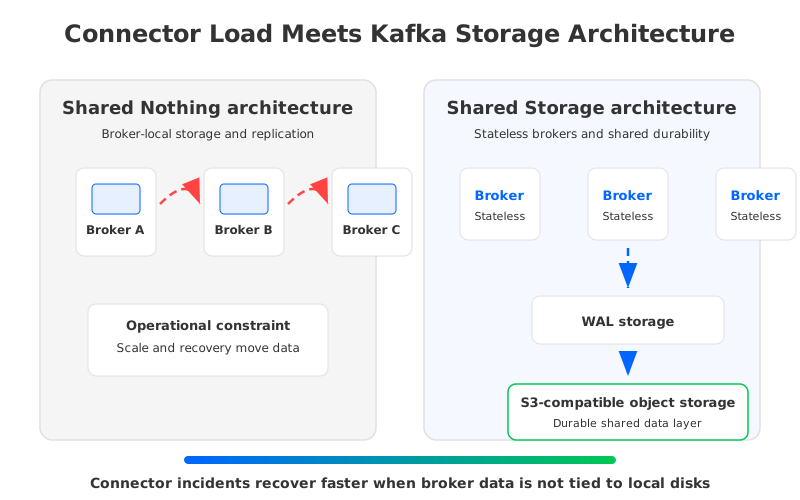
Traditional Kafka deployments add another layer to the same pressure. In a Shared Nothing architecture, brokers own local storage and rely on broker-to-broker replication for durability. Scaling the Kafka layer means planning broker capacity, disk, partition placement, replication traffic, and reassignment work. Connector growth then lands on an already coupled system: more tasks produce or consume more records, more topics and internal topics need retention, and recovery work can compete with normal traffic. A secrets incident may begin in a connector, but the blast radius reaches broker storage, network throughput, and operational queues.
Tiered Storage can reduce the cost of retaining older Kafka data, but it does not make brokers stateless. Recent data still depends on local broker storage, leadership, and replication behavior. That distinction matters for connector operations because many connector incidents are about recovery velocity: how quickly can the platform absorb lag, restart tasks, rebalance load, and return to a steady state after a credential or network change?
3Architecture options and trade-offs
There are several credible ways to run connector secrets management for Kafka, and none should be dismissed as universally wrong. The right answer depends on who owns the connector runtime, how sensitive the connected systems are, how often credentials rotate, and how much operational control the platform team needs.
| Option | Where it fits | Trade-off to test |
|---|---|---|
| Self-managed Kafka Connect with externalized secrets | Teams that want plugin control, custom workers, and direct integration with an internal secret manager. | The team owns worker patching, plugin review, restart behavior, monitoring, and secret-provider integration. |
| Managed connector service | Teams that want less worker infrastructure and faster onboarding for common sources and sinks. | The service boundary may hide worker details, network behavior, plugin versions, or secret handling semantics. |
| Kafka-compatible platform with integrated connector management | Teams standardizing streaming and data integration as one platform boundary. | The platform must prove Kafka compatibility, security isolation, observability, and recovery behavior under rotation and failure. |
| Dedicated ELT or CDC tool feeding Kafka | Teams that want source-specific capture and operational abstraction outside Kafka Connect. | Kafka still needs topic governance, retention, replay, and downstream ownership. |
The key is to compare operating models, not product names. A connector platform should be evaluated by the work it removes, the control it preserves, and the failure modes it makes visible. Secrets management is a useful forcing function because it exposes whether a platform has clear boundaries or a pile of undocumented exceptions.
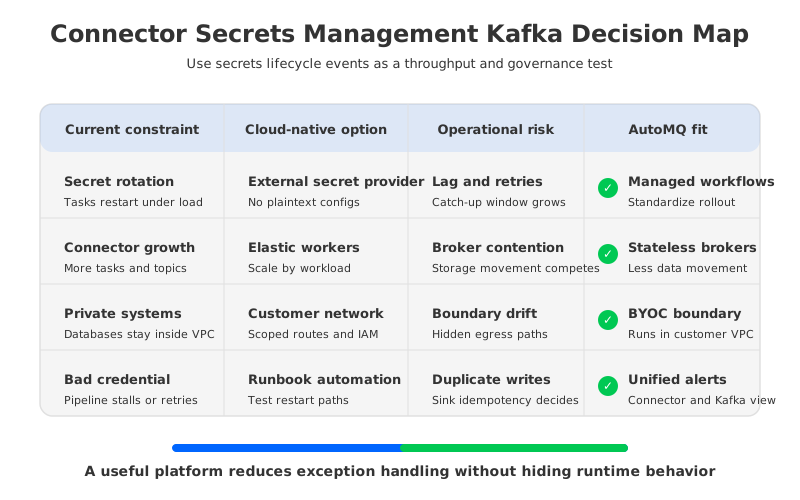
Compatibility comes first. Kafka Connect plugins may depend on connector class names, converters, single message transforms, internal topics, offset formats, task counts, and error-handling semantics. A platform that accepts Kafka client traffic but breaks connector behavior is not enough for a data integration migration. Validate connector plugins and worker configs before validating cost or user interface convenience.
Cost comes next, but not as a single line item. Connector cost includes worker compute, Kafka broker capacity, storage, cross-Availability Zone traffic, PrivateLink or private endpoint charges, secret manager API usage, observability, and operator time. Cloud pricing pages can tell you what each service charges, but the architecture decides how often those meters run. A design that creates extra cross-zone traffic during replication or connector routing can make a small connector fleet look more expensive than expected.
Governance is the third filter. Each connector should have an owner, secret scope, network path, Kafka principal, topic allowlist, dead-letter policy, and rollback plan. If those controls are implemented manually, throughput planning turns into ticket planning. The connector platform needs a repeatable contract so data teams can move quickly without bypassing security review.
Recovery is the final filter. Ask what happens when a secret is revoked by mistake, a database account expires, a sink token loses permission, or a worker group restarts during peak traffic. The answer should include offset safety, duplicate handling, lag catch-up, alerting, and rollback. A connector that resumes correctly after a bad rotation is more valuable than a connector that only looks clean during the first deployment.
4Evaluation checklist for platform teams
A practical checklist keeps the discussion from drifting into generic security language. Use the following questions when planning connector throughput and secrets management together:
- Compatibility: Can your current connector classes, converters, transforms, internal topics, and offset behavior move without changing application semantics?
- Secret lifecycle: Can credentials be created, scoped, rotated, revoked, and audited without writing secret values into connector configs, Terraform state, images, or logs?
- Throughput under change: What happens to lag and task assignment during credential rotation, worker restart, plugin upgrade, and source throttling?
- Network boundary: Do connector workers reach private sources and sinks through documented VPC, subnet, security group, PrivateLink, or private endpoint paths?
- Cost model: Which meters grow with connector count, task count, throughput, retention, cross-zone traffic, and secret-manager calls?
- Failure recovery: Can the team prove restart position, sink idempotency, dead-letter behavior, and rollback before a production incident?
- Observability: Are task errors, lag, worker health, secret-resolution failures, and downstream throttling visible in the same operational view?
The checklist is deliberately operational. A design can look compliant in a diagram and still fail the first time a credential rotation overlaps with a backfill. The platform should be judged by the path from policy to runtime behavior.
5How AutoMQ changes the operating model
Once the evaluation framework is clear, the architecture question becomes easier: how much of the connector operating model is caused by Kafka's broker-local storage assumptions, and how much is caused by connector runtime ownership? AutoMQ is a Kafka-compatible streaming platform that keeps the Apache Kafka protocol and ecosystem surface while replacing broker-local persistent storage with a Shared Storage architecture backed by S3-compatible object storage.
That change does not remove the need for good connector governance. Secrets still need scoped ownership, rotation policy, audit evidence, and careful sink-side duplicate handling. What it changes is the Kafka operating model underneath connector growth. AutoMQ Brokers are stateless because persistent data lives in shared storage through S3Stream, WAL storage, and object storage. Broker replacement, scaling, and partition reassignment no longer require the same broker-local data movement that traditional Kafka deployments must plan around.
For connector-heavy environments, this matters in three ways. First, elastic broker capacity is easier to align with connector throughput because adding or replacing brokers is less tied to copying partition data. Second, recovery work has less contention with storage rebalancing because data ownership can move through metadata and leadership changes rather than large local-disk transfers. Third, multi-AZ cost planning changes when the platform can reduce broker replication traffic and use object storage as the durable data layer.
AutoMQ BYOC also keeps the deployment boundary aligned with enterprise security reviews. In BYOC, the control plane and data plane run in the customer's cloud account and VPC, and customer data remains within that environment. That boundary is important for connector secrets because many connectors need private routes to databases, warehouses, object stores, or internal APIs. A managed connector feature is more useful when it can operate inside the same customer-controlled network and identity boundary instead of forcing data integration traffic through an external runtime.
Managed Connector in AutoMQ BYOC builds on that model by providing a managed Kafka Connect capability through the AutoMQ control plane. The goal is not to make secret governance disappear. The goal is to standardize connector deployment, task monitoring, alerting, and operational workflows so the platform team can treat connectors as managed infrastructure rather than a collection of handcrafted worker clusters. For teams that already rely on Kafka semantics, the combination of Kafka compatibility, Shared Storage architecture, stateless brokers, and customer-controlled deployment boundaries gives them a cleaner place to enforce secrets policy without turning every connector into a bespoke operations project.
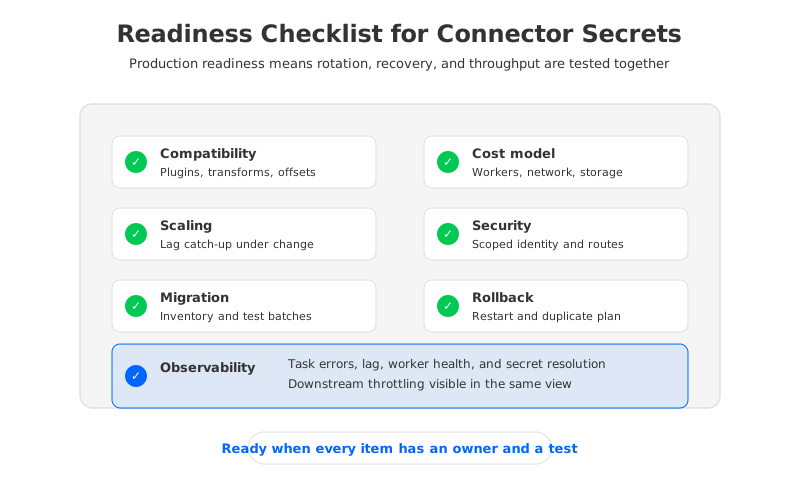
The migration path should still be staged. Start by inventorying connectors, plugin versions, task counts, internal topics, secrets, source and sink systems, network paths, and rollback behavior. Then test a representative source connector, a representative sink connector, and one high-throughput pipeline under credential rotation. Measure lag, restart time, duplicate behavior, and alert quality. The result should be a readiness score, not a promise that every connector will behave the same way.
Connector secrets management is a throughput problem because secrets are on the hot path of data movement. If your team is evaluating Kafka-compatible streaming platforms with that lens, review AutoMQ's BYOC and Managed Connector model as part of the operating-model comparison: explore AutoMQ Cloud.
6FAQ
6.1Is connector secrets management only a Kafka Connect configuration problem?
No. Kafka Connect supports externalized configuration patterns, but production secrets management also includes identity scope, network routes, audit evidence, worker restart behavior, offset safety, and sink-side duplicate handling. The configuration mechanism is one part of the operating model.
6.2Should connector credentials rotate during peak ingestion windows?
Avoiding peak windows is safer, but the platform should still be tested under realistic load. Rotation can restart tasks, break external sessions, or trigger retries. A production plan should measure connector lag, task recovery, and downstream side effects during a controlled rotation exercise.
6.3Does Shared Storage architecture remove the need to plan connector capacity?
No. It changes the Kafka broker operating model, but connector workers, external systems, task parallelism, and network paths still need capacity planning. The benefit is that broker scaling and recovery are less constrained by local data movement.
6.4What should be validated before migrating connectors to a Kafka-compatible platform?
Validate connector plugins, connector configs, converters, transforms, internal topics, offset behavior, secret-provider integration, network reachability, observability, dead-letter behavior, and rollback. A successful connector start is not the same as a safe migration.


