
Table of Contents
Table of Contents
Teams usually search for sink connector idempotency kafka after a sink has taught them a hard lesson. A database table contains duplicate rows after a connector restart. A warehouse load job replays the same batch after a worker rebalance. A CDC pipeline looks healthy in Kafka metrics, yet the downstream system shows gaps, retries, and write amplification. These incidents rarely start as obvious Kafka failures. They start as a mismatch between source throughput, connector commit behavior, sink write semantics, and the platform's ability to recover without moving the problem elsewhere.
Sink connector idempotency is the discipline of making repeated delivery safe at the destination. Kafka gives you offsets, consumer groups, producer idempotence, transactions, and Kafka Connect, but a sink connector still writes to a system that may not share Kafka's ordering, transaction, or retry model. Throughput planning matters because idempotency is not a boolean setting. The same connector can behave predictably at moderate volume and become fragile when a rebalance, sink throttling, or batch retry exceeds its write-path assumptions.
The practical question is not "Can Kafka support idempotency?" The better question is "What throughput can this sink sustain while keeping duplicates, retries, offset commits, and recovery inside an acceptable operating envelope?" That question forces platform teams to evaluate architecture, capacity, governance, and migration risk together instead of treating the connector as an isolated integration component.
1Why teams search for sink connector idempotency kafka
Most production sink pipelines are at-least-once before they are anything else. Kafka Connect workers poll records, pass them to sink tasks, write to the destination, and commit offsets according to connector and worker behavior. If a task writes records and fails before offsets are committed, those records can be delivered again. If the sink supports upserts, deterministic keys, or transactional batch writes, the replay may be harmless. If the sink appends blindly, the same replay becomes duplicate data.
That is why the search query often appears during design reviews, not only during outages. Teams want to know whether to rely on connector behavior, destination constraints, Kafka transactions, deduplication tables, or a custom write pattern. Each choice has a different throughput cost:
- Idempotent writes at the sink work well when every record has a stable key and the destination can treat repeated writes as updates. The cost moves into key design, index pressure, and write contention.
- External deduplication can protect append-only sinks, but it adds state and often creates a second bottleneck outside Kafka.
- Transactional sink writes can reduce partial batch exposure, but the sink must support transactions with acceptable latency at the target batch size.
- Offset discipline keeps replay windows bounded, but it does not make an unsafe downstream write safe by itself.
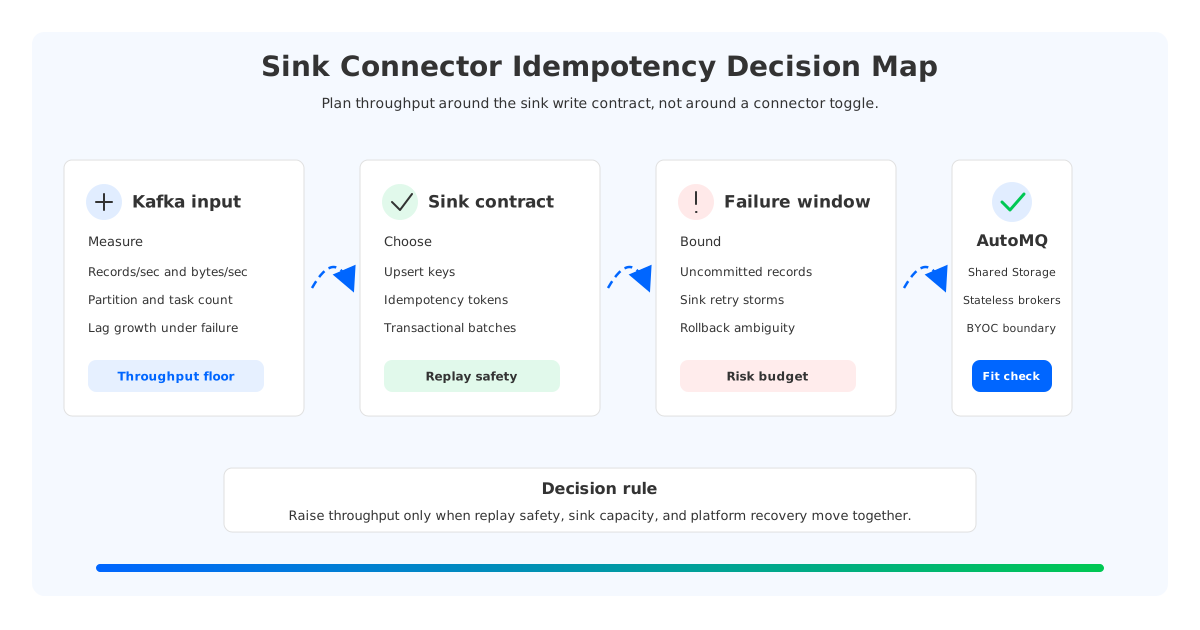
These choices are not interchangeable. A connector writing account balances into a relational table can often use primary-key upserts. A connector writing immutable events into object storage needs a different strategy, usually based on deterministic object paths, commit files, or downstream compaction. A connector loading a SaaS API may be constrained by rate limits and idempotency keys that expire. Throughput planning starts by naming the sink's real write contract.
2The production constraint behind the problem
Throughput exposes idempotency bugs because it compresses recovery time. At low volume, a restarted connector might replay a few records, and the destination catches up before anyone notices. At higher volume, the same restart can replay a large batch, saturate the sink, delay offset commits, trigger more retries, and push consumer lag upward. The connector is not broken in a simple sense. It is operating outside the rate at which the sink can absorb repeated delivery.
There are four constraints worth separating before changing the Kafka cluster or connector configuration:
| Constraint | What to measure | Why it matters for idempotency |
|---|---|---|
| Source ingress | Records per second, bytes per second, partition count | Sets the minimum sustained rate the connector must process. |
| Sink write capacity | Accepted writes, throttled writes, batch latency | Determines whether retries are rare recovery events or a constant mode of operation. |
| Replay window | Uncommitted records per task, batch size, commit interval | Defines how much duplicate work can appear after failure or rebalance. |
| Recovery behavior | Rebalance duration, restart time, lag drain rate | Shows whether the system returns to steady state or keeps amplifying backlog. |
The replay window is where many teams underestimate the problem. Smaller batches can reduce the number of records repeated after a crash, but they may also lower sink efficiency. Larger batches improve throughput, but a failed batch can make more work ambiguous. Commit offsets too aggressively, and you risk acknowledging records before the sink has made them durable. Commit too slowly, and you widen the replay window. The right answer depends on the sink's write contract, not on a universal connector setting.
Kafka's partition model also matters. A sink task normally receives records from assigned partitions. More partitions can increase parallelism, but they can also multiply concurrent writes against the same downstream index, table, bucket, or API. If the sink's idempotency key is too coarse, parallelism turns into contention. If it is too fine, deduplication may not catch repeated writes that should map to the same business entity. This is why connector throughput planning belongs in the same conversation as topic design and downstream schema design.
3Architecture options and trade-offs
The traditional Kafka operating model adds another layer to the problem. In a Shared Nothing architecture, each broker owns local storage for its partitions, and durability is achieved through replication among brokers. That model is proven, but it binds capacity planning to broker-local disks, partition placement, inter-broker replication, and data movement during rebalancing or scaling. For sink connectors, the effect is indirect but real: platform teams reserve more broker capacity than the steady-state connector load requires because recovery, retention, and rebalancing are expensive operations to trigger under pressure.
When connector throughput grows, the platform team has several choices. None is wrong by default, but each changes a different part of the risk model.
| Option | What it improves | What it does not solve |
|---|---|---|
| Tune connector tasks and batches | Raises sink-side parallelism and can improve write efficiency. | Does not change the sink's idempotency contract or broker storage model. |
| Add partitions | Increases available consumer parallelism for sink tasks. | Can increase downstream contention and operational spread. |
| Add brokers or storage | Gives the cluster more headroom for traffic and retention. | May require data movement and more capacity planning. |
| Use a cloud-native Kafka-compatible platform | Changes how storage, scaling, and recovery behave. | Still requires correct sink keys, offsets, and write semantics. |
This is where platform architecture becomes relevant. If every scaling event requires broker-local storage planning, teams become conservative. They overprovision to avoid data movement during incidents, avoid partition changes because reassignment competes with production traffic, and keep connector recovery windows larger than they want.
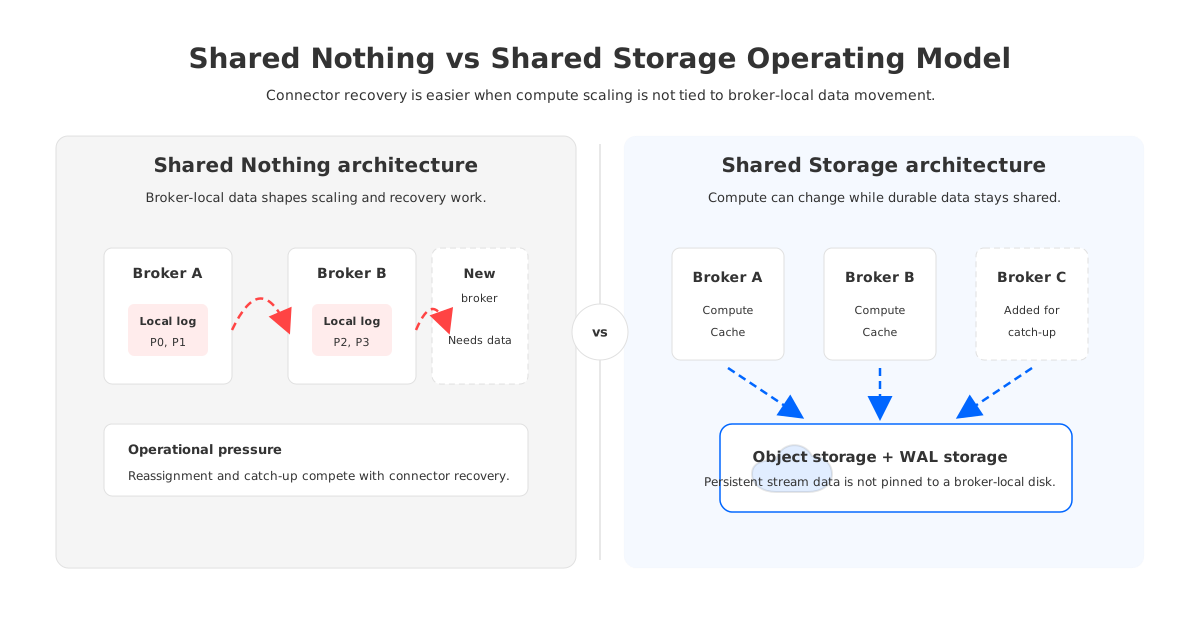
A Shared Storage architecture changes this operating model by separating compute from durable storage. Brokers continue to serve Kafka protocol requests, but persistent data lives in shared object storage rather than being pinned to broker-local disks. The architectural implication is straightforward: scaling compute does not have to mean copying large amounts of partition data between brokers. For connector-heavy platforms, that reduces the friction around adding capacity, replacing brokers, and absorbing temporary catch-up load after a downstream outage.
This does not make sink connector idempotency automatic. It makes the platform less likely to be the limiting factor while the integration team fixes the real idempotency contract. That distinction is important. A better storage architecture cannot turn an append-only API into an idempotent sink, but it can give the team a more elastic and predictable Kafka-compatible foundation while they design retries, keys, offsets, and rollback paths.
4Evaluation checklist for platform teams
The most useful evaluation is a readiness review, not a vendor comparison spreadsheet. A connector that looks safe in staging can fail in production because staging rarely reproduces sink throttling, worker eviction, rebalance storms, or long catch-up after destination downtime. Before committing to a throughput target, platform teams should answer these questions.
- What makes a repeated write safe? Identify whether the sink uses primary-key upserts, deterministic object names, idempotency keys, transactional commits, or downstream deduplication. If the answer is "the connector retries," the design is incomplete.
- How large is the replay window? Estimate the number of records that can be written but not committed during a worker crash, restart, or rebalance. Keep the estimate tied to connector batch size, task count, and commit behavior.
- Can the sink drain backlog faster than it receives incoming data? A connector that only matches steady-state ingress has no recovery margin. After any outage, lag will persist or grow.
- Who owns schema and key changes? Idempotency usually depends on stable keys. If the data integration team cannot enforce key quality, the platform team inherits duplicate-handling risk.
- What is the rollback path? A safe plan includes a way to pause the connector, replay from a known offset, quarantine duplicate-prone data, and restore downstream state.
These questions prevent a common mistake: treating idempotency as a connector feature rather than an end-to-end property. The connector, Kafka cluster, destination system, schema owner, and incident response path all participate. Throughput is the stress test that reveals whether those boundaries are clear.
5How AutoMQ changes the operating model
After the neutral checklist, the architectural requirement becomes clearer: a Kafka-compatible platform for connector-heavy workloads should preserve Kafka semantics while making capacity changes less dependent on local disk movement. AutoMQ fits that category. It is a Kafka-compatible streaming platform built around Shared Storage architecture, stateless brokers, and object-storage-backed durability.
For sink connector idempotency planning, the useful point is not that AutoMQ changes the sink write contract. It does not. The useful point is that AutoMQ changes the platform pressure around that contract. Because persistent stream data is stored in shared object storage through S3Stream and WAL (Write-Ahead Log) storage, broker replacement and scaling are not organized around moving broker-local partition data. That makes it easier to add compute capacity for connector catch-up, isolate unhealthy nodes, or rebalance traffic without turning the storage layer into the slowest part of the recovery.
AutoMQ BYOC also matters for data integration teams with strict network and governance boundaries. The control plane and data plane run inside the customer's cloud account and VPC, while customer data remains in the customer-controlled environment. For connector pipelines that move operational data into databases, warehouses, object storage, or analytics services, this boundary is often as important as throughput. The platform team can evaluate connector routing, IAM, private networking, observability, and rollback inside the same cloud account instead of routing business data through an external hosted control plane.
AutoMQ Managed Connector extends that operating model to Kafka Connect itself. It gives teams a managed way to deploy and operate connectors in AutoMQ BYOC, while keeping the underlying question honest: the connector still needs a safe idempotency design at the sink. What changes is the amount of platform work required to keep workers, brokers, scaling, and observability aligned with the throughput target.
6A readiness scorecard for production rollout
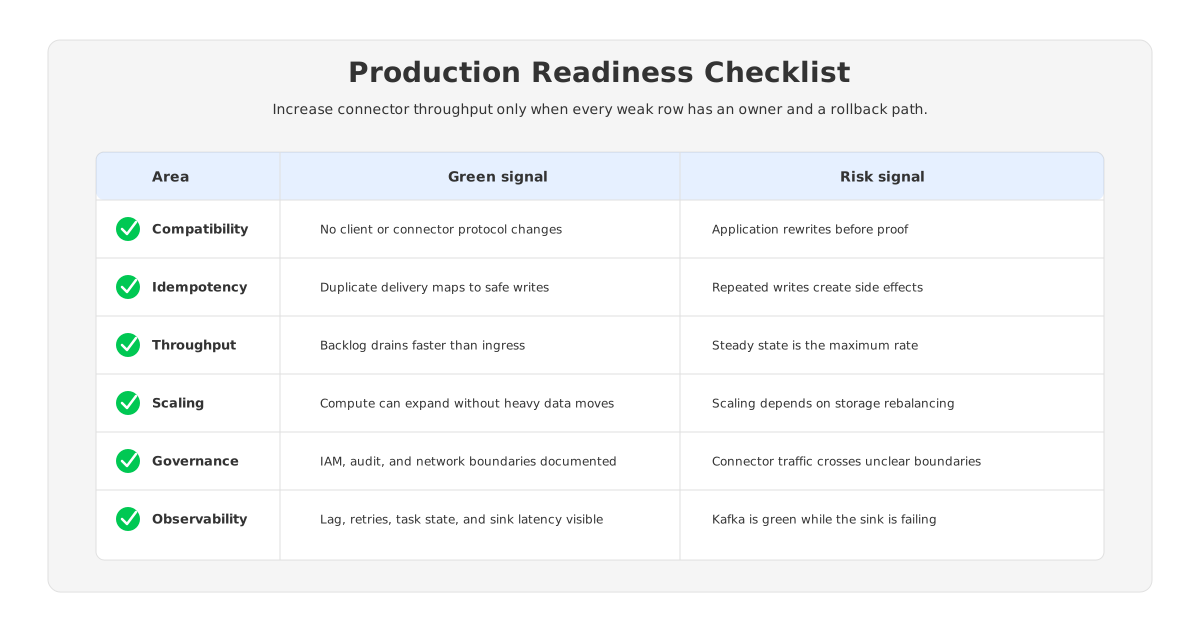
Use the following scorecard before increasing connector throughput. A team does not need a perfect score to ship, but every weak row should have an owner and a rollback plan.
| Area | Green signal | Risk signal |
|---|---|---|
| Compatibility | Existing Kafka clients, Connect workers, and sink connectors run without protocol changes. | Migration requires application rewrites before the idempotency model is proven. |
| Idempotency contract | Duplicate delivery maps to safe upserts, deterministic writes, or bounded deduplication. | Duplicate delivery creates irreversible side effects. |
| Throughput margin | Sink can drain backlog faster than source ingress after interruption. | Steady-state throughput is the maximum achievable rate. |
| Scaling model | Additional connector and broker capacity can be added without heavy data movement. | Scaling depends on long storage rebalancing or manual placement. |
| Governance | Network, IAM, audit, and data residency boundaries are documented. | Connector traffic crosses boundaries the security team has not approved. |
| Observability | Lag, retries, sink errors, task state, and write latency are visible together. | Kafka looks healthy while the destination silently accumulates bad writes. |
| Rollback | The team can pause, replay, quarantine, and restore from known offsets. | Recovery depends on ad hoc deletes or manual downstream cleanup. |
The scorecard should be run with production-like fault injection. Restart a worker during a large batch. Throttle the sink. Force a rebalance. Pause the destination long enough to build lag, then measure whether the connector drains it without widening the duplicate window. These tests answer the question that matters: can the platform survive the exact failure mode idempotency is supposed to make boring?
If your team is evaluating Kafka-compatible infrastructure for connector-heavy workloads, review the AutoMQ BYOC path and compare it against your connector readiness scorecard: talk to AutoMQ.
7FAQ
7.1Does Kafka guarantee sink connector idempotency?
Kafka provides the primitives that make reliable processing possible, including offsets, consumer groups, producer idempotence, and transactions. A sink connector still has to write to an external system, so end-to-end idempotency depends on the connector implementation and the destination's write semantics.
7.2Is exactly-once semantics the same as sink idempotency?
No. Exactly-once semantics in Kafka addresses how records are produced and processed within Kafka's transactional model. A sink connector writes outside Kafka, so the destination must still tolerate retries, partial failures, and repeated delivery.
7.3Should teams increase partitions to improve sink throughput?
More partitions can increase parallelism, but they can also increase downstream contention. Increase partitions only after confirming that the sink can handle parallel writes with the chosen idempotency key and batching strategy.
7.4Where does AutoMQ help most?
AutoMQ helps when the Kafka-compatible platform itself becomes the operational bottleneck for scaling, recovery, or governance. It does not remove the need to design idempotent sink writes, but its Shared Storage architecture and stateless brokers reduce the storage-side friction around connector-heavy workloads.


