
Table of Contents
Table of Contents
Teams do not search for tiered storage assumptions kafka because storage tiers sound interesting. They search for it when a Kafka cluster that used to feel manageable starts carrying a different job: longer retention, more replay, more audit history, and less tolerance for broker capacity mistakes. The first instinct is reasonable. Move older segments to object storage, keep hot data on broker disks, and stop buying expensive local or block storage for rarely read data.
That instinct solves part of the problem, but it can hide the part that matters most in production. Retention is not only a storage cost question. It changes how brokers recover, how partitions move, how consumers replay, how cloud network bills grow, and how the platform team explains failure boundaries to security and governance teams. A tiered design can reduce retained bytes on broker disks while leaving the operational model mostly unchanged.
The useful question is therefore not “does Kafka support tiered storage?” Apache Kafka has documented tiered storage concepts and configuration. The harder question is which assumptions remain true after you extend retention and make replay a normal workload rather than an exception.
1Why teams search for tiered storage assumptions kafka
The search usually begins after one of three events. A compliance requirement pushes retention from days to months. A lakehouse or ML pipeline starts replaying historical events instead of consuming only the live tail. Or an incident forces the team to rebuild a downstream system, and the rebuild interferes with the primary cluster.
Kafka operators know how to size for write throughput, partition count, and short-term consumer lag. They often have a less precise model for cold reads because older Kafka estates treated replay as a rare event. Once replay becomes routine, the storage layer becomes part of the service contract. A team that promises “90 days of retention” is also promising that those 90 days can be found, fetched, governed, and restored.
That is where tiered storage assumptions get slippery. Object storage is attractive because it changes the cost curve for retained data, and cloud providers document storage classes, request charges, lifecycle policies, and access characteristics in detail. But Kafka is not a file archive. It is a log with ordering, offsets, consumer groups, compaction, transactions, retention policies, and operational habits built around partitions. Moving bytes out of the broker-local hot tier does not automatically move ownership, recovery, or replay pressure out of the broker operating model.
2The production constraint behind the problem
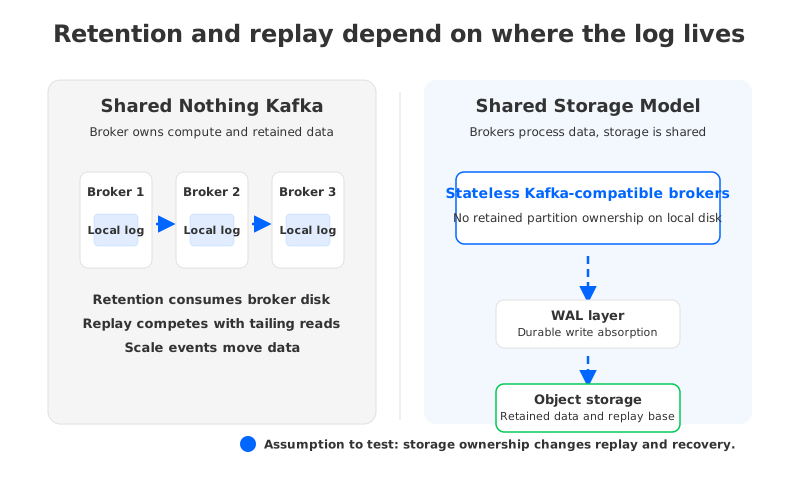
Traditional Kafka is a Shared Nothing system. Each broker owns local log segments for the partitions assigned to it, and Kafka’s replication protocol keeps follower replicas in sync. This design is durable and well understood. It also means the broker is not interchangeable compute. It is compute, storage, and part of the recovery surface.
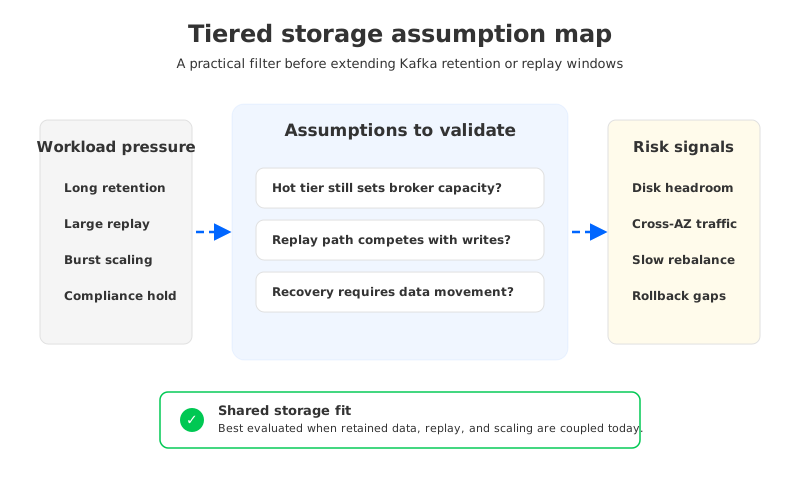
Tiered storage softens the storage pressure by making remote storage part of the log lifecycle. In a practical deployment, however, the hot tier still matters. Brokers need enough local capacity and I/O headroom for active segments, leader traffic, follower traffic, compaction where applicable, and consumer reads that have not moved to the remote tier. If a scaling event, broker replacement, or partition reassignment still requires local state movement, then the system has reduced retained storage cost but has not fully escaped broker-state operations.
The replay path is the second constraint. When a consumer group falls far behind or a downstream system requests a long historical scan, the cluster must serve reads that are very different from tailing reads. Catch-up reads touch older segments, may pull from remote storage, and can generate request and network patterns that were absent from the original write-throughput sizing exercise.
The cloud bill is the third constraint, and it is easy to underestimate because it is spread across different meters. Teams tend to model storage capacity first. Then production adds cross-Availability Zone replication, client placement, object storage requests, private connectivity, and egress boundaries. The Kafka-specific cost depends on where producers, brokers, consumers, and retained data sit relative to each other.
3Architecture options and trade-offs
There are three broad ways to respond when retention and replay pressure outgrow the original cluster design. None is universally right. The right answer depends on which assumption is currently hurting you.
| Option | What changes | What remains risky |
|---|---|---|
| Larger broker-local storage | More disk or block storage per broker; fewer retention emergencies | Broker state grows, recovery remains heavy, over-provisioning becomes normal |
| Kafka tiered storage | Older log segments move to remote storage; hot tier can shrink | Hot-tier sizing, replay isolation, request cost, and operational semantics still need testing |
| Shared storage architecture | Brokers no longer own retained data as local state; storage becomes a shared service | Requires architecture migration, compatibility validation, and a new failure model review |
Bigger broker-local storage is familiar and often defensible for stable workloads, but it compounds the broker-state problem. A broker with more local data is harder to replace, rebalance, and reason about during failure.
Tiered storage is the natural middle path. It can improve the economics of long retention and reduce pressure on the hot tier. The evaluation should not stop at “old segments are remote.” It should test what happens when many consumers replay old offsets, when remote reads coincide with traffic spikes, and when a broker failure happens during backfill.
Shared storage changes the operating model rather than adding another tier under the old one. The retained log lives in a shared storage layer, often object storage, with a write-ahead layer to absorb low-latency writes. That can remove much of the broker-local data movement that makes retention and scaling painful, but client behavior, protocol semantics, rollback, observability, and security boundaries still need testing.
4Evaluation checklist for platform teams
The strongest evaluations start with workload behavior, not vendor features. Before choosing a storage model, build a small matrix that separates what your applications require from what your infrastructure currently assumes. Kafka storage problems become expensive when basic assumptions remain implicit.
Start with compatibility. List the Kafka features that are in real use: idempotent producers, transactions, compacted topics, Kafka Streams state stores, Connect workloads, consumer group behavior, ACLs, quotas, and admin tooling. A storage architecture that is excellent for append-and-scan workloads may still be a poor fit if it weakens a semantic your applications depend on.
Then test replay as a first-class workload. Run a backfill while normal consumers are tailing. Watch broker CPU, storage request rates, cache hit behavior, consumer lag recovery, and latency at the live tail. If the architecture has a remote tier, measure the point at which remote reads become visible to applications or operators.
The cost model needs the same realism. Storage capacity is only one line. A useful model includes these categories:
- Hot-tier capacity and IOPS. Even with remote storage, the hot tier may determine broker sizing, failure recovery time, and compaction headroom.
- Remote storage capacity and requests. Object storage is usually cost-effective for retained data, but request patterns and retrieval classes matter when replay is frequent.
- Cross-zone and private connectivity traffic. Multi-AZ Kafka replication, client placement, PrivateLink-style connectivity, and egress boundaries can dominate the bill for high-throughput systems.
- Operational labor. Partition reassignment, broker replacement, incident drills, and compliance exports consume engineering time that rarely appears in a per-GB spreadsheet.
Governance should be evaluated before migration, not bolted on afterward. Long retention makes Kafka part of the audit and data governance surface. The team must know who controls encryption keys, where data physically resides, how lifecycle policies interact with Kafka retention, how deletion is proven, and how access to replayed data is audited.
Finally, design the rollback path while enthusiasm is still low. A migration from broker-local retention to tiered or shared storage changes the recovery surface. You need a plan for offset validation, mirrored topics, cutover criteria, lag thresholds, and a decision point for reverting clients.
5How AutoMQ changes the operating model
Once the evaluation reaches the point where broker-local ownership is the root constraint, a shared storage model becomes worth examining. AutoMQ is a Kafka-compatible cloud-native streaming platform that takes this route: it keeps Kafka protocol semantics while replacing Kafka’s broker-local storage layer with S3Stream, a shared streaming storage layer backed by object storage and a WAL layer.
The architectural difference is subtle on a slide and large in operations. In classic Kafka, retained data is physically tied to the broker’s local log layout. In AutoMQ’s shared storage architecture, data is written through a WAL for durability and write efficiency, then stored in object storage as the retained data layer. Brokers no longer need to carry the full retained partition state on attached disks.
That changes retention first. Longer retention no longer implies the same growth in broker-local data ownership. It also changes replay because historical reads are served from a storage architecture designed around shared retained data rather than from a broker whose disk estate is also the scaling boundary. Object storage still has latency and request-cost characteristics that must be engineered around; the WAL and caching layers exist because streaming systems cannot pretend every object storage operation behaves like a local disk read.
The compatibility question is equally important. AutoMQ’s public docs describe an approach that reuses Kafka’s compute layer and replaces the storage layer around log segments. That cut point determines whether existing clients, consumer groups, compaction behavior, Connect jobs, and operational tooling can remain familiar. For most platform teams, the migration value is changing storage ownership without asking application teams to rewrite Kafka clients.
AutoMQ also has a specific cost implication in multi-AZ cloud deployments. Its documentation describes an S3-based shared storage approach that avoids broker-to-broker replica replication traffic across Availability Zones and supports routing patterns to reduce inter-zone client traffic. For retention-heavy workloads, the cost driver is often not only retained bytes; it is the repeated movement of those bytes across zones.
This does not remove the need for testing. It changes what you test. Instead of asking only how much disk to buy per broker, you ask whether the WAL option matches latency needs, whether object storage request patterns fit replay behavior, whether IAM and encryption boundaries satisfy governance, and whether observability covers both broker health and storage-layer behavior.
6A readiness scorecard for retention and replay
The cleanest way to finish an evaluation is to give every candidate architecture the same scorecard. A tiered storage design, a larger local-storage design, and a shared storage design should all pass through the same gates.
| Gate | Pass condition | Why it matters |
|---|---|---|
| Compatibility | Real clients and ecosystem tools pass functional tests | Kafka semantics are the product contract |
| Replay isolation | Backfills do not destabilize live tail consumption | Retention has value only if replay is usable |
| Cost visibility | Storage, requests, network, and operations are modeled | Per-GB storage alone hides the real bill |
| Failure recovery | Broker replacement and partition movement are exercised | Retention increases recovery stakes |
| Governance | Encryption, residency, lifecycle, and audit controls are clear | Longer history increases compliance exposure |
| Migration safety | Mirror, offset validation, cutover, and rollback are rehearsed | Architecture changes should not depend on hope |
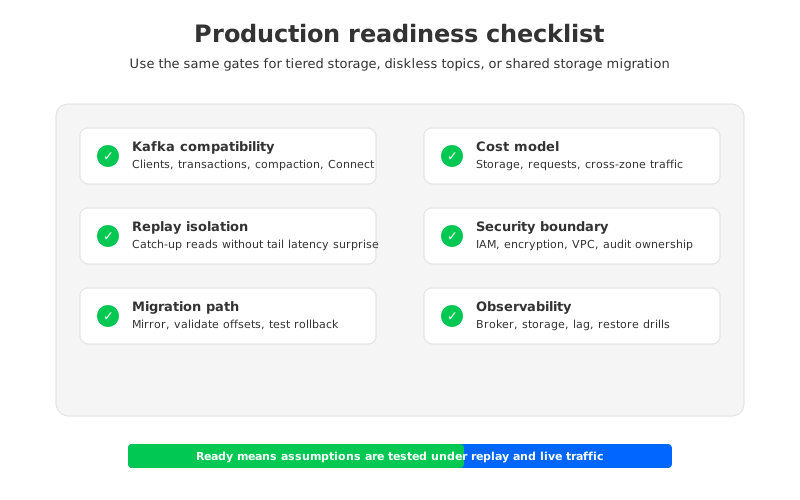
The scorecard also prevents a common mistake: treating tiered storage as a yes-or-no feature. In production, it is a set of assumptions about hot data, cold data, reads, writes, metadata, failure, and cost. If a proposal cannot explain how replay behaves during a broker incident, the evaluation is not done.
If your current Kafka estate is under pressure from retention and replay, test the storage ownership model directly. AutoMQ’s shared storage architecture is one option to include when broker-local data movement and cross-AZ replication are the pain points you are trying to remove. Use the AutoMQ architecture documentation as the next checkpoint for that evaluation.
7References
- Apache Kafka documentation: Operations and configuration
- Apache Kafka documentation: Tiered Storage
- Apache Kafka documentation: Consumer configuration
- Apache Kafka documentation: Producer configuration
- AutoMQ documentation: Architecture overview
- AutoMQ documentation: S3Stream shared streaming storage
- AutoMQ documentation: Native compatible with Apache Kafka
- AutoMQ documentation: Eliminate inter-zone traffic
- AWS documentation: Amazon S3 storage classes
- AWS pricing: Amazon EC2 On-Demand pricing
- Google Cloud documentation: Cloud Storage classes
- Microsoft Learn: Azure Blob Storage access tiers
8FAQ
8.1Is tiered storage enough for long Kafka retention?
It can be enough when the main problem is retained-byte cost and replay is predictable. It is less likely to be enough when broker replacement, partition reassignment, cross-zone traffic, or frequent backfills are already painful.
8.2What is the difference between tiered storage and shared storage?
Tiered storage usually keeps a broker-local hot tier and moves older segments to remote storage. Shared storage changes the ownership model so retained data lives in a storage service that is not tied to a single broker’s local disk.
8.3What should I measure during a Kafka replay test?
Measure live-tail latency, consumer lag recovery, broker CPU, storage throughput, object storage request rate, network traffic by zone, and error rates. Also measure whether operators can throttle replay and identify the source of pressure.
8.4Does object storage remove all Kafka storage complexity?
No. Object storage changes the durability and capacity model, but streaming systems still need low-latency writes, efficient reads, metadata consistency, caching, and clear recovery behavior.
8.5When should AutoMQ be part of the evaluation?
AutoMQ is worth evaluating when the main constraint is broker-local state: slow scaling, expensive multi-AZ replication traffic, long retention on attached disks, or operational risk during replay. It is a different storage ownership model that should be validated against your Kafka semantics, security boundary, and migration plan.


