
Table of Contents
Table of Contents
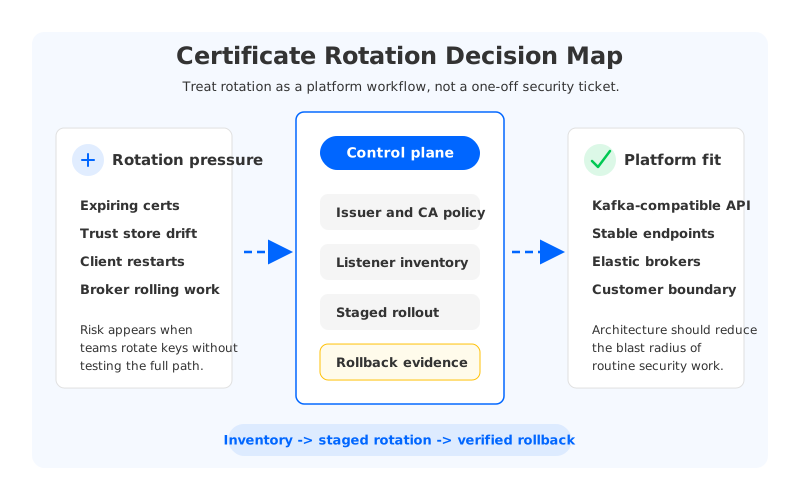
Teams search for tls certificate rotation kafka when a routine security requirement starts to look like an availability risk. A certificate is approaching expiry. A private certificate authority is changing. A compliance team wants shorter credential lifetimes. A platform team knows the cluster cannot pause while brokers, clients, connectors, automation jobs, and trust stores converge on the updated chain. The problem is not whether Kafka can use TLS. Apache Kafka documents SSL/TLS authentication and authorization patterns clearly. The hard part is rotating those materials across a live streaming platform where producers and consumers expect stable endpoints.
The stress comes from the shape of Kafka itself. A single cluster may have external listeners for applications, internal listeners for brokers, admin clients, Kafka Connect workers, observability agents, CI/CD jobs, and downstream services that keep their own trust stores. Some clients refresh metadata quickly. Others pin DNS, cache connections, or run inside release pipelines that deploy once per quarter. If the rotation plan assumes every participant updates at the same time, the plan is already fragile.
TLS rotation is therefore a platform workflow. It touches identity, networking, client compatibility, broker lifecycle management, incident response, and audit evidence. The question for architects is not "how do we replace a file?" It is "how do we rotate trust without breaking the data plane?"
1Why teams search for tls certificate rotation kafka
The search usually starts with a narrow operational trigger. A certificate has an expiry date, and the team needs commands, configuration names, or a Kubernetes operator procedure. That first pass is useful, but it hides the wider dependency graph. Kafka TLS sits between every client and broker. In mutual TLS designs, both sides may need certificate material. In SASL plus TLS designs, TLS may still carry server authentication, encryption, and hostname verification. In regulated environments, certificate rotation may also be tied to evidence collection, key management policy, and approved issuer changes.
Kafka adds a few practical wrinkles. Broker listeners can have different security settings. Inter-broker traffic may use one listener while applications use another. Clients may validate hostnames against advertised listeners, and those advertised names may differ across private networks, public endpoints, Kubernetes services, or cloud load balancers. A certificate that is cryptographically valid can still fail because the subject alternative name does not match the endpoint a client actually uses.
That is why a rotation runbook needs more than a broker restart sequence. It must include inventory. Which listeners exist? Which certificate authorities are trusted? Which client libraries and runtime environments are in use? Which connectors or stream processors need their own trust stores? Which teams own deployment pipelines for workloads that cannot be interrupted during a maintenance window? The answers turn TLS rotation from a security task into a production readiness exercise.
The most reliable teams separate the problem into two phases. First, they expand trust so old and updated chains can coexist. Then they replace presented certificates and remove retired trust after traffic proves healthy. That pattern avoids a brittle all-at-once cutover. It also creates a useful audit trail: the team can show what changed, when it changed, which services were tested, and how rollback would work.
2The production constraint behind the problem
Certificate rotation feels deceptively small because the artifact is small. The operational blast radius is large because the artifact controls connectivity. When a producer cannot validate a broker certificate, the failure looks like an application outage. When a connector loses trust, the data pipeline may fall behind without immediately stopping every consumer. When an admin client fails during the same window, the platform team may lose the very tool it planned to use for remediation.
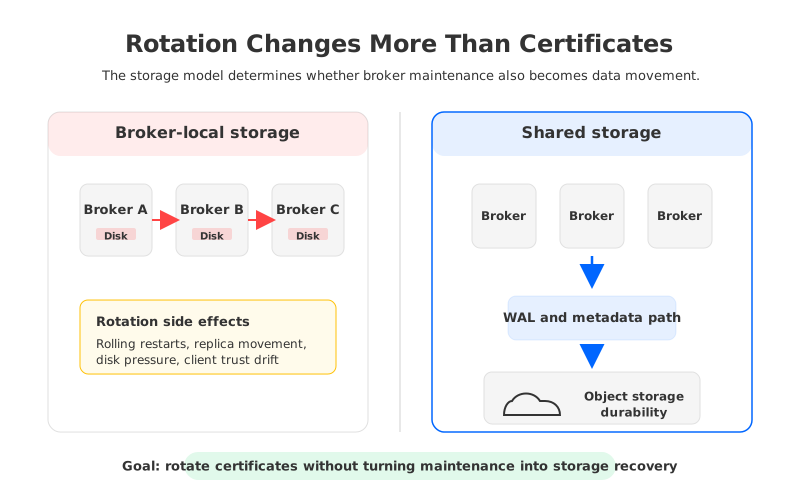
Traditional Kafka deployments intensify this pressure because brokers are stateful infrastructure. A rolling broker change is not merely a container replacement. The platform has to preserve leader availability, replication health, controller stability, disk headroom, and client reconnection behavior while the security change rolls through the fleet. If storage is tied to broker-local disks, any maintenance operation also carries the background concern that a bad restart, node problem, or capacity issue will become a data placement issue.
That does not mean broker-local Kafka cannot rotate certificates safely. Many teams do it well. The point is that the operating model has little room for confusion. A rotation plan that ignores ISR health, client retry behavior, trust-store propagation, or rolling restart order can turn a routine security change into a partial outage. The same applies to managed and Kubernetes-based deployments: automation helps when it encodes the right lifecycle, and it hurts when it hides the state transitions that operators need to verify.
The cost side is less visible but still real. Every failed rotation consumes platform engineering time, incident response attention, and sometimes extra capacity. If the team delays rotation because it fears disruption, the organization accumulates security risk. If the team rotates too aggressively without testing, it accumulates availability risk. The right platform design narrows that gap.
3Architecture options and trade-offs
TLS rotation can be implemented through several operating patterns. The right choice depends on team maturity, deployment model, and how much control the organization needs over issuers, private networking, and workload identity.
| Option | What it gives you | Rotation risk to evaluate |
|---|---|---|
| Self-managed Kafka on virtual machines | Maximum control over files, listeners, restart order, and certificate authority policy | The team owns every client inventory, broker rollout, rollback, and audit step |
| Kafka on Kubernetes with an operator | Declarative lifecycle management, secret integration, and repeatable rolling changes | Operator behavior must be tested for partial failures, listener changes, and client trust propagation |
| Managed Kafka service | Reduced broker maintenance and a provider-defined certificate process | Control over issuer policy, timing, private endpoints, and workload-specific trust stores may be constrained |
| Kafka-compatible shared-storage platform | Kafka semantics with a different broker and storage operating model | Compatibility, deployment boundaries, WAL design, and operational access need validation |
The table is not a ranking. It is a reminder that certificate rotation has two halves: the cryptographic material and the platform behavior around it. A managed service can reduce broker work but may give the security team less control over certificate authority choices. A self-managed deployment gives deep control but makes the internal team responsible for every failure mode.
Client behavior deserves special attention. Kafka clients often keep long-lived connections. Some applications have careful retry and metadata refresh settings. Others treat startup as their main validation point for infrastructure assumptions. A mature platform team tests representative producers, consumers, stream processors, and connectors through the rotation path before touching production. The goal is to discover whether any workload depends on a pinned certificate, stale trust store, nonstandard hostname verification rule, or fragile deployment pipeline.
Authorization should be reviewed at the same time, but not confused with TLS itself. TLS can authenticate endpoints and encrypt transport. Kafka authorization, such as ACLs, still defines what a principal can do to topics, consumer groups, transactional IDs, and cluster operations. A rotation should not widen permissions because the emergency path was easier. The cleaner approach is to rotate certificates while preserving the authorization model, then verify access with representative workloads.
4Evaluation checklist for platform teams
A useful tls certificate rotation kafka checklist starts with the live system, not with certificate commands. Draw the complete path from certificate authority to client runtime. Include brokers, external listeners, internal listeners, load balancers, DNS names, Kubernetes secrets, Java trust stores, container images, connector workers, CI/CD jobs, monitoring agents, and admin tooling. Then mark each component as inventory complete, staged, rotated, verified, or retired.
Use the following questions before choosing or changing a platform:
- Compatibility: Can existing Kafka clients, security protocols, hostname verification settings, and admin tools keep working during the rotation path?
- Governance: Who approves issuer changes, certificate lifetimes, trust-store updates, and emergency exceptions?
- Elasticity: Can broker replacement or restart happen without turning the event into a storage recovery or partition movement problem?
- Rollback: Can the platform restore the previous trust path, endpoint mapping, and secret version if client errors rise?
- Observability: Can operators see TLS handshake failures, client reconnect storms, broker health, consumer lag, connector task status, and authorization failures in the same window?
- Migration risk: If the platform is changing at the same time, can the team isolate certificate behavior from client cutover, offset movement, and application changes?
This checklist often exposes an ownership problem. Security owns policy, platform owns broker operations, application teams own clients, and networking owns endpoint reachability. Certificate rotation cuts across all of them. A strong design gives each team a named responsibility while keeping the sequence centrally visible.
5How AutoMQ changes the operating model
After the evaluation framework is clear, architecture becomes easier to judge. The relevant question is whether the platform makes routine security work less stateful and easier to reverse. If every broker operation is coupled to local storage, the platform team has to treat certificate rotation as another stateful maintenance event. If durable data is decoupled from broker-local disks, broker lifecycle work can become closer to compute maintenance.
AutoMQ is a Kafka-compatible cloud-native streaming platform built around shared storage and stateless brokers. Its relevance to TLS rotation is not that it replaces TLS, certificate authorities, ACLs, or security governance. Those controls still matter. The architectural difference is that AutoMQ separates compute from durable storage, with object storage carrying long-term durability and WAL choices serving the write path. That changes what operators are afraid of during broker replacement, scaling, or rolling maintenance.
In a shared-storage model, a broker can be treated more like replaceable compute because it is not the long-term owner of local log data. That does not remove the need for careful listener configuration or client testing, but it reduces the chance that a routine broker lifecycle event becomes a data relocation project. For platform teams, this matters because certificate rotation is rarely the sole maintenance item on the calendar. The same operating model affects upgrades, scaling, incident recovery, and capacity planning.
AutoMQ also fits teams that need customer-controlled deployment boundaries. In BYOC and private deployment patterns, the organization can keep streaming resources inside its own cloud environment while adopting a managed operating model. That is useful for certificate governance because issuer policy, network reachability, audit requirements, and data sovereignty can remain aligned with the customer's environment. The platform still needs explicit runbooks, but the control boundary is easier to explain to security and compliance reviewers.
The practical evaluation is straightforward: test AutoMQ or any Kafka-compatible platform with the same rotation workflow you expect to run in production. Keep the Kafka API surface, clients, ACLs, consumer groups, connectors, and observability path in the test. A platform that looks attractive in an architecture diagram should still prove that it can preserve client connectivity, expose useful signals, and roll back cleanly.
6A readiness scorecard for certificate rotation
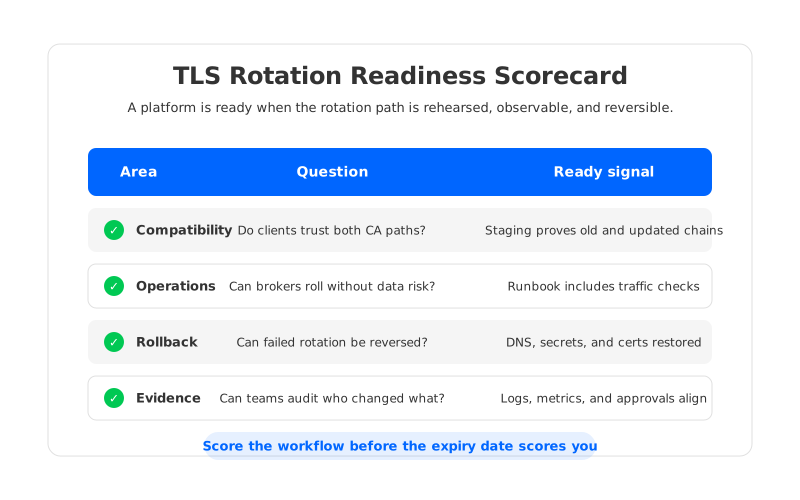
The final decision should be made with evidence. A team that has never rehearsed TLS rotation in staging is not ready because the wiki says it has a procedure. A team is ready when the procedure has touched representative workloads, produced metrics, generated audit evidence, and survived a planned rollback.
Score the platform across these dimensions:
| Dimension | Good signal | Warning signal |
|---|---|---|
| Client readiness | Representative clients trust both chains during staging | Production contains unknown client libraries or pinned certificates |
| Broker lifecycle | Rolling work preserves availability and produces clear health signals | Restart order depends on tribal knowledge |
| Storage coupling | Broker replacement does not require long data movement | Maintenance windows are dominated by disk and partition concerns |
| Governance | Issuer, approval, expiry, and exception paths are documented | Security and platform teams disagree during the change window |
| Observability | TLS, lag, connector, and broker signals are reviewed together | Errors are visible only after application teams report impact |
| Rollback | Previous trust path can be restored without widening access | Rollback requires manual edits across many teams |
This scorecard keeps the conversation grounded. It prevents the team from overvaluing a polished control plane while ignoring workload behavior. It also prevents the opposite mistake: staying with a familiar platform because the team has learned to survive its operational sharp edges. Familiar pain is still pain.
For teams evaluating Kafka-compatible infrastructure under security and compliance pressure, run certificate rotation as a proof point. If the platform can handle trust changes, broker lifecycle work, client compatibility, observability, and rollback without drama, it is likely healthier than a platform that passes only steady-state benchmarks. AutoMQ's BYOC and shared-storage architecture are designed for teams that need Kafka compatibility, customer-controlled deployment boundaries, and a more elastic operating model. You can review the deployment model on the AutoMQ BYOC page and compare it against the scorecard above.
7References
- Apache Kafka documentation: SSL authentication
- Apache Kafka documentation: Authorization and ACLs
- Apache Kafka documentation: Consumer groups and offsets
- AutoMQ documentation: Shared Storage architecture overview
- AutoMQ documentation: Kafka compatibility
- AutoMQ: Bring Your Own Cloud Kafka data streaming
8FAQ
8.1What is the safest way to rotate TLS certificates in Kafka?
The safest pattern is staged trust expansion followed by certificate replacement and trust retirement. Add the updated certificate authority or chain to client and broker trust stores first, verify representative workloads, rotate presented certificates through a controlled rollout, then remove retired trust after production traffic is stable. The exact commands depend on the deployment model, but the sequence should preserve connectivity throughout the window.
8.2Does TLS certificate rotation require Kafka downtime?
It should not require downtime when the platform supports rolling broker work, clients can trust both old and updated chains during the transition, and workloads have healthy retry behavior. Downtime risk rises when clients use pinned certificates, trust stores are unknown, listener names do not match certificates, or broker restarts are coupled to storage recovery concerns.
8.3How is certificate rotation different in mutual TLS?
Mutual TLS adds client certificate lifecycle management. The platform must rotate server certificates for brokers and client certificates for producers, consumers, connectors, and administrative tools. That makes inventory and ownership more important because every workload identity may have its own certificate, expiry, issuer, and revocation path.
8.4Where does AutoMQ fit in a TLS rotation strategy?
AutoMQ does not replace TLS policy or Kafka authorization. It changes the operating model around broker lifecycle work by using Kafka-compatible shared storage and stateless brokers. For teams that need customer-controlled cloud boundaries and less storage-coupled maintenance, that architecture can make certificate rotation, upgrades, scaling, and broker replacement easier to rehearse and recover.


