
Table of Contents
Table of Contents
Teams searching for tool call telemetry kafka are past the demo stage. The prototype already logs prompts, responses, tool names, latency, and errors. The uncomfortable part begins when the agent starts touching production systems: a retrieval API, payment workflow, ticketing tool, code repository, warehouse query, or internal action service. At that point, telemetry becomes the record that explains what an agent tried to do, which context it used, and whether the output can be trusted.
Kafka enters the conversation because these events need to be durable, ordered enough to reconstruct behavior, replayable for investigation, and consumable by many downstream systems. Security wants audit trails, SREs want latency signals, data teams want evaluation datasets, and risk teams want policy evidence. One log sink rarely satisfies them.
The hard question is not whether agent telemetry can be sent to Kafka. It can. The harder question is whether the streaming platform can absorb bursty, governance-heavy event streams without turning every agent launch into a broker capacity project. Tool call telemetry stresses the storage model, not only the producer API.
1Why teams search for tool call telemetry kafka
Tool call telemetry is different from generic application logging because the event stream carries decision context. A normal service log might say that a request failed. An agent trace often needs to show the instruction, retrieved context, tool schema, arguments, authorization path, partial output, final response, and policy decision. Some of that data is sensitive; some is needed for replay; some should never be retained longer than policy allows.
That mix pushes teams toward an event streaming backbone. Kafka-compatible infrastructure gives them established producer and consumer semantics, consumer groups, offsets, replay, partitions, Kafka Connect, and a broad ecosystem. Those mechanics matter because agent telemetry has multiple consumers with different speeds: an incident detector may process events immediately, while an evaluation pipeline may replay yesterday's traces after a model change.
The search term is also a sign that the team is thinking about ownership. OpenTelemetry can describe spans and events, including semantic conventions for generative AI workloads, but the organization still needs a durable transport and retention layer.
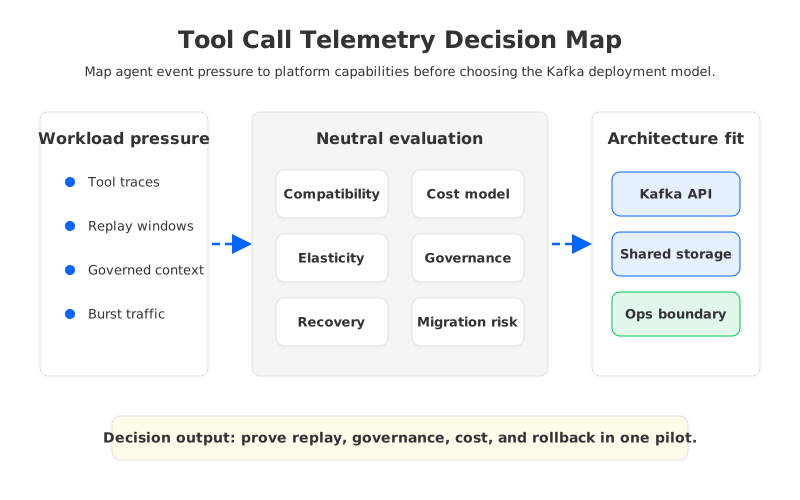
The production pressure usually shows up in four places:
- Burst shape: Agent traffic is often tied to user sessions, batch evaluations, or workflow automation windows. Over-provisioning brokers for rare peaks is expensive.
- Replay requirements: Investigation and model evaluation require historical reads. Replay is not a corner case; it is part of the operating model.
- Governance scope: Tool arguments, retrieved context, and outputs may contain customer data, secrets, regulated fields, or internal identifiers. Retention, encryption, access control, and redaction belong in the stream design.
- Downstream fan-out: Security analytics, warehouse ingestion, dashboards, quality evaluation, and incident response all want the same events without blocking one another.
Together, these requirements expose whether the Kafka platform is mostly a cluster of stateful disks or a cloud-native streaming substrate that can be scaled, governed, and migrated with predictable effort.
2The freshness and governance problem behind AI event streams
Agent systems put unusual pressure on freshness because the value of a telemetry event decays at different rates for different users. SREs need near-real-time error signals when a tool returns malformed output. Security teams need prompt evidence when a sensitive action is attempted. Data teams can tolerate more delay, but they need completeness and replay.
Traditional log pipelines often split those needs too early. Real-time traces go to one backend, raw logs go to another, audit records go somewhere else, and model evaluation data lands in a warehouse after a separate batch process. During an agent incident, the question is "what happened in this chain of tool calls, can we prove it, and can we replay the relevant context without exposing data to the wrong team?"
A streaming design keeps the event trail explicit. Tool call requests, tool responses, policy decisions, redaction outcomes, and evaluation labels can be modeled as events with keys that preserve relationships. Kafka topics do not solve governance by themselves, but they give platform teams a durable place to enforce ownership through schemas, ACLs, retention, connector boundaries, and consumer permissions.
Governance also changes the payload design. Raw prompts and tool responses are tempting to publish because they make debugging easier. In production, a layered pattern is safer: a minimal operational event for high-volume monitoring, a redacted detail event for investigation, and a restricted evidence stream for data that needs stricter access.
3Architecture options for durable, replayable AI context
Once the event model is clear, the next decision is the storage architecture. A conventional Kafka deployment stores partition logs on broker-local disks and relies on replication between brokers for durability and availability. That Shared Nothing architecture has served Kafka well for many workloads, but it also means retained data is attached to broker capacity.
That attachment becomes expensive when telemetry grows unevenly. Adding brokers can require partition reassignment and data movement. Increasing retention may mean provisioning more disk on the same machines that handle active traffic. Multi-AZ deployment improves availability, but it also introduces network paths that need careful cost modeling.
Tiered storage changes part of the equation by moving older data into object storage. The primary log still remains broker-local for the active working set, so scaling and recovery are still partly tied to broker storage. For tool call telemetry, that distinction matters: teams want near-real-time writes and cost-effective replayable history without turning every retention decision into another broker sizing cycle.
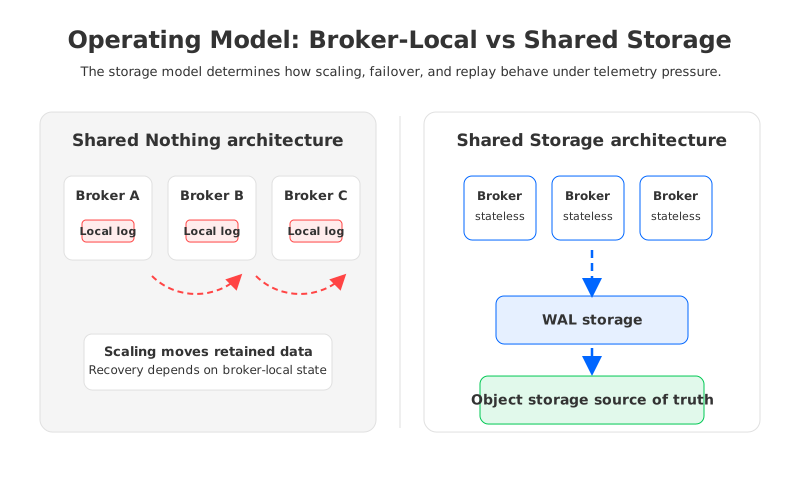
A Shared Storage architecture takes a more direct path: durable stream data is stored in shared cloud storage, while brokers behave more like stateless compute nodes for protocol handling, caching, leadership, and scheduling. The details vary by implementation, especially around write-ahead log design and low-latency writes, but the operating model changes in a concrete way: scaling compute no longer has to mean moving the long-lived log from one broker disk to another.
The trade-off is not magic. Shared storage systems still need predictable write acknowledgment, recovery for unflushed data, metadata correctness, cache design, and clear cloud storage cost modeling. The architecture is attractive because it changes the main constraint, but it must be tested against the agent workload.
4Evaluation checklist for platform teams
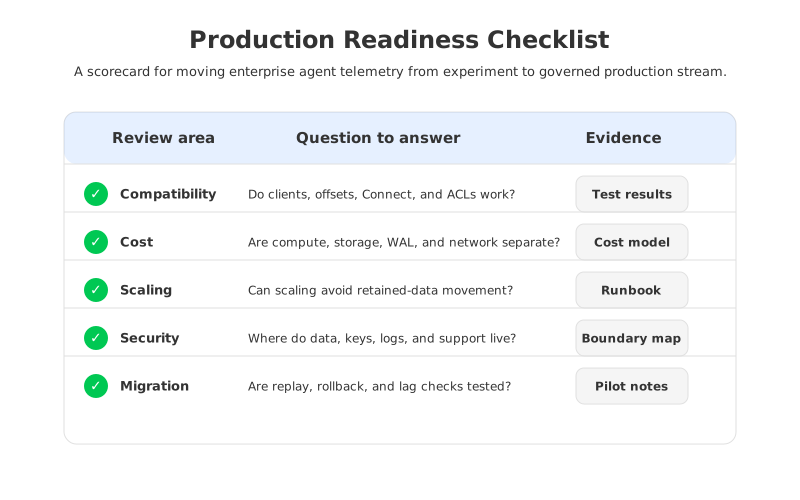
The strongest evaluation starts with a neutral checklist. A tool call telemetry platform is not only a message bus. It is an evidence system, an operations system, and a migration boundary. Every option, including self-managed Kafka, managed Kafka, BYOC platforms, and Kafka-compatible alternatives, should answer the same questions.
| Evaluation area | What to verify | Why it matters for agent telemetry |
|---|---|---|
| Kafka compatibility | Producers, consumers, offsets, transactions where needed, Kafka Connect, ACLs, monitoring tools, and client versions | Agent teams should not rewrite working ingestion and consumer code to adopt a different storage model |
| Event model | Topic design, keys, schemas, retention, redaction, and payload separation | Tool call data often mixes operational signals with sensitive context |
| Cost model | Compute, storage, WAL, object requests, cross-zone networking, private connectivity, and operations | Telemetry volume grows quickly, and the cost driver may not be where the application team expects |
| Elasticity | Scale-out, scale-in, partition movement, broker replacement, and burst handling | Agent launches can create sudden traffic without predictable long-term baselines |
| Recovery | Broker failure, zone failure, replay, consumer lag recovery, and rollback | The platform must preserve the event trail when the agent system is already under investigation |
| Governance | IAM, ACLs, encryption, audit logs, support access, and deployment boundary | Tool payloads can carry regulated or confidential data |
| Migration risk | Dual writes, connector cutover, consumer lag validation, and rollback plan | Observability migrations fail when teams cannot prove event equivalence |
For each row, ask for evidence from a pilot: metrics, cost estimates, replay tests, failure drills, and security review notes. A platform that looks strong in diagrams but cannot show a credible migration and rollback path is not ready for enterprise agent telemetry.
5How AutoMQ changes the operating model
After that neutral framework is in place, AutoMQ becomes relevant as a Kafka-compatible, cloud-native streaming platform built around a Shared Storage architecture. Tool call telemetry magnifies the problems that broker-local storage makes operationally heavy: retained-data movement, storage over-provisioning, multi-AZ traffic modeling, and slow capacity changes.
AutoMQ keeps Kafka protocol compatibility while replacing Kafka's broker-local log storage with S3Stream, WAL storage, and S3-compatible object storage. AutoMQ Brokers are designed as stateless brokers: they serve Kafka clients, but durable stream data is no longer owned by a specific broker disk. AutoMQ's public compatibility documentation says it leverages Apache Kafka's computing layer with storage-layer changes, which is why existing Kafka ecosystem components can remain part of the evaluation.
The WAL layer is the part to inspect carefully. Object storage is durable and cost-effective, but it is not a low-latency append log by itself. AutoMQ uses WAL storage to acknowledge writes and recover data that has not yet been uploaded to object storage. Its documentation describes S3 WAL, NFS WAL, and Regional EBS-style choices in commercial editions, while AutoMQ Open Source supports S3-compatible storage as the WAL option.
For cloud cost, the shift is that compute, durable storage, WAL choice, and network locality become separable levers. A conventional Kafka cluster often bundles these into broker count and disk size. AutoMQ's zero inter-zone traffic documentation describes how S3-based shared storage and same-AZ routing can reduce inter-zone data transfer paths for production, replication, and consumption traffic. Teams should still validate this in their own cloud account because private connectivity, client placement, and cloud-provider pricing can change the final bill.
Deployment boundary is the other reason AutoMQ belongs in the evaluation. In AutoMQ BYOC, the environment model places resources in the customer's cloud account and VPC, with the data plane privately accessible and maintenance access governed by authorization. For agent telemetry, that affects where tool payloads, metrics, logs, buckets, IAM policies, and support workflows live.
AutoMQ is not a substitute for event design. Teams still need schemas, redaction policy, topic ownership, access control, and consumer discipline. The narrower technical argument is this: if tool call telemetry makes broker-local storage the bottleneck for scaling, replay, and cloud cost, a Kafka-compatible Shared Storage architecture gives the team a different operating model without forcing a full ecosystem rewrite.
6A practical migration path
The safest migration starts with one telemetry stream that is important enough to matter but bounded enough to reason about. A good candidate is tool invocation events with a stable schema: agent ID, session ID, tool name, policy decision, timestamps, outcome, error class, and redacted metadata.
Run the pilot in parallel with the current telemetry path. Dual-write the event, consume it with a small set of downstream jobs, and compare counts, lag, ordering expectations, and replay behavior. Existing clients, consumer groups, and Kafka Connect jobs should behave as expected.
The migration scorecard should include five artifacts:
- A topic and schema design that separates operational telemetry from restricted evidence payloads.
- A replay test that reconstructs a known agent session from the stream.
- A cost model that separates broker compute, storage, WAL, object requests, network paths, and operations.
- A failure drill that covers broker replacement, consumer lag recovery, and rollback to the existing path.
- A governance review that identifies who can read each telemetry class and where the data physically resides.
If the pilot cannot produce these artifacts, the team may need clearer event contracts or stricter data classification before scaling telemetry. If it can, widen the stream set to tool errors, policy denials, retrieval events, evaluation labels, and high-value audit records.
The original search for tool call telemetry kafka starts with a transport question, but production turns it into an operating model question. The right platform lets your team prove what happened, replay what matters, control where sensitive context lives, and scale without making broker storage the center of every decision. To evaluate whether AutoMQ fits that path, start with a bounded workload and use the AutoMQ technical evaluation flow here: talk to AutoMQ.
7References
- Apache Kafka documentation for consumer groups, offsets, transactions, replication, Kafka Connect, and operational configuration.
- OpenTelemetry generative AI semantic conventions for standardizing AI and agent telemetry attributes.
- OpenTelemetry traces concepts for understanding spans, events, and trace relationships.
- Amazon S3 data durability documentation for object storage durability background.
- AWS PrivateLink pricing for cloud private connectivity cost considerations.
- AutoMQ compatibility with Apache Kafka for Kafka ecosystem compatibility positioning.
- AutoMQ architecture overview for Shared Storage architecture, S3Stream, WAL storage, and stateless brokers.
- AutoMQ WAL storage for WAL design and storage media options.
- AutoMQ zero inter-zone traffic overview for same-AZ routing and shared-storage traffic modeling.
- AutoMQ BYOC environment overview for customer cloud account and VPC deployment boundaries.
8FAQ
8.1Is Kafka a good fit for tool call telemetry?
Kafka is a strong fit when the telemetry needs durable ingestion, multiple independent consumers, replay, offsets, long retention, and integration with downstream systems. It is less compelling for a small prototype where a trace backend or application log store already satisfies debugging needs. The decision changes when telemetry becomes evidence for security, compliance, model evaluation, and incident response.
8.2How should agent tool calls be modeled as Kafka events?
Start with a stable event for each tool invocation: agent ID, session ID, tool name, request timestamp, response timestamp, outcome, error class, policy decision, and redacted metadata. Avoid publishing raw prompts, secrets, or full tool outputs to broad-access topics. Use separate restricted topics for evidence payloads that need tighter access control and retention policy.
8.3Do OpenTelemetry and Kafka compete in this architecture?
No. OpenTelemetry helps standardize traces, spans, events, and attributes. Kafka can act as the durable streaming backbone that moves selected telemetry events to security analytics, warehouses, evaluation pipelines, dashboards, and incident workflows. Many teams use both: OpenTelemetry for instrumentation and trace semantics, Kafka-compatible streaming for durable fan-out and replay.
8.4What is the main risk in using traditional Kafka for agent telemetry?
The main risk is not the Kafka API. It is the operating model behind broker-local storage. As telemetry volume and retention grow, teams may need more broker disk, more partition movement, more replication traffic analysis, and more careful capacity planning. For workloads with bursty traffic and long replay windows, that can make observability infrastructure feel heavier than the agent application it supports.
8.5When should AutoMQ be evaluated for tool call telemetry?
Evaluate AutoMQ when the team wants Kafka-compatible APIs but sees broker-local storage, slow scaling, cross-zone traffic cost, or deployment-boundary control as major constraints. It is especially relevant for cloud-native agent telemetry platforms that need replayable history, elastic capacity, and customer-controlled infrastructure boundaries. The right validation is a pilot that tests compatibility, replay, WAL choice, cost, governance, and rollback with one real telemetry stream.


