
Table of Contents
Table of Contents
Teams rarely leave Confluent Cloud, Amazon MSK, or Redpanda because they suddenly dislike event streaming. They leave because the current platform no longer matches the workload: the bill is hard to predict, the operational model is too heavy, the cloud boundary is wrong, or the team has outgrown the assumptions behind broker-local storage, hosted SaaS, or a Kafka-compatible engine.
That is why the replacement conversation should not start with "Kafka versus X." A payments system that depends on Kafka ordering, Connect, Schema Registry, and consumer group behavior has a different risk profile from an IoT ingestion pipeline that only needs durable fan-out into analytics. If you collapse those workloads into one generic "event streaming platform" bucket, you will either overpay for Kafka semantics you do not need or underestimate the migration risk of leaving them behind.
1Quick Answer
If you are leaving Confluent Cloud, AWS MSK, or Redpanda but still run Kafka workloads, start with Kafka compatibility, not brand familiarity. AutoMQ, Aiven for Apache Kafka, Amazon MSK, Confluent Cloud, Redpanda, WarpStream, and self-managed Apache Kafka all sit close to the Kafka migration path, but they make different bets about ownership, storage, operations, and protocol fidelity. If you do not need the Kafka API, Azure Event Hubs, Google Cloud Pub/Sub, Apache Pulsar, and NATS JetStream may be better fits for cloud-native messaging or streaming patterns.
| Platform | Best fit | Kafka posture | Main trade-off |
|---|---|---|---|
| AutoMQ | Kafka-compatible workloads that need customer-resident control plane, data plane, and object-storage economics | Kafka-compatible, storage layer redesigned around cloud object storage | Newer ecosystem than Confluent and AWS-native services |
| Confluent Cloud | Teams that want the richest managed Kafka ecosystem | Fully managed Apache Kafka-centered data streaming platform | Hosted-service boundary and premium platform packaging may not match every cost/control requirement |
| Amazon MSK | AWS-centered teams that want managed Apache Kafka | AWS-managed Apache Kafka | AWS-only operating model; capacity and cost modeling still matter |
| Redpanda | Teams open to a Kafka API-compatible non-JVM engine | Kafka API-compatible, not Apache Kafka internally | Compatibility and operational behavior must be tested against real workloads |
| WarpStream | High-throughput Kafka-compatible workloads suited to diskless/object-storage architecture | Kafka protocol over stateless agents and object storage | Confluent-owned, and not a neutral Apache Kafka broker replacement |
| Aiven for Apache Kafka | Managed open-source Kafka across clouds or BYOC | Managed Apache Kafka, with classic and object-storage-oriented options | Feature availability varies by tier and deployment model |
| Self-managed Apache Kafka | Maximum control and open-source baseline | Apache Kafka | Highest operational burden |
| Apache Pulsar / StreamNative | Multi-tenant streaming, geo-replication, and Pulsar-native designs | Different API and architecture, with Kafka-facing options in some offerings | Platform migration, not a drop-in Kafka service swap |
| Azure Event Hubs | Azure-native ingestion and event streaming with Kafka endpoint support | Kafka endpoint, not Apache Kafka brokers | Azure service semantics differ from Kafka internals |
| Google Cloud Pub/Sub | GCP-native asynchronous messaging, fan-out, and analytics ingestion | Not Kafka; Google provides Kafka migration/integration guidance | Per-message messaging model differs from partition-based Kafka designs |
The table is deliberately not a ranking by "best." It is a shortlist map. A team leaving Confluent for cloud-account control should not evaluate the same way as a team leaving MSK for lower storage overhead or a team leaving Redpanda because it needs Apache Kafka internals.
2What Counts as an Event Streaming Platform?
Event streaming platforms share a core job: they let producers write ordered or semi-ordered streams of events and let consumers process those events independently. Beyond that, the category splits quickly. Kafka popularized the durable distributed log as an application platform. Cloud providers then built managed ingestion services around similar event-streaming use cases. Systems like Pulsar and NATS JetStream approach the problem from different messaging and storage assumptions.
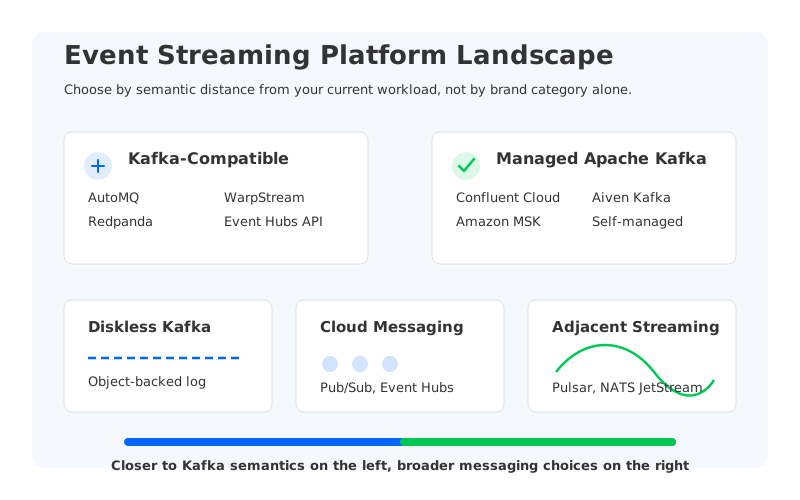
For buyers, the useful split is not "open source versus cloud." It is semantic distance from your current workload:
- Kafka-compatible platforms preserve the Kafka client surface or run Apache Kafka itself. They are the safest starting point when application rewrites, consumer group behavior, Connect pipelines, or existing Kafka operational knowledge matter.
- Kafka-derived cloud-native platforms keep the Kafka-facing workflow but redesign major internals such as storage, metadata, or broker state. These platforms can change the cost and elasticity profile, but they need compatibility testing.
- Cloud messaging and ingestion services solve many event streaming use cases without pretending to be Kafka. They can be excellent for telemetry, service decoupling, and analytics ingestion, but they are not neutral replacements for every Kafka workload.
- Adjacent streaming systems such as Pulsar or NATS JetStream may be better architectural choices when the target design cares more about multi-tenancy, lightweight messaging, or global fan-out than Kafka ecosystem continuity.
This distinction prevents a common evaluation mistake. Azure Event Hubs and Google Cloud Pub/Sub can both power serious streaming systems, but a team using Kafka transactions, compacted topics, specific admin APIs, or Kafka Connect connectors should not treat them as drop-in broker replacements. The reverse is also true: a new event ingestion pipeline should not inherit Kafka operational complexity only because the last platform did.
3How to Evaluate Platforms If You Are Leaving Confluent, MSK, or Redpanda
The first evaluation question is not whether the platform can move events. Most can. The harder question is what you are trying to escape. Confluent Cloud pain often comes from hosted-service boundaries, packaging, or platform cost. MSK pain often comes from broker sizing, storage, networking, and AWS-specific operations. Redpanda pain, when it appears, often centers on whether Kafka API compatibility is enough for the specific workload.
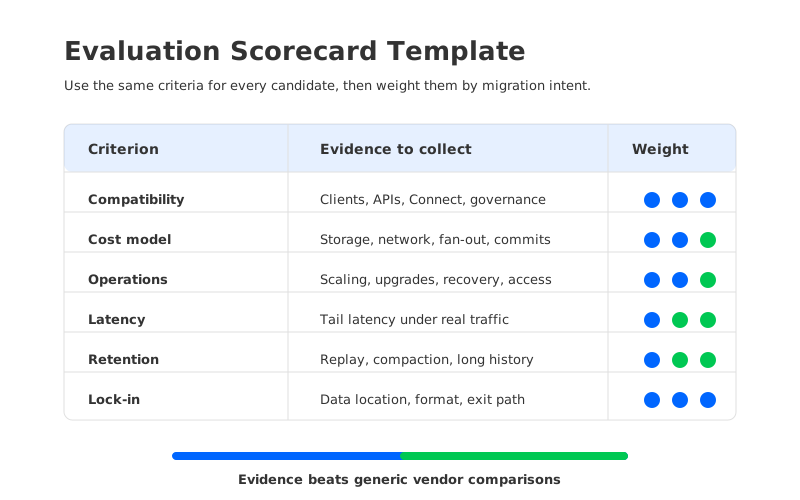
Use the same scorecard for every candidate, but weight the rows differently based on the migration intent:
| Criterion | What to test | Why it matters |
|---|---|---|
| Compatibility | Producer/consumer behavior, admin APIs, transactions, compaction, Connect, Schema Registry, observability tooling | This is the largest hidden migration cost for Kafka workloads. |
| Cost model | Broker or agent capacity, storage, read fan-out, retention, network transfer, private connectivity, minimum commitments | Vendor list prices rarely reveal the workload-shaped bill. |
| Operations | Scaling, upgrades, partition movement, incident handling, recovery, observability, support access | A lower platform bill can be erased by permanent operational drag. |
| Latency and throughput | Tail latency under real batch sizes, partitions, compression, consumer lag, and failure scenarios | Object-storage-backed and cloud messaging systems make different latency trade-offs. |
| Retention and replay | Long retention cost, historical read behavior, compaction, backfill, replay isolation | Streaming platforms become data infrastructure once replay matters. |
| Ecosystem | Connectors, stream processing, governance, security integrations, Terraform/IaC, managed services | Ecosystem depth is often why teams chose Confluent or AWS in the first place. |
| Lock-in and exit path | Data location, format, API portability, control plane boundary, open-source fallback | The second migration should be easier than the first. |
Pricing claims deserve special discipline. Public pricing pages are useful for unit economics, but private contracts, committed spend, cloud discounts, cross-zone traffic, support tiers, and workload shape can dominate the real number. Use official pricing pages to build a model, then validate it with your own throughput, retention, and fan-out profile.
4Top Event Streaming Platforms Compared
4.1AutoMQ
AutoMQ is a strong fit when the workload should stay Kafka-compatible but the team wants a cloud-native storage and deployment model. AutoMQ Cloud documentation describes a fully managed Kafka cloud service with 100% Apache Kafka compatibility, BYOC deployment where resources run in the user's cloud account/VPC, and object-storage-based architecture for elasticity and cost efficiency. The BYOC environment overview goes further: the environment console/control plane and Kafka service/data plane are both deployed in the user-defined network environment. That combination puts AutoMQ closest to teams leaving Confluent Cloud for stronger control-plane and data-plane ownership, leaving MSK because broker storage economics are painful, or leaving Redpanda because they want Kafka compatibility with a different cloud storage model.
The important architectural point is that AutoMQ should not be evaluated as "another hosted Kafka UI." Its value is in changing the broker-storage cost and elasticity assumptions while keeping Kafka-facing workloads close enough to migrate. That makes compatibility testing non-negotiable: run your real producers and consumers, check connector behavior, validate monitoring and ACL expectations, and test failure scenarios before making a platform decision.
Useful sources: AutoMQ Cloud overview, AutoMQ migration docs, AutoMQ GitHub.
4.2Confluent Cloud
Confluent Cloud remains the ecosystem-rich managed Kafka benchmark. Confluent positions it as a fully managed, cloud-native Apache Kafka service and wraps it with connectors, stream governance, stream processing, Tableflow, private networking options, and enterprise support. If you are leaving MSK or Redpanda because you want a more complete managed data streaming platform, Confluent Cloud is still a rational candidate.
The trade-off is that many teams reading this article are leaving Confluent Cloud itself. In that case, be precise about the reason. If the problem is vendor concentration, platform packaging, data-plane ownership, or cost model, moving deeper into the same ecosystem may not solve it. If the problem is self-managed or AWS-native Kafka operations, Confluent may be exactly the simplification you wanted.
Useful source: Confluent Cloud product page.
4.3Amazon MSK
Amazon MSK is the conservative AWS-native Apache Kafka option. AWS describes MSK as a fully managed service for Apache Kafka, and MSK Serverless adds a managed capacity model for teams that do not want to provision and manage broker capacity directly. For organizations already standardized on AWS networking, IAM, observability, procurement, and compliance patterns, MSK can reduce vendor review friction.
MSK does not remove every Kafka-shaped problem. Teams still need to understand cluster type, broker or capacity behavior, storage, private connectivity, quotas, upgrades, and data transfer. It is a strong choice when "managed Apache Kafka inside AWS" is the real requirement. It is less compelling when the migration goal is multi-cloud portability, object-storage-first economics, or escaping broker/storage planning as a core operating concern.
Useful sources: Amazon MSK developer guide, Amazon MSK Serverless, Amazon MSK pricing.
4.4Redpanda
Redpanda is most relevant when the team likes the Kafka API but wants a different implementation underneath. Redpanda documentation describes a Kafka API-compatible streaming platform with its own architecture rather than Apache Kafka's JVM broker model. Redpanda Cloud also offers managed deployment models, including BYOC for teams that want the data plane in their own cloud environment.
The buyer risk is not whether Redpanda can handle serious workloads. It can be a good platform for teams that validate the fit. The risk is assuming Kafka API compatibility equals Apache Kafka equivalence. If your workload depends on subtle broker behavior, ecosystem tools, connector assumptions, or operational procedures built around Apache Kafka, test those directly.
Useful sources: Redpanda architecture, Redpanda Cloud BYOC architecture.
4.5WarpStream
WarpStream belongs in the evaluation when object-storage-backed Kafka compatibility is attractive and the workload can fit its architecture. Its documentation describes stateless Agents that speak the Apache Kafka protocol, separate storage from compute, and use object storage plus a cloud metadata store. Confluent acquired WarpStream, so it is not a vendor-diversification path away from Confluent, but it may be a deployment-model alternative to conventional Confluent Cloud.
The architectural trade-off is explicit. WarpStream is not Apache Kafka with tiered storage; it is a diskless Kafka-compatible system. That can be compelling for high-throughput, retention-heavy workloads where object storage changes the economics. It should be tested carefully for latency-sensitive workloads, compaction behavior, consumer fan-out, and operational dependency on the managed control plane.
Useful sources: WarpStream architecture, Confluent WarpStream product page.
4.6Aiven for Apache Kafka
Aiven is a practical candidate for teams that want managed Apache Kafka without committing to a single cloud provider's native service. Aiven's documentation describes Aiven for Apache Kafka as a fully managed Apache Kafka service, with Classic Kafka and Inkless Kafka cluster types. The docs also state that Kafka services can run on Aiven Cloud or BYOC, with feature availability varying by service type and deployment model.
That makes Aiven especially useful for teams leaving MSK because they want cross-cloud consistency, or leaving Confluent because they want managed open-source data services with a different commercial model. The trade-off is that the exact feature set, Kafka Connect availability, BYOC eligibility, and cost model need to be checked against the plan and deployment model you will actually buy.
Useful sources: Aiven for Apache Kafka docs, Aiven BYOC docs.
4.7Self-Managed Apache Kafka
Self-managed Apache Kafka is still the baseline for maximum control. The Apache Kafka project describes Kafka as an event streaming platform that combines publish/subscribe, storage, and stream processing capabilities. If you need the most direct Apache Kafka semantics, full infrastructure control, and an open-source operating model, self-managed Kafka remains hard to beat on principle.
The cost is paid in people, process, and risk. Kafka operations involve partition planning, broker sizing, replication, upgrades, quotas, rebalancing, storage pressure, security configuration, consumer lag, and recovery procedures. Self-management is a good answer for platform teams that already have that muscle. It is a poor answer if the reason you are leaving MSK, Confluent, or Redpanda is that the streaming platform already consumes too much operational attention.
Useful source: Apache Kafka documentation.
4.8Apache Pulsar / StreamNative
Apache Pulsar is not a Kafka clone, and that is the point. Pulsar's architecture separates serving and storage through brokers and BookKeeper, and the project is often attractive for multi-tenancy, geo-replication, and messaging-plus-streaming designs. StreamNative packages Pulsar as a managed cloud platform and offers BYOC options for teams that want a managed Pulsar-centered architecture.
Pulsar is a serious candidate when the target architecture is broader than "run our Kafka applications somewhere else." It is less natural when the organization wants a conservative Kafka migration. Kafka protocol options can reduce some application friction, but a Pulsar move changes platform semantics, operational concepts, ecosystem tooling, and team skills.
Useful sources: Apache Pulsar concepts, StreamNative Cloud overview, StreamNative BYOC overview.
4.9Azure Event Hubs
Azure Event Hubs is a strong option when the workload is Azure-native ingestion rather than Kafka-platform preservation. Microsoft describes Event Hubs as a fully managed real-time data streaming platform, and its Kafka endpoint lets existing Kafka clients connect to an Event Hubs namespace without running Kafka clusters. That makes it attractive for telemetry, application logs, clickstream analytics, IoT ingestion, and pipelines feeding Azure analytics services.
The migration boundary is important. Event Hubs can speak the Kafka protocol, but it is not Apache Kafka brokers under the hood. Teams leaving Confluent, MSK, or Redpanda should test partitioning, retention, client configuration, Kafka Streams assumptions, connector support, and operational semantics before treating Event Hubs as a drop-in Kafka platform.
Useful sources: Azure Event Hubs overview, Azure Event Hubs for Apache Kafka overview.
4.10Google Cloud Pub/Sub
Google Cloud Pub/Sub is best evaluated as cloud-native asynchronous messaging and event distribution, not as Kafka in managed form. Google describes Pub/Sub as an asynchronous, scalable messaging service that decouples producers and consumers, supports streaming analytics and data integration pipelines, and uses per-message processing rather than Kafka's partition-based processing model.
That difference can be a benefit. Pub/Sub can simplify fan-out, service decoupling, and integration with Dataflow, BigQuery, Cloud Run, and other Google Cloud services. It can also be the wrong answer for applications that depend on Kafka ordering, partitions, broker-level controls, compacted topics, or Kafka ecosystem tools. If your team is leaving Kafka because the workload never needed Kafka semantics, Pub/Sub deserves a close look. If you need Kafka compatibility, look at Google Cloud Managed Service for Apache Kafka or Kafka-compatible platforms instead.
Useful source: Google Cloud Pub/Sub overview.
5Which Platform Fits Which Migration Path?
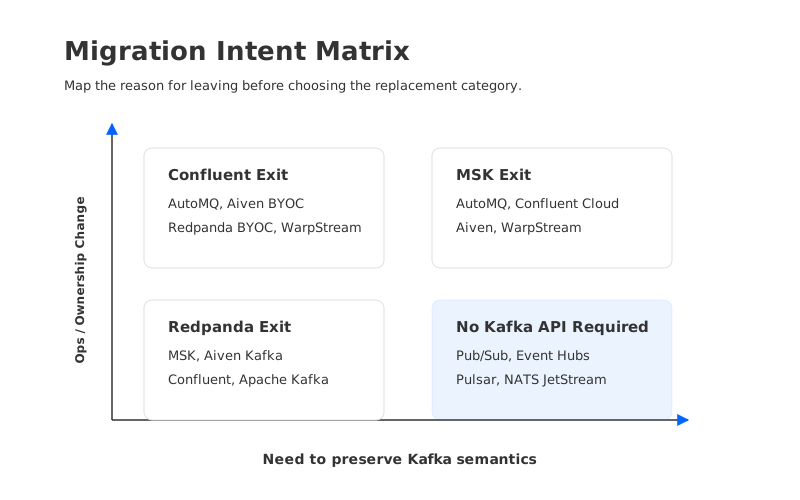
Leaving a platform is not a strategy by itself. The practical strategy is to name the constraint that changed and choose the replacement category around that constraint.
| Migration intent | Start with | Be careful with |
|---|---|---|
| Leaving Confluent Cloud for cloud-account control | AutoMQ, Aiven BYOC, Redpanda BYOC, WarpStream, StreamNative BYOC | AutoMQ is the stricter BYOC option when the control plane must also live in the customer environment; WarpStream is Confluent-owned, so it is not vendor diversification. |
| Leaving Confluent Cloud for lower Kafka infrastructure cost | AutoMQ, WarpStream, Aiven Inkless Kafka, MSK, self-managed Kafka | Compare full workload cost, not only vendor subscription lines. |
| Leaving MSK for less broker/storage planning | AutoMQ, Confluent Cloud, WarpStream, Aiven, Redpanda | Moving to another broker-based Kafka service may preserve the same planning work. |
| Leaving MSK for multi-cloud portability | AutoMQ, Aiven, Confluent Cloud, Redpanda, Apache Kafka | Native cloud services are convenient but can deepen provider lock-in. |
| Leaving Redpanda for Apache Kafka semantics | Amazon MSK, Aiven for Apache Kafka, Confluent Cloud, self-managed Kafka | Kafka-compatible systems should be tested rather than assumed equivalent. |
| Leaving Kafka APIs entirely | Azure Event Hubs, Google Pub/Sub, Apache Pulsar, NATS JetStream | Application and operational semantics will change; plan it as a redesign. |
For most teams with existing Kafka applications, the safest shortlist is a two-track evaluation. Track one contains conservative Kafka options such as MSK, Aiven, Confluent Cloud, and self-managed Kafka. Track two contains cloud-native or Kafka-compatible redesigns such as AutoMQ, WarpStream, and Redpanda. The first track reduces migration uncertainty. The second track is where the larger cost, elasticity, or ownership changes usually live.
6Where AutoMQ Fits
AutoMQ fits the path where Kafka compatibility still matters, but the team wants to change the cost and operations curve created by traditional broker-local storage. That is a narrower claim than "AutoMQ replaces every event streaming platform." It does not try to be Pub/Sub, Event Hubs, Pulsar, or NATS. It is most relevant when producers, consumers, and Kafka operational concepts should remain familiar while the underlying storage and deployment model become more cloud-native, and when the team wants both control plane and data plane to stay inside its own cloud environment.
That positioning matters because many platform migrations fail by solving the wrong problem. If the problem is "we do not need Kafka semantics," choose a cloud messaging or streaming service on its own merits. If the problem is "we need Kafka semantics, but the current cost, elasticity, or cloud boundary is wrong," AutoMQ belongs on the shortlist with other Kafka-compatible and managed Kafka options.
7FAQ
7.1What is the best event streaming platform for replacing Confluent Cloud?
There is no universal best replacement. If you want the closest managed Kafka ecosystem, evaluate Amazon MSK, Aiven for Apache Kafka, and self-managed Apache Kafka alongside Confluent alternatives. If you want cloud-account control and object-storage economics, evaluate AutoMQ and WarpStream, with AutoMQ standing out when control-plane residency is part of the requirement. If you want to leave Kafka semantics entirely, evaluate Azure Event Hubs, Google Pub/Sub, Pulsar, or NATS JetStream as a redesign.
7.2Is Redpanda a drop-in replacement for Kafka?
Redpanda is Kafka API-compatible, but it is not Apache Kafka internally. Many Kafka clients and workloads can work well, but compatibility should be proven with your real producers, consumers, admin workflows, connectors, security model, and operational tooling.
7.3Is AWS MSK cheaper than Confluent Cloud?
It depends on workload shape and commercial terms. MSK exposes AWS-native infrastructure and service costs, while Confluent Cloud packages a broader managed platform. Compare broker or capacity units, storage, retention, read fan-out, private networking, cross-zone transfer, support, connector needs, and operational labor before drawing a conclusion.
7.4When should a team choose Pub/Sub or Event Hubs instead of Kafka?
Choose Pub/Sub or Event Hubs when the workload is primarily cloud-native event ingestion, service decoupling, fan-out, or analytics pipeline integration and does not depend heavily on Kafka-specific semantics. If Kafka ordering, partitions, compaction, Connect, transactions, or existing Kafka tooling are central, treat them as migration targets that require deeper application testing.
7.5Should teams leaving Kafka consider NATS JetStream?
Yes, but usually for lightweight messaging, service communication, and simpler stream persistence patterns rather than as a broad Kafka platform replacement. NATS documentation describes JetStream as the persistence layer that lets messages be stored and replayed later, but its operational and semantic model is different enough that it should be evaluated as a new architecture.
7.6What is the lowest-risk migration path?
The lowest-risk path is usually the one with the smallest semantic change: Apache Kafka to managed Apache Kafka, or Kafka-compatible platforms validated against the real workload. The highest upside path may be different. Object-storage-backed or cloud messaging platforms can change the cost and operations profile more dramatically, but they deserve a proof of concept before procurement momentum takes over.


