
Table of Contents
Table of Contents
If you're reading this, there's a good chance your Confluent Cloud bill has a line item that makes you wince every month. You're not alone. Confluent built a powerful platform on top of Apache Kafka, but its pricing model — opaque CKU-based billing, per-partition fees, mandatory Private Link charges — has pushed many teams to ask a straightforward question: what else is out there?
The Kafka ecosystem has changed dramatically since Confluent dominated the conversation. WarpStream got acquired by Confluent (which itself was acquired by IBM for $11B). Redpanda raised hundreds of millions to build a C++ Kafka alternative. Aiven launched Inkless, its take on diskless Kafka based on KIP-1150. And a new architectural approach — diskless, S3-native Kafka — has moved from theory to production at companies like Grab, JD.com, and Tencent.
This isn't a rehash of "Top 12 Kafka Alternatives" with a paragraph on each. We're comparing five specific platforms that a team evaluating Confluent replacements would realistically shortlist, scored across the dimensions that actually matter: cost structure, elasticity, operational burden, cloud-native architecture, and Kafka compatibility.
1What's Actually Wrong with Confluent Cloud?
Before jumping to alternatives, it's worth understanding why teams leave. The issues aren't about Kafka itself — they're about how Confluent packages and prices it.
Confluent's SaaS model sits on top of cloud infrastructure. You pay for the underlying compute and storage, plus Confluent's margin on top. As throughput and retention grow, your bill scales with both cloud resource usage and Confluent's pricing layers. For a production workload at 300 MB/s average throughput with 50 TB retention, Confluent Cloud costs roughly $94,282/month — the highest among all major Kafka platforms, according to public pricing comparisons.
Three cost drivers stand out:
- The partition tax. Confluent charges $0.0015 per partition-hour. With hundreds of CDC tables or microservice topics, partition count becomes a pricing lever rather than an engineering decision. For many customers, partition fees alone exceed 50% of the total invoice.
- Private Link surcharges. Connecting your VPCs to Confluent Cloud requires Private Link, which generates recurring network charges that add zero direct business value.
- No BYOC option. Your data lives in Confluent's infrastructure. You can't leverage reserved instances, enterprise agreements, or committed cloud spend. Data residency is controlled by Confluent, not you.
These aren't edge cases. They're structural features of Confluent's business model. The question is whether the alternatives have matured enough to offer a credible path forward.
2The 5 Alternatives, Compared
Here's the quick overview before we dive into each one:
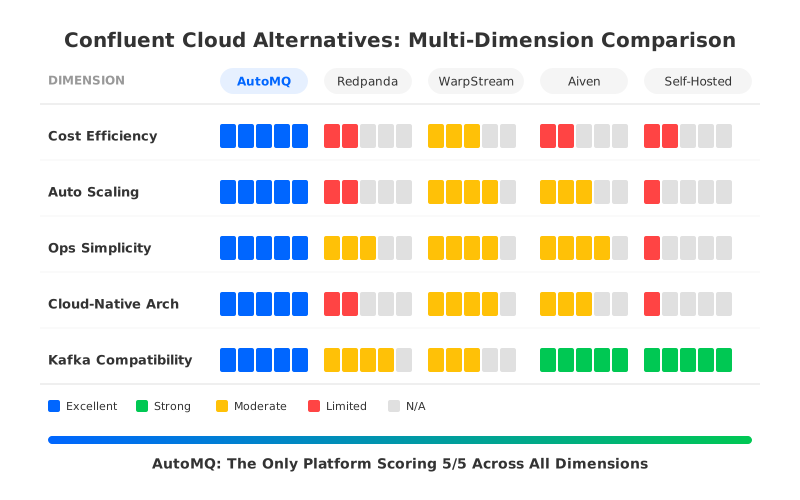
| Dimension | AutoMQ | Redpanda | WarpStream | Aiven | Self-Hosted |
|---|---|---|---|---|---|
| Monthly Cost (300 MB/s, 50 TB) | $21,513 | $93,065 | Varies (uncompressed billing) | Similar to Kafka | $80,043 |
| Architecture | Shared-storage, diskless | Shared-nothing, disk-based | Diskless, S3-direct | Shared-nothing, disk-based | Shared-nothing, disk-based |
| Scaling Speed | Seconds | Hours | Minutes | Hours | Hours |
| Open Source License | Apache 2.0 | BSL (enterprise) | Not open source | Apache Kafka (managed) | Apache 2.0 |
| BYOC Support | Yes (data + control plane) | No | Partial (metadata external) | No | N/A (self-hosted) |
Now let's look at each in detail.
2.1AutoMQ — Diskless Kafka on S3 (Open Source, BYOC)
AutoMQ takes a fundamentally different approach to the Kafka cost problem. Instead of optimizing around disk-based architecture, it replaces the storage layer entirely. AutoMQ forks the Apache Kafka codebase and swaps the lowest-level LogSegment implementation with an S3-native streaming storage engine. The rest of the Kafka stack — protocol handling, consumer groups, transactions, KRaft metadata — remains unchanged.
The result is a platform that's 100% Kafka-compatible (1000+ KIPs implemented, 387 Apache Kafka test cases passed) but architecturally different where it matters most: storage and elasticity.
Cost structure. AutoMQ stores one copy of data in S3 at $0.023/GB, compared to Kafka's effective $0.48/GB (3x EBS replication at $0.08/GiB with 50% utilization headroom). Cross-AZ traffic — the single largest cost item in traditional Kafka deployments, often exceeding 60% of the total bill — drops to near zero because writes go directly to S3 within a single AZ. For the same 300 MB/s, 50 TB scenario, AutoMQ costs $21,513/month. That's 4.4x less than Confluent Cloud.
Elasticity. Brokers are stateless. Partition reassignment is a metadata update, not a data migration. Scaling from 3 to 30 brokers takes under 10 seconds. Scaling back down is equally fast — something that's nearly impossible with traditional Kafka, where removing a broker means migrating terabytes of partition data while production traffic is running.
Deployment. AutoMQ offers genuine BYOC: both data plane and control plane run in your VPC. Cloud resources are billed directly to your cloud account at standard rates — no markup. It also supports self-managed (Software) deployment for teams that want full control.
Open source. Apache 2.0 licensed. No BSL, no SSPL, no "open core" restrictions. The full codebase is on GitHub with close to 10,000 stars.
Production track record. JD.com runs 8,000+ nodes processing 13 trillion messages/day. Grab replaced 6+ hour partition rebalancing with sub-minute operations. POIZON (得物) handles 40+ GiB/s peak throughput across 6 clusters. LG U+, Honda, Tencent Music, and HubSpot are also in production.
2.2Redpanda — C++ Kafka-Compatible Engine
Redpanda rewrote Kafka's broker in C++ with a focus on raw performance. It eliminates the JVM, uses a thread-per-core architecture (Seastar framework), and targets low-latency workloads where microsecond-level improvements matter.
Where it shines. Tail latency. Redpanda's P99 latency numbers are consistently strong in benchmarks, particularly for workloads that are sensitive to JVM garbage collection pauses. The single-binary deployment model simplifies initial setup compared to traditional Kafka + ZooKeeper.
Where it falls short. Redpanda still uses a shared-nothing, disk-based architecture. Each broker owns its data on local NVMe or EBS volumes, and data is replicated across brokers just like traditional Kafka. This means the fundamental cost equation doesn't change: you still pay for 3x storage replication, cross-AZ traffic for ISR sync, and over-provisioned compute to handle peak + failure scenarios. At 300 MB/s throughput, Redpanda Tier 6 costs $93,065/month — nearly identical to Confluent Cloud.
Redpanda has a "Cloud Topic" feature in beta that leverages S3 to reduce replication traffic, but it's not yet generally available. Even when it ships, Cloud Topics still can't eliminate cross-AZ traffic for client writes, and they sacrifice latency (hundreds of milliseconds).
Licensing. Redpanda's enterprise features are under the Business Source License (BSL). The community edition is more limited. If you're evaluating open-source alternatives specifically to avoid vendor lock-in, the BSL is worth reading carefully.
2.3WarpStream — Diskless Kafka (Acquired by Confluent/IBM)
WarpStream pioneered the "zero-disk Kafka" concept by writing directly to S3 and eliminating inter-broker replication. The architecture is genuinely innovative — stateless agents, no local storage, S3 as the single source of truth.
The acquisition problem. Confluent acquired WarpStream in late 2024, and IBM subsequently acquired Confluent for $11B. WarpStream is now a product within the IBM/Confluent portfolio. For teams evaluating WarpStream specifically to escape Confluent's ecosystem, this creates an obvious tension. Pricing, roadmap, and open-source strategy are now controlled by the same entity you were trying to leave.
Technical trade-offs. WarpStream writes everything directly to S3 with no local WAL tier, which means P99 write latency sits in the hundreds of milliseconds. This works for latency-tolerant workloads like logging and metrics, but rules it out for use cases that need sub-20ms acknowledgment. WarpStream also bills on uncompressed bytes written — with a typical 5:1 compression ratio, you're effectively metered on 5x the data you actually transmitted.
Compatibility. WarpStream re-implemented the Kafka protocol in Go rather than forking the Kafka codebase. This introduces the risk of edge-case semantic mismatches and has historically created a multi-year lag for complex features like transactions and compaction.
Data sovereignty. WarpStream uses a split architecture where critical metadata lives in a vendor-managed control plane. You don't own all your data.
2.4Aiven for Apache Kafka — Managed Kafka (SaaS)
Aiven provides fully managed Apache Kafka as a service across AWS, GCP, and Azure. It runs unmodified Apache Kafka, which means full compatibility with the Kafka ecosystem — no protocol re-implementation, no behavioral surprises.
Where it shines. Operational simplicity. Aiven handles provisioning, patching, upgrades, and monitoring. The multi-cloud support is genuine — same management interface across all three major clouds. Aiven launched "Inkless" in early 2026, its implementation of diskless topics based on KIP-1150, which could eventually bring S3-native storage benefits to their managed offering.
Where it falls short. Aiven runs standard Kafka under the hood, which means you inherit the same architectural limitations: disk-based storage with 3x replication, cross-AZ traffic costs, and limited elasticity. Scaling still requires adding brokers and rebalancing partitions. Inkless is promising but based on KIP-1150, which was only accepted in March 2026 — production maturity will take time.
Pricing. Aiven's pricing is more transparent than Confluent's, but the underlying cost structure is similar because the architecture is the same. You're paying for managed Kafka, not for a fundamentally different cost model.
No BYOC. Aiven is SaaS-only. Your data runs in Aiven's infrastructure, not your VPC.
2.5Self-Hosted Apache Kafka — Full Control, Full Burden
Running Apache Kafka yourself on EC2/EKS/GKE gives you maximum control and zero vendor lock-in. You pick the instance types, configure the storage, and own every operational decision.
Where it shines. Flexibility and control. No vendor pricing surprises, no feature gates, no dependency on a third party's roadmap. The Kafka ecosystem is massive — Kafka Connect, Schema Registry, Strimzi Operator, and thousands of community resources are at your disposal.
Where it falls short. Everything that makes Kafka expensive on the cloud is amplified when you self-host. Cross-AZ traffic for a 300 MB/s cluster costs $51,000/month on AWS. EBS storage with 3x replication and 50% headroom adds another $24,000/month. Total: roughly $80,000/month — and that's before counting the engineering time for capacity planning, partition rebalancing, version upgrades, security patching, and incident response.
Kafka operations typically consume 0.5–1 FTE of dedicated engineering time. Partition rebalancing after adding brokers takes hours. Scaling back down is so risky that most teams never attempt it, leading to chronic over-provisioning where cluster utilization sits below 30%.
When it makes sense. If you have a dedicated platform team, specific compliance requirements that rule out managed services, or workloads small enough that the operational overhead is manageable, self-hosting remains a valid choice. For everyone else, the total cost of ownership — infrastructure plus people — usually exceeds managed alternatives.
3How They Stack Up
The cost numbers tell a clear story. Three of the five alternatives — Redpanda, Aiven, and self-hosted Kafka — share the same disk-based architecture as Confluent, which means they share the same cost structure. Cross-AZ traffic and storage replication dominate the bill regardless of who manages the cluster. WarpStream solves the storage cost problem but introduces latency trade-offs and is now part of the Confluent/IBM portfolio. AutoMQ is the only option that eliminates the cost drivers architecturally while maintaining low latency and full Kafka compatibility.
4Choosing the Right Alternative
The right choice depends on what's driving you away from Confluent.
If your primary concern is cost, the architecture matters more than the vendor. Disk-based platforms (Redpanda, Aiven, self-hosted) will give you a different bill but not a fundamentally different cost structure. Diskless platforms (AutoMQ, WarpStream) change the equation — but WarpStream's acquisition by Confluent/IBM and its latency limitations narrow the field.
If your primary concern is vendor lock-in, look at the license and deployment model. AutoMQ (Apache 2.0, BYOC) and self-hosted Kafka give you the most control. Redpanda's BSL and WarpStream's proprietary status introduce different forms of lock-in. Aiven is SaaS-only.
If your primary concern is operational simplicity and cost is secondary, Aiven offers a clean managed experience with genuine multi-cloud support. AutoMQ's BYOC model also eliminates operational burden while keeping data in your VPC.
If your primary concern is raw latency performance, Redpanda's C++ engine delivers strong tail latency numbers. AutoMQ achieves P99 < 20ms on AWS Multi-AZ through its pluggable WAL design — sufficient for most production workloads, though not targeting the microsecond-level optimization that Redpanda pursues.
5The Kafka Cost Equation Is Changing
A year ago, the Confluent alternatives conversation was mostly about "which managed Kafka is cheaper." That framing assumed the underlying architecture was fixed — that you'd always pay for 3x replication, cross-AZ traffic, and over-provisioned brokers. The only question was who managed it and what margin they charged.
That assumption no longer holds. KIP-1150's acceptance into the Apache Kafka roadmap validated what AutoMQ has been running in production for years: Kafka's storage layer can be decoupled from local disks entirely. When your data lives in S3, the three biggest cost drivers — cross-AZ replication, storage multiplication, and compute over-provisioning — disappear. The cost gap isn't 20% or 30%. It's 3–4x.
Your Confluent Cloud bill isn't going to shrink on its own. But the alternatives have never been stronger. Whether you choose a diskless architecture, a different managed service, or self-hosting, the first step is the same: understand where your money is actually going, and decide whether that cost structure still makes sense for your team.
Ready to see how much you could save? Try the AutoMQ cost calculator or start a free trial.


