
Table of Contents
Table of Contents
If your team is looking for an open source Kafka alternative, the search is probably not about fashion. It usually starts with a bill, a license review, or a painful scaling operation. Kafka still has a deep ecosystem in streaming, but running it in the cloud can make teams pay for broker-local disks, replica traffic, and idle capacity long after the application code has stopped caring where the log physically lives.
That is why the word "alternative" needs a sharper filter. Some projects are true Apache 2.0 open source. Some are source-available under terms that matter to compliance teams. Some are Kafka-compatible at the protocol layer but not at the semantic layer. Some lower storage cost by using object storage, while others keep the same local-disk economics and mostly change the broker implementation.
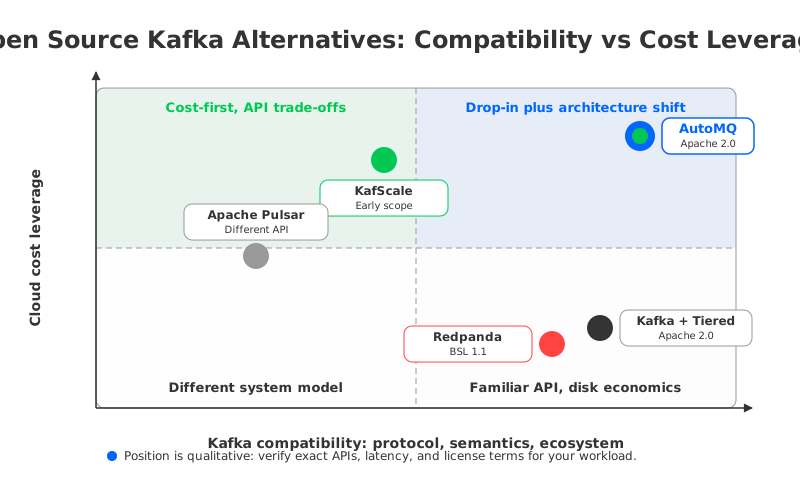
The quadrant above uses two questions that matter more than a generic feature checklist. How close is the system to Kafka in the APIs, behavior, and ecosystem integrations your applications already depend on? And how much does the architecture change the cost structure that made you search for an alternative in the first place?
1Quick Comparison
GitHub repository metadata in this table was checked on May 7, 2026. Stars move every day, so treat them as a rough community signal rather than a ranking.
| Option | Public-code starting point | License posture | Kafka compatibility | Cost architecture | Public production proof |
|---|---|---|---|---|---|
| AutoMQ | AutoMQ/automq public repo created Aug 2023; Apache Kafka-derived storage rewrite | Apache 2.0 | Kafka protocol and ecosystem compatibility by preserving the Kafka computation layer | Diskless shared storage on S3-compatible object storage plus WAL options | JD.com, Grab, Tencent, LG U+ |
| Redpanda Community | Public repo created Nov 2020; Kafka API-compatible broker in C++ | BSL 1.1 with a change date; review before treating as open source | Strong Kafka API compatibility for many workloads | Shared-nothing broker model with local storage and tiered storage options | NYSE, Teads, Akamai, Chess.com, Truecaller |
| Apache Pulsar | Yahoo-originated system; Apache repo created Jun 2016 | Apache 2.0 | Different native API; Kafka compatibility typically relies on KoP or adapters | Broker + BookKeeper + ZooKeeper architecture with tiered storage support | Yahoo, Tencent, Attentive, Intuit, Verizon Media |
| KafScale | Public repo created Dec 2025; Go implementation | Apache 2.0 | Kafka protocol compatibility for core produce, fetch, and consumer group APIs | Stateless brokers with S3 and etcd metadata | Public repo says production use exists, but no named reference customer in the README |
| Apache Kafka + Tiered Storage | Kafka repo created Aug 2011; KIP-405 production-ready since Kafka 3.9 | Apache 2.0 | Native Kafka | Local hot tier plus remote tier for older log segments | Kafka itself is broadly validated; tiered storage reduces retention pressure but keeps the broker-local hot path |
The table already narrows the decision. If your requirement is "Apache 2.0 and Kafka-compatible," the field gets small. If your requirement is "source-available and Kafka API-compatible," Redpanda stays in the conversation. If your requirement is "open source streaming platform, Kafka API optional," Pulsar becomes a mature candidate. Those are different searches, and mixing them creates bad architecture decisions.
2AutoMQ: Open Source Kafka Compatibility With Diskless Economics
AutoMQ is a direct fit for teams that want a Kafka replacement without leaving Kafka semantics behind. It is open source under Apache 2.0, and the public repository was created in August 2023. The design choice is conservative where compatibility matters and aggressive where cost matters: preserve Kafka's computation layer, replace the broker-local storage layer with shared object storage, and make brokers much easier to scale or replace.
The cost difference comes from changing what brokers own. In traditional Kafka, brokers own durable data, so durability means local disks, replicas, cross-zone replication, and rebalancing when data placement changes. AutoMQ moves durable log data to S3-compatible storage and uses a WAL layer to absorb writes before data is flushed to object storage. That lets broker compute scale without dragging partition data behind it.
For cost-conscious teams, this is the core reason AutoMQ belongs near the top of this comparison:
- License: Apache 2.0, with public source code available in the AutoMQ GitHub repository.
- Compatibility: Built from the Apache Kafka codebase, so Kafka clients, Kafka Connect, Flink, Schema Registry-style integrations, and operational expectations have a lower migration risk than ground-up protocol rewrites.
- Cost model: Diskless shared storage reduces the need for broker-local data replication and attacks cross-AZ traffic at the architecture level.
- Production proof: AutoMQ has published customer material for JD.com, Grab, Tencent, LG U+, Honda, Geely, Bambu Lab, and other production users.
JD.com is a useful proof point because it is not a small pilot. The published AutoMQ case study describes JD.com replacing Kafka at large scale, with the public page titled "Why JD.com Replaces Kafka with AutoMQ at 40 GiB/s Scale". Grab is the other type of proof: a cloud-native platform team on AWS, focused on rebalancing time, efficiency, and operational load. Its public story describes moving partition rebalancing from hours to under a minute and improving data streaming efficiency by 3x.
The trade-off is that AutoMQ is company-led rather than an Apache Software Foundation project. If your governance requirement is upstream Apache Kafka itself, Kafka Tiered Storage and KIP-1150-style work may matter more. But if the practical goal is an Apache 2.0 Kafka-compatible engine that changes the cloud cost structure, AutoMQ is a strong open-source candidate in this list.
3Redpanda Community: Kafka API Compatibility, But Read the License
Redpanda is a serious Kafka alternative because it attacks a different pain point: broker complexity. It removes the JVM, removes ZooKeeper, and implements a Kafka API-compatible streaming platform in C++. Its public repository was created in November 2020, and Redpanda's public customer page lists production users such as NYSE, Teads, Akamai, Chess.com, Truecaller, and Zafin.
The license is where teams searching for "open source Kafka alternative" need to slow down. Redpanda's repository includes a Redpanda Business Source License 1.1. The license includes an additional use grant and a change date, but it is not the same posture as Apache 2.0. For many internal production uses this may be acceptable. For companies building a managed streaming service, embedding Redpanda into a broader commercial platform, or requiring OSI-style open source terms, legal review is not optional.
Architecturally, Redpanda keeps the broker-centric shared-nothing model. That is good for low-latency local storage and for teams that want fewer moving parts than Kafka, but it does not remove the core cloud cost drivers in the same way a diskless design does. Tiered storage can lower long-retention storage pressure, yet the hot write path still depends on broker-attached storage and replicated ownership.
Redpanda is a good fit when your main problems are JVM operations, ZooKeeper-era complexity, and Kafka operational friction. It is a weaker fit when the main problem is the structural cost of local disks and cross-AZ replication. For a cost-first open-source shortlist, that distinction matters.
4Apache Pulsar: Mature Open Source, Different Ecosystem
Apache Pulsar is a mature non-Kafka system in this list. It originated at Yahoo, was running there in production by Q2 2015 according to the Pulsar case-study page, and entered the Apache ecosystem with a public repository in 2016. The Apache Pulsar case studies include Yahoo, Tencent, Attentive, Intuit, Verizon Media, and others. This is a real production system with real scale behind it.
The question is not whether Pulsar is credible. It is whether Pulsar is the right answer to a Kafka replacement search. Pulsar's native model is different: brokers, BookKeeper, and ZooKeeper form a multi-layer architecture with a separate durable storage layer. That design gives Pulsar features Kafka did not historically emphasize, including multi-tenancy and geo-replication. It also means a Kafka team evaluating Pulsar is replacing more than a broker; it is adopting a different operational and client ecosystem.
Kafka compatibility exists through projects such as Kafka-on-Pulsar, but compatibility through an adapter is not the same as preserving Kafka semantics inside the broker implementation. A basic producer and consumer may work well. A platform that depends on Kafka Streams, transactions, compaction semantics, ACL behavior, connector edge cases, or operational tooling needs workload-level validation.
Pulsar is a strong option when you want an Apache 2.0 streaming platform and are willing to adopt the Pulsar model. It is less compelling when the migration goal is "keep Kafka behavior, lower the Kafka bill." In that case, the operational change is large enough that the cost model should be evaluated alongside retraining, tooling, and application migration work.
5KafScale: S3-Native and Apache 2.0, But Early
KafScale is interesting because it says the quiet part out loud: for many workloads, durable logs belong in object storage, not in stateful brokers. The public KafScale platform repository was created in December 2025, is Apache 2.0 licensed, and describes stateless brokers, S3-backed immutable segments, etcd-backed metadata, and Kafka wire protocol support for core produce, fetch, and consumer group APIs.
That focus is also the boundary. The README explicitly lists non-goals including exactly-once semantics and transactions, compacted topics, Kafka internal replication protocols, and embedded stream processing inside the broker. This is not a small detail hidden in a footnote. It tells you where KafScale can be evaluated: durable pipe workloads, replay-oriented systems, and greenfield services that use a limited Kafka surface.
KafScale's production signal is thinner than the other options. The README says it is used in production environments, but as of May 7, 2026 the public repository does not list named flagship customers comparable to JD.com, Grab, NYSE, Yahoo, or Tencent. That does not make the project uninteresting. It means the burden of proof shifts to your own tests.
For cost-conscious engineers, KafScale is worth tracking because it is small, direct, S3-native, and permissively licensed. It should not be treated as a drop-in replacement for a feature-rich Kafka estate without validating every API your applications depend on.
6Apache Kafka + Tiered Storage: The Conservative Open Source Path
Sometimes the right Kafka alternative is still Kafka, with a narrower storage problem. Apache Kafka is Apache 2.0, deeply validated, and has the ecosystem gravity that every alternative is trying to borrow. KIP-405, Kafka Tiered Storage, became production-ready since Kafka 3.9 according to the Apache Kafka 3.9.0 release announcement. It lets Kafka keep a local hot tier while moving older log segments to remote storage such as S3.
That design is valuable because long retention no longer has to mean keeping every byte on broker-local disks. It can reduce local storage pressure, improve retention economics, and reduce the amount of data a broker must restore after some failure or scaling events. If your Kafka bill is dominated by old retained data, Tiered Storage deserves a hard look before any replacement project.
But Tiered Storage is not diskless Kafka. The hot path remains local. Brokers still own active partitions. Replication still exists. Cross-AZ traffic does not disappear when older segments move to a remote tier. In the KIP's own framing, the local tier remains the current Kafka storage model, while the remote tier handles completed log segments.
That makes Kafka + Tiered Storage a low-migration-risk option and a less complete architectural break from Kafka's cloud cost model. It is a strong fit when governance, ecosystem stability, and incremental change matter more than a clean break from broker-local storage.
7Which One Should You Shortlist?
The right answer depends on the constraint that started the search.
| If your main constraint is... | Shortlist first | Why |
|---|---|---|
| Apache 2.0 license plus Kafka compatibility | AutoMQ, Kafka + Tiered Storage | Both keep the Kafka ecosystem close; AutoMQ changes storage more deeply |
| Lower cloud infrastructure cost | AutoMQ, KafScale, then Kafka Tiered Storage | Diskless or remote-tier designs attack storage cost more directly |
| Proven production maturity outside Kafka | Pulsar, Redpanda | Both have substantial public customer references |
| Minimal application migration risk | Kafka + Tiered Storage, AutoMQ, Redpanda | The closer the system stays to Kafka semantics, the lower the application risk |
| Avoiding source-available license ambiguity | AutoMQ, Pulsar, Kafka, KafScale | All are Apache 2.0 in the public repositories checked for this article |
The subtle trap is tuning for one column while pretending you covered all of them. A license-first team may pick Pulsar and then discover the migration is not a Kafka drop-in. A performance-first team may pick Redpanda and then discover the cost model still depends on broker-local economics. A cost-first team may pick an early S3-native project and then discover it does not support the Kafka semantics the platform uses.
8A Practical Test Plan Before You Commit
Before replacing Kafka, run a proof of concept that is boring in exactly the right ways. Use your real message sizes, partition counts, retention windows, consumer fanout, security settings, and failure scenarios. A demo that produces and consumes one topic says almost nothing about production compatibility.
The validation plan should cover:
- License and governance: Confirm whether the code is Apache 2.0, BSL, or another license, and whether your use case is allowed.
- Kafka feature surface: Test transactions, compaction, consumer groups, Kafka Connect, Kafka Streams, ACLs, Schema Registry integration, and offset behavior if you rely on them.
- Cost under your workload: Model storage, cross-AZ traffic, object-storage requests, compute, and idle capacity. Do not compare instance prices alone.
- Failure recovery: Kill brokers, throttle object storage, force coordinator movement, and watch client behavior.
- Operational fit: Check observability, upgrades, Kubernetes support, backup/restore, and the team's ability to debug the system at 2 a.m.
This is where open source matters beyond license ideology. Being able to inspect, run, fork, and test the system under your own workload is a practical risk reducer. The more critical your streaming platform is, the less you should rely on compatibility claims that stop at the API surface.
9The Bottom Line
The search term says "open source Kafka alternative," but the real decision is more specific: how much Kafka do you need to keep, and which part of Kafka's cost model are you trying to escape?
If you want a low-change path, start with Apache Kafka + Tiered Storage. If you want a mature non-Kafka streaming system and can adopt a different ecosystem, evaluate Apache Pulsar. If you want Kafka API compatibility and simpler broker operations, Redpanda deserves a test, with license review included. If you want an early Apache 2.0 S3-native project for limited Kafka workloads, track KafScale closely.
For teams that want Apache 2.0 licensing, Kafka-compatible migration, and a diskless architecture in one package, AutoMQ is a strong option in this comparison. The important part is not the label. It is the combination: open code, Kafka semantics, object-storage economics, and published production validation from companies running streaming systems at serious scale.
Run your own workload through the AutoMQ Pricing Calculator before you choose. The first useful answer is not which platform has the nicest comparison table. It is which architecture makes your own Kafka bill make sense.


