
Table of Contents
Table of Contents
OCI teams used to face an awkward Kafka choice. Oracle Cloud Infrastructure had strong primitives for compute, networking, Kubernetes, Object Storage, and database integration, but many Kafka services treated OCI as a second-tier target compared with AWS, Azure, and Google Cloud. That gap has narrowed, especially now that Oracle offers OCI Streaming with Apache Kafka as a fully managed Kafka service. Still, the decision is not as simple as "use the native service" or "run Kafka yourself."
The right answer depends on what you mean by Kafka. Some workloads need open source Apache Kafka behavior, ecosystem tools, and familiar broker semantics. Some only need Kafka client compatibility for producers and consumers. Others care more about private networking, BYOC control, object-storage economics, or keeping data close to Oracle Database and GoldenGate. OCI has options for each of those patterns, but the support boundaries are uneven.
1Quick Answer
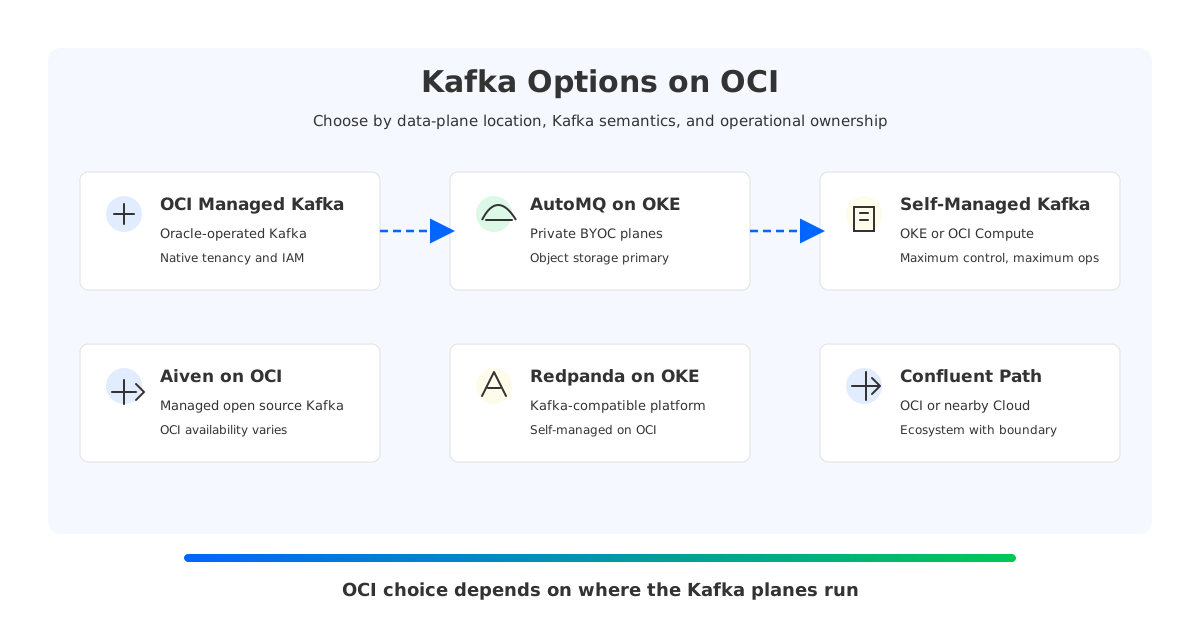
For most enterprise teams already committed to OCI, start with Oracle's managed Kafka service if you want the lowest operational burden and native OCI procurement. Evaluate AutoMQ on OKE when you need Kafka compatibility with a cloud-native storage architecture that uses object storage and can run inside your own OCI environment. Use self-managed Apache Kafka only when you need maximum upstream control and have a team ready to operate brokers, storage, upgrades, and rebalancing.
The short list looks like this:
| Option | Best fit on OCI | Kafka compatibility | Operational model | Main caveat |
|---|---|---|---|---|
| OCI Streaming with Apache Kafka | OCI-native managed Kafka | High | Fully managed by Oracle | Newer service; verify region and feature availability in your tenancy |
| AutoMQ on OKE | BYOC, object-storage-backed Kafka-compatible workloads | High | Runs in your OCI environment with Kubernetes | Requires platform ownership of OKE, networking, and object storage setup |
| Self-managed Apache Kafka on OKE or Compute | Teams needing upstream Kafka control | Highest | Your team operates the full stack | Highest operational burden |
| Aiven for Apache Kafka on OCI | Managed open source Kafka with Aiven operations | High | Managed service, OCI listed as limited availability | Availability and commercial terms need account-team validation |
| Redpanda self-managed on OKE | Kafka API-compatible streaming without JVM Kafka brokers | Medium to high, workload-dependent | Self-managed Kubernetes or Linux deployment | Redpanda Cloud BYOC docs list AWS, GCP, and Azure, not OCI |
| Confluent Platform or cross-cloud Confluent Cloud | Confluent ecosystem, governance, connectors, hybrid patterns | High | Self-managed on OCI, or managed outside OCI | Confluent Cloud regions are listed for AWS, Azure, and Google Cloud, not native OCI |
That table intentionally separates "managed on OCI" from "can be made to work near OCI." For regulated workloads, that difference matters. A service that runs in another provider but connects privately to OCI may be acceptable for integration traffic; it is a different control model from a Kafka data plane running inside your OCI tenancy.
2Why Kafka Selection Is Harder on OCI
AWS users can compare MSK, Confluent Cloud, Aiven, Redpanda Cloud, WarpStream, and several marketplace paths without leaving the mainstream vendor roadmap. OCI buyers have to ask a more basic question first: does the vendor publicly support OCI as a deployment target, or are we assembling a Kubernetes/self-managed path ourselves? The answer changes the risk model more than the product brochure usually admits.
There are four checks worth doing before any benchmark:
- Kafka semantics vs Kafka API compatibility. Oracle documents a Kafka compatibility path for the older OCI Streaming service and separately offers OCI Streaming with Apache Kafka as a managed Kafka service. Those are not the same architectural choice. The older compatibility page also documents Kafka APIs and features that are not implemented in OCI Streaming, so treat it as API compatibility, not a full broker replacement.
- Data-plane location. If data must stay in OCI, prioritize services that run in your OCI tenancy or are explicitly managed by Oracle. Cross-cloud SaaS may still work, but it moves the trust and networking question outside OCI.
- Storage architecture. Traditional Kafka depends on local or block storage attached to brokers. Object-storage-native platforms such as AutoMQ change the failure, scaling, and cost profile by putting durable log data in object storage.
- Support boundary. "Runs on Kubernetes" is useful, but it is not the same as "vendor-supported on OCI." If a vendor only documents AWS, Azure, or GCP for managed BYOC, assume OCI requires a written support confirmation.
OCI itself gives you the building blocks for serious streaming systems. Oracle Container Engine for Kubernetes is a managed Kubernetes service. OCI Object Storage is a regional object store and supports an Amazon S3 Compatibility API. Object Storage also has private endpoints, which matters when streaming traffic should stay on private network paths. The hard part is choosing a streaming platform that actually takes advantage of those primitives without creating a fragile support story.
3Top Kafka Options on Oracle Cloud
3.1OCI Streaming with Apache Kafka
Oracle's strongest native answer is OCI Streaming with Apache Kafka, a fully managed OCI service for creating and running Kafka clusters in an OCI tenancy. Oracle positions it as a managed Apache Kafka service, not merely a Kafka endpoint in front of a different streaming API. The public product page also emphasizes compatibility with open source Apache Kafka, managed operations, OCI security integration, and pay-as-you-go pricing based on compute and storage usage.
This should be the first stop for OCI-first teams that want a managed service with Oracle support. It is especially natural when your upstream or downstream systems are Oracle Database, GoldenGate, OCI Data Flow, OCI Functions, or analytics workloads already inside the same cloud. Procurement, IAM, networking, and support escalation are also cleaner than stitching together a Kafka service from another cloud provider.
The trade-off is service maturity and control. Managed cloud services rarely expose every broker-level knob that a platform team might use in self-managed Kafka. You should verify region availability, Kafka version, supported broker shapes, storage limits, networking modes, monitoring exports, and connector ecosystem needs in the OCI Console and current documentation before standardizing on it. For many enterprise workloads, that is a reasonable trade; for teams that have spent years tuning Kafka internals, it may feel constraining.
3.2AutoMQ on OKE with OCI Object Storage
AutoMQ's OCI installation guide documents AutoMQ on OCI, and its Kubernetes documentation describes deployment on Kubernetes with object storage as the durable storage layer. AutoMQ's BYOC environment model also places the environment console/control plane and Kafka service/data plane in the user's network environment. That makes it a serious option when you want Kafka compatibility but do not want traditional Kafka's broker-local storage model or an external vendor control plane to define your cloud architecture.
The key architectural difference is that AutoMQ is built around storage-compute separation. Brokers run on compute, while durable stream data is offloaded to object storage. On OCI, that maps naturally to OKE plus OCI Object Storage, assuming the required object storage API behavior, IAM policies, networking, and storage classes are configured correctly. This is not "Kafka with tiered storage" in the narrow sense of moving older segments away from brokers after the hot path has already gone through local disks. The design goal is to make object storage part of the primary storage path so compute can scale with less data movement tied to broker identity.
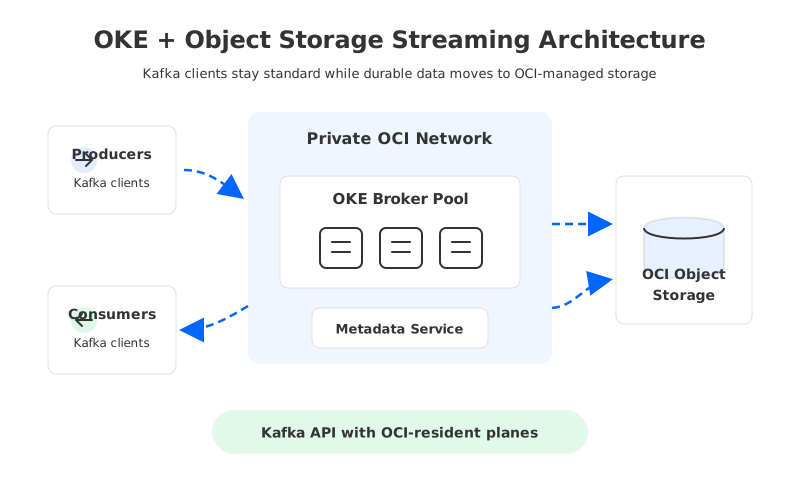
AutoMQ fits teams that want their Kafka control plane and data plane inside OCI but also want a cloud-native cost and elasticity model. It is a good candidate for strict BYOC requirements, private network requirements, and organizations that need similar architecture across multiple clouds rather than a different managed Kafka implementation in every cloud.
The trade-off is that you own more of the platform envelope than with Oracle's managed Kafka service. OKE cluster lifecycle, OCI networking, object storage policy, observability integration, and capacity planning still matter. If your organization wants a single Oracle support contract for the whole streaming stack, the native service may be simpler. If you want Kafka compatibility with a storage architecture designed for object storage, AutoMQ deserves a deeper proof of concept.
3.3Self-Managed Apache Kafka on OKE or OCI Compute
Self-managed Kafka remains the control maximum. You can run upstream Apache Kafka on OCI Compute instances, or run it on OKE with an operator such as Strimzi. You choose Kafka versions, broker settings, KRaft migration timing, storage layout, TLS/SASL model, topic defaults, Connect deployment, Schema Registry equivalent, and monitoring stack.
That control is valuable when your team has hard requirements that managed services do not expose. It also helps when you already have mature Kafka automation and want to lift that operating model into OCI. OCI gives you the primitives: compute shapes, block volumes, file storage, private networking, load balancers, OKE, IAM, Vault, Logging, Monitoring, and Object Storage for backups or tiering-related workflows.
The problem is not whether Kafka can run on OCI. It can. The problem is whether your platform team wants to keep paying the operational tax:
- Broker storage sizing and disk replacement.
- Partition placement, leader balance, and reassignments.
- Rolling upgrades and security patching.
- Multi-AD or fault-domain design.
- Disaster recovery and cross-region replication.
- On-call expertise for under-replicated partitions, controller instability, and client-side retry storms.
Self-managed Kafka is the right answer when control matters more than operational simplicity. It is the wrong answer when the team is choosing it only because the managed options were not evaluated carefully.
3.4Aiven for Apache Kafka on OCI
Aiven is one of the few third-party managed data platforms that publicly lists OCI in its cloud footprint. Its available cloud regions documentation says Oracle Cloud Infrastructure is supported on the Aiven Platform as a limited availability feature, and Aiven has also announced availability through the Oracle Cloud Marketplace. For buyers who want managed open source Kafka rather than a cloud-provider-specific Kafka service, that is worth investigating.
Aiven's value proposition is operational consistency across data services. A team can manage Kafka alongside services such as PostgreSQL, OpenSearch, or Flink-style integrations through one vendor platform. Aiven also documents a BYOC model, but its current BYOC architecture examples focus on AWS and Google Cloud, so OCI support should not be assumed for every deployment mode.
The practical recommendation is simple: ask Aiven to confirm the exact OCI region, Kafka plan, networking model, support level, and whether your desired deployment is Aiven-managed infrastructure, marketplace procurement, BYOC, or something else. Limited availability can be perfectly acceptable for enterprise customers, but it is not the same risk posture as broadly documented self-service availability.
3.5Redpanda Self-Managed on OKE
Redpanda is Kafka API-compatible rather than Apache Kafka itself. For some teams, that is a feature: no JVM brokers, a different storage engine, and a simpler deployment model for certain workloads. Redpanda's self-managed documentation includes Kubernetes deployment paths, so OCI teams can evaluate Redpanda on OKE or OCI Compute like any other self-managed stateful system.
The managed-cloud story is more constrained. Redpanda's BYOC documentation lists AWS, GCP, and Azure deployment targets, and its BYOC regions page lists those providers rather than OCI. That does not disqualify Redpanda for OCI, but it changes the category: on OCI, treat Redpanda primarily as a self-managed option unless Redpanda provides a current, written managed-service path for your account.
Redpanda fits teams that are open to a Kafka-compatible platform but not tied to Apache Kafka internals. It is less appropriate when you need exact broker behavior, deep compatibility with every Kafka ecosystem tool, or a vendor-managed OCI data plane.
3.6Confluent Platform or Cross-Cloud Confluent Cloud
Confluent is still the broadest Kafka ecosystem vendor. If your evaluation is driven by connectors, governance, Schema Registry, Flink, enterprise support, and a mature commercial Kafka distribution, Confluent belongs in the conversation. The question is how close it can run to OCI.
Confluent Cloud's supported regions documentation lists availability across AWS, Azure, and Google Cloud. It does not present OCI as a native Confluent Cloud provider. That leaves two OCI-oriented patterns: run Confluent Platform yourself on OCI infrastructure, or keep Confluent Cloud in a supported cloud and connect OCI systems over private or controlled networking.
The first pattern gives you OCI data-plane control but brings self-managed platform work. The second gives you Confluent's managed service but moves the Kafka cluster outside OCI. That can be fine for cross-cloud integration, data products, or organizations already standardized on Confluent Cloud. It is harder to justify when the requirement says the streaming data plane must live inside OCI.
4OCI-Native Streaming vs Kafka-Compatible Platforms
The OCI streaming landscape has one naming trap: "OCI Streaming" and "OCI Streaming with Apache Kafka" are related but not interchangeable choices. The older OCI Streaming Kafka compatibility documentation explains how Apache Kafka clients can use the Streaming service, but it also lists Kafka APIs and features that are not implemented. That can be a useful bridge for applications that need Kafka producers and consumers, but it is not the same as selecting a full Kafka cluster.
Oracle's managed Apache Kafka service is a stronger fit when Kafka semantics matter. OCI Streaming compatibility is a stronger fit when you want OCI's stream abstraction and only need enough Kafka API support for specific client workloads. AutoMQ, self-managed Kafka, Aiven, Redpanda, and Confluent each sit somewhere else on the spectrum between "Apache Kafka itself," "Kafka-compatible implementation," and "managed streaming service with Kafka endpoints."
Use this distinction early in the evaluation. It prevents expensive surprises later, especially around consumer group behavior, admin APIs, transactions, compaction, ecosystem tooling, and operational visibility.
5How to Choose for OKE and Object Storage
OCI teams should not copy the AWS Kafka decision tree. OCI has different native services, different marketplace coverage, different object storage details, and a different enterprise buyer base. A better decision tree starts with data-plane location and operational ownership.
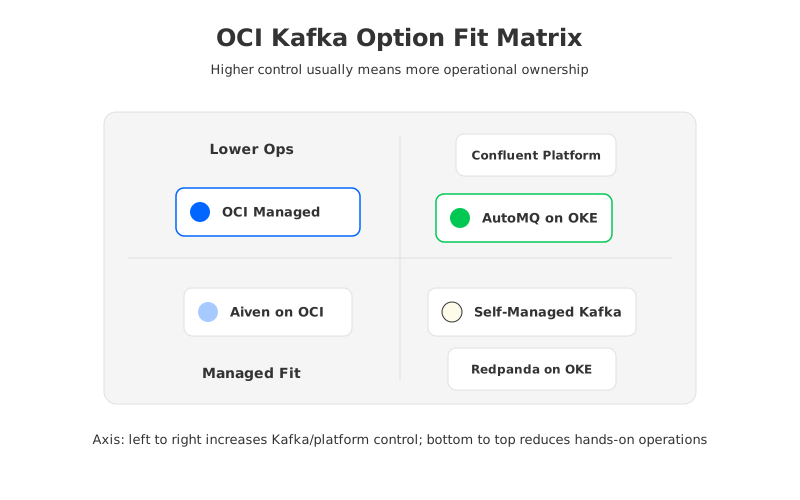
Choose OCI Streaming with Apache Kafka when you want Oracle to run the Kafka service and your workloads are already anchored in OCI. Choose AutoMQ on OKE when you want a Kafka-compatible control plane and data plane inside your environment with object storage as a first-class storage layer. Choose self-managed Apache Kafka when you need upstream Kafka control and have operational maturity. Choose Aiven when managed open source Kafka and multi-service operations matter, but validate OCI limited availability. Choose Redpanda when Kafka API compatibility is enough and you are comfortable operating it yourself on OCI. Choose Confluent when the ecosystem is the main driver, while being explicit about whether the data plane is self-managed on OCI or managed outside OCI.
For OKE-based options, pay special attention to object storage and networking:
- Object Storage API behavior: OCI supports S3-compatible access, but S3-compatible does not mean every S3 feature behaves identically. Validate multipart upload behavior, endpoint format, authentication, lifecycle policies, and performance under your real write pattern.
- Private access: Use private endpoints or service-gateway-style patterns where appropriate so brokers or agents do not depend on public internet paths for durable storage.
- Failure domains: Map Kafka replication, OKE node pools, load balancers, and storage paths to OCI availability domains or fault domains. A three-broker diagram is not a resilience plan by itself.
- Observability: Confirm how broker metrics, client metrics, logs, and audit events land in your monitoring stack. Managed services reduce operations, but they do not remove the need for visibility.
- Support ownership: Write down who owns incidents that cross Kubernetes, storage, networking, and the streaming platform. This is where many "it runs on Kubernetes" deployments become uncomfortable in production.
The most important architectural question is whether broker identity should own durable data. Traditional Kafka assumes brokers and partitions carry state that must be carefully moved. Object-storage-backed systems challenge that assumption. On OCI, where Object Storage is regional and accessible through private paths, that design can be attractive, but only after validating the exact storage integration and vendor support policy.
6FAQ
6.1Does Oracle Cloud have a managed Kafka service?
Yes. Oracle offers OCI Streaming with Apache Kafka as a fully managed Kafka service on OCI. Oracle also has the older OCI Streaming service with Kafka compatibility, but that compatibility path is not the same as a full Kafka cluster and has documented API and feature limitations.
6.2Is OCI Streaming the same as Apache Kafka?
Not always. OCI Streaming is Oracle's managed streaming service. It can expose Kafka-compatible client access for certain use cases, but Oracle's Kafka compatibility documentation lists unsupported Kafka APIs and features. OCI Streaming with Apache Kafka is Oracle's managed Kafka service and should be evaluated separately.
6.3Can I run Kafka on OKE?
Yes. You can run Apache Kafka, AutoMQ, Redpanda, or other Kubernetes-deployable streaming systems on OKE, subject to each project's support policy. The engineering question is not basic feasibility; it is whether your team wants to own stateful operations, storage design, upgrades, monitoring, and incident response.
6.4Which option is most OCI-native?
OCI Streaming with Apache Kafka is the most OCI-native managed Kafka path because Oracle operates it as an OCI service. AutoMQ on OKE is OCI-native in a different sense: the environment console/control plane and Kafka service/data plane can run in your OCI environment and use OCI infrastructure primitives, but your platform team still owns the Kubernetes and environment layer.
6.5Is Confluent Cloud available directly on OCI?
Confluent's public cloud region documentation lists AWS, Azure, and Google Cloud regions. For OCI, evaluate Confluent Platform self-managed on OCI infrastructure or a cross-cloud Confluent Cloud architecture with controlled networking.
6.6Is Redpanda Cloud BYOC supported on OCI?
Redpanda's public BYOC documentation lists AWS, GCP, and Azure. Redpanda can be evaluated as a self-managed deployment on OCI, but do not assume a managed BYOC OCI option unless Redpanda confirms it for your account.
6.7Where does AutoMQ fit compared with Oracle's managed Kafka service?
Oracle's service is the simpler native managed choice. AutoMQ is more relevant when you want Kafka compatibility, deployment of both control plane and data plane inside your own OCI environment, Kubernetes-based operations, and an object-storage-first architecture. In practice, teams should evaluate both if they care about OCI-resident control, data-plane control, and long-term storage economics.


