
Table of Contents
Table of Contents
A Kafka cluster that looks reasonable at 100 MiB/s can become a very different system at 1 GiB/s or 5 GiB/s. Storage throughput, replicated bytes, cross-zone traffic, retention windows, partition movement, and operational recovery all start compounding. At that point, the better question is not "which Kafka service is lower cost?" It is: which storage and deployment model keeps cost proportional to useful workload?
High-throughput Kafka is rarely constrained by one line item. Logging stresses network efficiency, feature pipelines stress broker headroom, and long-retention streams stress storage. The same GB/s number can lead to different platform choices once you account for where the bytes are copied, stored, and served.
1Quick Answer
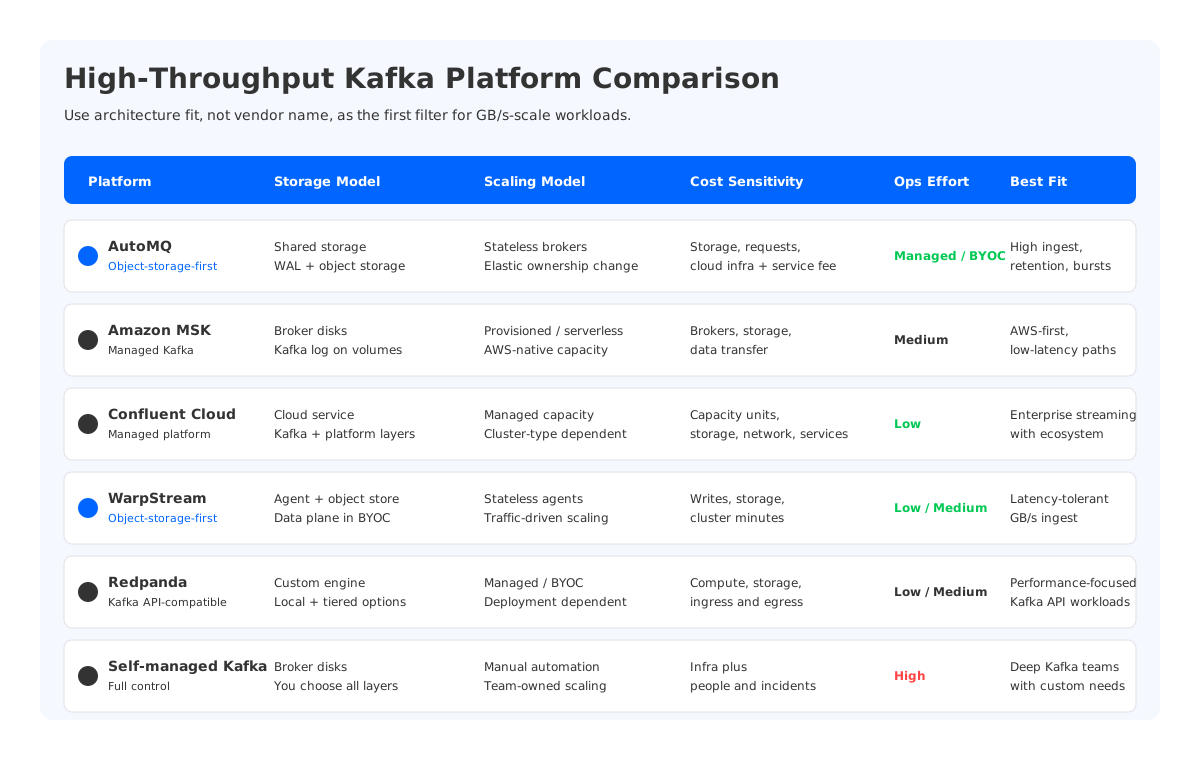
For high-throughput Kafka workloads, the cost-effective options usually fall into a few architectural families.
- Broker-disk Kafka platforms keep the Kafka log tied to brokers or broker-attached volumes. Amazon MSK and many self-managed Kafka deployments fit here. They can be a strong fit for low-latency hot paths, but storage and rebalancing cost tend to scale with broker state.
- Object-storage-first platforms move the durable data plane toward object storage and keep compute more elastic. AutoMQ and WarpStream are the clearest examples.
- Fully managed cloud platforms such as Confluent Cloud and Redpanda Cloud reduce operational effort. Their economics depend on the vendor's metering dimensions, cluster type, and enterprise requirements.
If your workload is GB/s-scale, bursty, retention-heavy, or sensitive to cross-AZ replication cost, evaluate object-storage-first designs early. If it is extremely latency-sensitive and mostly hot-read, broker-disk or dedicated managed platforms may still fit better. The decision should come from a workload model, not a logo comparison.
2Why High-Throughput Kafka Workloads Change The Cost Equation
Kafka's shared-nothing design keeps partitions on brokers and replicates data across brokers for durability. That model is robust and familiar, but it was born with different storage and network assumptions from cloud infrastructure pricing. In the cloud, every extra copy of a byte may touch provisioned volumes, instance bandwidth, inter-AZ transfer, and background data movement.
At small scale, those costs hide inside a few brokers. At GB/s scale, they become the architecture. A three-AZ Kafka cluster with replication factor 3 writes replicas, serves consumers, retains data, and moves partition state during expansion, failures, or balancing. When teams estimate cost from write throughput alone, they usually miss at least one multiplier:
- Replication multiplier. Broker-disk Kafka durability uses replicated partition logs. The cloud bill sees the physical copies and the network path, not only the logical producer bytes.
- Fanout multiplier. A topic read by several consumer groups turns retained data into repeated egress from brokers. Fetch-from-follower can help locality, but the read pattern still matters.
- Retention multiplier. Longer retention forces more durable storage. Tiered storage can reduce the hot-disk footprint, but it does not erase the primary write path.
- Headroom multiplier. High-throughput systems need slack for broker loss, spikes, rolling upgrades, and partition imbalance. A cluster sized to average throughput is not production-sized.
A fair comparison starts with assumptions. Without them, "cost per GB/s" is a slogan. With them, the platform trade-offs become visible.
3Workload Assumptions To Compare Platforms Fairly
Use a model that describes the workload before choosing a platform. The numbers below are illustrative inputs, not vendor benchmark claims:
| Input | Example Value | Why It Matters |
|---|---|---|
| Peak write throughput | 1 GiB/s or 5 GiB/s | Drives broker, agent, or service capacity |
| Average write throughput | 40-70% of peak | Determines monthly data volume |
| Read fanout | 1x, 3x, or 5x | Changes egress and broker serving load |
| Retention | 24 hours, 7 days, 30 days | Shifts cost toward storage |
| Availability zones | 1 or 3 | Changes durability and cross-zone traffic |
| Compression ratio | Workload-specific | Pricing may use compressed or uncompressed bytes |
| Latency target | sub-20 ms, sub-100 ms, or relaxed | Determines whether object-storage-first paths are acceptable |
| Operational model | SaaS, BYOC, or self-managed | Moves cost between vendor bill, cloud bill, and people time |
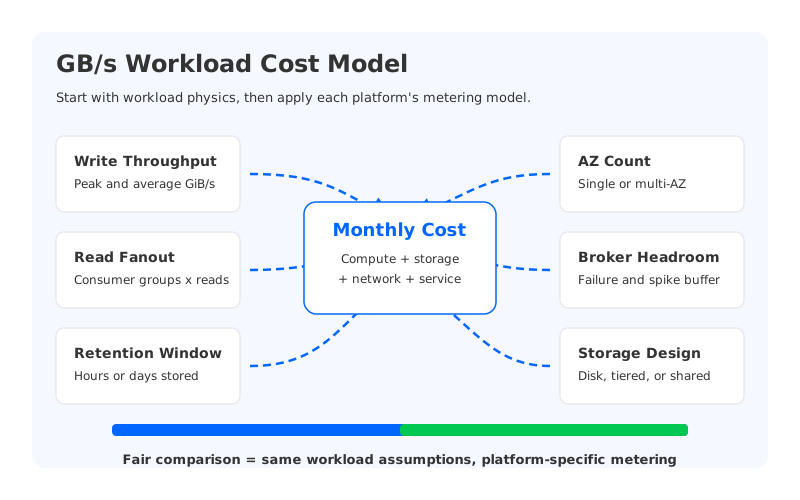
For a monthly estimate, start with data volume:
monthly_write_GiB = average_write_GiB_per_second * 86,400 * days
stored_GiB = average_write_GiB_per_second * retention_seconds
read_GiB = monthly_write_GiB * read_fanout
Then apply the platform-specific model. Amazon MSK pricing includes broker instances, storage, and data transfer. Confluent Cloud publishes billing units for cluster usage, networking, storage, and related services. WarpStream prices BYOC Kafka-compatible streaming around write throughput, storage, and cluster minutes. AutoMQ's pricing calculator separates cloud infrastructure from the AutoMQ managed service fee and lets users model throughput, retention, fanout, partitions, and AZ mode.
The formula is deliberately plain. If a vendor charges on uncompressed writes, use uncompressed writes. If a platform requires provisioned brokers, include broker headroom. If a platform stores most data in object storage, include object storage requests and retrieval behavior. There is no universal answer because the bill follows the architecture.
4Top Platforms For High-Throughput Kafka Workloads
4.1AutoMQ
AutoMQ is a Kafka-compatible streaming platform built around shared storage. Its architecture stores data in object storage through S3Stream, while a WAL layer handles durable writes and recovery. Broker compute is less tightly bound to retained data, so scaling does not require the same broker-local data migration pattern as classic Kafka.
AutoMQ is most interesting when retention, burst elasticity, and cloud storage economics matter as much as single-broker latency. Evaluate it for log analytics, observability pipelines, and high-ingest systems where broker-disk replication cost dominates the model. The trade-off to validate is latency profile across WAL storage choices.
4.2Amazon MSK
Amazon MSK is the native managed Kafka service on AWS. It is often the default choice for teams that want Apache Kafka semantics, AWS integration, and reduced operational ownership.
At high throughput, MSK cost modeling should include broker capacity, storage, data transfer, and the choice between provisioned and serverless modes. MSK still requires careful thinking about partition placement, broker headroom, and replication. For AWS-first teams with strict latency needs, MSK can be a conservative option.
4.3Confluent Cloud
Confluent Cloud is a fully managed data streaming platform with Kafka at the center and a broad ecosystem around connectors, stream processing, governance, and schema management. For many teams, its value is the surrounding platform, especially when the project needs enterprise controls and multi-cloud availability.
Usage can involve Kafka capacity units, storage, networking, and additional platform services. Confluent Cloud can be compelling when operational simplicity and platform breadth fit the bill. For a pure GB/s ingest pipeline, pressure-test whether you need the full platform surface or only a cost-efficient Kafka-compatible data plane.
4.4WarpStream
WarpStream is a Kafka-compatible, object-storage-first system now under Confluent. Its BYOC model runs agents in the customer's cloud account while the control plane is managed by WarpStream. Its pricing page meters dimensions such as write throughput, storage, and cluster minutes.
WarpStream is relevant for latency-tolerant workloads where cross-AZ replication and broker-attached storage are main cost drivers. Object-storage-first systems still need validation against latency-sensitive paths. For observability, audit logs, clickstream, or large fan-in pipelines, the architecture deserves a test.
4.5Redpanda
Redpanda is Kafka API-compatible but uses its own engine rather than Apache Kafka brokers. Redpanda Cloud offers serverless, dedicated, and BYOC deployment models, with billing metrics documented across deployment types.
Redpanda is a strong candidate when teams want Kafka compatibility with a different broker implementation and a managed or BYOC operating model. It can fit low-latency streaming paths. For retention-heavy or latency-tolerant streams, evaluate how tiered storage and Cloud Topics affect the workload.
4.6Self-Managed Apache Kafka
Self-managed Kafka remains the most flexible option: instance types, disk types, rack awareness, partition assignment, upgrade timing, monitoring, and tuning are all yours.
The cost risk is that every hidden operational cost is yours too: capacity planning, incidents, rebalancing, disk expansion, broker replacement, upgrades, and performance debugging. A self-managed cluster may still have the lowest direct vendor bill, but only if the team can keep utilization high without turning every expansion into a data movement project.
5Cost Model Comparison: Broker-Disk Vs Object-Storage-First
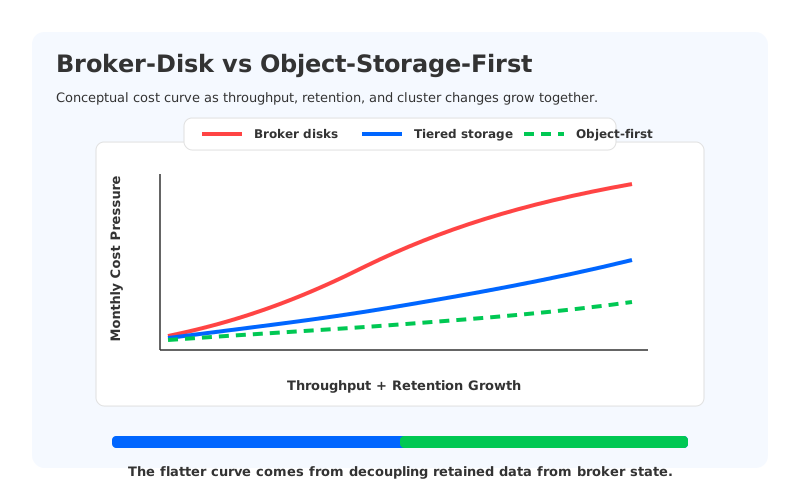
Broker-disk Kafka and object-storage-first Kafka-compatible systems can both run high-throughput workloads, but they spend money in different places.
| Dimension | Broker-Disk Model | Object-Storage-First Model |
|---|---|---|
| Durable data location | Broker-attached disks or volumes first | Object storage as primary durable layer |
| Scaling pressure | Broker count and disk state grow together | Compute can scale more independently from retained data |
| Rebalancing | Often moves partition data between brokers | Often moves metadata or ownership more than data |
| Cost sensitivity | Instances, storage, replication, cross-zone traffic, operations | Object storage, requests, agents/compute, managed service fees |
| Best fit | Low-latency hot workloads with mature Kafka operations | High-ingest, retention-heavy, bursty, or latency-tolerant workloads |
Tiered storage is the important nuance. It can reduce long-term disk pressure by offloading older segments to object storage, and Apache Kafka added official tiered storage through KIP-405. But tiered storage is not the same as making object storage the primary data layer. In a tiered model, the hot path still relies on broker-local primary storage.
That distinction shows up during scaling. Broker-disk Kafka still has to rebalance partitions and data placement. In shared-storage designs, retained data is less bound to a specific broker, so adding compute does not necessarily imply moving large volumes of historical data.
6FAQ
6.1What is the right benchmark for high-throughput Kafka cost?
Use your own workload first. A useful benchmark states write throughput, read fanout, partition count, retention, compression, AZ layout, latency target, instance types, storage type, and cloud region. A single throughput number without these assumptions is not enough to compare platforms.
6.2Is object-storage-first Kafka always lower cost?
No. It is often attractive when storage volume, burst elasticity, and cross-zone replication dominate the bill. It may be less attractive for ultra-low-latency workloads with mostly hot reads. Test the latency path and recovery behavior before making a decision.
6.3Should teams include operations in the cost model?
Yes, especially above 1 GiB/s. Operations are overprovisioning, slower upgrades, incident risk, rebalancing windows, and delayed product work. Fully managed platforms make some costs visible in the vendor bill. Self-managed platforms hide them until the team has to scale, recover, or upgrade.
6.4Which platform should I shortlist first?
For AWS-first teams that want managed Apache Kafka, start with MSK. For teams that need a broad managed streaming platform, include Confluent Cloud. For object-storage-first economics, include AutoMQ and WarpStream. For Kafka-compatible performance with a different engine, include Redpanda. For teams with deep Kafka automation, keep self-managed Kafka as a baseline.
High-throughput Kafka cost is decided by where each byte goes after the producer sends it: how many times it is copied, how long it is retained, how often it is read, and how much broker state has to move when the cluster changes. Once those mechanics are explicit, the platform shortlist becomes much easier to defend.
Official source notes: AutoMQ pricing, AutoMQ architecture docs, AutoMQ S3Stream docs, Amazon MSK pricing, Confluent Cloud billing docs, Confluent Cloud pricing estimator, WarpStream pricing, Redpanda Cloud billing docs, Redpanda Cloud overview, and Apache Kafka documentation.


