
Table of Contents
Table of Contents
Redpanda is attractive for a good reason: it speaks the Kafka API, avoids the JVM, ships as a compact operational unit, and gives teams a credible path away from running classic Kafka clusters themselves. If your pain is broker tuning, ZooKeeper-era complexity, or unpredictable operational toil, Redpanda belongs on the shortlist.
The harder question comes after that first screen. A Kafka-compatible platform is not only a broker replacement. It becomes the surface area for client compatibility, storage economics, license policy, cloud networking, governance, and your future exit path. Redpanda's own docs describe Kafka compatibility with specific exceptions, and its self-managed Community Edition is source-available under the Redpanda Business Source License rather than Apache 2.0 open source. Those details do not make Redpanda a bad choice. They do mean the comparison has to go beyond throughput claims.
1Quick Answer
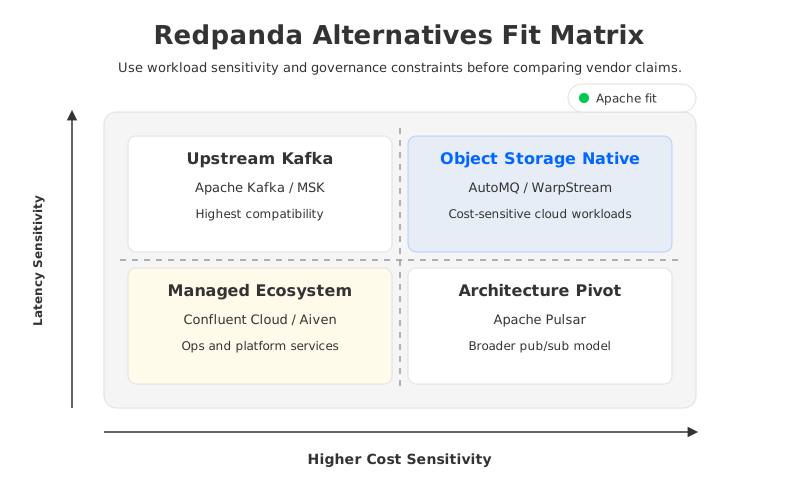
If you need a Redpanda alternative, start with the constraint that matters most:
| Best fit | Redpanda alternative | Why teams evaluate it |
|---|---|---|
| Kafka-compatible, open source, object-storage-native architecture | AutoMQ | Apache 2.0 project built on the Kafka protocol layer with S3/object storage as the storage foundation |
| Maximum upstream Kafka compatibility | Apache Kafka or Amazon MSK | Uses Apache Kafka itself, which keeps the broadest ecosystem and behavioral compatibility |
| Fully managed Kafka ecosystem | Confluent Cloud | Managed Kafka plus Schema Registry, Connect, governance, Flink, and enterprise controls |
| BYOC with object-storage economics | WarpStream | Kafka protocol-compatible service with stateless agents and object storage in the customer's cloud |
| Broader pub/sub architecture beyond Kafka | Apache Pulsar | Apache 2.0 streaming platform with a different broker/bookkeeper architecture and Kafka protocol options through KoP |
| Managed open-source Kafka across clouds | Aiven for Apache Kafka | Managed Kafka service with multi-cloud deployment options and operational tooling |
There is no universal "best Redpanda alternative." The strongest choice depends on whether you are optimizing for Kafka compatibility, open-source licensing, low-latency local storage, cloud cost structure, managed operations, or multi-cloud control.
2Why Teams Consider Redpanda
Redpanda's pitch lands because many Kafka teams have lived through the same operational pattern. A cluster starts as infrastructure, then slowly becomes a specialized system that needs broker sizing, partition planning, disk management, client upgrades, rebalance discipline, monitoring, and incident runbooks. Redpanda reduces part of that burden by implementing a Kafka API-compatible platform in C++ without the JVM and without ZooKeeper.
That is a meaningful trade. Redpanda's official Kafka compatibility page says clients developed for Kafka versions 0.11 and later are compatible, subject to documented limitations. For teams with existing Kafka producers and consumers, that matters more than a clean-room streaming API. Rewriting client code is rarely where platform teams want to spend their migration budget.
But Kafka API compatibility is table stakes for this category. Once several vendors can receive records from Kafka clients, the real evaluation moves to questions that show up later in production:
- What happens when retention grows? Local disk, tiered storage, and object-storage-native designs produce very different cost curves.
- Who owns the data plane? SaaS, BYOC, self-managed, and marketplace deployments create different security and compliance trade-offs.
- What license risk can your company accept? Apache 2.0, source-available BSL, and commercial-only services are different procurement conversations.
- How close must behavior stay to Apache Kafka? Some alternatives implement the Kafka protocol; others run Apache Kafka itself.
- What is the exit path? The more proprietary surrounding services you adopt, the more important migration tooling and standard interfaces become.
3What to Compare Before Choosing Redpanda
A fair Redpanda alternatives list should not rank products by a single benchmark. Streaming platforms are unusually workload-sensitive: a low-retention request/reply workload, a high-retention analytics workload, and a regulated multi-cloud data platform will all choose differently.
Use these dimensions first, then read vendor claims through that lens:
| Evaluation dimension | What to check | Why it matters |
|---|---|---|
| Kafka compatibility | Kafka protocol coverage, client support, transactional behavior, Connect and Streams expectations | Compatibility gaps usually appear during migration, not during the demo |
| Storage architecture | Local disk, replicated disk, tiered storage, or object-storage-native design | Storage architecture drives retention cost, recovery behavior, and scaling model |
| Deployment model | Self-managed, managed SaaS, BYOC, marketplace, Kubernetes | The operating model determines who handles incidents and where data flows |
| License and governance | Apache 2.0, BSL/source-available, commercial service terms | Legal review can block an otherwise good technical fit |
| Ecosystem | Schema Registry, connectors, stream processing, observability, IAM, governance | Kafka is usually part of a platform, not a standalone broker |
| Latency profile | Tail latency under your producer settings, replication model, cloud region topology | Vendor benchmarks rarely match your workload exactly |
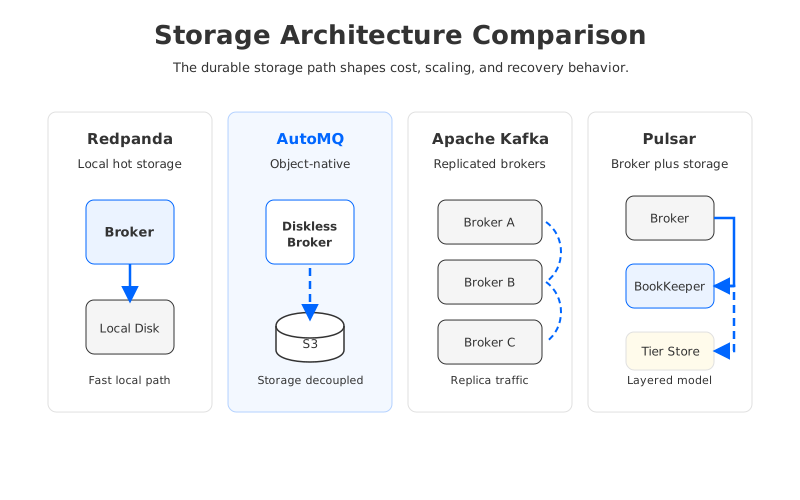
The storage row deserves extra attention. Traditional Kafka and Redpanda are built around broker-local storage as the hot path, with replication or tiering depending on configuration and edition. Diskless or object-storage-native systems move the durable storage responsibility toward cloud object storage. That can reduce replicated disk and cross-zone traffic pressure, but it also changes the latency and failure-mode analysis. The right question is not "which architecture is newer?" It is "which architecture fits this workload's retention, latency, and ownership constraints?"
4Top Redpanda Alternatives
4.1AutoMQ
AutoMQ is a strong Redpanda alternative for teams that want Kafka compatibility, Apache 2.0 open-source licensing, and a storage model designed around object storage instead of broker-local disks. The project describes itself as built on Apache Kafka's protocol layer with a cloud-native storage engine, and the AutoMQ GitHub repository lists the project under the Apache 2.0 license. Its BYOC model is also materially different from a typical managed BYOC split: AutoMQ documents the environment console/control plane and the Kafka service/data plane as deployed in the user's network environment, rather than only placing the data plane in the customer cloud.
The architectural difference matters most in cloud environments. Traditional Kafka-style replication writes multiple copies across brokers and availability zones. Redpanda reduces operational complexity, but it still belongs closer to the local-storage lineage for hot data. AutoMQ takes a different path: brokers are designed to be diskless, while durable data is stored in S3-compatible object storage. That model is most interesting when retention grows, traffic crosses availability zones, or teams want compute and storage to scale more independently.
AutoMQ is not the answer for every Redpanda buyer. If your primary requirement is the lowest possible latency on a tightly controlled local-disk deployment, test carefully against your own workload. If your bigger pain is cloud TCO, elastic scaling, Kafka client compatibility, customer-VPC-resident control, and open-source license posture, AutoMQ deserves a serious proof of concept.
Useful sources:
4.2Apache Kafka or Amazon MSK
The safest compatibility answer is still Apache Kafka itself. If your organization has years of Kafka operational knowledge, deep use of Kafka Streams, Connect, MirrorMaker, transactional APIs, or edge-case client behavior, staying with upstream Kafka avoids the uncertainty that comes with protocol-compatible reimplementations.
The trade-off is operational. Self-managed Kafka gives maximum control, but platform teams still own broker sizing, disk planning, upgrades, partition movement, security configuration, and incident response. Amazon MSK removes some of that operational burden by running Apache Kafka as a managed AWS service, with pricing based on broker instance usage and related resources. That makes MSK a natural Redpanda alternative for AWS-centered teams that value upstream Kafka semantics more than a new storage architecture.
Kafka or MSK is usually the right path when compatibility risk is more expensive than infrastructure inefficiency. It is less compelling when the main problem is cloud cost from replicated storage and cross-AZ traffic, or when the team wants faster elasticity than broker-local storage normally allows.
Useful sources:
4.3Confluent Cloud
Confluent Cloud is the Redpanda alternative for teams that want the broadest managed Kafka platform, not only a broker. Confluent offers multiple Kafka cluster types, and its documentation ties cluster choice to features, capabilities, and price. The platform also brings surrounding services that matter in enterprise data streaming: Schema Registry, connectors, governance, stream processing, networking controls, and multi-cloud availability.
The value is ecosystem depth. If your platform team is spending as much time on schemas, connectors, governance, and operational controls as on brokers, Confluent Cloud can reduce integration work. That is why Confluent often wins in organizations where streaming is becoming a shared enterprise platform rather than a single application dependency.
The trade-off is commercial and architectural lock-in. Confluent Cloud is a managed service with its own pricing units and platform features. That can be exactly what a large organization wants, but it changes the buying motion from "Kafka-compatible broker replacement" to "managed data streaming platform." If you are comparing it with Redpanda, make sure the scope is honest: broker cost alone is not the full comparison.
Useful sources:
4.4WarpStream
WarpStream is a relevant Redpanda alternative when the reason for leaving classic Kafka is cloud cost structure. It is Kafka protocol-compatible but does not run Apache Kafka brokers. Instead, WarpStream's model uses stateless agents and object storage, with a BYOC posture where the data plane runs in the customer's cloud account and the control plane is managed by WarpStream.
That architecture attacks a different problem than Redpanda. Redpanda focuses on a simpler, high-performance Kafka-compatible broker. WarpStream focuses on removing local disks and reducing the replicated-networking cost pattern that appears in cloud Kafka deployments. Its pricing page states that BYOC clusters run the data plane in the customer's cloud account and that data does not leave that account.
The trade-off is latency profile and platform fit. Object-storage-first systems can be very attractive for high-retention or cost-sensitive workloads, but teams with strict low-latency requirements should test producer acknowledgment settings, consumer fetch behavior, and tail latency under realistic load. WarpStream belongs on the shortlist when BYOC, object-storage economics, and operational simplicity matter more than matching classic broker internals.
Useful sources:
4.5Apache Pulsar
Apache Pulsar is not a drop-in Redpanda replacement in the same way Kafka-compatible broker platforms are. It is a different streaming system with a broker layer, Apache BookKeeper storage, native multi-tenancy concepts, and a topic model that can fit teams looking beyond Kafka's architecture.
That difference is both the reason to evaluate it and the reason to be careful. Pulsar can be compelling when you want multi-tenancy, geo-replication patterns, and separation between serving and storage. It also has Kafka protocol options through the Kafka-on-Pulsar ecosystem, but protocol compatibility through an additional layer should be tested more carefully than a native Kafka deployment. Your Kafka clients may connect, but operational behavior, tooling expectations, and edge cases need a real migration test.
Pulsar is best treated as an architectural alternative to Redpanda, not merely a Redpanda clone. It fits teams willing to adopt a broader Pulsar operating model in exchange for its design advantages.
Useful sources:
4.6Aiven for Apache Kafka
Aiven for Apache Kafka is a practical Redpanda alternative for teams that want managed open-source Kafka across clouds without adopting a larger proprietary streaming platform. Aiven's Kafka service runs across major cloud providers, and its pricing page presents plan-based options for Apache Kafka with included components such as Schema Registry and REST proxy in some tiers.
The appeal is operational convenience with recognizable Kafka behavior. Instead of moving to a Kafka-compatible reimplementation, you keep Apache Kafka as the underlying system and let Aiven manage provisioning, upgrades, monitoring, and routine operations. That can be a good fit for lean data teams that want less infrastructure work but still want portability across cloud providers.
The trade-off is that managed Kafka does not automatically remove Kafka's underlying storage economics. Aiven has introduced diskless Kafka positioning as well, so the exact comparison depends on which Aiven offering you evaluate. If the target is "managed upstream Kafka," Aiven is strong. If the target is "object-storage-native Kafka-compatible architecture," compare the specific diskless offering against AutoMQ and WarpStream.
Useful sources:
5Redpanda Alternatives Comparison Table
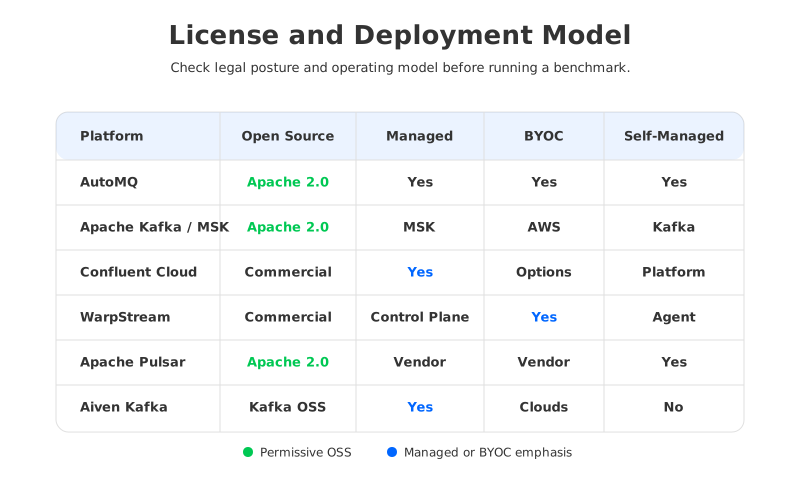
| Platform | Kafka compatibility posture | License / commercial posture | Deployment options | Best fit | Watch-outs |
|---|---|---|---|---|---|
| AutoMQ | Kafka protocol-compatible, built on Kafka protocol layer | Open source under Apache 2.0; commercial cloud/BYOC offerings available | Self-managed open source, BYOC, cloud options | Kafka-compatible cloud-native streaming with object storage | Validate latency and feature coverage against your exact Kafka usage |
| Apache Kafka / Amazon MSK | Runs Apache Kafka | Apache Kafka is Apache 2.0; MSK is managed AWS service | Self-managed or AWS managed | Highest Kafka compatibility and ecosystem continuity | Operational work and storage/network cost structure can remain significant |
| Confluent Cloud | Managed Kafka platform | Commercial managed service | SaaS across major clouds and enterprise networking modes | Enterprise Kafka ecosystem, governance, connectors, stream processing | Pricing and platform scope go beyond broker replacement |
| WarpStream | Kafka protocol-compatible, not Apache Kafka brokers | Commercial BYOC service | BYOC with customer-owned data plane | Cost-sensitive cloud workloads using object storage | Test tail latency and Kafka feature assumptions carefully |
| Apache Pulsar | Native Pulsar; Kafka protocol through KoP ecosystem | Apache 2.0 | Self-managed, Kubernetes, vendor-managed options | Teams open to a different streaming architecture | Not a simple Redpanda drop-in; migration requires deeper validation |
| Aiven for Apache Kafka | Managed Apache Kafka | Commercial managed service around open-source components | Managed service across multiple clouds | Teams wanting managed Kafka without changing platforms | Underlying cost model depends on the selected Kafka or diskless offering |
The table is deliberately qualitative. Public pricing pages are useful for screening, but precise cost comparisons depend on region, retention, compression ratio, replication settings, partitions, ingress/egress, private networking, support tier, and whether the vendor bills on logical or replicated data.
6How to Choose by Scenario
Choose AutoMQ if your Redpanda evaluation is mostly about Kafka compatibility plus cloud storage economics. It is especially relevant when the team wants Apache 2.0 open-source software and a design that makes object storage the durable foundation rather than an archive tier.
Choose Apache Kafka or Amazon MSK if compatibility risk dominates everything else. This is the conservative option for teams with complex Kafka behavior, older clients, Kafka Streams applications, or strict expectations around upstream semantics.
Choose Confluent Cloud if the broker is only one part of the platform you need. When governance, connectors, schema management, stream processing, and enterprise controls are first-class requirements, Confluent's broader platform can be worth the commercial commitment.
Choose WarpStream if your strongest requirement is BYOC with object-storage-driven cost structure and you are comfortable validating latency and compatibility against a non-Kafka-broker implementation.
Choose Apache Pulsar if you are willing to consider a different streaming architecture, not just a Kafka-compatible broker. Pulsar is more of a platform pivot than a drop-in swap.
Choose Aiven for Apache Kafka if you want managed Kafka across clouds while staying close to the open-source Kafka ecosystem. It is a pragmatic path for teams that want less ops without a major architecture change.
7FAQ
7.1What is the best open-source Redpanda alternative?
For a permissive open-source license, Apache Kafka and AutoMQ are the most direct options in this list. Apache Kafka is the upstream Apache 2.0 project. AutoMQ is also Apache 2.0 and targets Kafka-compatible streaming with an object-storage-native architecture. Redpanda Community Edition is source-available under the Redpanda Business Source License according to Redpanda's licensing documentation, so it should not be treated the same as Apache 2.0 software in procurement reviews.
7.2Is Redpanda fully Kafka-compatible?
Redpanda documents Kafka API compatibility for Kafka clients developed for Kafka versions 0.11 and later, subject to limitations listed in its docs. That is strong enough for many producer and consumer workloads, but "Kafka-compatible" should still be validated with your exact clients, security settings, transactions, admin APIs, Connect usage, and operational tooling.
7.3Is AutoMQ a Redpanda alternative?
Yes, if the requirement is Kafka-compatible streaming with a different storage architecture and a stricter customer-cloud boundary. AutoMQ is not trying to be a local-disk Redpanda clone. It is a diskless Kafka-compatible system built around object storage, with BYOC deployments where the control plane and data plane live in the user's network environment. That makes it most relevant for cloud workloads where storage cost, cross-AZ traffic, retention, elasticity, and governance boundaries matter.
7.4Is WarpStream a Redpanda alternative?
Yes, for BYOC and object-storage-first workloads. WarpStream is Kafka protocol-compatible but does not run Apache Kafka brokers. That makes it a serious Redpanda alternative for cloud cost optimization, but teams should test latency and Kafka feature assumptions before migrating critical workloads.
7.5Should I choose Redpanda, Kafka, or a managed Kafka service?
Choose Redpanda when its operational simplicity and Kafka API compatibility fit your workload and license requirements. Choose Apache Kafka or MSK when upstream compatibility matters most. Choose Confluent Cloud or Aiven when managed operations and ecosystem services matter more than controlling the broker architecture. Choose AutoMQ or WarpStream when cloud storage economics and elastic architecture are central to the decision.
8Sources
- Redpanda Kafka compatibility
- Redpanda licensing
- Redpanda BYOC
- AutoMQ GitHub repository
- AutoMQ documentation overview
- AutoMQ Cloud BYOC overview
- Apache Kafka protocol documentation
- Amazon MSK pricing
- Confluent Cloud cluster types
- Confluent pricing
- WarpStream pricing
- Apache Pulsar documentation
- Kafka-on-Pulsar repository
- Aiven for Apache Kafka
- Aiven pricing


