
Table of Contents
Table of Contents
Aiven for Apache Kafka is easy to understand as a buying decision. You get Apache Kafka as a managed service, multi-cloud deployment choices, a developer-friendly console, and a vendor that has stayed close to open source infrastructure. For many platform teams, that is exactly the right trade: keep Kafka, reduce the operational surface, and avoid building a full streaming platform team around brokers, disks, upgrades, and connectors.
The search for an Aiven Kafka alternative usually starts later, when the workload shape changes. Retention gets longer. Cross-zone traffic starts showing up in the cloud bill. A security review asks where the data plane actually runs. A platform team wants the same Kafka experience across AWS, GCP, and Azure, but the cost and control model cannot be treated as a secondary detail anymore. At that point, "managed Kafka" stops being one category.
The useful comparison is not Aiven versus everyone else in a generic feature checklist. It is a set of paths: stay with a fully managed Kafka service, move to a cloud-provider-native service, adopt a BYOC model, evaluate diskless Kafka, or go back to self-managed Apache Kafka with stronger internal ownership.
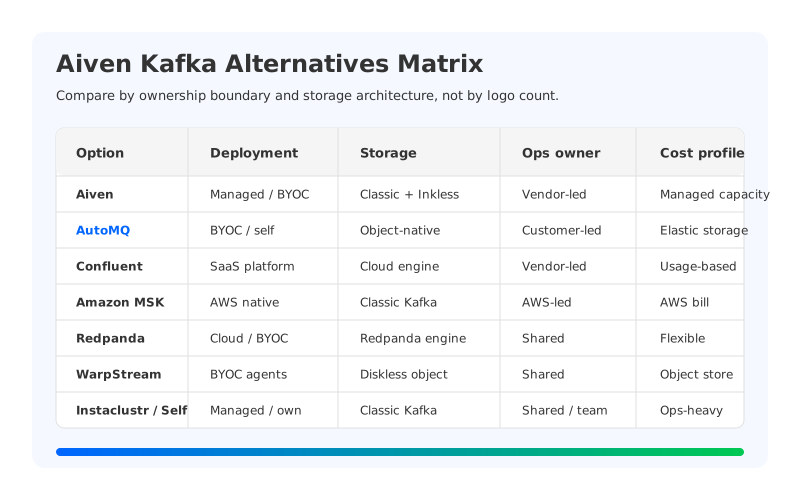
1Quick Answer
Start with these seven Aiven for Apache Kafka alternatives:
| Alternative | Best fit | Deployment model | Storage model | Main trade-off |
|---|---|---|---|---|
| AutoMQ | Teams that want Kafka compatibility, BYOC control, and object-storage-native economics | BYOC or self-controlled deployment | Object storage as the durable storage foundation | Less familiar operational model than classic Kafka |
| Confluent Cloud | Enterprises that need a broad managed Kafka ecosystem with governance, connectors, and stream processing | Fully managed SaaS across major clouds | Confluent-managed cloud-native Kafka engine | Strong platform value, but less data-plane control than BYOC |
| Amazon MSK | AWS-centered teams that want native AWS operations and billing | AWS managed service | Native Apache Kafka clusters, with AWS-managed infrastructure | Best inside AWS; weaker multi-cloud consistency |
| Redpanda Cloud | Teams that want Kafka API compatibility with managed or BYOC deployment choices | Serverless, Dedicated, or BYOC | Redpanda engine with local storage and object-storage features depending on configuration | Kafka API-compatible, not Apache Kafka itself |
| WarpStream | BYOC teams prioritizing diskless, object-storage-backed streaming | BYOC with agents in the customer cloud | Diskless architecture built on object storage | Kafka-compatible rather than Apache Kafka; control-plane dependency matters |
| NetApp Instaclustr for Apache Kafka | Teams that want managed open source Kafka across cloud, hybrid, or on-prem environments | Managed service in provider account, customer account, or on-prem | Traditional Apache Kafka | Less cloud-native storage redesign than diskless options |
| Self-managed Apache Kafka | Teams with deep Kafka operations capacity and strict control requirements | Your infrastructure | Traditional Kafka storage unless extended with tiering | Maximum control, maximum operational responsibility |
This is not a ranking. Aiven remains a strong choice when a team wants managed Apache Kafka with predictable service packaging. The alternatives become interesting when one of four constraints dominates the decision: data-plane ownership, cloud-provider alignment, object-storage architecture, or the desire to own Kafka operations directly.
2Why Teams Choose Aiven for Apache Kafka
Aiven's appeal is that it lets teams keep the Apache Kafka mental model while handing off much of the operational work. The Aiven pricing page positions Aiven for Apache Kafka as high-availability, single-tenant dedicated clusters with private networking across plans, while the service packaging wraps Kafka with surrounding pieces such as Schema Registry, REST proxy, Connect, and MirrorMaker depending on plan and configuration. That matters because Kafka is rarely deployed alone; the ecosystem around the brokers often determines how much operational work remains.
Aiven also matters because it is not limited to one hyperscaler. A platform team that runs across clouds can evaluate Aiven without immediately rewriting its Kafka strategy around a single provider's identity, networking, monitoring, and billing model. That is a practical advantage for SaaS companies with regional expansion plans, acquisitions that bring different cloud estates, or internal teams trying to standardize service delivery.
The newer piece is Aiven's Inkless path. Aiven's docs describe Inkless as an Apache Kafka service for cloud deployments that supports diskless topics and object storage-backed retention. The related diskless topics docs say diskless topics are available in Inkless Kafka services on Aiven Cloud and BYOC, while classic and diskless topics can coexist in the same service. That puts Aiven in both the traditional managed Kafka conversation and the diskless Kafka conversation.
That combination is exactly why the alternative analysis needs nuance. You may be replacing classic Aiven Kafka. You may be evaluating Aiven Inkless against object-storage-native systems. Or you may be trying to decide whether the managed-service boundary is still the right boundary for your company.
3Why Teams Look for Aiven Alternatives
Most teams do not leave Aiven because Aiven is "bad Kafka." They look elsewhere because the original managed-service decision no longer answers the most expensive or sensitive part of the workload. Kafka cost, availability, and operations are shaped by storage, replication, network placement, and ownership boundaries. A managed console helps, but it does not erase those architecture choices.
The recurring reasons are familiar:
- Cost profile changes at scale. High-throughput topics, long retention, multi-AZ replication, and read fan-out can turn a comfortable managed-service bill into a strategic infrastructure discussion.
- Data-plane control becomes a requirement. Security, compliance, residency, or internal platform policy may require the streaming data path to stay in a customer-controlled cloud account.
- Cloud alignment matters more than portability. AWS-heavy teams often prefer Amazon MSK because IAM, PrivateLink, CloudWatch, and procurement are already part of the operating model.
- Object storage becomes the architecture question. Teams comparing Aiven Inkless, AutoMQ, and WarpStream are no longer asking only who manages Kafka; they are asking whether broker-attached disks should remain the primary durable layer.
- Open-source fallback matters. Some organizations want the option to self-operate Apache Kafka or a compatible open-source project if vendor terms, roadmap, or acquisition risk changes.
The mistake is to collapse all of those reasons into "find a lower-cost managed Kafka service." Sometimes that is the right answer. Often, the better answer is to choose a different operating model.
4Top Aiven Kafka Alternatives
4.1AutoMQ
AutoMQ is the strongest fit when the search for an Aiven alternative is really about cloud-native Kafka architecture. The AutoMQ overview describes AutoMQ as a cloud-native, fully Kafka-compatible streaming platform built on S3. Its deployment docs position AutoMQ as a storage-compute separated Kafka distribution that can run on public clouds or private environments with S3-compatible storage.
The important distinction is that AutoMQ is not a classic managed Kafka cluster with bigger disks and a nicer control plane. It replaces Kafka's local-disk-oriented storage layer with an object-storage-backed architecture while preserving Kafka compatibility as the user-facing contract. AutoMQ BYOC also places the environment console/control plane and Kafka service/data plane in the user's network environment, so the review is not only about where topic data lives. Instead of planning broker disks, partition movement, and replication capacity as the primary scaling levers, teams evaluate object storage, stateless brokers, WAL choices, failure recovery, maintenance authorization, and BYOC boundaries.
AutoMQ is a good Aiven alternative when you want Kafka-compatible workloads to stay close to the Kafka ecosystem but you also want more control over where the control plane and data plane run. It is especially relevant for teams that are considering Aiven Inkless because both products point toward object storage-backed Kafka, but with different packaging and control assumptions.
Good fit:
- You want Kafka-compatible streaming with object storage as the durable storage foundation.
- You prefer BYOC or self-controlled deployment over a fully opaque SaaS data plane.
- Your pain is tied to broker disks, replication cost, scale-out friction, or long retention.
Watch closely:
- Validate compatibility for your exact Kafka features: transactions, compaction, ACLs, Connect, Streams, Schema Registry, and migration workflows.
- Test latency and backlog-read behavior with your own traffic shape rather than relying on architecture labels.
Useful sources: AutoMQ overview, AutoMQ deployment overview.
4.2Confluent Cloud
Confluent Cloud is the natural alternative when the buyer wants the broadest Kafka-centered platform rather than a narrower managed Kafka service. Confluent's docs describe Confluent Cloud as a fully managed data streaming platform available on AWS, Google Cloud, and Azure, with a cloud-native Apache Kafka engine plus security, stream processing, and governance capabilities. Its pricing page also makes clear that Confluent has multiple cluster types and platform services beyond brokers.
That platform breadth is the reason to evaluate it. If your Aiven estate has grown into a larger data streaming program, the surrounding capabilities may matter as much as Kafka itself: managed connectors, Schema Registry, governance, Flink, enterprise support, and a large ecosystem of commercial experience. Confluent is often less about finding "Kafka hosting" and more about standardizing a data streaming platform.
The trade-off is control. A fully managed SaaS experience means the vendor owns more of the operating model. That can be positive if your team wants to reduce Kafka operations. It can be a blocker if your security model requires the data plane to run in your account or if you want deeper control over storage architecture.
Good fit:
- You want a mature managed platform around Kafka, not only broker hosting.
- Governance, connectors, stream processing, and support are major purchase drivers.
- Your organization is comfortable with a SaaS data plane and Confluent's commercial model.
Watch closely:
- Separate Confluent Cloud from WarpStream BYOC in your evaluation; they solve different ownership and architecture problems.
- Model cost with your real throughput, storage, connectors, networking, and support assumptions.
Useful sources: Confluent Cloud overview, Confluent pricing.
4.3Amazon MSK
Amazon MSK is the default alternative for AWS-centered teams. AWS describes Amazon MSK as a managed streaming data service that operates and scales Apache Kafka infrastructure, while the developer guide says MSK provisions compute, storage, and network resources and handles infrastructure operations. For teams that already standardize on AWS networking, IAM, observability, and procurement, that native fit can outweigh multi-cloud portability.
The strongest reason to choose MSK over Aiven is not that MSK is universally simpler. It is that MSK sits inside the AWS operating model. Security groups, PrivateLink, IAM authentication, CloudWatch, AWS billing, and regional architecture can be governed with the same processes used for the rest of the AWS estate. That reduces organizational friction even when Kafka itself still requires careful sizing and tuning.
The weaker side is multi-cloud consistency. If your platform spans AWS, GCP, and Azure, MSK does not give you one Kafka service model everywhere. It is also still a managed Apache Kafka service rather than a diskless redesign of Kafka's storage layer. That makes it a strong Aiven Classic alternative for AWS teams, but a less direct substitute for Aiven Inkless or AutoMQ-style object-storage-native evaluations.
Good fit:
- Your Kafka workloads are primarily on AWS.
- You want native AWS identity, networking, monitoring, and procurement integration.
- Your team is comfortable keeping the traditional Kafka architecture while AWS owns more infrastructure operations.
Watch closely:
- Include cross-AZ traffic, storage, broker sizing, connector infrastructure, and observability in the cost model.
- Avoid assuming that AWS-native automatically means less Kafka expertise is required.
Useful sources: Amazon MSK overview, Amazon MSK developer guide.
4.4Redpanda Cloud
Redpanda Cloud is relevant when you want Kafka API compatibility with a different engine and flexible deployment choices. Redpanda's BYOC docs say BYOC clusters run Redpanda in your cloud environment while Redpanda manages provisioning, monitoring, upgrades, and security policies. The same docs describe AWS, GCP, and Azure support, with data kept in the customer's environment for BYOC.
That makes Redpanda a serious alternative for teams that like the Aiven managed-service idea but want a different operational model or performance profile. Redpanda is not Apache Kafka; it is Kafka API-compatible. That difference can be useful because it gives Redpanda room to simplify parts of the broker architecture, but it also means compatibility testing belongs at the center of the migration plan.
Redpanda is also part of the BYOC discussion. Its docs describe a control-plane/data-plane split where the data plane lives in the customer's VPC or VNet, while Redpanda manages operations. That can satisfy some data sovereignty requirements without asking the customer to self-operate everything. It is not the same as open-source Apache Kafka in your own account, and Redpanda's own docs note restrictions on customer access to internal data plane resources for managed BYOC clusters.
Good fit:
- You want Kafka API-compatible streaming with managed or BYOC deployment options.
- You are open to a non-Apache Kafka engine if client behavior and ecosystem compatibility test well.
- You want the vendor to manage operations while keeping data in your cloud environment.
Watch closely:
- Test Kafka protocol behavior, connector compatibility, transactions, ACLs, consumer groups, and operational tooling.
- Understand what you can and cannot modify inside the managed BYOC data plane.
Useful sources: Redpanda BYOC docs, Redpanda BYOC architecture, Redpanda Cloud billing.
4.5WarpStream
WarpStream belongs in the Aiven alternatives list because it attacks the same cloud Kafka pain from a more radical direction. Its docs describe WarpStream as a diskless, Apache Kafka-compatible streaming platform built directly on cloud object stores such as S3, GCS, and Azure Blob. The architecture docs say WarpStream replaces physical Kafka clusters with stateless agents that communicate with object storage and a managed metadata/control plane.
For a team comparing Aiven Inkless, WarpStream is a useful reference point. Both shift durable topic data toward object storage, but the operating model differs. WarpStream is BYOC-oriented and Kafka-compatible rather than Apache Kafka as a managed service. It is now part of Confluent after Confluent's WarpStream acquisition, which can be a plus for enterprise support and a consideration for roadmap or vendor-consolidation review.
The trade-off is compatibility and control-plane dependency. Diskless systems can reduce the operational burden around broker disks and replication, but they also move complexity into batching, metadata, object store behavior, and remote reads. You should not evaluate WarpStream as "Aiven with a lower bill." Evaluate it as a different architecture for Kafka-compatible workloads.
Good fit:
- You want a BYOC, diskless, object-storage-backed Kafka-compatible platform.
- Your workload is high-volume and cloud-native enough to benefit from separating compute from storage.
- You are comfortable with a Confluent-owned product path.
Watch closely:
- Validate Kafka compatibility against the exact client features your estate uses.
- Inspect metadata/control-plane dependencies, failure modes, and migration paths.
Useful sources: WarpStream docs, WarpStream architecture, WarpStream billing.
4.6NetApp Instaclustr for Apache Kafka
NetApp Instaclustr is the alternative for teams that want managed open source infrastructure without necessarily buying a cloud-native storage redesign. Its managed Apache Kafka page positions Instaclustr for Apache Kafka as production-ready managed Kafka that can run in the cloud or on-prem, with support, monitoring, Terraform/API provisioning, and options for running in the customer's cloud account or the provider's account.
That makes Instaclustr interesting for regulated, hybrid, or open-source-oriented teams. If the reason you use Aiven is "we want managed open source services," Instaclustr fits the same broad buying motion. It can also be a better fit when on-prem or hybrid deployment is part of the requirement, where pure SaaS Kafka services may not match the operating environment.
The trade-off is that Instaclustr is not primarily a diskless Kafka architecture play. If your evaluation has moved toward Aiven Inkless, AutoMQ, or WarpStream because storage architecture is the core issue, Instaclustr may feel closer to traditional Kafka operations with vendor management layered on top. That can still be the right answer when organizational control and open source posture matter more than rethinking the storage layer.
Good fit:
- You want managed Apache Kafka with strong open-source positioning.
- Hybrid, on-prem, or customer-account deployment matters.
- You value support and operations more than a redesigned storage architecture.
Watch closely:
- Compare the exact shared-responsibility model against Aiven and your internal platform team.
- Treat pricing as workload-specific; Instaclustr's pricing page directs some Kafka scenarios to contact sales.
Useful sources: Instaclustr managed Apache Kafka, Instaclustr pricing.
4.7Self-Managed Apache Kafka
Self-managed Apache Kafka is still a real alternative, though it is rarely the easiest one. It is the right path when the team wants maximum control over versioning, configuration, networking, storage, security, and operational automation. The official Apache Kafka quickstart and documentation remain the baseline for understanding Kafka as a project rather than as a vendor service.
The reason to return from Aiven to self-managed Kafka is usually not nostalgia. It is control. Some teams need custom broker configuration, strict air-gapped deployment, deep integration with internal platforms, or a cost model where vendor management fees are harder to justify than internal operations. Others already have a Kafka platform team and want to standardize around Kubernetes operators, internal SRE practices, and their own upgrade cadence.
The cost is operational responsibility. You own capacity planning, broker and disk failure, partition reassignment, upgrades, monitoring, incident response, security hardening, and disaster recovery. You also own the consequences when a workload grows faster than the platform model. Self-managed Kafka is powerful precisely because it gives you control; it is risky when that control is treated as free.
Good fit:
- You have a capable Kafka/SRE team and need deep operational control.
- Vendor data-plane or control-plane dependencies are not acceptable.
- Your environment requires custom deployment patterns that managed services do not support.
Watch closely:
- Budget for people, automation, testing, and on-call load, not only infrastructure.
- Decide whether you are self-managing classic Kafka, Kafka with tiered storage, or a broader Kafka-compatible platform.
Useful sources: Apache Kafka quickstart, Apache Kafka documentation.
5Aiven Alternatives Comparison Table
The table below is deliberately qualitative. Vendor pricing, supported regions, and feature packaging change often, and exact costs depend on throughput, retention, egress, partitions, connectors, support, and reserved commitments. Use this table to narrow the shortlist, then run a workload-specific cost and behavior test.
| Option | Cloud coverage | Data-plane ownership | Kafka posture | Storage architecture | Cost-control angle |
|---|---|---|---|---|---|
| Aiven for Apache Kafka / Inkless | Multi-cloud, with service-specific availability | Aiven-managed; BYOC available for some models | Apache Kafka service | Classic Kafka plus Inkless diskless topics | Managed capacity, diskless topics for selected use cases |
| AutoMQ | Public or private environments with S3-compatible object storage | BYOC or self-controlled deployment | Kafka-compatible | Object-storage-native, storage-compute separated | Targets disk, replication, and elasticity cost drivers |
| Confluent Cloud | AWS, Azure, and GCP | Confluent-managed SaaS | Kafka-centered Confluent platform | Confluent-managed cloud-native Kafka engine | Usage-based platform pricing and managed operations |
| Amazon MSK | AWS | AWS-managed in customer AWS environment | Native Apache Kafka | Traditional Kafka infrastructure managed by AWS | AWS-native procurement, IAM, monitoring, and networking |
| Redpanda Cloud | AWS, GCP, Azure depending on cluster type and region | Vendor-managed; BYOC places data plane in customer cloud | Kafka API-compatible | Redpanda engine with local/object storage features | Managed or BYOC deployment choices |
| WarpStream | Major object-store clouds through BYOC architecture | Agents in customer cloud, managed control plane | Kafka-compatible | Diskless, object-storage-backed | Removes broker disks and inter-AZ replication patterns by design |
| Instaclustr | Cloud, customer account, hybrid, or on-prem options | Managed by Instaclustr depending on account model | Apache Kafka | Traditional Kafka | Managed open source operations and deployment flexibility |
| Self-managed Kafka | Wherever your team can operate it | Customer-owned | Apache Kafka | Traditional Kafka unless extended | Avoid vendor management fees, but absorb operational cost |
The most important row is not visible in the table: your workload. A small event bus, a high-volume observability pipeline, a payment stream, and a long-retention audit log should not pick the same architecture by default.
6Managed Kafka Decision Paths
The decision becomes clearer when you start with the constraint instead of the vendor name.
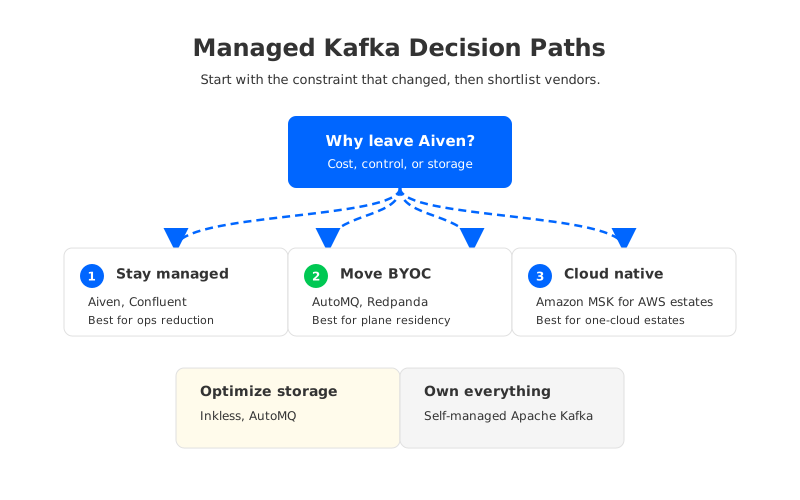
If your current Aiven setup is working and the main issue is incremental cost optimization, start by reviewing Aiven plan sizing, topic retention, partition count, compression, consumer fan-out, and whether Inkless topics fit high-retention workloads. Switching vendors before cleaning up the workload can move the bill without fixing the cause.
If the problem is cloud-provider alignment, MSK belongs near the top for AWS teams, while Confluent and Aiven remain stronger multi-cloud SaaS options. Redpanda, AutoMQ, WarpStream, and Instaclustr can all enter the discussion when "where the planes run" matters more than who hosts the UI. AutoMQ deserves a separate look when the control plane also needs to stay inside the user's network environment.
If the problem is storage architecture, compare Aiven Inkless, AutoMQ, and WarpStream first. This is where language matters. Tiered storage, diskless topics, and object-storage-native Kafka are related ideas, but they are not the same operating model. The migration test should include hot writes, cold reads, compaction, consumer lag, broker or agent failure, and scale-out behavior.
If the problem is control, self-managed Kafka and BYOC systems deserve a harder look. BYOC can keep data in your account, but it may still depend on a vendor control plane. AutoMQ is different here because its BYOC environment places the environment console/control plane in the user's network environment as well. Self-managed Kafka gives the most control, but it also puts the operational blast radius back on your team.
7Traditional Managed Kafka vs Diskless Kafka
Classic managed Kafka changes who operates the cluster. Diskless Kafka changes what the cluster is operating.
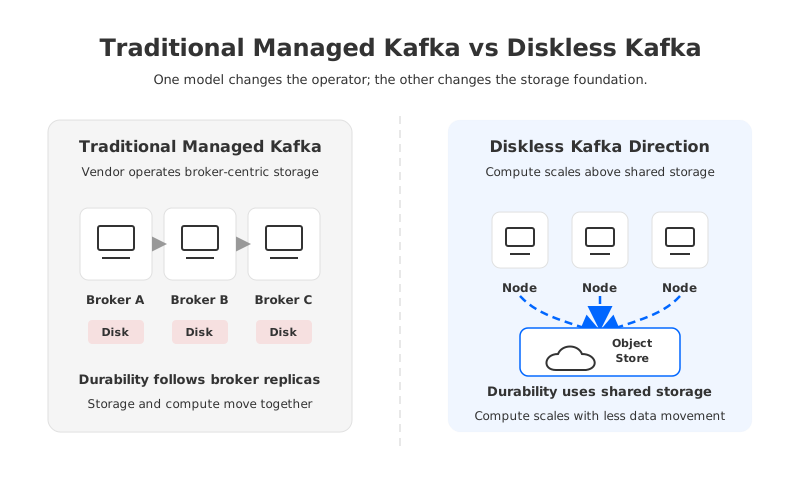
In traditional Kafka, brokers own local or attached storage, and replication between brokers is part of the durability model. Managed services can automate a large share of the work, but the underlying design still has to think about broker storage capacity, partition movement, cross-zone replication, and recovery from disk-heavy node replacement.
Diskless designs push durable log storage into object storage and make compute easier to replace. That can reduce some of the hardest cloud Kafka cost and elasticity problems, but it does not make the system simple in an absolute sense. The hard problems move into object-store write patterns, caching, metadata coordination, remote read behavior, and compatibility coverage.
That is why Aiven Inkless is strategically important. Aiven is not pretending classic Kafka disappears overnight; its docs say classic and diskless topics can coexist in the same Inkless service. For many teams, that mixed model is attractive. For others, a platform such as AutoMQ or WarpStream may be a cleaner architectural bet because object storage is not a per-topic extension; it is the center of the storage design.
8Where AutoMQ Fits
AutoMQ fits when the Aiven alternative search has moved beyond "who can host Kafka for us?" and into "what should cloud Kafka be built on?" The core bet is that Kafka's API and ecosystem are still worth preserving, but broker-attached storage and application-level replication are not the right default for elastic cloud infrastructure.
That does not make AutoMQ the universal answer. If your team wants the most mature SaaS platform around Kafka, Confluent may be the better shortlist leader. If you are all-in on AWS, MSK may reduce organizational friction. If you already like Aiven and only need diskless topics for selected workloads, Inkless may be the simplest path. If you need managed open source across hybrid environments, Instaclustr may be a cleaner fit.
AutoMQ should be on the first test list when three conditions line up: your applications should keep Kafka-compatible behavior, your control plane and data plane should stay in an environment you control, and your cost or elasticity problem comes from Kafka's classic storage model. At that point, a storage-compute separated design is not a product checkbox. It is the architecture question.
For a hands-on evaluation, start with the AutoMQ documentation and test the workload you actually run today: topic count, message size, retention, fan-out, failure mode, and migration rollback included.
9FAQ
9.1Which Aiven for Apache Kafka alternative should we shortlist first?
There is no universal first choice. AutoMQ is a strong fit for teams that want Kafka compatibility with object-storage-native architecture and BYOC control. Confluent Cloud is strong for managed platform breadth. Amazon MSK is usually the first AWS-native option. Redpanda Cloud, WarpStream, Instaclustr, and self-managed Kafka each fit different ownership and architecture constraints.
9.2Is Aiven Inkless the same as diskless Kafka?
Aiven's docs describe Inkless as an Apache Kafka service that supports diskless topics and object storage-backed retention. Diskless topics store topic data in object storage rather than on broker disks, but they are part of Aiven's managed service model and have their own availability, configuration, and feature boundaries. Treat Inkless as a specific managed implementation of diskless-topic ideas, not as a generic label for every diskless Kafka-compatible architecture.
9.3Is AutoMQ an Aiven Inkless alternative?
Yes, if your reason for evaluating Aiven Inkless is object-storage-backed Kafka. AutoMQ approaches the problem as a Kafka-compatible, storage-compute separated platform built around object storage. Aiven Inkless approaches it as an Aiven-managed Apache Kafka service with diskless topics. The right choice depends on whether you value Aiven's managed service boundary or a more directly controlled object-storage-native deployment.
9.4Is Amazon MSK lower cost than Aiven?
It depends on workload and architecture. MSK may fit AWS procurement and networking better, but total cost depends on broker type, storage, retention, cross-AZ traffic, data transfer, connectors, monitoring, support, and internal operations. Use AWS and Aiven pricing calculators with the same workload assumptions before drawing a conclusion.
9.5Should we choose BYOC instead of fully managed Kafka?
Choose BYOC when data residency, network control, cloud account ownership, or security review matters enough to accept a more explicit shared-responsibility model. Fully managed SaaS is often better when your main goal is to reduce operations and your data-plane requirements fit the vendor model. BYOC is not automatically more open; inspect the control plane, metadata, support access, and exit path.
9.6What should we test before migrating from Aiven?
Test producer and consumer compatibility, partition count, retention, compression, ACLs, transactions if used, compaction if used, Schema Registry, connectors, consumer lag, backlog reads, failure recovery, and scale-out behavior. Also test the migration path itself: dual writes or replication, offset handling, rollback, DNS/client cutover, and how long both systems must run in parallel.


