
Table of Contents
Table of Contents
Amazon MSK removes a lot of Kafka operations work, but it does not remove Kafka's cost model. A production MSK bill still reflects broker hours, storage, client traffic, optional storage throughput, private connectivity, and DR replication. The biggest cost drivers rarely appear under one friendly label called "Kafka replication cost."
That is why MSK cost optimization needs a different lens from generic EC2 right-sizing. Broker count matters, but the expensive behavior often comes from replication, retention, consumer placement, and DR. A DR design may be technically correct and still replicate far more data than the recovery objective requires.
1Quick Answer
The practical way to reduce AWS MSK cost is to separate configuration optimizations from architecture changes. Configuration work includes right-sizing brokers, tuning retention, checking replication factor, and reducing avoidable cross-AZ reads. Architecture work includes tiered storage, DR changes, or moving to a storage-separated Kafka-compatible platform when broker-attached storage becomes the ceiling.
| Strategy | Type | Primary cost area | Main tradeoff |
|---|---|---|---|
| Right-size brokers and storage throughput | Configuration | Broker hours, provisioned storage throughput | Less headroom if traffic spikes |
| Tune retention by topic | Configuration | Primary storage and replay window | Shorter recovery or audit window |
| Review replication factor | Configuration | Storage footprint and broker workload | Durability and availability risk if reduced carelessly |
| Use MSK tiered storage carefully | Architecture/configuration | Long-retention storage | Higher latency for remote-tier reads |
| Reduce unnecessary cross-AZ reads | Configuration/topology | AWS data transfer | More client-placement discipline |
| Separate DR from hot-path replication | Architecture | Replicator, transfer, target cluster cost | RPO/RTO decisions become explicit |
| Evaluate object-storage-first alternatives | Architecture | Storage, scaling, DR model | Migration and platform validation |
2Why MSK Cost Is More Than Broker Hours
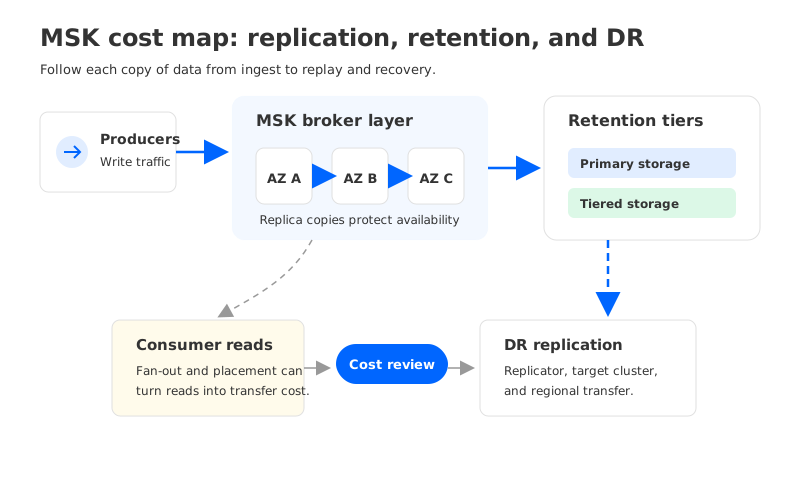
The official Amazon MSK pricing page makes the split visible: provisioned clusters charge for broker instance usage, storage, optional provisioned storage throughput, private connectivity, and standard AWS data transfer for data transferred in and out of MSK clusters. MSK Replicator adds hourly and data-processed charges, plus cross-region transfer for cross-region replication.
That breakdown matters because Kafka turns one business event into several infrastructure events. A producer write lands on a leader, replication sends data to followers, retention keeps it available for replay, and DR may copy it to another Region. If you optimize only broker size, you may leave most cost behavior unchanged.
The right cost map starts with workload shape:
- Ingest rate determines storage growth and DR replication volume.
- Retention determines how long primary or tiered storage carries each record.
- Consumer fan-out determines how many times retained data is read.
- Availability and DR goals determine how many copies exist and where they live.
3Top MSK Cost Optimization Strategies
3.1Right-size brokers before increasing storage or throughput
Many MSK clusters become expensive because sizing decisions are made under uncertainty and never revisited. Kafka failures are visible; overprovisioned headroom is quiet. If broker CPU, network, disk throughput, and partition distribution are consistently below the planned envelope, the cluster is carrying cost that no longer maps to risk.
Start with broker utilization, partition density, network in/out, request latency, under-replicated partitions, and storage throughput metrics. The goal is to identify whether the cluster is sized for real peak behavior or a historical guess. Downsizing can reduce hourly cost, but check peak windows, replay events, and lag recovery before changing broker shape.
3.2Tune retention by topic, not by cluster habit
Retention is where Kafka cost quietly compounds. A cluster-wide retention default is convenient, but topics rarely have the same replay, audit, and compliance requirements. Some topics need days or weeks; others need a few hours. Compacted topics may need a different conversation because size-based retention and compaction behavior matter more than a simple time window.
For each topic, ask what retained data is doing: recovery, backfill, audit, debugging, or convenience. Then set topic-level retention.ms and retention.bytes where the requirement differs from the default. This is one of the safest cost levers because it removes data that no consumer or recovery plan needs.
3.3Review replication factor with reliability in mind
Replication factor is not a discount knob. For production MSK clusters, reducing it can weaken fault tolerance. Still, it deserves a review because non-production topics, transient pipelines, and copied data sets sometimes inherit production-grade replication without the same recovery requirement.
The review should classify topics by consequence, not by team preference:
- Critical production streams should keep the replication model required by the service SLO.
- Derived topics that can be rebuilt may tolerate a different durability posture.
- Development and test clusters should not silently mirror production retention and replication settings.
- Dead-letter, audit, and replay topics need explicit owners because they often become storage sinks.
min.insync.replicas, producer acknowledgments, and failure-domain placement matter here. A lower replication factor combined with aggressive producer settings can create a risk profile nobody intended.
3.4Use MSK tiered storage for long retention, but model reads
MSK tiered storage is the obvious lever when retention is the cost problem. AWS documents that Kafka copies closed log segments from primary storage to tiered storage; local.retention.ms or local.retention.bytes controls how long data remains in primary storage, while the usual retention settings apply to the full log across both tiers in the MSK tiered storage retention rules.
The trap is treating tiered storage as a universal storage discount. It changes long-retention economics, but also read behavior. If consumers frequently rewind into older data, or if incident recovery requires heavy remote-tier reads, test latency, throughput, and recovery time under that pattern. Tiered storage works best when most reads are near the head of the log and older data is retained for occasional replay, audit, or backfill.
3.5Reduce unnecessary cross-AZ reads and private connectivity processing
AWS notes on the MSK pricing page that standard AWS data transfer charges apply for data transferred in and out of MSK clusters. For general EC2-style regional networking, AWS publishes data transfer pricing on the EC2 On-Demand pricing page. The exact charge depends on topology, so model where producers, brokers, consumers, and connected services run.
Kafka clients do not always align neatly with broker placement. A consumer group deployed unevenly across subnets may pull from leaders in other AZs, and a stream processing job may read from MSK through private connectivity. Good topology hygiene means placing major consumers in the expected Region and AZ footprint, reviewing multi-VPC connectivity, and checking whether fan-out consumers are multiplying transfer.
3.6Separate disaster recovery from always-on hot replication
DR is where cost conversations become uncomfortable because the correct design depends on business promises, not Kafka preferences. A near-zero RPO, low-RTO, multi-region design is expensive because it keeps target capacity, replicated data, networking, and failover readiness close to production. A lower RPO/RTO target can use a different model.
MSK Replicator is a useful official option for same-region and cross-region replication. AWS describes it as a managed MSK feature for replicating data across MSK clusters in the same or different Regions, including asynchronous replication of data and consumer group offsets in supported configurations in the MSK Replicator documentation. Its pricing includes a per-hour Replicator charge and a per-GB data-processed charge; cross-region replication also pays standard cross-region transfer, according to the MSK pricing page.
That pricing model is a hint: replicate what the recovery plan actually needs. You may not need every topic, consumer group, and retention window in the DR target. Separate topics into mission-critical, rebuildable, archival, and non-DR classes, then size the target around those classes.
3.7Know when configuration optimization has hit the ceiling
Configuration work can remove waste, but it cannot fully change the broker-attached storage model. If a workload needs long retention, frequent scaling, high fan-out reads, and strict DR together, the cost ceiling may be architectural. At that point, the question is whether the workload still fits the operating model.
This is where object-storage-first Kafka-compatible systems enter the evaluation. AutoMQ, for example, describes a storage-compute separated architecture where Kafka log storage is offloaded to object storage through S3Stream, with brokers made lighter because persistent data is not bound to broker disks in the same way. The official AutoMQ docs explain the shared storage architecture and S3 storage; the AutoMQ pricing calculator can compare assumptions against a specific workload.
Do this evaluation after the MSK model is clean. Compare the same ingest rate, retention window, consumer fan-out, DR objective, and migration constraints.
4Replication, Retention, And DR Tradeoffs
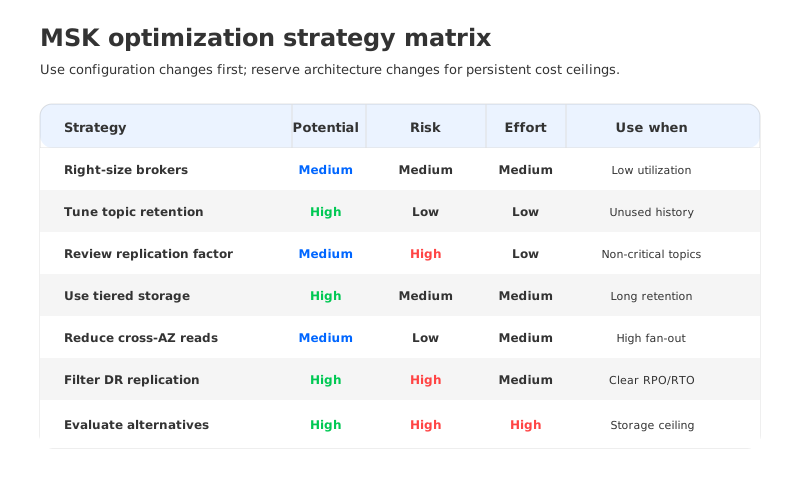
The seven strategies fall into two buckets. Configuration discipline covers right-sizing, retention, replication settings, and accidental traffic. Architecture changes include tiered storage, a different DR pattern, or a storage-separated Kafka-compatible platform.
| Decision | Cost question | Reliability question | Test before changing |
|---|---|---|---|
| Retention | How many retained bytes are still useful? | How far back must consumers replay? | Backfill, audit, incident recovery |
| Replication | Which topics need production durability? | What failure can this topic survive? | Broker/AZ failure and producer acks |
| Tiered storage | Can old data leave primary storage? | Can remote-tier reads meet recovery needs? | Cold replay and lag recovery |
| DR replication | Which data must exist in the target? | What RPO/RTO did the business commit to? | Failover, offsets, rollback |
| Alternative architecture | Is broker storage the limiting model? | Can the new platform meet Kafka semantics and SLOs? | Client compatibility and production-like load |
No MSK cost strategy is free. Lower retention narrows replay. Tiered storage changes cold-read behavior. DR filtering prioritizes topics.
5When To Consider An MSK Alternative
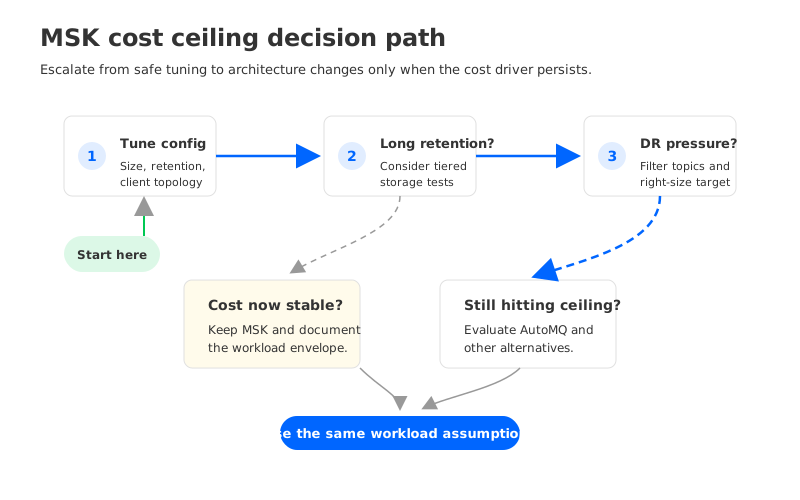
Consider an MSK alternative when the same cost pattern survives multiple tuning rounds. If the cluster is still dominated by long-retention storage, slow broker scaling, partition movement, or large duplicated DR clusters, the issue may be structural.
AutoMQ should appear on the shortlist when the team wants Kafka compatibility but needs object-storage-first economics and elasticity. Test clients, consumer groups, replay, failover, observability, security, and rollback.
The cleanest decision path is boring in a good way. First remove configuration waste. Then use tiered storage or DR filtering where the tradeoff is acceptable. When those changes stop helping, compare MSK against alternatives with the same workload assumptions.
6FAQ
6.1What is the biggest AWS MSK cost driver?
It depends on workload shape. Low-retention clusters may be dominated by broker hours. Long-retention clusters may be dominated by storage. DR-heavy designs may be dominated by replication processing, target cluster capacity, and cross-region transfer.
6.2Does MSK charge for broker-to-broker replication traffic?
AWS states on the MSK pricing page that you are not charged for data transfer used for replication between brokers or between metadata nodes and brokers, while standard AWS data transfer charges apply for data transferred in and out of MSK clusters. Verify this against your topology because client and private connectivity paths can still create charges.
6.3Is MSK tiered storage always lower cost?
No. Tiered storage can reduce pressure on primary storage for long-retention topics, but the economics depend on retained volume, read patterns, and operational requirements. If consumers frequently read old data, model remote-tier latency and throughput first.
6.4Should I reduce Kafka replication factor to save money?
Usually not for production-critical topics. Replication factor is part of the reliability model. Review it for non-production, derived, or rebuildable topics, but do not reduce it for critical streams unless the availability and durability tradeoff is explicitly accepted.
6.5When is AutoMQ relevant to MSK cost optimization?
AutoMQ is relevant when MSK configuration tuning has hit an architectural ceiling around broker-attached storage, long retention, and elastic scaling. It belongs in the alternative-evaluation stage, not as a replacement for basic MSK hygiene.


