
Table of Contents
Table of Contents
Confluent Cloud is often the default managed Kafka shortlist entry, and for good reasons: it has a mature managed experience, broad ecosystem coverage, private networking options, and strong enterprise packaging. The harder question starts when a security, platform, or finance team asks where the control plane runs, where the data plane runs, who owns the cloud resources, and what the exit path looks like if requirements change.
That is where "Confluent Cloud alternative" becomes too vague. A team that only wants a lower-friction Kafka service has different needs from a bank, healthcare platform, marketplace, or AI data platform that must keep Kafka traffic, storage, network paths, and audit visibility inside its own cloud account. BYOC is not a checkbox. It is an ownership model.
1Quick Answer
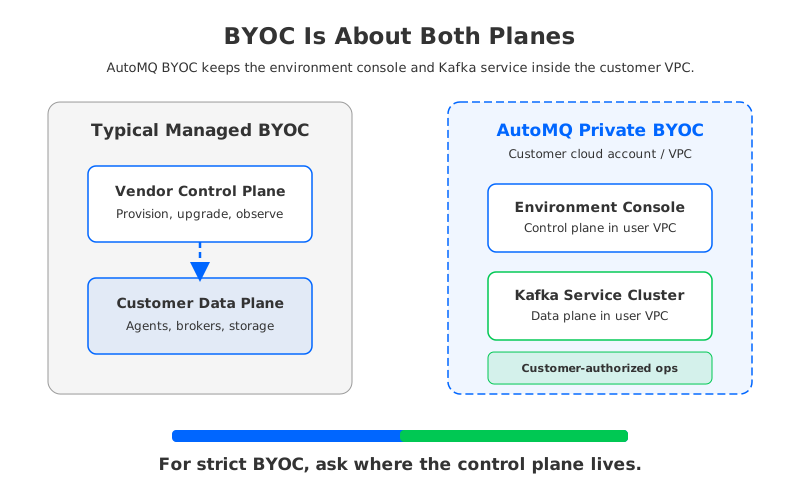
If your main reason for looking beyond Confluent Cloud is data control, start with the deployment boundary rather than the feature list. The strongest candidates are the ones that make the control-plane/data-plane split explicit, document how customer-owned infrastructure is used, and give you a credible path if you later need to self-manage, change vendors, or standardize across clouds. AutoMQ is unusual in this category because its BYOC model places both the environment console/control plane and the Kafka service/data plane in the user's cloud account and VPC, rather than keeping a vendor-hosted control plane outside the customer environment.
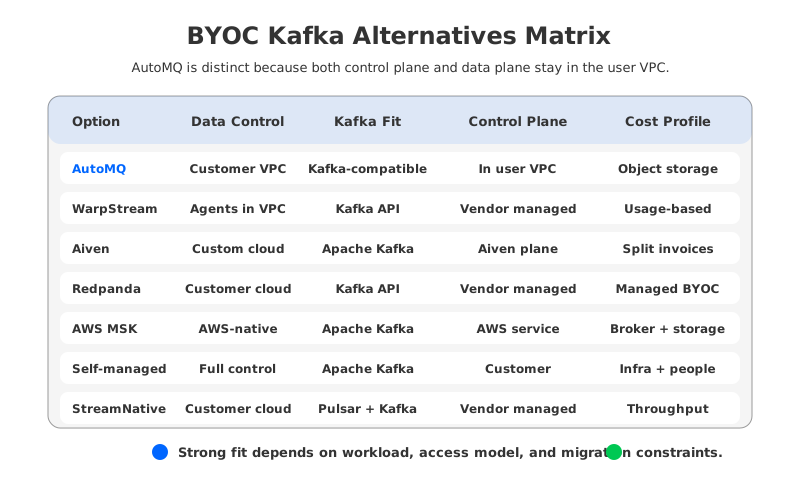
| Option | Best fit | Data-plane model | Kafka compatibility posture | Main trade-off |
|---|---|---|---|---|
| AutoMQ | Kafka-compatible BYOC with object storage economics and open-source fallback | Control plane and data plane both run in the customer cloud account/VPC | Reuses Apache Kafka compute-layer behavior with a storage-layer redesign | Newer ecosystem than Confluent and AWS MSK |
| WarpStream by Confluent | Large-scale Kafka-compatible workloads that can tolerate object-storage-backed architecture | Agents run in customer infrastructure; metadata/control functions are managed | Kafka-compatible, not Apache Kafka itself | Now part of Confluent, so not a vendor-diversification move |
| Aiven for Apache Kafka | Managed open-source Kafka with BYOC for enterprise accounts | Custom cloud inside customer cloud account | Managed Apache Kafka | BYOC is case-by-case and adds setup complexity |
| Redpanda Cloud BYOC | Teams open to a Kafka API-compatible non-JVM engine | BYOC data plane in customer cloud | Kafka API-compatible Redpanda engine | Not Apache Kafka internally |
| Amazon MSK | AWS-native managed Apache Kafka | AWS-managed service in your AWS account/network | Apache Kafka | AWS-only and still tied to broker/storage planning |
| Self-managed Apache Kafka | Maximum control and open-source escape hatch | Fully customer-controlled | Apache Kafka | Highest operational burden |
| StreamNative BYOC | Pulsar-first teams that still need Kafka-facing options | BYOC infrastructure and network under customer ownership | Pulsar platform with Kafka-compatible offerings depending on profile | Architectural shift away from Kafka internals |
For a pure Confluent Cloud replacement, AWS MSK and Aiven usually feel familiar because they keep Apache Kafka close to the surface. For a BYOC architecture built around object storage and lower infrastructure waste, AutoMQ and WarpStream deserve deeper evaluation. For teams already considering a broader streaming-platform reset, Redpanda and StreamNative belong in the conversation, but they are not neutral drop-in replacements for every Kafka workload.
2What BYOC Really Means for Kafka
BYOC is easy to oversimplify as "the service runs in our cloud account." That definition is useful, but incomplete. Kafka is not a stateless API tier; the important assets are the log data, metadata, control plane, network paths, encryption boundary, operational credentials, and the behavior of the system during upgrades and incidents. If a vendor says BYOC, ask which of those pieces moves into your account and which remain in the vendor's control plane.
The practical questions are blunt:
- Where do brokers, agents, or compute nodes run? Some services deploy full broker fleets in your VPC. Others run lightweight agents while coordination or metadata stays in a managed control plane.
- Where does the control plane run? In many BYOC products, the customer hosts the data plane while the vendor still runs the orchestration, metadata, upgrade, or monitoring control plane. AutoMQ's BYOC model is stricter: the environment console/control plane is deployed in the user's network environment together with the Kafka service clusters.
- Where does durable data live? Local disks, attached block storage, object storage, and tiered storage create different cost and recovery behaviors.
- Who can access what during operations? BYOC does not automatically mean vendor engineers have no operational path. It means the authorization path should be explicit and auditable.
- Who pays the cloud bill? In many BYOC models, the vendor bill and the cloud-provider infrastructure bill are separate. That can help cloud-commit utilization, but it can also hide the real unit cost if you only compare vendor invoices.
- What happens if you leave? The cleanest exit path is usually the one where data formats, Kafka protocol behavior, and infrastructure ownership are least proprietary.
Confluent Cloud offers private networking options such as PrivateLink, VPC/VNet peering, Transit Gateway, and Private Service Connect depending on cloud and cluster type, and its documentation is clear that private networking changes access paths and operational responsibilities. It is still Confluent Cloud, though: the managed service boundary is different from a BYOC model where the streaming data plane is deployed in infrastructure you own. Confluent's own 2024 acquisition of WarpStream acknowledged this gap by adding a BYOC streaming form factor to its portfolio.
3Confluent Cloud Alternatives for Data-Controlled Deployments
4AutoMQ
AutoMQ is the most direct fit when the requirement is "Kafka-compatible, BYOC, and built for cloud object storage rather than broker-local disks." AutoMQ Cloud's BYOC documentation describes a stricter model than the common "vendor control plane plus customer data plane" pattern: the control plane system, called the environment console, and the data plane system, the Kafka service cluster, are both deployed in the user-defined network environment. The AWS installation guide makes this concrete by requiring the AutoMQ console EC2 instance to run in the same VPC as the AutoMQ clusters that will be deployed later.
That matters for security review. In AutoMQ BYOC, the underlying physical resources belong to the user, data stays inside the user's VPC, and maintenance requires user authorization. The observability path is also designed around customer-owned infrastructure: AutoMQ collects system metrics and logs through a maintenance bucket, with the service provider receiving read-only access for monitoring and alerting rather than a standing data-plane path.
The technical bet is different from traditional managed Kafka. AutoMQ keeps Kafka compatibility as a first-order requirement while redesigning the storage layer around object storage and a WAL layer. In practice, that means the buyer is not only choosing a different managed-service boundary; they are choosing a different cost and elasticity profile from the broker-disk model used by classic Kafka deployments.
AutoMQ is strongest when these conditions are true:
- You need Kafka protocol and semantic compatibility, not a broad migration to another streaming API.
- You want the control plane, data plane, cloud resources, and Kafka traffic to stay in your account/VPC.
- Storage cost, cross-AZ replication patterns, and scale-out speed are part of the purchasing case.
- You want an open-source path rather than a purely hosted-service dependency.
The honest caveat: AutoMQ does not have Confluent's long ecosystem history or AWS MSK's native AWS procurement gravity. It should be evaluated with workload tests, migration tooling checks, and security review, especially if you rely heavily on Confluent-specific connectors, governance tools, or managed Flink features.
Useful sources: AutoMQ Cloud overview, AutoMQ BYOC environment overview, AutoMQ AWS BYOC installation guide, AutoMQ GitHub license.
5WarpStream by Confluent
WarpStream is awkward to place in an "alternatives to Confluent Cloud" article because it is now part of Confluent. That does not make it irrelevant. It makes the buyer question more precise: are you trying to leave Confluent as a vendor, or are you trying to leave the Confluent Cloud deployment model?
WarpStream's architecture documents describe a Kafka-compatible streaming system where Agents run as the data plane and connect to a managed control plane. Its BYOC documentation focuses on object storage as the primary storage layer, and its security notes say raw data written to BYOC data-plane clusters does not leave the customer's VPC or object storage buckets. WarpStream's own pricing page also says BYOC clusters are charged for uncompressed writes, cluster-minutes, and storage, without network ingress or egress charges from WarpStream for self-hosted clusters.
That model can be compelling for high-volume workloads where object storage economics matter more than ultra-low tail latency. Confluent's acquisition announcement positioned WarpStream for large-scale workloads with relaxed latency requirements, which is a useful boundary to keep in mind. It may be a very good fit for observability streams, data lake ingestion, and other throughput-heavy pipelines; it may be less natural for workloads that expect Apache Kafka internals or latency behavior to remain unchanged.
Useful sources: WarpStream architecture, WarpStream object storage configuration, WarpStream security and privacy, Confluent acquisition announcement.
6Aiven for Apache Kafka
Aiven is a strong candidate for teams that want managed open-source data services rather than a single-vendor Kafka platform. Aiven's Kafka product is a managed Apache Kafka service, and its BYOC documentation says custom clouds run Aiven-managed data services in the customer's cloud provider account while keeping data in the customer's own cloud. Aiven also documents a real trade-off that many vendor pages gloss over: BYOC is bespoke, eligible only under certain support and commitment conditions, and creates separate Aiven and cloud-provider invoices.
That separation can be positive for procurement. If your organization has committed spend with AWS or Google Cloud, BYOC may let you use cloud discounts for the underlying infrastructure while still buying managed operations from Aiven. It also gives network teams more visibility than a pure SaaS model, especially when the requirement is VPC-level auditability.
The trade-off is that Aiven BYOC is not the fastest path for every team. The docs state that BYOC deployments are not automated in the same way as the regular Aiven deployment and add complexity around control-plane communication, service management, key management, and security. If you need a quick managed Kafka cluster and your compliance team accepts standard hosted deployment, Aiven's regular model may be simpler.
Useful sources: Aiven for Apache Kafka docs, Aiven BYOC docs.
7Redpanda Cloud BYOC
Redpanda Cloud BYOC is worth evaluating when your team wants Kafka API compatibility but is open to a different engine underneath. Redpanda's BYOC architecture documentation says clusters are deployed in your own AWS, Azure, or GCP environment and that all data is contained in your own environment. It also makes the control-plane/data-plane split explicit: Redpanda manages provisioning, operations, maintenance, Kubernetes upgrades, and infrastructure maintenance, while the data plane is where the cluster lives.
That can be attractive if the goal is operational simplicity inside a customer-owned environment. Redpanda is not Apache Kafka, so the evaluation should include protocol coverage, client behavior, operational tooling, migration path, and the features you currently use in Kafka or Confluent. Some teams are perfectly comfortable with that trade; others need Apache Kafka itself for governance, compatibility, or internal platform reasons.
Redpanda's BYOC fit is strongest when you want a managed experience, cloud-account data control, and a simpler operational model than self-managed Kafka, and when your compatibility tests show that your producers, consumers, connectors, and admin workflows behave as expected.
Useful source: Redpanda Cloud BYOC architecture.
8Amazon MSK
Amazon MSK is not usually described as BYOC because AWS is the cloud provider rather than an independent software vendor deploying into your account. For AWS-heavy teams, however, it often satisfies the practical requirement: Kafka runs in AWS, integrates with AWS networking and IAM patterns, and procurement already understands the infrastructure model.
AWS describes MSK as a fully managed Apache Kafka service operated by AWS. You still choose broker types, broker counts, storage behavior, networking, authentication, and related AWS resources. Pricing also needs careful reading: AWS's MSK pricing page separates broker instance usage, storage, data written for certain broker types, PrivateLink-related charges, and standard AWS data transfer charges where applicable. That makes MSK transparent in an AWS-native way, but not automatically low-effort from a cost-modeling perspective.
MSK is strongest when your architecture is already AWS-centered and you want managed Apache Kafka without adopting a Kafka-compatible reimplementation. It is weaker when your goals include multi-cloud consistency, object-storage-first economics across providers, or a vendor-neutral BYOC operating model.
Useful sources: Amazon MSK documentation, Amazon MSK pricing.
9Self-Managed Apache Kafka
Self-managed Kafka is the control baseline. It is not glamorous, and that is the point: you own the brokers, disks, network, security posture, upgrades, monitoring, partition reassignment, capacity planning, incident response, and migration path. If the buyer's priority is maximum control and an open-source exit path, no managed service can beat it on first principles.
The cost is operational drag. Kafka operations are rarely hard because a single broker is mysterious; they are hard because production clusters accumulate partitions, retention policies, client behaviors, uneven traffic, rebalance risk, replication overhead, cross-AZ traffic, upgrade windows, and backup/restore expectations. The more regulated the environment, the more those operational details become audit artifacts.
Self-managed Kafka belongs on the shortlist when you have a mature platform team, strict internal platform standards, or a requirement that excludes vendor control planes. It should not be the default answer for teams whose main pain is already Kafka operations.
Useful sources: Apache Kafka documentation, Apache Kafka source repository.
10StreamNative BYOC
StreamNative BYOC is the out-of-family option. It is relevant because some buyers asking for "Confluent Cloud alternative" are really asking for "managed streaming with stronger data control," not necessarily "Apache Kafka forever." StreamNative's BYOC overview describes a fully managed Pulsar solution operating within the customer's cloud environment, with infrastructure and network under customer ownership and managed by StreamNative. Its current docs also describe Kafka-compatible data streaming options in StreamNative Cloud, but the architectural center of gravity remains Pulsar and its cloud-native storage model.
That makes StreamNative a serious option when multi-tenancy, geo-replication, topic scale, and Pulsar semantics are part of the target architecture. It is less natural when you want a conservative Kafka replacement that preserves Kafka internals, operational patterns, and team muscle memory.
The key evaluation step is to separate protocol compatibility from platform migration. Kafka-compatible endpoints can reduce application friction, but the operating model, data model, and ecosystem assumptions are different enough that this should be treated as a streaming-platform decision, not only a Confluent Cloud replacement.
Useful sources: StreamNative BYOC overview, StreamNative Cloud overview, StreamNative billing docs.
11Comparison Table
This table is deliberately qualitative. Vendor pricing pages change, private networking support varies by region and cloud, and enterprise contracts can change the real answer. Use it to decide what to test, not as a procurement shortcut.
| Criterion | AutoMQ | WarpStream | Aiven Kafka | Redpanda BYOC | AWS MSK | Self-managed Kafka | StreamNative BYOC |
|---|---|---|---|---|---|---|---|
| Customer-owned cloud resources | Full private BYOC fit | Strong BYOC fit | BYOC available under eligibility constraints | Strong BYOC fit | AWS-native managed service | Full control | Strong BYOC fit |
| Data plane in customer environment | Yes; Kafka service clusters run in the user's network environment | Yes for Agents/raw data path | Yes in custom cloud | Yes | Runs in AWS-managed MSK environment | Yes | Yes |
| Control plane ownership | Environment console/control plane runs in the user's network environment; maintenance is customer-authorized | Managed WarpStream/Confluent control plane | Aiven management plane | Redpanda managed control plane | AWS service control plane | Customer | StreamNative control plane |
| Apache Kafka internals | Kafka-compatible AutoMQ distribution | Kafka-compatible reimplementation | Apache Kafka | Kafka API-compatible Redpanda | Apache Kafka | Apache Kafka | Pulsar-centered with Kafka-compatible options |
| Cost profile | Object-storage-centered, designed for cloud elasticity | Consumption + object storage model | Managed service + cloud-provider bill in BYOC | Managed BYOC | AWS broker/storage/data-transfer model | Infrastructure + people cost | Throughput-based BYOC billing plus cloud resources |
| Operational burden | Managed private BYOC with customer-resident control plane | Managed control plane, customer runs agents | Managed by Aiven, with BYOC setup complexity | Managed by Redpanda | Managed by AWS | Highest | Managed by StreamNative |
| Vendor-diversification from Confluent | Yes | No, now part of Confluent | Yes | Yes | Yes | Yes | Yes |
The main pattern is visible: "data-controlled Kafka" is not one market. Some products keep Kafka and move the ownership boundary. Some keep the Kafka API and replace the engine. Some move the storage model to object storage. Some keep everything open-source and push the burden back to your platform team.
12How to Choose by Compliance, Cost, and Operations
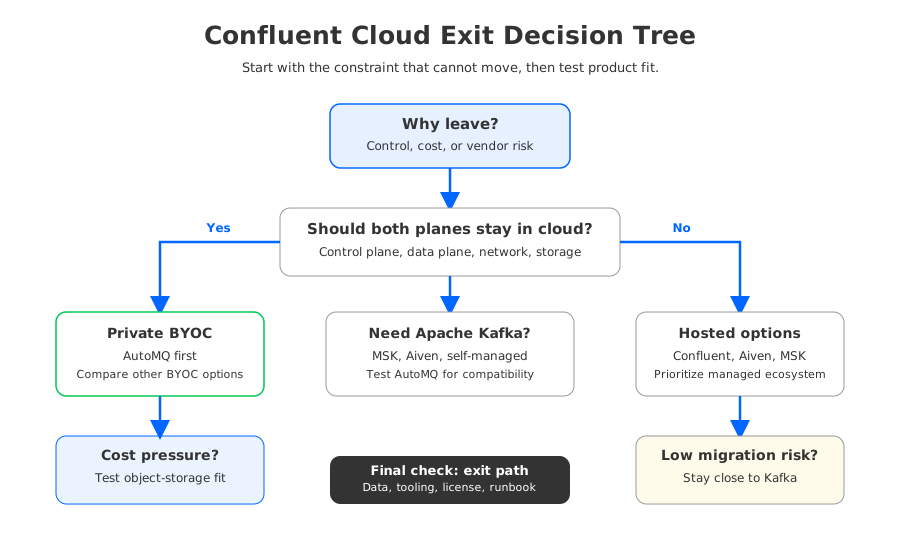
Start with compliance if it is a hard requirement. If data must stay in a customer-owned VPC, the first cut should remove pure hosted SaaS deployments that cannot meet that boundary. Then ask whether the vendor's operational access model is acceptable. A BYOC diagram is not enough; your security team needs to understand maintenance authorization, logging, metrics, diagnostic data, identity boundaries, and emergency access.
After compliance, test cost mechanics with your own workload shape. Kafka cost is sensitive to write throughput, read fan-out, retention, partitions, replication, cross-AZ traffic, private connectivity, and idle capacity. Object-storage-backed systems can change that equation materially, but only if their latency and feature behavior match your workload. Traditional broker-based systems can be easier to reason about, but they may preserve the same storage and replication costs that triggered the evaluation.
For operations, be honest about your team. A strong Kafka team can make self-managed Kafka look rational. A small platform team supporting dozens of internal product teams may be better served by managed BYOC, even if the vendor bill is not the absolute minimum. The worst outcome is a "control" decision that quietly turns into a permanent on-call tax.
Here is a practical shortlist by scenario:
- Strict data residency and cloud-account control: evaluate AutoMQ first if control-plane residency matters, then compare Redpanda BYOC, Aiven BYOC, WarpStream, and StreamNative BYOC. Include vendor access, maintenance authorization, and diagnostic-data handling in the security review.
- AWS-native Apache Kafka with conservative migration risk: evaluate Amazon MSK and Aiven Kafka. AutoMQ should also be tested if storage cost and elasticity are central to the project.
- Object-storage-first economics: evaluate AutoMQ and WarpStream first. Include latency, compaction, consumer fan-out, and operational recovery tests.
- Vendor diversification away from Confluent: do not count WarpStream as diversification after the Confluent acquisition. Treat it as a Confluent-owned BYOC option.
- Open-source fallback: compare AutoMQ, Aiven-managed Apache Kafka, and self-managed Apache Kafka. Check licensing, data format, and migration tooling rather than relying on brand claims.
- Pulsar or multi-tenant streaming strategy: include StreamNative, but frame it as a platform migration rather than a Kafka service swap.
13FAQ
13.1Is Confluent Cloud BYOC?
Confluent Cloud offers private networking and dedicated deployment options, but that is not the same as a general BYOC model where the Kafka data plane runs in your own cloud account. Confluent now owns WarpStream, which Confluent positioned as a BYOC data streaming option after the 2024 acquisition.
13.2Is WarpStream still a Confluent Cloud alternative?
It is an alternative to the Confluent Cloud deployment model, not an alternative vendor. That distinction matters for procurement, concentration risk, and exit planning.
13.3Which alternative is closest to Apache Kafka?
Self-managed Apache Kafka and Amazon MSK are the most direct Apache Kafka options. Aiven for Apache Kafka is also a managed Apache Kafka option. AutoMQ is Kafka-compatible with a storage-layer redesign, so it should be tested as a Kafka-compatible replacement rather than treated as a generic hosted Kafka clone.
13.4How is AutoMQ BYOC different from a typical managed BYOC model?
Many BYOC products place the data plane in the customer's cloud account but keep the control plane, orchestration, or metadata services in the vendor's managed environment. AutoMQ's BYOC model is more private: the environment console/control plane and the Kafka service/data plane are both deployed in the user's network environment. AutoMQ maintenance still exists, but it is based on customer authorization and read-only observability access rather than a permanently externalized control plane.
13.5Which option is best for BYOC and lower infrastructure cost?
AutoMQ and WarpStream are the most explicit object-storage-centered options in this list. Aiven BYOC and Redpanda BYOC focus more on managed service deployment inside your cloud account. MSK keeps you in the AWS managed Kafka model. The right answer depends on workload shape, latency targets, retention, read fan-out, and your cloud-provider discounts.
13.6What should I ask vendors before choosing?
Ask for a written control-plane/data-plane diagram, cloud-resource ownership model, data storage path, encryption and key ownership details, maintenance access process, diagnostic-data handling, network-cost model, migration path, and failure-mode responsibilities. If a vendor cannot answer those questions clearly, the product may still work technically, but it is not ready for a data-control-driven purchase.
The real Confluent Cloud exit question is not "which service has the longest feature table?" It is "which ownership model can we live with for the next several years?" Once that is clear, the shortlist gets much shorter.


