
Table of Contents
Table of Contents
Google Cloud used to have an obvious gap for Kafka buyers: there was Pub/Sub, there was self-managed Kafka on Compute Engine or GKE, and there were third-party managed services, but there was no Google-operated Apache Kafka service that felt like a direct AWS MSK equivalent. That premise changed. Google Cloud now offers Managed Service for Apache Kafka, so the selection problem is no longer "how do we get Kafka on GCP at all?"
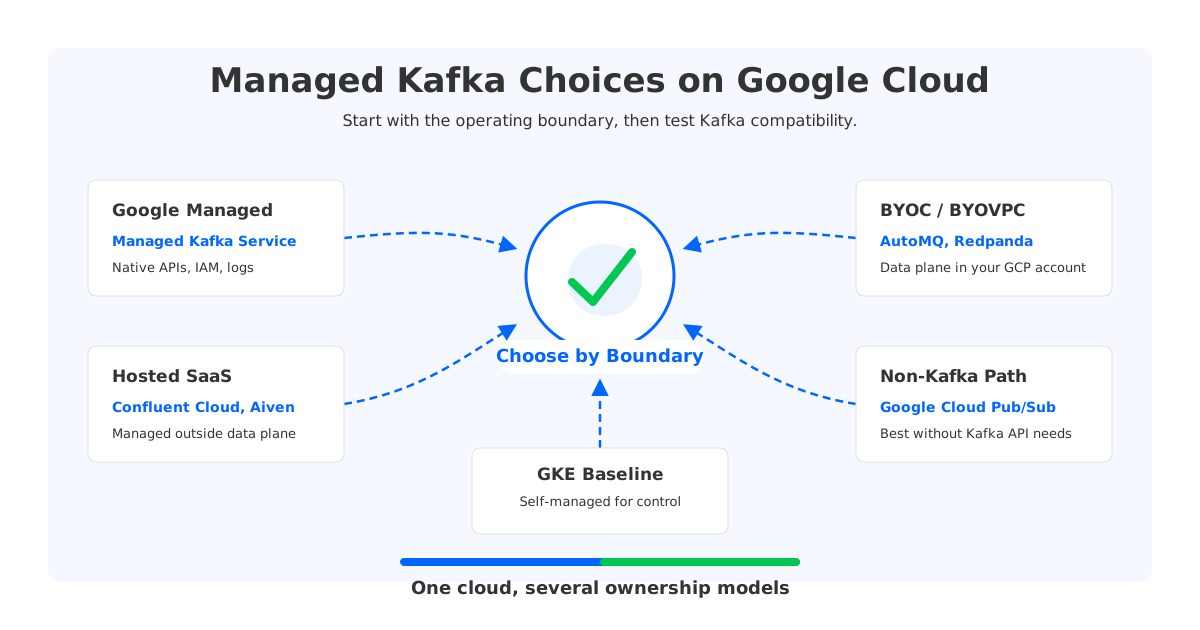
The harder problem is choosing the right operating model. Some teams want Google-native procurement, IAM, Cloud Monitoring, and Private Service Connect. Some want Confluent's ecosystem. Some need BYOC because the data plane must stay in their own VPC. Some are willing to use a Kafka-compatible engine if it changes the storage economics. Others should not choose Kafka at all, because Pub/Sub is the more natural Google Cloud primitive for their workload.
1Quick Answer
For most GCP teams, the first shortlist should include Google Cloud Managed Service for Apache Kafka, Confluent Cloud, Aiven for Apache Kafka, AutoMQ, Redpanda Cloud BYOC, WarpStream, StreamNative Cloud, and Google Cloud Pub/Sub. Self-managed Kafka on GKE remains an important baseline, but it is a build-and-operate path rather than a managed option.
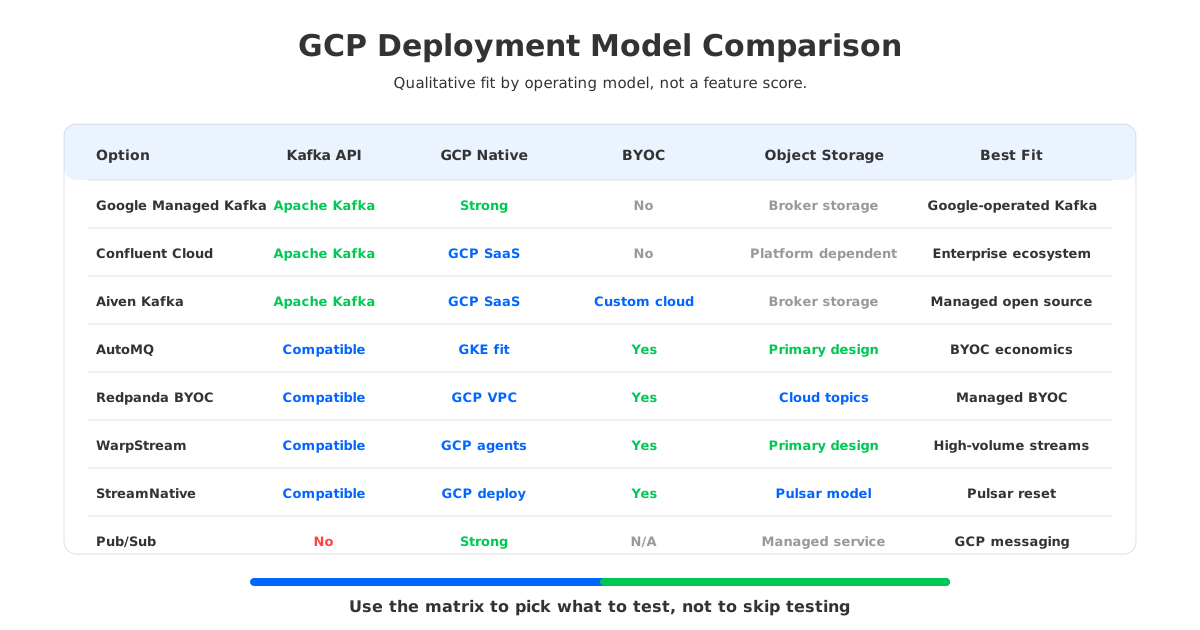
| Option | Best fit on Google Cloud | Kafka posture | Deployment model | Main trade-off |
|---|---|---|---|---|
| Google Cloud Managed Service for Apache Kafka | Teams that want Google-operated Apache Kafka with native GCP administration | Runs open-source Apache Kafka | Google-managed service exposed through Google Cloud APIs | Service-level limits and Google-defined operations model |
| Confluent Cloud | Teams that need a mature Kafka platform, governance, connectors, and enterprise support | Apache Kafka-based managed platform | SaaS with GCP networking options | Data plane is not BYOC in the usual customer-account sense |
| Aiven for Apache Kafka | Teams that prefer managed open-source services across clouds | Managed Apache Kafka | Managed service, with BYOC/custom cloud options for eligible accounts | BYOC adds commercial and setup complexity |
| AutoMQ | Teams that want Kafka compatibility, private BYOC, GKE, and object-storage-centered economics | Kafka-compatible AutoMQ distribution | BYOC with control plane and data plane in the customer GCP environment | Newer ecosystem than Confluent and traditional Kafka services |
| Redpanda Cloud BYOC | Teams open to a Kafka API-compatible non-JVM engine in their own GCP environment | Kafka API-compatible Redpanda | BYOC/BYOVPC on GCP | Not Apache Kafka internally |
| WarpStream | High-volume workloads that fit a diskless Kafka-compatible architecture | Kafka-compatible, object-storage-backed | Agents in customer environment with managed control plane | Now owned by Confluent, and latency/feature fit must be tested |
| StreamNative Cloud | Pulsar-first or mixed Pulsar/Kafka teams that want managed streaming in GCP | Pulsar plus Kafka-compatible service options | Hosted, dedicated, or BYOC | Platform migration, not a neutral Kafka clone |
| Google Cloud Pub/Sub | GCP-native event ingestion and messaging where Kafka APIs are not required | Not Kafka | Fully managed Google Cloud service | Different API, semantics, and operational model |
The table hides the most important design fork: Apache Kafka, Kafka-compatible, and non-Kafka are not interchangeable labels. If your application depends on Kafka clients, admin tools, ACL behavior, transactions, compaction assumptions, or specific broker configuration semantics, start with compatibility tests before looking at price. If your application only needs durable event delivery inside Google Cloud, Pub/Sub may remove a lot of Kafka-shaped complexity.
2Why Kafka Selection Is Different on Google Cloud
On AWS, many Kafka conversations start with Amazon MSK because it is the cloud-native default. On Google Cloud, the decision has historically been more open-ended, and even with Google's managed Kafka service now available, the market still looks more varied. Google Cloud buyers often compare a native managed Kafka service, Confluent Cloud through Google Cloud Marketplace or direct procurement, BYOC vendors, GKE-based platforms, object-storage-backed Kafka-compatible systems, and Pub/Sub in the same evaluation.
That range is useful, but it makes shallow comparison tables dangerous. A product can "support GCP" in several very different ways:
- Google-operated service: Google Cloud Managed Service for Apache Kafka is administered through Google Cloud APIs, Cloud Monitoring, Cloud Logging, and GCP networking constructs.
- Hosted SaaS on GCP: Confluent Cloud and Aiven can run managed services on Google Cloud infrastructure while the provider operates the service boundary.
- BYOC or BYOVPC: AutoMQ, Redpanda, WarpStream, StreamNative, and Aiven's custom-cloud model can place more of the data plane or infrastructure inside the customer's cloud environment, depending on the product. AutoMQ's BYOC model is the stricter form here because its environment console/control plane and Kafka service/data plane are both deployed in the user's network environment.
- GKE platform: Some options deploy into GKE, which can fit platform teams that already standardize on Kubernetes operations and policy.
- GCP-native alternative: Pub/Sub avoids Kafka operations entirely, but the API and semantics are different enough that it should be treated as an architecture choice, not a transparent replacement.
The practical evaluation starts with ownership. Where do brokers, agents, metadata services, object storage buckets, keys, audit logs, and private endpoints live? Who can change them during an incident? Which bill carries compute, storage, inter-zone data transfer, Private Service Connect, and support charges? A managed Kafka choice on GCP is usually a control-plane/data-plane decision wearing a messaging-platform label.
3Managed Kafka Options on GCP
3.1Google Cloud Managed Service for Apache Kafka
Google's managed Kafka service is now the most natural first stop for teams that want Apache Kafka without running broker fleets themselves. The official overview says the service runs open-source Apache Kafka, exposes cluster management through Google Cloud APIs, exports metrics to Cloud Monitoring, exports broker logs to Cloud Logging, and uses Private Service Connect to make clusters reachable from configured VPC subnets. Google also documents security defaults such as required TLS, encrypted storage, IAM-based management, Kafka ACL support, and automatic patching.
The biggest advantage is not novelty; it is alignment. A GCP platform team can manage Kafka with familiar Google Cloud operational surfaces, Terraform providers, IAM patterns, logging, monitoring, and private networking. For organizations that already treat Google Cloud as the control plane for infrastructure, that reduces the number of vendor boundaries in the runbook.
The trade-off is that the service is opinionated. Google's documentation lists constraints around cluster topology, zone selection, local storage configuration, KRaft mode, unsupported JMX APIs, compression support, and managed broker configuration. Those limits may be acceptable for a new Kafka estate, but they matter if you are migrating clusters with carefully tuned broker settings or legacy operational assumptions. Use Google's service when native GCP operations are the priority; test carefully when migration fidelity is the priority.
Useful sources: Managed Service for Apache Kafka overview, product page, pricing.
3.2Confluent Cloud on Google Cloud
Confluent Cloud remains the broadest managed Kafka platform in the GCP ecosystem. It is usually the strongest option when the Kafka cluster is only one part of a larger Confluent estate: Schema Registry, connectors, stream governance, managed Flink, enterprise support, and cross-cloud consistency. Confluent also documents GCP private networking options, including Google Cloud Private Service Connect for dedicated clusters, which can give clients private connectivity from a customer VPC to Confluent Cloud.
That maturity comes with a service-boundary trade-off. Private Service Connect changes the network access path, but it is not the same as a BYOC model where the Kafka data plane is deployed into your own GCP account and operated under your infrastructure boundary. For many teams, that is fine. For regulated environments, internal platform standards, or cloud-commit optimization, it may be the central blocker.
Confluent is strongest when feature breadth and ecosystem integration outweigh strict data-plane ownership. It is weaker when the mandate is "run the streaming data plane inside our GCP project" or when storage architecture is the main cost problem.
Useful sources: Confluent networking on Google Cloud, Private Service Connect for Confluent Cloud, Confluent Cloud pricing.
3.3Aiven for Apache Kafka
Aiven is a pragmatic choice for teams that want managed Apache Kafka and prefer an open-source-service provider model. Aiven positions its Google Cloud partnership around managed open-source services, including Apache Kafka, and its Kafka documentation keeps the product close to the familiar Apache Kafka surface area. For teams already using Aiven for PostgreSQL, OpenSearch, Flink, or other services, Kafka can fit into an existing vendor and operations pattern.
Aiven's custom cloud/BYOC documentation is also relevant for GCP buyers who need stronger data residency or customer-cloud control. The catch is that BYOC is not the same experience as clicking a standard hosted cluster into existence. Aiven documents eligibility, setup, control-plane communication, separate cloud-provider billing, and additional operational considerations.
Aiven is strongest when you want managed Apache Kafka without buying into a single streaming mega-platform. It is weaker when you need the lowest possible operational friction or when your architecture depends on object-storage-first Kafka economics rather than traditional broker-based Kafka.
Useful sources: Aiven for Apache Kafka docs, Aiven and Google Cloud, Aiven BYOC docs.
3.4AutoMQ
AutoMQ fits a specific GCP problem: you want Kafka compatibility, but you do not want Kafka's traditional storage and broker-scaling model to define the economics of the platform. AutoMQ Cloud's documentation describes BYOC mode as deploying software services in the user's cloud account so data does not leave the user's VPC. More specifically, the BYOC environment overview says the control plane system, the environment console, and the data plane system, the Kafka service cluster, are all deployed in the user-defined network environment. Its Kubernetes deployment documentation also states that AutoMQ BYOC environments support managed Kubernetes platforms such as GCP GKE.
The architectural difference is that AutoMQ is built around cloud object storage and elastic cloud compute rather than broker-local disks as the center of gravity. On Google Cloud, that means the buyer can evaluate a Kafka-compatible platform around GKE, Cloud Storage, private networking, and customer-account deployment instead of treating Kafka as a fixed fleet of stateful brokers. This is especially relevant for teams with bursty workloads, long retention, many partitions, or strong cloud-account ownership requirements.
The honest evaluation point is ecosystem maturity. AutoMQ should be tested with your Kafka clients, connectors, security model, failover expectations, and operational workflows. It is a strong fit when private BYOC, customer-VPC-resident control, object storage, and multi-cloud consistency are first-order requirements; it is less likely to be the first choice if your priority is the largest prebuilt Kafka ecosystem or a purely Google-operated service.
Useful sources: AutoMQ Cloud overview, deploy AutoMQ on Kubernetes, AutoMQ GitHub.
3.5Redpanda Cloud BYOC
Redpanda Cloud BYOC is a managed option for teams that want their streaming platform inside their own GCP environment but are open to a Kafka API-compatible engine rather than Apache Kafka itself. Redpanda's BYOC documentation says BYOC deploys into the customer's cloud network, including GCP VPCs, and that data stays in the customer's environment. It also documents BYOVPC for teams that want more control over the network lifecycle.
This model is appealing when operational simplicity and customer-environment deployment both matter. Redpanda manages provisioning, monitoring, upgrades, and security policies, while the customer keeps the data environment boundary. The evaluation hinge is compatibility. Kafka API compatibility can be enough for many applications, but it does not mean every Apache Kafka internal behavior, broker setting, tool expectation, or migration path is identical.
Redpanda is strongest when your team wants a managed BYOC experience and is willing to validate a non-Apache Kafka engine. It is weaker when internal policy requires Apache Kafka itself or when you depend heavily on Kafka-specific broker internals.
Useful sources: Redpanda BYOC docs, Redpanda BYOC on GCP.
3.6WarpStream
WarpStream is another object-storage-centered Kafka-compatible option, and it is particularly relevant for high-volume workloads where diskless architecture can change the cost and operations profile. WarpStream's documentation describes a Kafka-compatible streaming platform built on cloud object stores including GCP and Azure, with Agents deployed into the customer's environment and a managed control plane.
There are two caveats. First, WarpStream is now part of Confluent, so it should not be treated as vendor diversification away from Confluent. Second, diskless Kafka-compatible architectures need workload testing. They can be compelling for ingestion-heavy and retention-heavy streams, but latency profile, compaction behavior, connector expectations, and operational tooling should be verified rather than assumed.
WarpStream is strongest when object storage is central to the business case and the application can tolerate the architecture's behavior. It is weaker when you need a conservative Apache Kafka migration or a non-Confluent vendor strategy.
Useful sources: WarpStream introduction, WarpStream architecture, Confluent acquisition announcement.
3.7StreamNative Cloud
StreamNative belongs in the GCP shortlist when the question is broader than Kafka. Its documentation describes StreamNative Cloud as a managed Pulsar and Kafka service, and its BYOC page says it can run Pulsar- and Kafka-compatible streaming in the customer's AWS, Google Cloud, or Azure account. That makes it relevant for teams considering a streaming-platform reset, not just a Kafka hosting change.
The platform center of gravity is different. Pulsar's architecture, topic model, storage model, and operational assumptions are not the same as Apache Kafka's. Kafka-compatible access can reduce client migration friction, but it does not turn a Pulsar-centered platform into a neutral Apache Kafka clone. That distinction is not a criticism; it is the reason some teams evaluate StreamNative in the first place.
StreamNative is strongest for multi-tenant streaming, Pulsar adoption, unified messaging and streaming, or teams that want a managed service with BYOC options across clouds. It is weaker when the mandate is "keep Kafka semantics and operations as close as possible."
Useful sources: StreamNative Cloud overview, StreamNative BYOC, StreamNative networking.
3.8Google Cloud Pub/Sub
Pub/Sub is not Kafka, and that is exactly why it belongs in the article. Some searchers looking for "Kafka on GCP" do not actually need Kafka. They need durable event ingestion, fan-out, managed scaling, and integration with Google Cloud services. For those workloads, Pub/Sub can remove broker operations, partition planning, and Kafka upgrade work from the design.
Google's migration documentation is clear that Pub/Sub and Kafka differ in ownership model and semantics. Pub/Sub is a Google-managed service with its own concepts, APIs, ordering behavior, subscription model, and cost model. That makes it a poor drop-in replacement for applications built around Kafka protocol behavior, Kafka Streams, Kafka Connect assumptions, or Kafka-specific operational tooling. It can be an excellent choice when the application boundary is flexible and GCP-native integration matters more than Kafka compatibility.
Use Pub/Sub when the architecture can be rewritten around Google Cloud primitives. Avoid treating it as "managed Kafka without Kafka" unless your producers, consumers, replay model, ordering requirements, and ecosystem dependencies have all been revisited.
Useful sources: migrate from Kafka to Pub/Sub, Pub/Sub overview, Pub/Sub pricing.
4How to Choose for GKE, Cloud Storage, and Multi-Cloud
The fastest way to narrow the list is to separate API compatibility from infrastructure ownership. If your application must keep Kafka clients and Kafka semantics, Pub/Sub drops out early. If your security team requires the data plane inside your GCP environment, pure hosted SaaS becomes harder. If your platform team standardizes on Google-managed services, Google's native managed Kafka service moves up. If object storage is part of the cost or elasticity thesis, AutoMQ and WarpStream deserve deeper testing.
For GKE-centered platform teams, the interesting choices are the ones that make Kubernetes a first-class deployment target rather than an incidental runtime. AutoMQ's Kubernetes BYOC path, Redpanda BYOC/BYOVPC, and some StreamNative deployment models fit that conversation. Self-managed Kafka on GKE can be a useful benchmark, but it should be priced with people cost, upgrade burden, partition operations, incident response, and storage growth included.
For Cloud Storage-centered architecture, be careful with the word "tiered." Traditional Kafka tiered storage, diskless Kafka-compatible systems, and object-storage-native storage layers are different designs. Tiered storage still often keeps brokers and hot storage as a major operational concern. Diskless or object-storage-centered systems make object storage part of the primary architecture. The right answer depends on whether your bottleneck is retention cost, broker scaling, cross-zone replication, cold reads, or operational recovery.
For multi-cloud teams, GCP support is necessary but not sufficient. Ask whether the same product can run consistently on AWS, Azure, and GCP; whether BYOC works similarly across clouds; whether object storage abstractions leak into operations; and whether your migration path preserves Kafka behavior or requires platform rewrites.
5Scenario-Based Shortlist
Use this as a starting point, not a final ranking:
- Google-native Apache Kafka: Start with Google Cloud Managed Service for Apache Kafka. Add Confluent or Aiven if ecosystem breadth or provider independence matters.
- Enterprise Kafka platform: Start with Confluent Cloud. Compare against Aiven if managed Apache Kafka is enough and against Google's service if GCP-native operations matter more than ecosystem breadth.
- BYOC with Kafka compatibility: Start with AutoMQ, Redpanda Cloud BYOC, WarpStream, StreamNative BYOC, and Aiven custom cloud. Ask each vendor to diagram the exact control-plane and data-plane boundary.
- Object-storage-centered architecture: Evaluate AutoMQ and WarpStream first. Include latency, compaction, retention, consumer fan-out, and disaster recovery tests.
- Pulsar or broader streaming reset: Include StreamNative. Treat it as a platform decision, not a small Kafka hosting change.
- GCP-native messaging without Kafka requirements: Use Pub/Sub as the baseline and justify Kafka only when protocol compatibility, ecosystem tooling, or log semantics are required.
6FAQ
6.1Does Google Cloud have a managed Kafka service in 2026?
Yes. Google Cloud offers Managed Service for Apache Kafka, a Google-operated service that runs open-source Apache Kafka and integrates with Google Cloud APIs, networking, Cloud Monitoring, and Cloud Logging.
6.2Is Pub/Sub a replacement for Kafka on GCP?
Sometimes, but not as a drop-in replacement. Pub/Sub is a Google Cloud messaging service with its own API and semantics. It can replace Kafka when the application can be adapted to Pub/Sub's model, but it is not suitable when Kafka protocol compatibility or Kafka ecosystem tooling is a hard requirement.
6.3Which managed Kafka option is most GCP-native?
Google Cloud Managed Service for Apache Kafka is the most GCP-native Apache Kafka option because it is administered through Google Cloud and integrates with native operational services. Pub/Sub is even more GCP-native, but it is not Kafka.
6.4Which options support BYOC on Google Cloud?
AutoMQ, Redpanda Cloud, StreamNative, WarpStream, and Aiven's custom-cloud model all document customer-cloud or BYOC-style deployment options relevant to GCP. The details differ substantially, so buyers should verify data-plane location, metadata handling, vendor access, networking, and cloud-resource ownership.
6.5Is Confluent Cloud available on Google Cloud?
Yes. Confluent Cloud supports Google Cloud and documents private networking options such as Private Service Connect for dedicated clusters. The key question is whether a hosted Confluent Cloud model satisfies your security and data-plane ownership requirements.
6.6Should I run Kafka myself on GKE?
Self-managed Kafka on GKE can make sense for teams with strong Kafka operations capability and strict control requirements. It is not a managed Kafka option, and it should be compared against managed services with the full operational cost included: upgrades, monitoring, rebalancing, storage management, incident response, and capacity planning.
The GCP Kafka question is no longer "where is Google's MSK?" That answer now exists. The better question is which boundary you want to own: Google-operated Kafka, vendor-operated SaaS, BYOC data plane, GKE platform, object-storage-centered Kafka compatibility, or a non-Kafka Google Cloud messaging service. Once that boundary is clear, the shortlist gets much smaller.


