
Table of Contents
Table of Contents
WarpStream made a specific idea hard to ignore: Kafka-compatible streaming does not have to mean broker-attached disks, broker-to-broker replication, and a long chain of rebalancing work every time storage pressure changes. Its official docs describe WarpStream as a diskless, Apache Kafka-compatible platform built directly on cloud object stores such as S3, GCS, and Azure Blob. That is the important part. The market is no longer asking only which managed Kafka service has the friendliest console. It is asking which architecture should be the default for cloud Kafka.
That question became more visible after Confluent acquired WarpStream in 2024, and even more strategic after IBM announced the completion of its Confluent acquisition on March 17, 2026. None of that makes WarpStream less relevant. It does mean platform teams now evaluate WarpStream alongside broader questions about ownership, BYOC boundaries, product roadmap, Kafka compatibility, and exit paths.
The right alternative depends on what you liked about WarpStream in the first place. If you want object storage as the primary storage layer, the shortlist is different from a team that mainly wants BYOC procurement. If you need the standard Kafka client ecosystem with minimal behavior change, the shortlist is different again. And if you can accept a non-Kafka architecture, Pulsar belongs in the conversation even though it solves the problem with a different storage model.
1Quick Answer
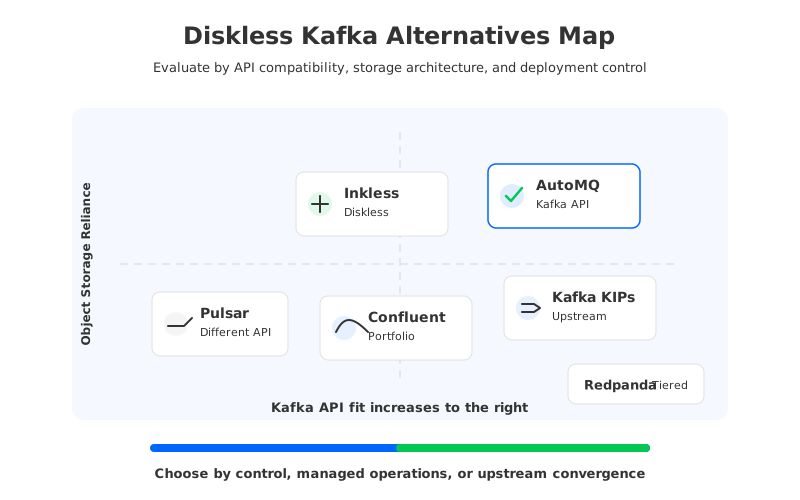
For most teams comparing WarpStream alternatives, start with these six options:
| Option | Best fit | Diskless or object-storage angle | Main trade-off |
|---|---|---|---|
| AutoMQ | Kafka-compatible teams that want object storage as primary storage with BYOC control | S3/object-storage-native storage layer with stateless brokers | Newer operational model than classic Kafka |
| Aiven Inkless | Aiven users or managed-service buyers who want diskless topics inside managed Apache Kafka | Diskless topics backed by object storage, available on Aiven Cloud and BYOC | Service-level abstraction and managed defaults shape control boundaries |
| Apache Kafka Diskless Topics roadmap | Teams willing to wait for upstream Kafka evolution | KIP-1150 introduces diskless topics; KIP-1163 defines core behavior under discussion | Not a current production feature in a stable Apache Kafka release |
| Confluent Cloud or Confluent Platform | Enterprises standardizing on Confluent's broader platform | Confluent positions WarpStream as its BYOC route; Confluent Cloud uses its own cloud-native engine | Not a like-for-like open diskless Kafka substitute |
| Apache Pulsar | Teams open to a non-Kafka-native architecture with separated serving and storage layers | Pulsar uses BookKeeper for persistent storage and supports tiered storage to long-term object storage | Kafka compatibility is not the native contract |
| Redpanda | Kafka API users who want a simpler self-managed or cloud Kafka-compatible engine with tiered storage | Tiered Storage uploads and fetches data from object storage through Kafka API-compatible access | It is tiered storage, not a fully diskless primary-storage architecture |
The cleanest way to read this table is not as a ranking. It is a set of trade-offs. WarpStream, AutoMQ, Aiven Inkless, and the Kafka Diskless Topics work all sit close to the diskless Kafka conversation. Confluent, Pulsar, and Redpanda are still relevant alternatives, but they answer adjacent questions: managed ecosystem, different streaming architecture, or Kafka API compatibility with tiered object storage.
2What Makes WarpStream Different
WarpStream's appeal is not only that it uses object storage. Plenty of Kafka products can offload cold segments to S3-style storage. The architectural shift is that WarpStream treats object storage as the durable storage layer rather than as an archive behind broker disks. Its docs describe the platform as diskless and Kafka-compatible, with deployment centered on agents that integrate with cloud object storage.
That changes the buyer's evaluation criteria. In classic Kafka, you spend much of the design review on broker disks, replication factor, partition placement, rebalance blast radius, and cross-AZ replication traffic. In diskless designs, those questions do not disappear, but they move. You now care about write batching, metadata coordination, read-after-write behavior, object store request patterns, cache design, and what happens when the control plane is unavailable.
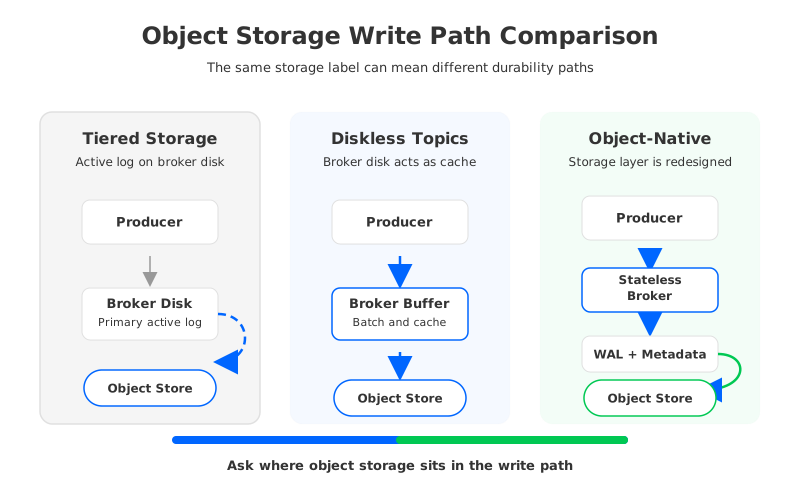
This is where vendor comparison gets slippery. A platform can say "object storage" and still mean several different things:
- Tiered storage: active data still lands on broker disks, while older segments move to object storage.
- Diskless topics: selected topics write durable data to object storage instead of local broker segments.
- Object-storage-native Kafka: the storage layer is redesigned around shared object storage as the primary durable medium.
- BYOC managed streaming: the data plane runs in your cloud account, but the control plane, billing, and support model may remain vendor-managed.
- Private BYOC: both the control plane and data plane run in your cloud account or VPC, with vendor maintenance handled through explicit authorization.
Those models overlap, but they are not interchangeable. A low-latency payments workload, a high-volume observability pipeline, and a seven-day event-retention platform can all be called "Kafka," yet they stress completely different parts of the architecture.
3How To Evaluate Diskless Kafka Alternatives
The evaluation starts with compatibility, but compatibility alone is not enough. Most teams do not migrate away from classic Kafka because the producer API is hard. They migrate because storage and operations stop scaling cleanly in cloud environments. A useful comparison therefore needs to ask how deep the Kafka compatibility goes and how much of the classic storage problem is actually removed.
Use these questions before you look at vendor packaging:
- Is object storage the primary durable store or a secondary tier? This determines whether the platform removes active-segment replication cost, or mostly improves long retention economics.
- Does it keep standard Kafka client behavior? Kafka API compatibility is broad. Transactions, compaction, consumer groups, ACLs, schema registry, connectors, and operational tooling may land at different maturity levels.
- Where does the data plane run? BYOC can mean your cloud account, your network, and your object store, but it does not automatically mean you control every operational dependency.
- How does the write path handle latency? Object storage changes durability economics, but it also changes batching and acknowledgement behavior. The architecture needs a clear answer for latency-sensitive workloads.
- What is the exit path? Standard Kafka clients help, but stored log format, metadata model, schema registry, and operational automation also affect how easily you can move later.
The last point matters more after acquisitions. Confluent's 2024 WarpStream acquisition brought WarpStream into a larger Kafka portfolio, and IBM's 2026 Confluent acquisition added another platform layer above that. For some buyers, that is a positive sign: a larger vendor, deeper enterprise support, and a broader platform. For others, it increases the need to understand product boundaries and long-term portability.
4Top WarpStream Alternatives
4.1AutoMQ
AutoMQ is the most direct alternative if your core requirement is Kafka compatibility plus object storage as the primary storage layer. AutoMQ's documentation describes it as a cloud-native, fully Kafka-compatible streaming platform built on S3, and its Kafka compatibility page says AutoMQ is licensed under Apache License 2.0. The important architectural point is that AutoMQ keeps the Kafka API surface while redesigning the storage layer around object storage and stateless brokers.
Its BYOC model is also more private than the common "customer data plane, vendor control plane" pattern. AutoMQ documents the environment console/control plane and Kafka service/data plane as deployed in the user's network environment, with maintenance requiring user authorization. That distinction matters if the reason you are looking beyond WarpStream is not only object-storage economics, but also control-plane residency.
That makes AutoMQ a fit for teams that want the diskless direction without giving up the Kafka ecosystem. Existing producers, consumers, Kafka Streams applications, Connect deployments, and operational assumptions still need migration testing, but the intent is not to ask teams to adopt a different messaging model. The evaluation should focus on compatibility depth, latency under your workload, object store configuration, and how the BYOC environment fits your security model.
AutoMQ is strongest when the problem is architectural rather than cosmetic. If your Kafka estate is fighting over-provisioned disks, slow partition movement, expensive multi-AZ replication, or long storage planning cycles, object-storage-native design directly targets the source of the pain. If your main need is a mature hosted control plane with a large commercial ecosystem, Confluent or Aiven may feel more familiar.
Good fit:
- You want Kafka-compatible streaming with object storage as the primary durable layer.
- You prefer an Apache 2.0 project and want a clearer open-source exit path.
- You are evaluating BYOC or self-controlled cloud infrastructure rather than a fully opaque SaaS data plane.
Watch closely:
- Validate operational maturity against your own SLOs, tooling, and incident response process.
- Test latency, compaction, transactions, connector behavior, and consumer lag patterns with your real workload.
Useful sources: AutoMQ overview, AutoMQ Kafka compatibility, AutoMQ BYOC experience docs.
4.2Aiven Inkless
Aiven Inkless is one of the most important WarpStream alternatives because it brings the diskless topic idea into an Apache Kafka service. Aiven's docs describe Inkless as an Apache Kafka service for cloud deployments that supports diskless topics and object storage-backed retention. The same docs say Inkless is available on Aiven Cloud and BYOC deployments, runs on Kafka 4.x, and supports classic and diskless topics within the same service.
That mixed-topic model is attractive. Many Kafka estates do not move as one clean unit. Some topics are high-volume retention streams where object storage economics matter most. Others are latency-sensitive operational topics that teams may prefer to keep on the classic path until diskless semantics are fully understood. Aiven's model gives teams a managed way to stage that decision topic by topic.
The trade-off is that Inkless is a managed Aiven service, not a general-purpose upstream Kafka feature you can freely operate anywhere today. Aiven's docs also note that some broker-level settings use managed defaults. That is not inherently bad; many teams choose Aiven precisely because they want the vendor to own more of the service. But if your WarpStream evaluation was motivated by deep data-plane control, you should inspect the BYOC boundary carefully.
Good fit:
- You already like Aiven's managed-service model.
- You want both classic and diskless topics in the same Kafka service.
- You want BYOC as a managed deployment option rather than a self-operated system.
Watch closely:
- Confirm which Kafka features are supported on diskless topics.
- Review which broker settings are managed defaults and which remain under your control.
- Check availability in your cloud, region, and contract model.
Useful sources: Aiven Inkless overview, Aiven diskless topics docs.
4.3Apache Kafka Diskless Topics Roadmap
The upstream Apache Kafka path matters even if you do not plan to run early diskless builds. KIP-1150, Diskless Topics, was accepted and frames the motivation clearly: cloud object storage changes the cost and durability assumptions behind classic Kafka replication. KIP-1163, Diskless Core, then describes the core mechanics of diskless topics and is marked under discussion as of this writing.
This is not a current drop-in WarpStream replacement. It is the direction of the upstream Kafka conversation. The KIP-1163 page says diskless topics store data durably in object storage, use local broker disk as cache rather than source of truth, and delegate replication to object storage rather than Kafka's direct broker replication. It also explicitly notes that remote storage may increase request and end-to-end latency compared with local disks.
That candor is useful. Diskless Kafka is not magic; it is a trade. You reduce or remove some disk and replication burdens by leaning on object storage, then you engineer around the latency, batching, metadata, and feature-coverage consequences. Upstream Kafka will likely be the safest long-term answer for teams that can wait, but it is not the answer for teams that need a production diskless Kafka architecture immediately.
Good fit:
- You prefer upstream Apache Kafka over vendor-specific implementations.
- Your timeline allows you to track KIP implementation, release notes, and production hardening.
- You want a future migration path that may converge with the broader Kafka ecosystem.
Watch closely:
- Do not treat accepted or under-discussion KIPs as production-ready features.
- Follow feature gaps such as compaction, transactions, metadata behavior, and migration tooling.
Useful sources: KIP-1150 Diskless Topics, KIP-1163 Diskless Core.
4.4Confluent Cloud or Confluent Platform
Confluent is not a simple "WarpStream alternative" because WarpStream is now part of Confluent's portfolio. Confluent's product page positions "Bring Your Own Cloud with WarpStream" as a Kafka-compatible BYOC-native data streaming service, while Confluent Cloud and Confluent Platform cover managed and self-managed Kafka-oriented deployments. After IBM completed its acquisition of Confluent in March 2026, the strategic umbrella became even broader.
That broader portfolio can be a reason to stay in the Confluent world. If your organization already standardizes on Confluent governance, connectors, Schema Registry, Flink, support, and enterprise procurement, the alternative to WarpStream may not be another diskless engine. It may be choosing the Confluent deployment model that fits each workload: Confluent Cloud for managed Kafka, Confluent Platform for self-managed environments, and WarpStream for BYOC object-storage-oriented workloads.
The trade-off is specificity. A broad data streaming platform is not the same thing as an open diskless Kafka architecture you can independently operate and replace. Buyers should separate platform convenience from storage architecture. If your reason for evaluating WarpStream is object-storage-first Kafka with a specific BYOC boundary, make sure the Confluent route preserves those properties rather than solving a different enterprise platform problem.
Good fit:
- You already run Confluent and value one commercial platform.
- Governance, connectors, managed operations, and enterprise support matter as much as storage design.
- Procurement prefers a large vendor relationship over assembling a narrower architecture.
Watch closely:
- Clarify whether the workload is actually a WarpStream workload, a Confluent Cloud workload, or a Confluent Platform workload.
- Review how IBM ownership affects your vendor-risk process, support path, and roadmap assumptions.
Useful sources: Confluent stream product page, IBM Confluent acquisition announcement.
4.5Apache Pulsar
Apache Pulsar belongs in the comparison when the requirement is cloud-native streaming rather than strict Kafka equivalence. Pulsar was designed with a separated architecture: brokers serve clients while Apache BookKeeper provides persistent message storage. Pulsar also supports tiered storage that offloads older backlog data to long-term storage such as S3 or GCS.
That makes Pulsar attractive for teams willing to adopt Pulsar's native model: multi-tenancy, namespace-level administration, geo-replication patterns, and a storage layer built around BookKeeper. It is not just "Kafka with a different disk layout." The operational model, client ecosystem, and tuning surface are different. Some teams prefer that separation; others see it as migration risk.
For a WarpStream alternatives article, Pulsar is best understood as a category boundary. It proves that separating serving from storage is a serious streaming design, but it does not preserve Kafka as the native contract. If your applications are deeply tied to Kafka protocol behavior, Kafka Connect, Kafka Streams, and Kafka operational tooling, Pulsar requires a more deliberate migration plan.
Good fit:
- You can evaluate a non-Kafka-native streaming architecture.
- Multi-tenancy, geo-replication, and separated serving/storage are major requirements.
- You have the team capacity to operate or consume Pulsar as its own platform.
Watch closely:
- Treat Kafka compatibility as a migration concern, not as an assumption.
- Include BookKeeper operations and Pulsar-specific tooling in the production readiness review.
Useful sources: Apache Pulsar overview, Pulsar tiered storage.
4.6Redpanda
Redpanda is relevant when the team wants Kafka API compatibility with a different implementation and a simpler operational footprint, but it is not a pure diskless Kafka substitute. Redpanda's docs describe Tiered Storage as a feature that uploads data from Redpanda to object storage and fetches remote data through Kafka API access. That is useful for retention economics and recovery patterns, but active writes still need careful comparison with diskless designs.
This distinction matters because many teams use "object storage Kafka" too loosely. Redpanda with tiered storage can reduce the pressure of long retention on local disks. It does not mean brokers become stateless in the same way as a primary-object-storage architecture. You should compare it against WarpStream only after separating the problem you are solving: retention cost, operational simplicity, Kafka API compatibility, or active-segment replication economics.
Redpanda can be a strong fit for teams that want Kafka-compatible clients, a non-JVM broker, and tiered storage without adopting a fully diskless model. If the main reason you are looking beyond WarpStream is latency sensitivity or operational familiarity rather than object-storage-first architecture, it deserves a serious test.
Good fit:
- You want Kafka API compatibility with Redpanda's broker architecture.
- Tiered storage and operational simplicity matter more than fully diskless storage.
- You are comfortable evaluating commercial licensing and support boundaries for production use.
Watch closely:
- Do not equate tiered storage with diskless primary storage.
- Test remote-read behavior, local cache sizing, recovery, and object store migration limits.
For Redpanda-specific details, check the current Redpanda documentation for the architecture and tiered storage behavior of the version you plan to evaluate.
5Object Storage Streaming Comparison Table
The practical decision is less "which vendor uses S3?" and more "which part of the Kafka storage model did the vendor replace?" That distinction determines latency behavior, operational burden, and lock-in risk.
| Platform | Kafka API posture | Storage model | BYOC posture | Best reason to evaluate |
|---|---|---|---|---|
| WarpStream | Kafka-compatible | Diskless, object-store-backed | Core product is BYOC-oriented | You like Confluent/WarpStream's managed BYOC model |
| AutoMQ | Kafka-compatible | Object storage as primary durable layer | BYOC and self-controlled deployment options | You want Kafka compatibility with an open, object-storage-native architecture |
| Aiven Inkless | Standard Kafka APIs and clients | Classic and diskless topics in managed Kafka | Aiven Cloud and BYOC | You want diskless topics inside a managed Apache Kafka service |
| Apache Kafka KIP path | Native Kafka direction | Diskless topics proposed through KIPs | Depends on future distributions | You want upstream convergence and can wait |
| Confluent Cloud / Platform | Kafka-oriented Confluent ecosystem | Cloud-native managed or self-managed Kafka platform | Multiple deployment options, WarpStream for BYOC | You want the broader Confluent platform more than a narrow diskless engine |
| Apache Pulsar | Native Pulsar, not Kafka-first | Brokers plus BookKeeper, with tiered storage | Deployment-dependent | You can adopt a different streaming architecture |
| Redpanda | Kafka API-compatible | Local storage with tiered object storage | Cloud or self-managed options | You want Kafka-compatible operations with tiered retention |
No table can replace a workload test. A streaming platform's behavior changes under partition skew, consumer lag, compaction, schema evolution, bursty producers, and cross-zone traffic. The table is useful because it prevents the most common mistake: comparing a primary-object-storage architecture with a tiered-storage feature as if they were the same thing.
6BYOC And Lock-In Risk Matrix
BYOC reduces some risks and introduces others. Running the data plane in your cloud account can help with data residency, network control, and security review. It does not automatically remove dependency on a vendor control plane, a proprietary metadata format, a billing model, or an operational runbook that only the vendor understands.
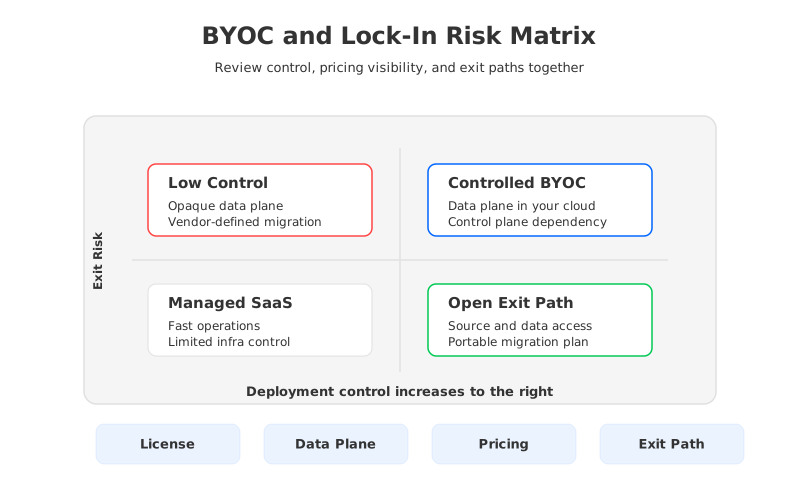
Use a four-part risk review:
- License and source access: Can your team inspect, operate, or fork enough of the system to survive a vendor change?
- Data plane control: Does streaming data stay in your account, and can you observe the agents, brokers, object store, and network path?
- Pricing control: Are the biggest costs in your cloud bill, the vendor bill, object store requests, cross-zone transfer, or bundled platform units?
- Exit path: Can you migrate data, offsets, schemas, ACLs, connectors, and operational workflows without a one-off professional services project?
This is where AutoMQ and upstream Kafka-oriented paths are attractive to teams that value control. It is also where Confluent and Aiven can be attractive to teams that value vendor ownership of operations. The answer is not universal. A small platform team may rationally prefer a managed control plane even if it creates dependency. A regulated enterprise may rationally accept more operational work to keep clearer ownership of data and deployment boundaries.
7How To Choose
If WarpStream attracted you because of diskless Kafka economics, evaluate AutoMQ, Aiven Inkless, and the Apache Kafka KIP path first. They are closest to the architectural question. WarpStream's baseline is object storage as a primary design point; a fair alternative should explain whether it does the same or only moves older data to an object store.
If WarpStream attracted you because of BYOC, include Confluent, Aiven, and AutoMQ in the same review, but ask sharper questions about the control plane. BYOC is not one product category. One vendor may run agents in your VPC while keeping metadata and orchestration in its control plane. AutoMQ goes further by placing the environment console/control plane and Kafka service/data plane in the user's network environment. Those differences matter during outages, audits, and contract changes.
If your main workload is latency-sensitive, avoid architecture labels and run a benchmark with your own producers, consumers, topic count, message size, retention, and failure modes. Diskless systems can be excellent for high-throughput cloud workloads, but object storage introduces batching and remote-read trade-offs that must be tested rather than assumed.
If your main requirement is ecosystem completeness, Confluent remains hard to ignore. Its platform breadth is the point. The question is whether you are buying that breadth because you need it, or because it hides a storage architecture decision you have not made yet.
The cleanest selection process looks like this:
- Define whether the workload needs strict Kafka behavior, Kafka API compatibility, or can tolerate a different streaming model.
- Separate active-write storage architecture from long-retention tiering.
- Decide whether BYOC means data residency, operational control, procurement preference, or all three.
- Run a workload test that includes normal traffic, backlog reads, broker or agent failure, scale-out, and migration rollback.
- Review exit paths before signing, not when the next acquisition or pricing change arrives.
8Where AutoMQ Fits
AutoMQ fits when the team wants the diskless idea but does not want the evaluation to collapse into a proprietary service decision. It keeps the Kafka compatibility goal front and center, uses object storage as the durable storage foundation, offers an Apache 2.0 route for teams that care about source access, and uses a private BYOC model where both control plane and data plane are deployed in the user's network environment.
That does not make it the default answer for every buyer. A team already deep in Confluent governance may prefer the Confluent route. A team standardized on Aiven may prefer Inkless. A team that wants upstream purity may wait for Apache Kafka's diskless work to mature. But if the reason you searched for WarpStream alternatives is "we want Kafka-compatible streaming built for cloud object storage, and we want more control over the deployment and exit path," AutoMQ should be on the first test list.
For a hands-on evaluation, start with the AutoMQ documentation and run a small workload that mirrors your current Kafka traffic shape. The useful test is not a vanity throughput run. It is whether the storage model changes the parts of Kafka operations your team is tired of owning.
9FAQ
9.1What is the best WarpStream alternative?
There is no single best alternative. AutoMQ is the closest fit for teams that want Kafka-compatible, object-storage-native streaming with stronger control and open-source posture. Aiven Inkless is a strong managed-service option for diskless topics. Confluent is the natural path for organizations that already standardize on the Confluent platform. Pulsar and Redpanda are useful when you are willing to evaluate adjacent architectures.
9.2Is Redpanda a diskless Kafka alternative?
Redpanda is a Kafka API-compatible streaming platform with tiered storage, but tiered storage is not the same thing as fully diskless Kafka. Redpanda can upload data to object storage and fetch remote data through Kafka API-compatible reads, but you should evaluate it as a tiered-storage architecture rather than assuming it removes active local storage in the same way as WarpStream-style diskless systems.
9.3Is Apache Kafka getting diskless topics?
The Apache Kafka community accepted KIP-1150, which introduces diskless topics, and related work such as KIP-1163 describes the core mechanics. That does not mean diskless topics are a stable production feature in the Apache Kafka release you are running today. Treat it as an important upstream direction and verify release status before planning a migration.
9.4How is diskless Kafka different from tiered storage?
Tiered storage typically keeps active segments on broker disks and moves older data to object storage. Diskless Kafka designs move durable topic data to object storage as the primary storage layer and use local disk, if present, as cache or temporary buffering. The operational difference is large: tiered storage mainly helps retention; diskless designs aim at active storage, replication, elasticity, and cloud infrastructure cost.
9.5Does BYOC eliminate lock-in?
No. BYOC can keep the data plane in your cloud account, but lock-in can still exist in the control plane, metadata model, support process, pricing unit, schema registry, or migration tooling. A good BYOC review checks what happens if you stop using the vendor: where the data lives, how offsets and schemas move, and whether another system can read or reconstruct the streams.
9.6Should I replace WarpStream after the Confluent and IBM acquisitions?
Not automatically. Acquisitions can improve support, roadmap investment, and enterprise integration. They can also change procurement, packaging, and product priorities. The practical move is to reassess vendor risk with current facts: Confluent acquired WarpStream in 2024, and IBM completed its acquisition of Confluent on March 17, 2026. If those ownership changes affect your architecture or procurement policy, compare alternatives before renewal.


