
Table of Contents
Table of Contents
Teams usually search for topic creation governance kafka after one of two things happens. Either developers are waiting days for a platform ticket to create a topic, or the platform team discovers a cluster full of topics nobody can explain. Both situations point to the same operating problem: topic creation is not a small administrative action in production Kafka. It is a commitment to storage, network movement, access control, naming, retention, observability, and future migration work.
Blocking every request is a tempting reaction, but it turns the platform team into a queue. Letting every application create topics freely feels faster, until defaults become invisible policy. A topic with unbounded retention, too many partitions, no owner tag, and unclear consumer expectations does not look dangerous at creation time. The cost appears later, when brokers need expansion, a connector multiplies traffic, or an incident response team cannot tell whether deleting a topic is safe.
Good governance is not the opposite of developer self-service. The goal is to make safe creation fast, make risky creation explicit, and make every topic understandable after the person who created it has moved on.
1Why teams search for topic creation governance kafka
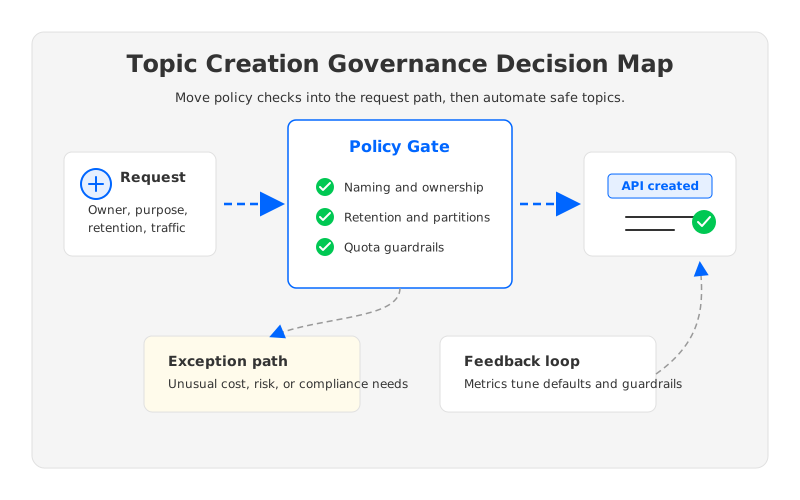
The phrase sounds narrow, but the search intent is usually broad. Kafka operators are not asking only how to disable automatic topic creation or which CLI command to approve. They need defaults for routine streams, guardrails for risky streams, and an exception path for workloads that are legitimately unusual.
Apache Kafka exposes configuration surfaces that matter here. Broker-level auto.create.topics.enable controls whether the cluster creates topics automatically when clients reference missing topic names. Topic-level configurations control retention, cleanup policy, minimum in-sync replicas, compression, and other operational behavior. Kafka Connect also has topic creation settings for source connectors, which matters because connector-driven pipelines can create many topics without a human typing a kafka-topics.sh command.
Those settings are useful, but they are not a governance model by themselves. A governance model answers questions Kafka configuration cannot infer:
- Who owns this topic when an alert fires at 03:00?
- Is the topic a product event stream, a temporary integration stream, a CDC stream, or a compliance archive?
- What retention is needed by consumers, not merely convenient for producers?
- What partition count is warranted by expected throughput and consumer parallelism?
- Which identity is allowed to produce, consume, alter configs, or delete?
- What happens if the topic must be migrated, renamed, compacted, or rolled back?
The strongest platform teams separate request policy from broker mechanics. The request path gathers intent and applies rules. Kafka then implements the resulting topic configuration. That distinction prevents a common failure mode: turning every production concern into either a manual ticket or a permissive broker default.
2The production constraint behind the problem
Traditional Kafka makes topic creation operationally expensive because data placement is tied to broker-local storage. A topic is not merely a namespace. It becomes partitions, replicas, segment files, page cache pressure, disk consumption, network replication, controller metadata, ACL entries, monitoring labels, and often connector or schema registry dependencies. Even before traffic arrives, its configuration shapes what the cluster must be ready to absorb.
This is why partition count is such a sensitive governance field. Too few partitions can limit consumer parallelism and create hot leaders. Too many partitions increase metadata, leader election work, recovery surface, and operational noise. The right answer depends on throughput, fan-out, latency goals, retention, key distribution, and how the application will evolve.
Retention is the other field that quietly becomes architecture. A seven-day event stream and a one-year audit stream have different cost profiles and recovery expectations. Compacted topics add another dimension because they preserve the latest value per key rather than aging out only by time. Once teams start using Kafka as a replayable system of record, topic creation becomes a data lifecycle decision, not a convenience API.
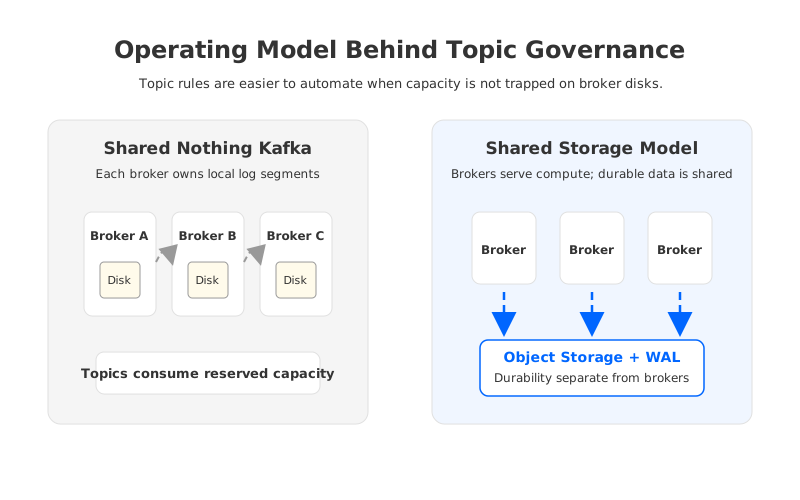
In a shared-nothing Kafka cluster, these decisions accumulate on broker disks. More topics and longer retention often mean more local storage, more replication traffic, more balancing work, and more careful capacity planning. Tiered storage can reduce pressure from older log segments, but it does not remove the operational importance of broker-local placement for the active part of the log. Platform teams still have to reason about how added topics affect brokers, partitions, replicas, and future reassignment.
That architecture explains why many organizations overcorrect. They disable automatic topic creation, require a service ticket, ask developers to fill out a long form, and then route the request to a small Kafka operations group. The process is rational from the operator's point of view. It is also slow enough that developers route around it, especially in environments where new data products, connectors, and machine learning pipelines appear weekly.
3Architecture options and trade-offs
There are three common ways to govern topic creation. The first is broker-default governance: disable automatic creation, define strict cluster defaults, and let a small group create topics manually. It is straightforward to understand and works for stable environments, but it does not scale well when many teams build event-driven applications.
The second is self-service with policy-as-code. Developers submit a request through an internal portal, Terraform module, GitOps repository, or platform API. The request includes owner, naming pattern, retention, partition count, cleanup policy, expected throughput, data classification, and ACL intent. Automated checks approve standard requests and route exceptions to review. This model is the strongest starting point for many teams because it turns governance into repeatable software rather than tribal knowledge.
The third is fully delegated creation by application teams. This can work when every team has strong Kafka skills and the platform has excellent observability, quotas, and chargeback. In most enterprises, it needs tight boundaries: per-team namespaces, enforced ACL templates, retention caps, and topic growth dashboards.
The architectural trade-off is not only "manual versus automated." It is where the platform places risk.
| Governance model | Developer speed | Platform control | Operational risk |
|---|---|---|---|
| Manual creation | Low | High | Ticket backlog and undocumented exceptions |
| Policy-as-code self-service | High | High | Requires good request schema and automation |
| Fully delegated creation | Very high | Medium | Depends on quotas, ownership, and observability |
Policy-as-code tends to win because it preserves context. A Git commit or API request can carry metadata that the topic itself does not express cleanly: business owner, service name, data classification, retention rationale, expected consumer groups, and rollback notes. That metadata becomes useful during audits, cost reviews, incident response, and migration planning.
4Evaluation checklist for platform teams
A useful governance checklist is short enough for developers to complete and specific enough for operators to trust. If the form is too long, teams will copy answers from the last request. If it is too vague, every request becomes a judgment call. Classify topics into patterns rather than forcing every team to design Kafka from first principles.
Start with pattern templates. A "service event" template might allow moderate retention, a bounded partition range, delete cleanup, and producer/consumer ACLs tied to one application namespace. A "CDC stream" template might require connector ownership, schema compatibility notes, and stricter naming. An "audit stream" template might trigger review because retention and access requirements are usually different.
The minimum gate should cover these dimensions:
- Compatibility: Does the workload require specific Kafka behavior such as compaction, transactions, idempotent producers, or strict ordering by key?
- Cost: Does retention, partition count, replication, or fan-out create a material storage or network commitment?
- Scaling: Can the topic grow without creating a partition reassignment or broker capacity incident?
- Security: Are ACLs, identity, encryption expectations, and audit ownership defined at creation time?
- Observability: Will dashboards, lag alerts, and owner labels exist before production traffic starts?
- Recovery: Is there a rollback path if the topic name, schema, or retention setting turns out to be wrong?
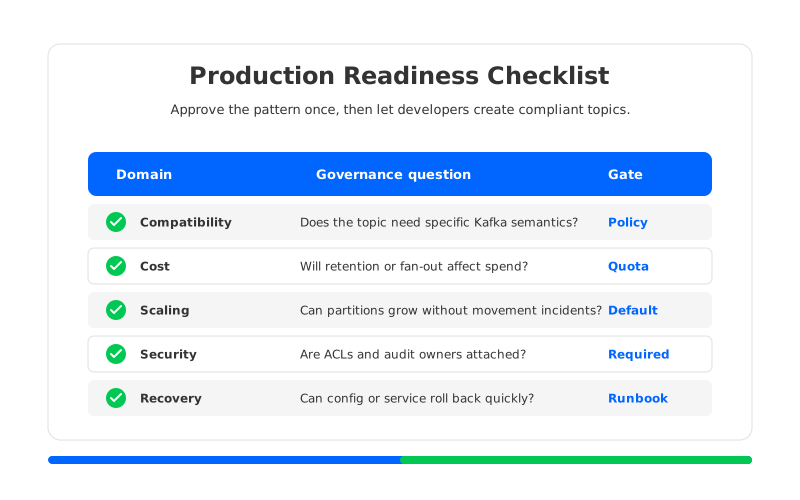
Notice what this checklist avoids. It does not ask developers to guess broker disk utilization or controller load. Developers describe intent and workload shape; the platform translates that intent into Kafka configuration, quotas, and infrastructure capacity.
5How AutoMQ changes the operating model
Once a team has a neutral governance model, the next question is whether the underlying Kafka-compatible infrastructure makes that model easier or harder to operate. This is where architecture matters more than portal design. A beautiful self-service workflow still creates operational debt if every approved topic increases broker-local storage pressure and future data movement.
AutoMQ is a Kafka-compatible, cloud-native streaming platform built around a Shared Storage architecture. Instead of binding durable log storage to broker-local disks, AutoMQ separates compute from storage and uses object storage as the durable storage layer, with WAL options used for low-latency persistence. Brokers become more stateless in the operating model, while Kafka protocol compatibility preserves the client and application surface teams already use.
For topic creation governance, the important change is not that governance disappears. It is that some governance questions become less coupled to broker capacity. Platform teams still need naming rules, ownership, ACLs, retention policy, observability, and lifecycle controls. But they can evaluate those controls against an architecture where storage capacity and compute capacity are not forced to grow in lockstep for every topic pattern.
That distinction matters in cloud environments. In a broker-local model, topic sprawl often becomes a storage and balancing conversation. In a shared storage model, the platform can focus more directly on workload intent, access boundaries, and cost visibility. AutoMQ documentation describes this architecture as Shared Storage with stateless brokers, Kafka compatibility, S3Stream storage, WAL storage, self-balancing, and zero inter-zone traffic patterns for supported deployments.
There is also a migration benefit. A governance catalog that records owner, topic pattern, retention, cleanup policy, ACL intent, and consumer dependencies becomes the inventory for moving workloads later. If the organization migrates from Apache Kafka to a Kafka-compatible platform, the hard part is rarely creating a topic with the same name. The hard part is preserving behavior, access, offsets, producer cutover, consumer expectations, and rollback.
6Implementation pattern: fast path, review path, escape hatch
The most practical implementation is a three-path model. The fast path handles common topics through approved templates. Developers choose a topic pattern, provide owner and workload metadata, and receive a policy-compliant topic with ACLs. The review path handles unusual retention, sensitive data, high partition counts, or cross-team ownership. The escape hatch handles urgent production needs, but still writes metadata after the fact.
This model works when each path leaves an audit trail. A topic created by Terraform, GitOps, or a platform API should record the request, approval result, resulting configuration, and owner. The cluster should then be monitored against that declared intent. If a topic requested as "low throughput" becomes a top producer, the platform should not wait for the next capacity incident to notice.
A mature workflow usually includes these controls:
- Naming convention validation before creation.
- Policy templates for retention, cleanup policy, partition ranges, and ACLs.
- Quotas or budget signals for teams that create many topics or long-retention streams.
- Automatic labels for owner, environment, service, data classification, and request ID.
- Periodic review of inactive topics, orphaned owners, and topics outside policy.
The default path should be boring. Developers should not need to understand every broker setting to create a standard event stream. Operators should not need to manually inspect every standard event stream to trust it.
7Decision matrix for technical buyers
When evaluating Kafka-compatible streaming infrastructure, include topic governance in the architecture review. Throughput, latency, compatibility, and price are easier to evaluate in isolation. The harder question is how the system behaves when hundreds of developers create thousands of topics over several years. That long tail is where operational cost and migration risk usually accumulate.
Ask each vendor or internal platform option the same questions:
| Question | Why it matters |
|---|---|
| How are topic defaults enforced? | Defaults become policy when creation is automated. |
| Can creation be driven by API, IaC, or GitOps? | Self-service needs repeatable automation, not ad hoc console work. |
| What happens when retention grows? | Retention changes storage cost, recovery, and capacity planning. |
| How does partition growth affect operations? | Partition count can drive metadata, balancing, and recovery work. |
| How are ACLs and ownership attached? | Security and incident response depend on topic-level ownership. |
| How hard is migration or rollback? | Governance metadata should support future platform changes. |
The right answer is not always the most permissive platform. A regulated financial services team may intentionally keep a review-heavy model. A fast-moving analytics platform may need broader self-service. The common requirement is transparency: developers should know what they can create, operators should know what has been created, and architects should understand how those topics affect infrastructure.
If your current governance process is stuck between slow tickets and unsafe defaults, use topic creation as a small but revealing architecture test. Build the checklist, classify your topic patterns, and then evaluate whether your Kafka-compatible platform makes that model easier to run. To explore how AutoMQ approaches Kafka-compatible shared storage and cloud deployment boundaries, start with the AutoMQ Cloud overview.
8References
- Apache Kafka documentation: Broker configuration
auto.create.topics.enable - Apache Kafka documentation: Topic-level configuration
- Apache Kafka documentation: Kafka Connect configuration
- AutoMQ documentation: Compatibility with Apache Kafka
- AutoMQ documentation: Shared Storage architecture overview
- AutoMQ documentation: S3Stream shared streaming storage
- AutoMQ documentation: Manage Topics
9FAQ
9.1Should Kafka automatic topic creation be disabled in production?
Many production teams disable broker-level automatic topic creation because a typo or missing deployment step can create an unintended topic with default settings. The better question is what replaces it. A self-service API, GitOps workflow, or Terraform module can keep creation fast while applying naming, ownership, retention, partition, and ACL policy.
9.2How many partitions should an added Kafka topic have?
There is no universal number. Choose partitions based on expected throughput, key distribution, consumer parallelism, ordering needs, and future growth. Governance should define safe ranges by workload pattern and require review for requests outside those ranges.
9.3Is topic governance mostly a security problem?
Security is one part of it, but not the whole problem. Topic governance also covers cost, retention, ownership, observability, scaling, cleanup policy, and migration readiness. A topic with correct ACLs can still create operational debt if it has no owner or an unsupported retention policy.
9.4Does shared storage remove the need for topic governance?
No. Shared storage changes the operating model by reducing the coupling between broker-local disks and durable log storage, but platform teams still need policy. The benefit is that safe self-service can be evaluated against a more elastic storage model rather than only against broker-local capacity.


