
Table of Contents
Table of Contents
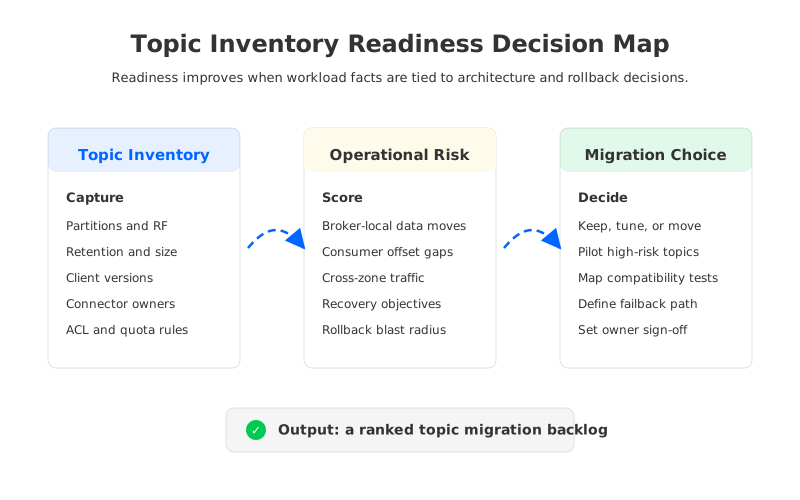
A Kafka migration rarely starts with brokers. It starts with a spreadsheet that nobody fully trusts. The platform team exports topic names, partition counts, retention settings, client owners, consumer groups, ACLs, quotas, and connector dependencies, then discovers that half the rows need interpretation. Some topics are business critical but small. Some are large but owned by a team that no longer exists.
That is why teams search for topic inventory readiness kafka before they search for a vendor checklist. They are asking whether their production topology is legible enough to survive a Kafka-compatible platform change without turning the cutover into archaeology. A topic inventory is the translation layer between application reality and infrastructure design.
The uncomfortable part is that most inventories are built too late. They appear after the target platform has been selected, after a migration calendar has been announced, and after leaders assume the remaining work is mechanical. At that point, the inventory becomes a blocker because it reveals hidden contracts: consumer offset behavior, transactional producers, schema compatibility, long retention topics, connector-managed topics, and topic-level settings tuned around the old cluster. Readiness means finding those contracts while the plan can still change.
1Why Teams Search for topic inventory readiness kafka
The search phrase sounds narrow, but the intent is broad. A team preparing for a Kafka-compatible migration usually has three pressures at the same time: production risk, cloud cost, and governance. Production risk comes from the fact that topics are not passive storage buckets. They are active contracts between producers, consumers, stream processors, connectors, and operational policies. Cloud cost comes from partition count, replication factor, retention, cross-zone traffic, and the spare capacity needed to rebalance or recover. Governance comes from ownership, access control, encryption, audit trails, and the ability to explain who is allowed to publish or consume each data stream.
The topic inventory is where those pressures meet. A broker sizing exercise can estimate CPU, memory, disk, and network, but it cannot tell you whether a topic can be migrated during a low-traffic window, whether a consumer group can tolerate offset translation, or whether a sink connector depends on exactly-once delivery semantics. Those answers live at the topic boundary.
For migration planning, every topic should be classified by more than volume:
- Runtime criticality: what breaks if the topic pauses, replays, duplicates, or loses ordering for a partition.
- Compatibility surface: which producer and consumer libraries, protocol features, authentication methods, and transaction settings are in use.
- Data gravity: how much retained data exists, how quickly it grows, and whether retention is operationally required or inherited.
- Ownership clarity: which team can approve changes to retention, partitioning, ACLs, quotas, and cutover timing.
- Rollback behavior: how the application behaves if traffic moves back to the source cluster after a partial migration.
That last item is often the real maturity test. A topic that can be mirrored forward but cannot be cleanly failed back is not migration-ready. It may still move, but it belongs in a different risk tier.
2The Production Constraint Behind the Problem
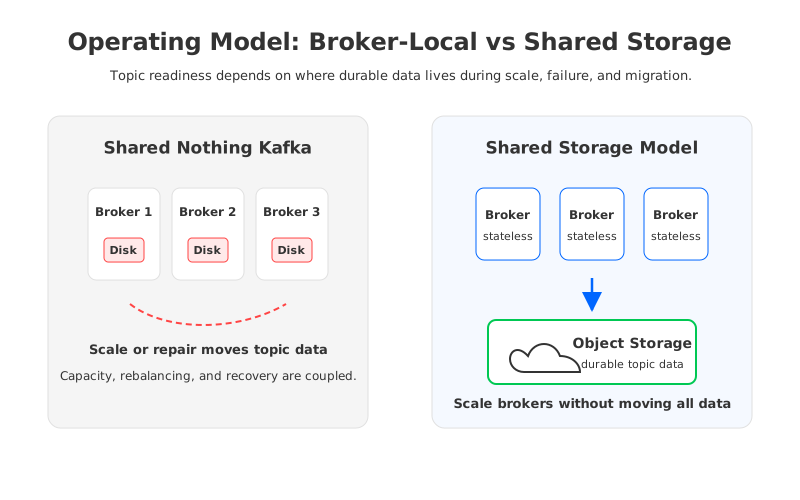
Traditional Kafka architecture makes topic readiness harder because durable data is tied to broker-local storage. Each broker owns partitions on its disks, and availability depends on replica placement across brokers and failure domains. This design is mature and well understood, but it means that capacity changes, disk pressure, broker repair, and partition reassignment all involve moving topic data through the broker fleet.
That matters during migration because the source cluster is usually already under production load. When a team adds temporary brokers for headroom, changes partition placement, extends retention for safety, or mirrors data into a target cluster, it may create additional network and disk work on the very system it is trying to protect. A small inventory error becomes expensive when it hits a topic with high write throughput, long retention, or strict consumer lag objectives.
Kafka's own feature set also raises the bar for readiness. Consumer groups coordinate offset progress. Transactions can tie producer writes and consumer reads into stronger processing guarantees. Kafka Connect stores connector configuration, status, and offsets in internal topics. KRaft removes the ZooKeeper dependency for metadata management, but it does not remove the need to understand topic-level operational contracts. Tiered Storage can move older log segments to remote storage, yet hot partitions and broker-local execution still shape recovery and scaling behavior.
None of this is a criticism of Kafka. It is the reason Kafka became the default streaming substrate for serious systems: its semantics are rich enough to support real production workloads. But rich semantics are also why "Kafka-compatible" should not be treated as a checkbox. Compatibility must be tested against the exact topic and client behaviors you run, not only against a protocol statement.
3Architecture Options and Trade-Offs
A topic inventory should not push every team toward the same target architecture. It should make the trade-offs visible enough that the right topics move first. In practice, platform teams usually compare three paths: keep and tune the existing Kafka estate, move to a managed Kafka service with a similar shared-nothing model, or adopt a Kafka-compatible architecture that separates compute from storage.
Keeping the current estate can be rational when the topic count is stable, the ownership model is clear, and the team has enough operational expertise to handle broker replacement, storage expansion, and rebalancing. The danger is that "stable" often means "nobody has measured the drift." If topic count, partition count, and retention have grown faster than the team has updated its operating model, the cluster may look reliable only because the next scaling event has not happened yet.
A managed Kafka service can reduce the infrastructure chores around provisioning, patching, and basic availability. It does not automatically simplify the topic inventory. The team still needs to understand partition count, retention cost, cross-zone replication, client compatibility, Connect behavior, security boundaries, and recovery objectives. Managed operations shift some responsibilities, but they do not erase application contracts.
A shared-storage Kafka-compatible platform changes a different layer of the problem. Instead of treating brokers as the durable home of topic data, the architecture places durable storage in object storage and makes brokers more stateless. That does not remove the need for a topic inventory either. It changes what the inventory is used for: less effort goes into predicting data movement during broker scaling, and more effort can go into compatibility, governance, workload placement, and migration sequencing.
| Evaluation area | Shared-nothing Kafka focus | Shared-storage Kafka-compatible focus |
|---|---|---|
| Capacity planning | Broker disk, partition placement, rebalance headroom | Independent compute and storage growth |
| Failure recovery | Replica health, broker repair, partition reassignment | Broker replacement with durable data outside brokers |
| Migration risk | Source load plus target ingestion and data copy | Compatibility, cutover, and rollback boundaries |
| Cost modeling | Disk, replication, overprovisioning, cross-zone traffic | Object storage, WAL choice, compute, and network path |
| Governance | Topic ownership, ACLs, quotas, internal topics | Same governance plus deployment boundary control |
The table is not an argument that one model wins every row. It is a reminder that the inventory should expose which constraints dominate your estate. A fleet with thousands of low-throughput topics and unclear owners has a governance problem. A cluster with a few high-throughput topics, long retention, and frequent broker scaling has an operating-model problem. A platform with strict transactional workloads has a compatibility and test-design problem.
4Evaluation Checklist for Platform Teams
Before selecting a migration sequence, build a readiness score for each topic or topic family. The score does not need to be mathematically elegant. It needs to be consistent enough that engineers, SREs, data owners, and leadership can look at the same row and agree on the next action.
Start with the source facts. Export topic configuration, partition count, replication factor, retention, message size limits, compaction settings, owners, consumer group lag, ACLs, quotas, schema dependencies, connector dependencies, and internal-topic relationships. Then add evidence. A row saying "owner unknown" is not ready. A row saying "owned by payments-platform, cutover approved only outside settlement window" is actionable.
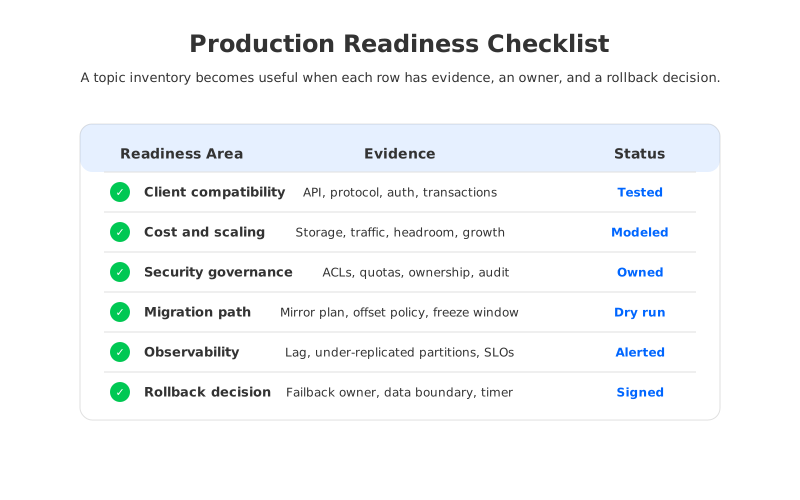
The checklist becomes useful when each area has a concrete test:
- Client and protocol compatibility: run representative producers and consumers against the target platform, including idempotent producers, transactions, compression codecs, authentication, authorization, and older client versions that still exist in production.
- Offset and consumer behavior: decide whether consumers start from mirrored offsets, reset policies, or a controlled replay. Document what happens to lag dashboards during the transition.
- Data retention and bootstrap: separate retention that is required for recovery from retention that accumulated because storage was available. Migration plans become cleaner when business retention and operational retention are not mixed.
- Connector and stream processing dependencies: test source and sink connectors, internal topics, Flink or Spark jobs, schema registry integration, and exactly-once assumptions as a system rather than as isolated clients.
- Security and governance: map ACLs, quotas, encryption expectations, audit requirements, network access, and team ownership before the first production topic moves.
- Rollback and freeze windows: define the exact condition that stops a migration, the owner who makes that decision, and the latest time the team can safely fail back.
The most useful output is a ranked backlog, not a single "go or no-go" answer. Low-risk topics become pilot candidates, medium-risk topics get remediation tasks, and high-risk topics force architectural decisions before they force production incidents.
5How AutoMQ Changes the Operating Model
Once the inventory shows that broker-local storage and data movement are the dominant operational constraints, a shared-storage design becomes worth evaluating. AutoMQ is a Kafka-compatible cloud-native streaming system built around that idea: keep Kafka APIs and client expectations, but decouple broker compute from durable storage by using object storage as the long-term data layer. Brokers become more stateless, while a write-ahead log layer handles the low-latency write path before data is persisted to object storage.
This distinction matters for topic inventory readiness because it changes the questions a platform team asks. In a traditional Kafka cluster, a topic with long retention and high throughput immediately raises concerns about broker disk, partition reassignment time, and the extra load created by repairs or scaling. In AutoMQ's shared-storage architecture, durable topic data is not bound to a specific broker's local disk in the same way. The readiness conversation can move toward client compatibility, WAL selection, object storage policy, network topology, access boundaries, and cutover mechanics.
AutoMQ also fits teams that need customer-controlled deployment boundaries rather than a fully external SaaS operating model. For organizations evaluating BYOC or self-managed software deployment, the inventory should include cloud account structure, network design, identity, object storage policy, and observability integration. Those controls determine who can operate, audit, and recover the platform after migration.
There is one subtle benefit that often shows up during inventory review: separating compute and storage makes temporary migration capacity less awkward. If brokers are primarily compute nodes, adding or replacing brokers does not imply that large amounts of topic data must be copied into broker-local disks before the system is healthy. That can simplify pilot design, blue-green testing, and failure drills. It does not eliminate migration work, but it removes one reason teams delay testing until the plan is too late to change.
Zero cross-AZ traffic claims should also be evaluated carefully and concretely. The important question is not whether a product has a marketing phrase for network savings. The important question is whether your specific deployment, WAL choice, replication path, client placement, and object storage access pattern avoid unnecessary inter-zone data transfer while still meeting durability and recovery objectives. A good inventory gives you the workload details needed to test that claim instead of accepting it abstractly.
6A Practical Readiness Scorecard
For each topic family, assign one of four readiness levels. Level 1 means the topic is discovered but not understood. Level 2 means the topic has an owner and basic configuration facts. Level 3 means compatibility, security, cost, and rollback have been tested. Level 4 means the topic has completed a dry run with observed producer behavior, consumer behavior, dashboards, and failure handling.
The scorecard should be boring enough to survive a late-night incident review:
| Readiness level | Evidence required | Migration action |
|---|---|---|
| Level 1: Discovered | Topic exists, but ownership or usage is unclear | Do not migrate until ownership is resolved |
| Level 2: Classified | Owner, criticality, configs, clients, and retention are known | Add to migration wave planning |
| Level 3: Validated | Compatibility, ACLs, offsets, cost, and rollback are tested | Eligible for controlled production pilot |
| Level 4: Proven | Dry run completed with monitoring and failback decision recorded | Eligible for broader migration wave |
This scoring model prevents a common failure mode: migrating low-risk topics and calling the platform ready while the hardest production contracts remain untouched. The first wave should include low-risk topics, but it should also include at least one topic that exercises the architecture you are trying to prove. If long retention, transactional producers, Connect, or strict consumer lag drove the platform evaluation, a pilot that avoids those behaviors does not validate the decision.
7References
- Apache Kafka Documentation
- Apache Kafka Tiered Storage
- Apache Kafka KRaft
- Apache Kafka Connect User Guide
- AutoMQ Architecture
- AutoMQ Stateless Broker
- AutoMQ WAL Storage
- AutoMQ Zero Cross-AZ Traffic Overview
8FAQ
What is topic inventory readiness in Kafka migration?
Topic inventory readiness is the point where each topic has enough verified information to support a migration decision: ownership, configuration, retention, client behavior, consumer groups, security rules, connector dependencies, cost drivers, monitoring, and rollback behavior.
Is Kafka protocol compatibility enough for migration readiness?
No. Protocol compatibility is necessary, but production readiness depends on the specific features and operating patterns your applications use. Transactions, idempotent producers, old client versions, ACLs, quotas, Connect internal topics, and offset behavior all need representative tests.
Which topics should move first?
Start with topics that have clear owners, low business criticality, representative traffic, and controlled rollback behavior. Do not make the first wave so limited that it proves nothing. Include at least one topic that exercises the architectural reason you are considering the target platform.
How does shared storage affect Kafka migration planning?
Shared storage can reduce broker-local data movement during scaling, repair, and replacement. Migration planning still needs compatibility and governance work, but the inventory can focus less on predicting data copies across broker disks and more on application contracts, network topology, and recovery behavior.
Where should AutoMQ fit in the evaluation?
Evaluate AutoMQ after you understand whether broker-local storage, cross-zone traffic, and coupled compute-storage scaling are real constraints in your estate. If those constraints dominate the inventory, review the AutoMQ architecture documentation and run a representative pilot against your highest-risk topic patterns.


