
Table of Contents
Table of Contents
Teams usually search for topic naming contracts kafka after the naming convention has stopped being a naming convention. The first version may have been a simple pattern like payments.authorized.v1 or prod.orders.shipped. It worked because a small group of engineers knew what each segment meant, which topics were safe for external consumers, and which records contained regulated data. Then the estate grew. More domains arrived, Connect jobs started creating topics, stream processors wrote intermediate topics, and every migration or access review exposed a slightly different interpretation of the same naming rule.
At that point, a topic name is no longer cosmetic metadata. It is a production contract. It tells a producer where it is allowed to write, a consumer what ordering and retention to expect, a platform team which ACL template should apply, and an SRE which owner to page when lag crosses a threshold.
The hard part is that Kafka itself treats the topic name as an identifier, not as a governance system. Topic-level settings such as cleanup.policy, retention.ms, retention.bytes, min.insync.replicas, and remote.storage.enable carry real operational meaning, but the semantic relationship between the name and those settings is owned by the platform team. A large Kafka estate needs a naming contract that connects human intent to those low-level controls without forcing every application team to become a broker operator.
1Why topic naming becomes an operating contract
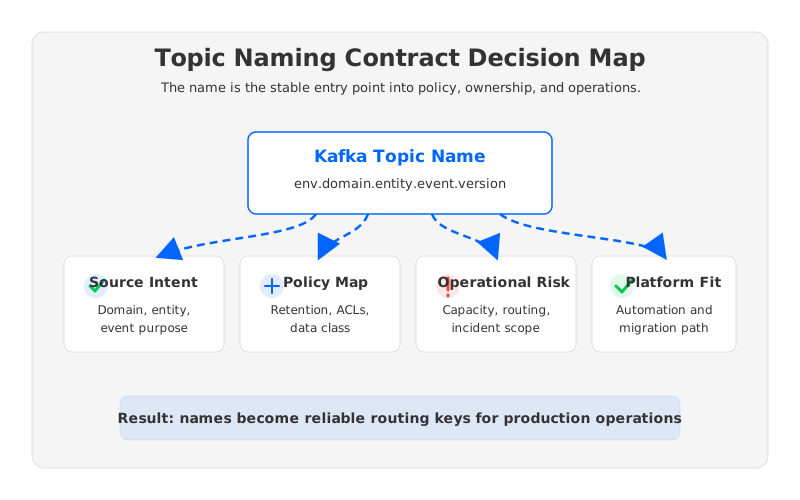
A useful Kafka topic name answers five questions quickly: who owns the stream, which environment it belongs to, what business entity or event it carries, how stable the schema is, and which operational policy should attach to it. If the name cannot answer those questions, the missing context moves somewhere else. It may land in a spreadsheet, a Slack thread, a half-updated service catalog, or a tribal rule that only one team remembers.
The common format looks simple:
<environment>.<domain>.<entity>.<event-or-purpose>.<version>
That pattern is not a universal standard. Some teams put region first because sovereignty matters. Some put tenant or data class in the name because ACL automation depends on it. Others keep environment out of the topic name because clusters are already separated by environment. The point is to define which segments are contractual, which segments are optional, and which segments are forbidden because they will break automation later.
Good contracts are also explicit about what the topic name does not mean. A suffix like .v2 may indicate schema compatibility, but it should not silently change retention. A domain prefix may route ownership, but it should not grant broad produce permissions by wildcard unless the platform has reviewed the risk. A topic name may include pii, internal, or public, but the name is not a substitute for encryption, ACLs, audit trails, and data handling policy.
2The production constraint behind the problem
The naming contract becomes painful because each topic is tied to physical consequences. A compacted topic has a different lifecycle from an append-only event stream. A long-retention topic consumes storage differently from a short-lived operational signal. A high-partition topic changes broker load, leader distribution, catch-up behavior, and migration work. A connector-created topic may also carry internal offsets, status records, or dead-letter data that should not follow the same rules as business events.
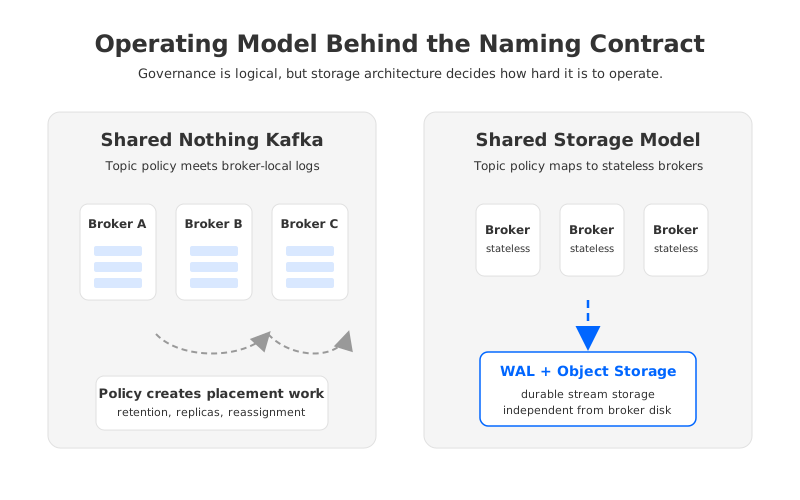
Traditional shared-nothing Kafka makes those consequences visible in broker-local storage and replication work. Each broker owns local log segments for the partitions it hosts. When traffic grows, the platform may need to add brokers, move partitions, rebalance leaders, expand disks, or tune retention. None of those steps are caused by the topic name alone, but a weak naming contract makes them harder to reason about because the platform cannot infer policy from intent.
That is why topic naming should sit next to capacity planning instead of only next to developer experience. A name that encodes audit.customer.profile.changed.v1 can trigger a longer retention class, stricter ACL review, schema approval, and more careful migration handling. A name that encodes tmp.enrichment.session-score.v1 can trigger shorter retention, lower blast-radius ownership, and deletion review after the experiment ends. The contract turns names into routing keys for operational policy.
The contract also protects migrations. When teams move between Kafka-compatible platforms, topic names become part of the inventory. They determine which topics are mirrored first, which consumer groups must be validated, which ACLs need translation, and which topics should be excluded because they are internal to Connect or a stream processor. A naming scheme that made sense only inside one cluster becomes a migration liability when the platform needs to prove that application semantics survived the cutover.
3Architecture options and trade-offs
There are three broad ways to operate a naming contract at scale. The first is a policy-only model: teams publish a naming guide, reviewers check topics, and exceptions are handled manually. This is fast to start, but it usually fails when topic creation becomes self-service. The second is a platform-control model: topic creation goes through a portal, Terraform module, or API that validates the name and applies defaults. This is stronger, but it can become a queue if the platform does not automate owner metadata, ACLs, quotas, and retention. The third is a contract-as-code model: naming rules, allowed segments, defaults, and exception paths are encoded in reusable modules and checked continuously.
Mature estates usually combine the second and third models. Application teams get self-service paths, but the path is narrow enough that each topic carries predictable labels and Kafka settings. The platform can then ask better questions: which domains create the most long-retention data, which teams depend on compacted topics, which topics are exposed across regions, and which naming segments create wildcard ACL risk.
| Decision area | Weak naming convention | Naming contract |
|---|---|---|
| Ownership | Owner kept in a wiki or ticket | Owner encoded in metadata and validated against domain registry |
| Retention | Set manually per topic | Derived from data class and purpose, with approved exceptions |
| Security | Wildcard ACLs follow broad prefixes | ACL templates map to domain, environment, and exposure level |
| Migration | Topic inventory needs manual interpretation | Migration batches are grouped by contract fields |
| Observability | Dashboards filter by ad hoc patterns | Metrics and alerts group by stable topic attributes |
The architecture underneath the Kafka-compatible platform determines how expensive these policies are to enforce. If storage and compute are tightly coupled, a governance decision often becomes a capacity decision. Long retention means more local disk pressure. Topic proliferation means more partitions to place and rebalance. The platform can still enforce the contract, but every rule has an operational cost behind it.
4Evaluation checklist for platform teams
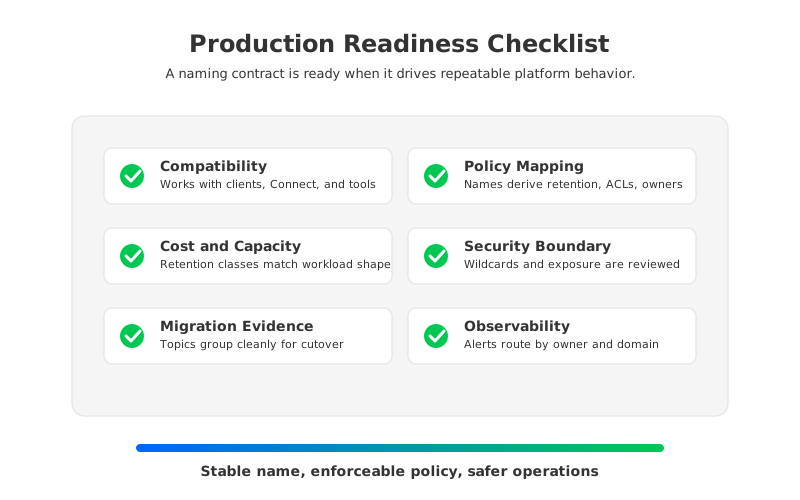
Before standardizing a topic naming contract, evaluate it against the systems that will consume it. A contract that works only in human review is not strong enough for a large estate. A contract that works only in automation may be too rigid for application teams. The practical test is whether the same name can drive policy, operations, and migration evidence without unreadable segments.
Use these checks before making the naming rule mandatory:
- Compatibility: The scheme should work with standard Kafka clients, Admin APIs, Kafka Connect, stream processors, and monitoring tools. Avoid characters or segment rules that are convenient in a portal but awkward in client code or shell-based operations.
- Policy mapping: Each required segment should map to a real policy decision. If
domain,data_class, orpurposedoes not change ACLs, retention, observability, or ownership, keep it as metadata rather than forcing it into the name. - Cost and capacity: The contract should distinguish short-lived operational topics from long-retention audit or replay topics. That distinction matters because retention and compaction affect storage, catch-up reads, and recovery planning.
- Security: Names can support access policy, but they are not a complete control plane. Treat broad wildcard ACLs as a design smell when the prefix boundary lacks ownership and data classification.
- Migration readiness: The contract should help teams group topics for replication, exclude internal topics, validate consumer groups, and decide rollback behavior.
- Observability: Metrics, alerts, and dashboards should group by contract fields so that incident response does not depend on manual topic interpretation.
One useful rule is to keep the topic name stable and move volatile context into metadata. Environment, domain, entity, event type, and major schema version are usually stable enough for the name. Owner email, cost center, ticket number, regulatory notes, and exception reason usually belong in a registry or infrastructure code. The name should be readable under pressure. If an SRE cannot parse it during an incident, the contract is too clever.
5How AutoMQ changes the operating model
Once the naming contract is tied to retention, migration, and capacity, the streaming platform architecture starts to matter. A platform team can design a strong contract on traditional Kafka, but broker-local storage means the contract often has to account for physical placement. Long retention topics need storage planning. Topic growth can trigger partition movement. Recovery and rebalancing work can compete with application traffic. The naming policy is logical, but the operating burden is physical.
AutoMQ fits into this discussion as a Kafka-compatible shared-storage architecture, not as a replacement for naming discipline. It keeps Kafka protocol compatibility while replacing Kafka's broker-local log storage with S3Stream, a storage layer that combines WAL storage and object storage. In this model, brokers become stateless, and object storage becomes the primary data repository. That does not make topic governance automatic. It changes the cost of enforcing the governance model.
The important shift is that policy can be less constrained by broker disk ownership. If a domain needs longer retention, the platform can evaluate the data policy and object-storage economics without treating the decision as a local disk expansion project. If a team creates more topics under a valid contract, the platform still needs partition and throughput planning, but capacity is not dominated by moving broker-local log segments. If a migration is required, Kafka compatibility keeps the application contract familiar while shared storage reduces the operational surface behind scaling and rebalancing.
AutoMQ's documentation also describes zero inter-zone traffic patterns based on S3-backed shared storage and zone-aware routing. For topic naming contracts, the practical implication is not "names reduce network cost." They do not. The implication is that a platform can separate logical governance from some of the cloud infrastructure side effects that make governance expensive to operate. A topic can be classified by domain, data class, and retention policy while the storage architecture handles durability through shared cloud storage rather than broker-to-broker replica movement.
This distinction matters for teams building self-service. A platform portal can validate the topic name, create the topic, attach ACLs, set retention, apply labels, and register ownership. With a stateless-broker model behind it, the platform has more room to make those operations routine.
6A readiness scorecard
A naming contract is ready for a large Kafka estate when it survives both normal growth and uncomfortable operations. Developers should be able to request topics, security teams should understand exposure, SREs should route incidents, and migration teams should build batches without reverse-engineering every prefix.
Start with one domain and run the contract through real workflows. Create a business event topic, a compacted state topic, a connector sink topic, a dead-letter topic, and an experiment topic. For each one, ask whether the name leads to the correct retention, ACLs, owner, observability labels, and deletion rules. Then simulate a migration. If the team cannot tell which topics move together, which internal topics stay behind, and which consumer groups need validation, the contract is not finished.
Good contracts are boring in daily use and valuable during stress. They do not try to encode every policy in the topic name, and they do not leave policy scattered across human memory. They make the name a stable entry point into a broader operating model. That is the difference between a naming convention and a production contract.
If you are reviewing topic governance while also rethinking the Kafka operating model, AutoMQ's shared-storage architecture overview is a useful next step: read the AutoMQ architecture documentation. Use it to compare how broker-local storage and shared storage change the cost of retention, scaling, and migration decisions behind your naming rules.
7References
- Apache Kafka topic configuration documentation
- Apache Kafka documentation
- AutoMQ architecture overview
- AutoMQ compatibility with Apache Kafka
- AutoMQ S3Stream shared streaming storage overview
- AutoMQ migration overview
- AutoMQ eliminate inter-zone traffic overview
- Amazon S3 FAQs
8FAQ
8.1What is a Kafka topic naming contract?
A Kafka topic naming contract is a rule set that connects topic names to operational policy. It defines which name segments are required, what each segment means, how names map to retention and access control, and how exceptions are approved. A convention says how names should look. A contract says what the platform will do because a topic has that name.
8.2Should environment be part of the topic name?
It depends on the cluster model. If each environment has separate clusters and separate bootstrap endpoints, putting prod or dev in every topic name may be redundant. If multiple environments share infrastructure, an environment segment can help with ACLs, observability, and deletion safety. The decision should follow the isolation model, not personal preference.
8.3How strict should topic naming rules be?
Strict enough that automation can trust them, but not so strict that teams invent workarounds. Required segments should map to real platform behavior. Optional context should live in metadata or infrastructure code. If a rule does not change ownership, access, retention, observability, or migration handling, it probably does not belong in the required topic name.
8.4Can topic names replace a data catalog?
No. Topic names are useful entry points, but they cannot carry full schema history, owner contacts, regulatory notes, lineage, cost attribution, and exception records. A mature estate usually combines a stable naming contract with a registry, catalog, Terraform module, or platform API that stores richer metadata.
8.5Does a shared-storage Kafka architecture remove the need for naming governance?
No. Shared storage changes the operating model behind retention, scaling, and broker recovery. It does not decide which team owns a stream or which data class deserves a stricter ACL. The practical benefit is that governance decisions can be less constrained by broker-local disk movement and capacity planning.


