
Table of Contents
Table of Contents
Teams usually search for kafka topic type strategy after their Kafka estate has outgrown a single operating pattern. The first few topics were probably created for applications that looked similar: one producer, one consumer group, a retention value, and a replication factor copied from a runbook. A few years later the same cluster may carry payment events, audit logs, CDC feeds, ML features, observability streams, lakehouse ingestion, and replay-heavy analytics. They all use Kafka topics, but they do not behave like the same product.
That difference is where topic type strategy starts. Kafka itself gives you topics, partitions, offsets, consumer groups, transactions, compaction, retention, and configurations. It does not give every organization a ready-made taxonomy for deciding which topics deserve strict latency, which should optimize for retention cost, which need governance controls, and which should be moved to a different storage model. Platform teams have to build that taxonomy themselves, then map it to infrastructure choices that will survive production.
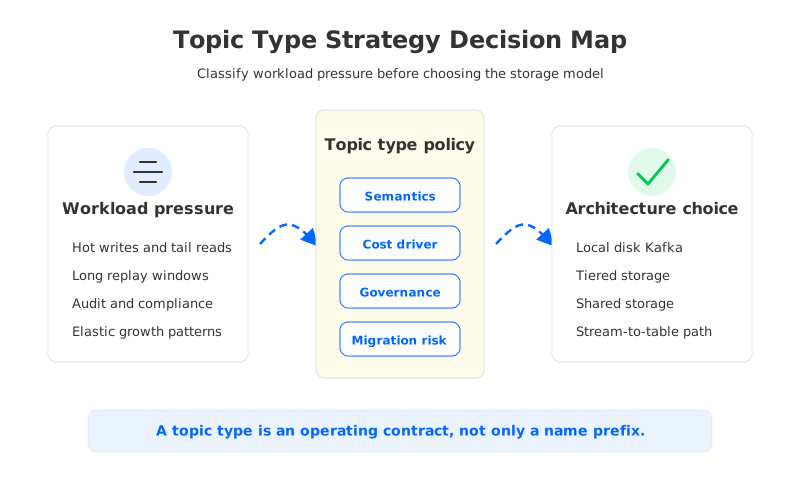
The mistake is treating topic type as a naming convention. A prefix such as audit. or cdc. can help humans, but it does not change broker storage pressure, cross-zone traffic, failure recovery, or migration risk. A real topic type defines an operating contract: who owns the data, how long it lives, what latency it needs, how consumers recover, how cost is charged back, and how the topic moves if the platform architecture changes.
1Why Teams Search for kafka topic type strategy
Kafka estates become hard to govern because topics accumulate faster than platform policy. Application teams create topics for local needs, data teams discover them later as shared assets, and SREs inherit the operational consequences. By the time the platform team introduces a formal review process, some topics are already business-critical and others are expensive historical buffers nobody wants to delete.
The pressure usually appears in four places. First, capacity planning stops being a broker-level exercise because different topic classes have different retention, throughput, and replay patterns. Second, cost allocation becomes political because high-retention or high-fanout topics consume shared infrastructure budget. Third, incident response gets slower because not every lag spike or reassignment event has the same business impact. Fourth, migration planning becomes fragile because a topic that looks ordinary in Kafka may carry hidden contracts with Connect jobs, stream processors, schema registries, dashboards, and compliance workflows.
A useful topic type strategy answers questions that a generic topic naming standard cannot answer:
- What is the topic's primary job: online application integration, durable audit trail, analytical replay, CDC distribution, operational telemetry, or stream-to-table materialization?
- Which Kafka semantics are required: ordering scope, compaction, transactions, idempotent producers, consumer group behavior, offset retention, and replay guarantees?
- What infrastructure property dominates cost: hot write throughput, retained bytes, fanout reads, partition count, cross-AZ traffic, or recovery movement?
- Which team owns the lifecycle: application, platform, data engineering, security, or a shared domain team?
- What is the migration posture: movable with a standard mirroring plan, movable only with offset preservation, or pinned until a specific application is changed?
These questions turn topic type into a governance tool. The goal is not to create bureaucracy around every topic. The goal is to make the expensive topics visible before they force the same infrastructure choice onto every workload.
2The Storage Constraint Behind Cloud Kafka
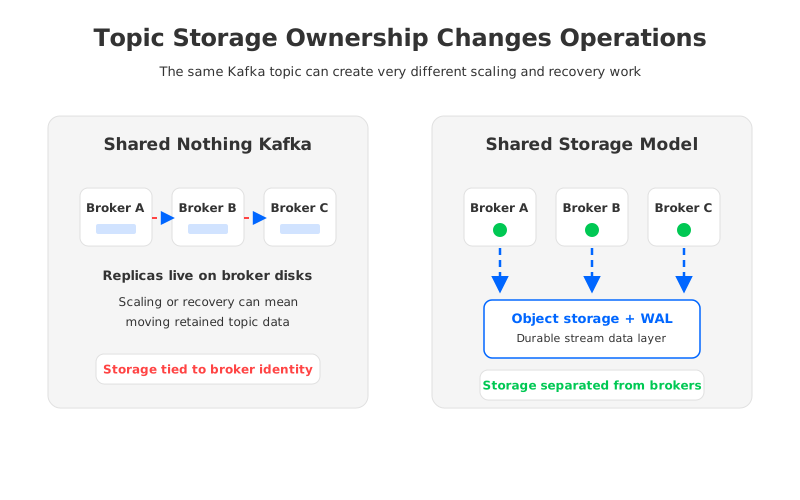
Traditional Kafka follows a shared-nothing model. Brokers own local log replicas, leaders serve writes and reads, followers replicate data, and partition reassignment moves bytes between broker disks. This model is robust and familiar, and it explains why Kafka became the default event streaming backbone for many teams. It also means the topic's operating behavior is coupled to broker-local storage.
That coupling matters more in cloud environments. A topic with high write throughput creates broker replication traffic. A topic with long retention consumes local or attached storage unless tiered storage moves older segments away. A topic with frequent replay creates cache and remote-read pressure. A topic with strict recovery objectives can turn broker replacement or partition movement into a data movement problem. The cloud bill does not care that all of these are "Kafka topics"; it charges for compute, storage, object operations, and network paths separately.
Tiered storage improves one part of the equation. Apache Kafka's tiered storage architecture separates local and remote log tiers so completed segments can live in remote storage while brokers keep local data for active operations. That can be the right answer when long retention is the dominant pressure. It does not automatically make brokers stateless, because active segments, leadership, local reads, and recovery behavior still need careful design.
Shared-storage and diskless Kafka-compatible architectures go further by moving durable stream data away from broker-local disks. That shift changes what a topic type can mean. Instead of asking only how many partitions and how much retention a topic needs, platform teams can ask whether the topic should be placed on an operating model optimized for elastic compute, object-storage durability, reduced broker data movement, or local-disk familiarity.
3Architecture Options: Local Disk, Tiered Storage, and Shared Storage
The right topic type strategy usually supports more than one infrastructure pattern. A platform that treats every workload as a low-latency online topic may overspend on retention. A platform that treats every workload as archival may disappoint product teams that depend on tail latency. The useful distinction is not a generational label. It is the match between workload pressure and storage ownership.
| Architecture option | Best-fit topic types | Main buyer check |
|---|---|---|
| Local-disk Kafka | Stable, latency-sensitive topics with predictable capacity and mature operations | Can the team tolerate broker-local data movement during scaling and recovery? |
| Kafka tiered storage | High-retention topics where older segments are rarely read but must remain replayable | Does the active segment path still meet latency and recovery objectives? |
| Shared-storage Kafka-compatible architecture | Elastic, high-retention, replay-heavy, or cost-sensitive topic classes where broker-local ownership is the constraint | Does the implementation preserve Kafka semantics while changing the storage model? |
| Stream-to-table or lakehouse integration | Topics consumed mainly for analytics, lake ingestion, and downstream table access | Should the topic remain only a stream, or should it also materialize into governed table storage? |
This table should not be read as a maturity ladder. Local-disk Kafka is still appropriate for many production systems. Tiered storage is a practical answer for retention-heavy estates. Shared storage becomes compelling when the painful part of Kafka operations is not only storing old bytes, but keeping those bytes attached to specific brokers while the workload, cluster, or team boundary changes.
The topic type decision should include failure behavior. An audit topic may tolerate slightly higher replay latency but needs strong durability and retention governance. A payment authorization topic may need tighter tail latency and transactional semantics. A CDC topic may be more sensitive to ordering, schema evolution, and consumer catch-up. A telemetry topic may need low-cost ingestion and predictable backpressure more than perfect long-term replay. The same broker-level defaults cannot express those differences well.
4Evaluation Checklist for Platform Teams
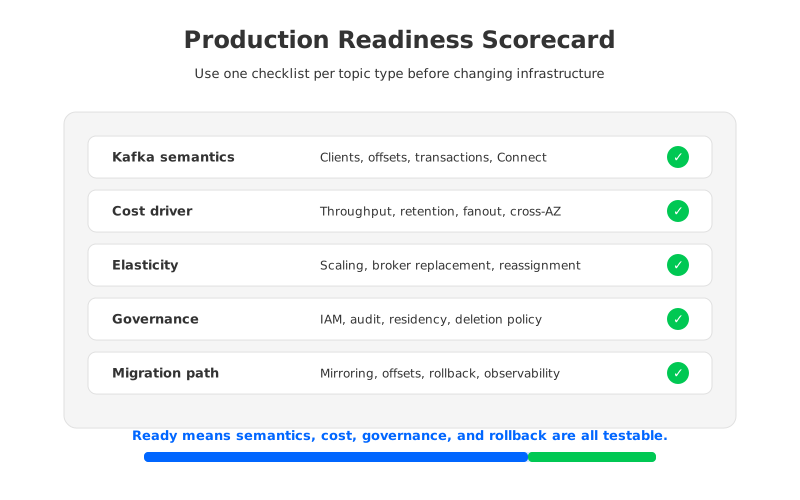
Topic type strategy becomes useful when it changes review behavior. Instead of approving topics by name and retention alone, platform teams can ask each workload to declare its operating contract. The contract does not need to be long, but it should be explicit enough that infrastructure placement, quota policy, observability, and migration planning follow from it.
| Review area | What to classify | Why it matters |
|---|---|---|
| Semantics | Ordering scope, compaction, transactions, idempotence, offset behavior, and consumer group expectations | Application compatibility depends on Kafka behavior, not only endpoint availability |
| Cost driver | Write throughput, retained bytes, fanout reads, partition count, object storage requests, and cross-zone traffic | Different topic types stress different parts of the cloud bill |
| Elasticity | Expected growth, burst profile, partition movement, broker replacement, and seasonal capacity change | Elastic topics punish architectures that require large broker-to-broker data movement |
| Governance | Data classification, encryption, IAM, audit logging, data residency, and deletion policy | Security and compliance requirements often decide where data can live |
| Recovery | RPO, RTO, replay window, consumer catch-up pattern, and rollback path | Recovery plans differ between online topics, audit logs, and analytical replay topics |
| Integration | Kafka Connect, MirrorMaker, stream processors, schema registry, lakehouse sinks, and dashboards | Hidden consumers can make a topic harder to move than its configuration suggests |
The checklist also helps with quotas. A quota strategy based only on producer throughput can miss a topic whose main cost is replay fanout. A retention policy based only on days can miss compacted topics whose logical state is small but operational importance is high. A migration plan based only on topic count can miss the few topics whose offsets, transactions, or Connect dependencies make them high risk.
The most useful artifact is a small decision matrix maintained by the platform team. Each topic type should have default retention, partition review rules, quota posture, observability signals, owner expectations, and approved infrastructure patterns. Exceptions are allowed, but they should be visible. A strategy nobody can override becomes shelfware; a strategy nobody has to explain becomes chaos with labels.
5How AutoMQ Changes the Operating Model
After the neutral evaluation is complete, AutoMQ is relevant as a Kafka-compatible shared-storage architecture for topic classes where broker-local data ownership is the operational constraint. AutoMQ keeps Kafka protocol compatibility while replacing Kafka's broker-local persistent log storage with S3Stream, WAL storage, and S3-compatible object storage. Brokers remain responsible for Kafka-facing compute and coordination, but durable stream data is no longer permanently tied to individual broker disks.
This matters for topic type strategy because it gives platform teams a different placement option. A replay-heavy analytical topic, a high-retention audit topic, or a cost-sensitive telemetry topic may not need the same broker-local storage model as a latency-critical transaction topic. With shared storage, the platform can reason about compute scaling, storage durability, and retained data growth as separate concerns. The goal is not to make every topic identical; it is to stop one storage model from dictating the cost and recovery posture of every topic class.
AutoMQ's architecture also changes the FinOps discussion around cross-AZ traffic in supported deployment patterns. Traditional Kafka replication often creates broker-to-broker traffic across zones when replicas are spread for availability. AutoMQ's shared-storage design can avoid server-side replica traffic between brokers and use object storage as the durable layer, which gives teams another lever when high-throughput topics make networking costs visible.
There is still no shortcut around validation. Kafka compatibility must be tested with the clients, transactions, consumer groups, connectors, and monitoring tools your estate uses. WAL behavior, object storage performance, cache behavior, and failover should be exercised under realistic traffic. The shared-storage model changes the operating surface, but production trust still comes from measured behavior under your workload.
6Migration and Governance Playbook
The safest adoption path is to classify before migrating. Start with the topics that are painful enough to justify architectural change and narrow enough to test cleanly. Good candidates are high-retention topics that drive storage cost, replay-heavy topics that trigger broker pressure, telemetry topics with bursty ingest, and topic classes where cross-zone traffic is a recurring FinOps issue.
The migration plan should preserve application contracts rather than only copy bytes. Producers, consumers, ACLs, quotas, schemas, offsets, Connect jobs, stream processors, and dashboards all need a cutover plan. For some topic types, dual-write or mirroring is enough. For others, offset preservation and rollback evidence are mandatory. A topic type strategy makes this visible because the migration posture is part of the type definition.
Governance should follow the same logic. Regulated topics need stronger access control, auditability, deletion policy, and data residency review. Analytical topics need lineage and downstream ownership. Operational topics need SLOs and alert routing that distinguish platform saturation from consumer misuse. None of these requirements are unique to shared storage, but shared storage can reduce the operational noise caused by broker-local data movement so teams can focus on the actual workload contract.
If your current Kafka estate is starting to look like one cluster serving several different products, the next step is not another global default. Build the topic taxonomy, pick one painful topic class, and test whether a Kafka-compatible shared-storage model changes the cost and recovery profile without changing application semantics. The AutoMQ Cloud Console is a practical starting point for that validation.
7References
- Apache Kafka documentation: https://kafka.apache.org/documentation/
- Apache Kafka consumer documentation: https://kafka.apache.org/documentation/#consumerapi
- Apache Kafka message delivery semantics: https://kafka.apache.org/documentation/#semantics
- Apache Kafka operations documentation: https://kafka.apache.org/documentation/#operations
- Apache Kafka tiered storage documentation: https://kafka.apache.org/41/operations/tiered-storage/
- Apache Kafka KIP-405: Kafka Tiered Storage: https://cwiki.apache.org/confluence/display/KAFKA/KIP-405%3A+Kafka+Tiered+Storage
- Apache Kafka KIP-1150: Diskless Topics: https://cwiki.apache.org/confluence/display/KAFKA/KIP-1150%3A+Diskless+Topics
- AutoMQ architecture overview: https://docs.automq.com/automq/architecture/overview?utm_source=blog&utm_medium=reference&utm_campaign=aivk-0005
- AutoMQ native Kafka compatibility: https://docs.automq.com/automq/architecture/technical-advantage/native-compatible-with-apache-kafka?utm_source=blog&utm_medium=reference&utm_campaign=aivk-0005
- AutoMQ cross-AZ traffic cost guidance: https://docs.automq.com/automq-cloud/best-practice/save-cross-az-traffic-costs-with-automq?utm_source=blog&utm_medium=reference&utm_campaign=aivk-0005
8FAQ
8.1Is there an official Kafka setting called topic type?
No. In this context, topic type is a platform taxonomy, not a single Kafka configuration. It groups topics by operating contract: semantics, cost driver, retention, ownership, recovery, governance, and migration posture.
8.2How is topic type strategy different from a naming convention?
A naming convention helps humans scan topics, but it does not define infrastructure behavior. A topic type strategy should influence defaults, quotas, observability, storage architecture, migration planning, and ownership.
8.3Should every Kafka estate use shared storage?
No. Local-disk Kafka and tiered storage remain valid choices for many workloads. Shared storage is most relevant when broker-local data ownership creates cost, scaling, recovery, or cross-AZ traffic problems.
8.4Where do compacted topics fit?
Compacted topics should be classified by their business role and recovery expectations, not only by cleanup policy. A compacted configuration topic, a CDC state topic, and a materialized-view changelog can have very different ownership and migration requirements.
8.5When should AutoMQ be evaluated?
Evaluate AutoMQ when Kafka compatibility is required but the topic class is constrained by broker-local storage, elastic scaling, retained data growth, or cross-AZ traffic. The proof of concept should use real producers, consumers, offsets, failure drills, and rollback criteria.


