
Table of Contents
Table of Contents
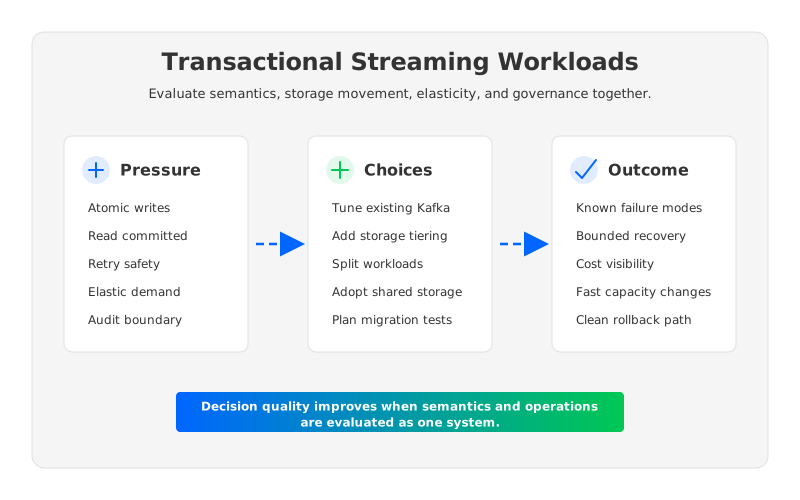
Teams usually search for transactional streaming workloads after Kafka has become part of a sensitive path. The cluster is no longer moving append-only logs that tolerate duplicate downstream work. It is coordinating payment events, inventory reservations, ledger updates, fulfillment state, model feature freshness, or fraud decisions where retries and replays have business meaning.
Kafka can support strong producer and read-process-write semantics, but that does not make every Kafka deployment ready for transactional workloads. The hard part is the architecture around those semantics: broker recovery, partition movement, replication traffic, storage growth, governance boundaries, and migration safety. A transactional workload turns those operational details into correctness risks because the platform is now part of the transaction boundary.
That is why the architecture question matters. The right evaluation is not "Does Kafka have transactions?" It is "Can this Kafka-compatible platform preserve transactional behavior while scaling, recovering, and changing capacity?"
1Why transactional streaming workloads matter now
The phrase "transactional streaming" can mean different things in different organizations. For an application team, it may mean exactly-once processing for a consume-transform-produce pipeline. For a platform team, it may mean predictable failure handling when a producer retries after a timeout. For a data engineering team, it may mean that downstream consumers should not read records from an aborted transaction. Those are related requirements, but they land on different parts of the system.
Kafka's producer configuration exposes two important building blocks. Idempotent production helps avoid duplicate records from producer retries, while transactions use a transactional.id to coordinate writes across sessions and allow applications to commit or abort a unit of work. Consumers that need transactional visibility must use read_committed isolation so they skip aborted transactional records. These mechanics are well documented in Apache Kafka, and they are the foundation of reliable transactional streaming.
The operational trap is assuming those mechanics are enough. A transactional workload also needs the surrounding cluster to behave predictably when brokers fail, when partitions move, when traffic spikes, and when a consumer group is behind. If a capacity change triggers heavy partition reassignment, the workload can experience elevated latency or a longer recovery window at exactly the moment the platform team is trying to regain control.
For architects, the design goal is not a slogan like "exactly once everywhere." It is a bounded failure model:
- A producer retry should not create a second committed business event for the same unit of work.
- A consumer should not act on records from a transaction that later aborts.
- A broker failure should have a clear recovery path without relying on hidden local state.
- A capacity event should not turn into a long data movement project.
- A migration should preserve offsets, compatibility expectations, and rollback options.
Those points decide whether the workload can become a shared platform primitive instead of a one-off exception.
2The production constraints behind the search
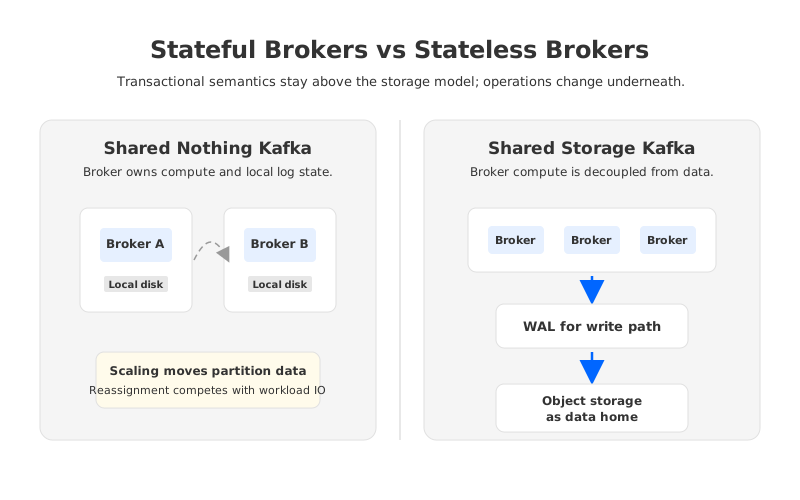
Traditional Kafka uses a shared-nothing storage model. Each broker owns local log segments for the partitions assigned to it, and Kafka uses replication across brokers to provide availability. That design is robust and historically sensible: a distributed log built on attached disks needs software-level replication to survive machine failure. The model also gives Kafka its familiar partition-level ordering and parallelism.
The same model becomes operationally heavy in elastic cloud environments. When partitions are reassigned, primary data moves between brokers. When a broker is decommissioned, local log ownership has to be drained or replicated elsewhere. When storage fills faster than expected, adding brokers increases capacity only after data movement catches up. Transactional workloads do not create these constraints, but they make the blast radius harder to ignore.
The cost model also changes in the cloud. Kafka replication is application-level data movement, and cloud data transfer between availability zones may be billed separately depending on the provider, service path, and region. Object storage changes a different part of the equation: services such as Amazon S3 are designed for very high durability and elastic capacity, but they do not behave like local disks. A streaming platform has to bridge that gap deliberately.
Transactional workloads expose five production constraints that should be evaluated together:
| Constraint | What to ask | Why it matters |
|---|---|---|
| Semantics | Are idempotence, transactions, and consumer isolation configured correctly? | The workload depends on application-visible correctness, not only broker uptime. |
| Failure recovery | What happens to in-flight transactions during producer, broker, or network failure? | Recovery behavior must be boring enough to test repeatedly. |
| Data movement | Does scaling require copying large volumes of partition data? | Reassignment can compete with transactional write and read paths. |
| Cost | Which bytes are replicated, stored, fetched, and moved across zones? | Transactional topics often carry high-value data with long retention or strict audit needs. |
| Governance | Who controls deployment, encryption, network boundaries, and retention? | Regulated workloads often care as much about control plane boundaries as APIs. |
The table is intentionally vendor-neutral because the first decision is architectural. If the workload is low volume and the team already has mature Kafka operations, tuning the current cluster may be enough. If retention is the cost driver but hot data stays manageable, tiered storage may be part of the answer. If the pain comes from elasticity, local disk ownership, and cross-zone replication traffic, the architecture conversation becomes more fundamental.
3Architecture patterns teams usually compare
Most platform teams compare three patterns before changing their streaming architecture.
The first pattern is optimized shared-nothing Kafka. This keeps the familiar broker-local storage model and improves operational hygiene: right-sizing partitions, tuning producer settings, enforcing acks=all where needed, using idempotent producers, validating transaction timeouts, monitoring transaction coordinator health, and keeping reassignment procedures disciplined. This path has low migration risk when the current cluster is already stable.
The second pattern is Kafka with remote historical storage. Tiered storage can reduce pressure from long retention by offloading older log segments to object storage while keeping the active log on broker-attached storage. It is useful when the hot set is predictable and the main economic problem is retention. It does not remove broker-local primary storage from the operating model, so teams still plan around partition movement, hot broker disks, and active log capacity.
The third pattern is shared-storage Kafka-compatible architecture. In this model, brokers are primarily compute nodes, while the durable data home is a shared storage layer, commonly backed by object storage and accelerated by a write-ahead log. This changes the operational shape of scaling and failover because partition data is no longer tied to a single broker's local disk. The design challenge is preserving Kafka protocol and semantic compatibility while moving the storage responsibility underneath the broker.
None of these patterns is universally correct. The wrong answer is choosing based on a single promise such as "lower storage cost" or "faster scaling." Transactional workloads are system-level workloads; they need a system-level evaluation.
4Evaluation checklist for platform teams
A practical evaluation starts with the application's transaction boundary. Some workloads only need idempotent writes to a single topic because downstream processing can deduplicate by key. Others need a read-process-write loop where consumed offsets and produced records succeed or fail together. Some need low-latency writes, while others need predictable replay and audit retention. Naming the boundary prevents the platform team from overengineering one workload and underprotecting another.
The next step is to test failure modes instead of trusting configuration names. Kill a producer after beginTransaction() but before commit. Force a broker restart during a write-heavy window. Run consumers in read_committed mode and verify that aborted records do not leak into downstream effects. Increase partition count or move leadership while measuring p99 latency, transaction aborts, consumer lag, and controller pressure. The point is to discover whether the architecture keeps failure narrow.
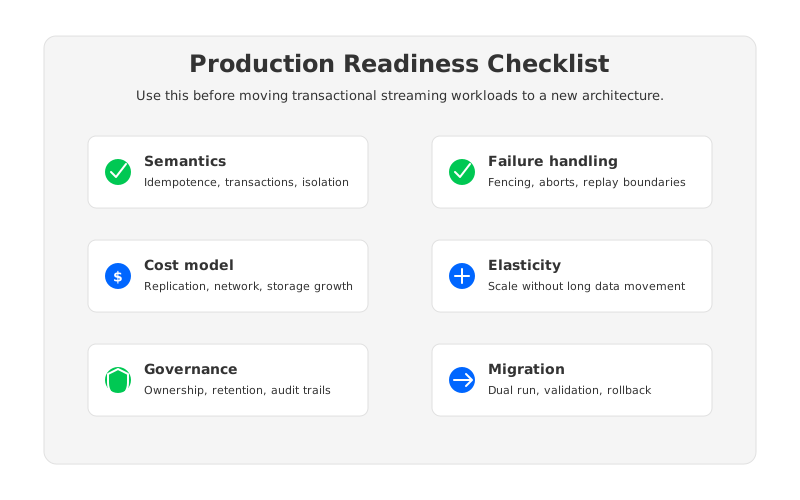
Use this checklist before approving a platform architecture for transactional streaming:
- Semantic contract: The team can state where idempotence is sufficient and where full Kafka transactions are required. Producer
transactional.idassignment, timeout values, and consumerisolation.levelare reviewed as part of application design. - Recovery contract: The platform has tested abort, retry, fencing, and broker recovery paths. Alerting distinguishes application transaction failures from storage or coordinator symptoms.
- Elasticity contract: The platform can add, remove, or replace broker capacity without turning the event into an extended partition-data movement operation.
- Cost contract: Storage, replication, reads, and inter-zone traffic are visible in the cost model. The team avoids quoting one number for Kafka cost when several independent meters are involved.
- Governance contract: Data location, encryption, network access, IAM, audit retention, and control plane ownership match the workload's regulatory and organizational requirements.
- Migration contract: The team can dual-run, compare offsets and record counts, validate consumer behavior, and roll back without asking application owners to rewrite clients.
This checklist is stricter than a normal Kafka readiness review. Transactional streaming workloads often become a shared dependency for revenue, compliance, or machine-learning freshness. A platform that is merely functional on a quiet day will eventually force application teams to compensate for infrastructure uncertainty in their own code.
5Where AutoMQ changes the operating model
After the neutral evaluation, AutoMQ becomes relevant as an example of the shared-storage pattern. It is a Kafka-compatible streaming platform that preserves the Kafka protocol surface while replacing Kafka's broker-local log storage with a shared storage architecture. In AutoMQ, brokers are designed to be stateless, and data is stored through S3Stream with object storage as the durable data home and a WAL layer for write acceleration and recovery.
The important point is not that "shared storage" is automatically better. The important point is that it changes which operations are expensive. In shared-nothing Kafka, broker capacity and data ownership are coupled. Scaling and reassignment involve moving partition data because the broker is both compute and storage owner. In a shared-storage architecture, broker compute can change without the same local-disk drain model, so operations such as reassignment, self-balancing, and replacement can be designed around metadata and shared data access rather than bulk local copy.
That operating model is especially relevant for transactional workloads for three reasons. First, elasticity becomes less likely to interfere with the workload's hot path through extended data movement. Second, failure recovery can be reasoned about around a shared durable data layer rather than opaque broker-local state. Third, cost analysis can separate compute, WAL, object storage, and network paths more explicitly, which is useful when high-value transactional topics have both strict semantics and meaningful retention.
There are still trade-offs. Object storage has different latency and IOPS characteristics from local disks, so the WAL design matters. Deployment boundaries matter too: many enterprises want Kafka-compatible behavior but also want cloud-account, VPC, IAM, and data-location control. AutoMQ's BYOC and self-managed deployment options are designed for those constraints, but the right architecture still depends on workload latency, cloud provider, recovery objective, and operational maturity.
For teams already deep in Kafka, the most useful way to evaluate AutoMQ is not as an application rewrite. Treat it as a storage and operations model evaluation under the Kafka compatibility umbrella. Keep the client behavior constant, then test the parts that usually hurt: scale-out, broker replacement, partition balancing, retained-data cost, and read-committed consumer behavior under failure.
6Decision table for architecture selection
The decision becomes clearer when the team maps workload pressure to the operating model instead of debating product categories.
| Situation | Likely first move | What to verify |
|---|---|---|
| Low-volume transactional producer with stable retention | Optimize current Kafka | Idempotence, transactional.id, timeout, monitoring, and failover tests. |
| Long retention dominates storage cost | Evaluate tiered storage or shared storage | Hot set size, cold read behavior, retention policy, and restore expectations. |
| Frequent scaling, broker replacement, or hot-spot rebalancing | Evaluate shared-storage Kafka-compatible architecture | Reassignment time, traffic balancing, failover behavior, and client compatibility. |
| Regulated workload with strict data-control requirements | Compare deployment boundaries first | VPC, IAM, encryption, audit retention, and control plane ownership. |
| Migration risk is the blocker | Run a compatibility and rollback proof | Dual write or mirror plan, offset validation, consumer isolation, and rollback criteria. |
Transactional streaming workloads reward boring engineering. The best architecture has failure modes that can be explained, tested, and repeated. If your current Kafka platform already gives you that, optimize it. If the bottleneck is broker compute coupled to local storage, cloud-native shared storage deserves evaluation.
For a deeper look at the shared-storage approach, start with the AutoMQ architecture documentation and test it against your own transactional workload shape rather than a synthetic benchmark alone.
7References
- Apache Kafka producer configuration:
transactional.idand idempotence - Apache Kafka KIP-98: Exactly Once Delivery and Transactional Messaging
- Apache Kafka design documentation: replication and committed messages
- AWS global network FAQ: data transfer between Availability Zones
- Amazon S3 FAQ: durability design
- AutoMQ architecture overview: shared storage and stateless brokers
- AutoMQ WAL storage documentation
- AutoMQ compatibility with Apache Kafka
8FAQ
8.1Are Kafka transactions the same as database transactions?
No. Kafka transactions coordinate writes to Kafka topics and can include consumed offsets in a read-process-write flow, but they do not automatically make an external database, cache, search index, or third-party API part of the same atomic transaction. If the workload updates Kafka and another system, the application still needs an explicit pattern such as an outbox, idempotent sink, compensating action, or external transaction coordinator.
8.2Is idempotence enough for transactional streaming workloads?
Sometimes. Idempotent production is useful when the main risk is duplicate writes caused by producer retries. Full Kafka transactions are needed when multiple writes, partitions, topics, or consumed offsets must commit or abort together. The distinction matters because transactions add coordination and operational concerns that should be tested under failure.
8.3Why does broker-local storage matter if the API semantics are the same?
API semantics describe what clients can expect from Kafka. Broker-local storage describes how the platform operates when capacity, failure, and retention change. Transactional workloads care about both because operational disruption can surface as latency spikes, aborts, lag, or delayed recovery even when the client API remains compatible.
8.4Does cloud-native Kafka remove the need to test transactional failure modes?
No. A cloud-native architecture can reduce certain operational burdens, especially around data movement and elasticity, but it does not remove the need to test producer fencing, aborts, read-committed consumers, broker restarts, network faults, and migration rollback. Transactional workloads should be accepted only after those tests are repeatable.
8.5When should a team evaluate AutoMQ for transactional streaming?
Evaluate AutoMQ when the workload needs Kafka compatibility but the current operating model is constrained by broker-local disks, slow reassignment, storage growth, cross-zone traffic exposure, or difficult capacity changes. The strongest evaluation keeps application clients unchanged and measures operational behavior under the same transactional workload profile.


