
Table of Contents
Table of Contents
A transactional workload is the part of a Kafka estate that punishes vague migration plans. The application may use idempotent producers, transactions, compacted topics, tightly managed consumer offsets, or sink systems that cannot tolerate duplicate side effects. The stream may look like ordinary event traffic from a cluster dashboard, but the business contract behind it is stricter: records must arrive in a predictable order, commits must mean something, and rollback cannot invent a second version of the truth.
That is why transactional workload checks kafka is not a generic checklist query. The person searching it is usually close to a platform decision: move to another Kafka-compatible service, consolidate clusters, change deployment boundaries, or adopt a cloud-native architecture. The risk is not only whether the target platform can run Kafka clients. The risk is whether the migration preserves the workload's correctness envelope while the infrastructure underneath is changing.
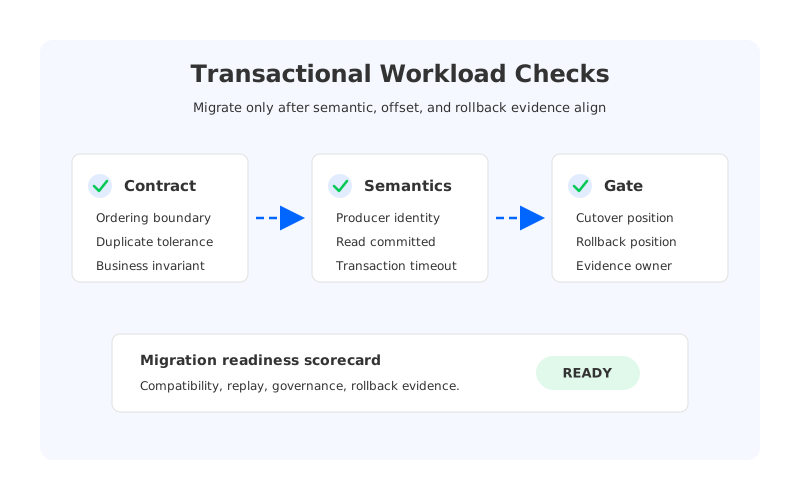
The useful starting question is not "Can we migrate this topic?" It is "What must be true before moving this workload is less risky than leaving it where it is?" Once framed that way, transactional readiness becomes a set of checks across semantics, offsets, broker behavior, cost, governance, and rollback state.
1Why Transactional Workloads Need Separate Migration Checks
Transactional workloads carry assumptions that are often invisible in ordinary Kafka inventories. A topic name, retention policy, replication factor, and throughput profile do not tell you whether a producer uses transactions, whether a consumer commits offsets only after a database write succeeds, or whether an upstream service treats message keys as a financial ordering boundary. Those details decide whether a migration is reversible or whether it can corrupt business state.
Kafka's transaction model is designed to help applications coordinate writes to multiple partitions and commit offsets as part of a transaction. That gives teams useful building blocks, but it does not remove the need to inspect application behavior. Exactly-once style processing is a contract between producers, brokers, consumers, state stores, and sinks. If a migration changes the timing, identity, or replay boundary of any of those pieces, the contract has to be revalidated.
The workloads that deserve a separate review usually share at least one of these traits:
- The workload controls money movement, entitlement changes, inventory allocation, order state, billing, fraud decisions, or a similar irreversible business process.
- Producers use idempotence or transactions, or consumers rely on
read_committedbehavior to avoid seeing aborted writes. - Consumer offset commits are tied to sink writes, database transactions, state store updates, or external API calls.
- Message keys, partition assignment, or compaction semantics encode business ordering rather than platform convenience.
- Rollback requires a known data position, not a broad instruction to "replay from earlier."
Those checks are not bureaucracy. They separate workloads that can tolerate migration noise from workloads where a duplicate record becomes a customer-visible incident.
2The Production Constraint Behind the Problem
Traditional Kafka architecture couples broker compute, local durable storage, replication, and partition placement. That model can be operated well, but it makes migration planning heavier because platform changes often affect data movement. If the migration needs temporary dual running, extra replication, partition reassignment, or expanded retention, the team may need spare broker disk, network headroom, and operational time at the same moment it is trying to prove application correctness.
Transactional workloads amplify this constraint because they extend the meaning of "healthy." A cluster can show normal broker metrics while a transaction coordinator, producer identity, sink idempotency rule, or offset boundary is misaligned. The migration plan therefore has to cover both platform readiness and semantic readiness. Treating those as one generic go-live checklist hides the most important failure modes.
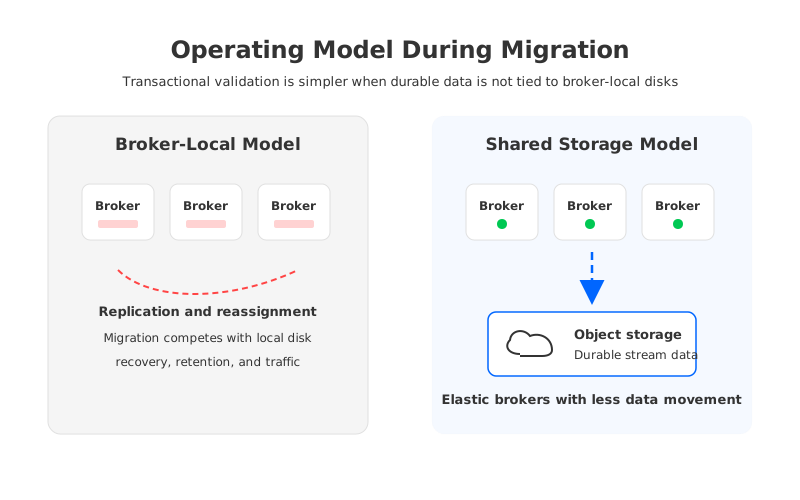
Cloud cost sits inside that operational constraint. Parallel validation paths can increase consumer reads, cross-zone traffic, storage retention, and broker recovery work. Teams sometimes shorten validation because the temporary state is noisy or expensive, but transactional workloads are exactly the workloads that need patient validation. A good migration architecture gives the team enough elasticity to validate semantics without turning capacity anxiety into a forcing function.
3Build the Transactional Contract Inventory
The first readiness artifact should be a contract inventory, not a cluster inventory. A cluster inventory tells you where topics live. A contract inventory tells you what must remain true after migration. For transactional workloads, that contract has to cover producer behavior, broker semantics, consumer isolation, offset ownership, sink idempotency, and rollback state.
Start with producer behavior. Record whether producers use idempotence, transactions, custom partitioners, explicit keys, or multiple-topic writes that must be observed together. Then inspect consumer behavior. A consumer group that commits offsets after writing to a database has a different recovery boundary from a consumer group that commits before the side effect. The migration plan must preserve the boundary the application actually uses, not the one the platform team wishes it used.
The inventory should also capture platform objects that influence correctness. ACLs, service accounts, topic configuration, compaction, retention, schema compatibility, advertised addresses, client timeouts, retry settings, and transaction timeouts all matter. Some are controlled by platform engineering; some are owned by application teams. The cutover is ready only when the ownership map is as clear as the topic map.
| Contract area | What to inspect | Migration risk if ignored |
|---|---|---|
| Producer identity | Transactional IDs, idempotence, retries, partitioning | Duplicate writes, fencing surprises, or changed ordering. |
| Consumer state | Isolation level, offset commit timing, group identity | Consumers may observe aborted data or resume from unsafe positions. |
| Topic semantics | Keys, compaction, retention, partition count, schemas | Replays can change ordering, overwrite behavior, or validation results. |
| Sink effects | Database writes, external APIs, idempotency keys | Rollback can duplicate side effects even when Kafka state looks clean. |
| Governance | ACLs, secrets, audit logs, network boundaries | A technically valid path may fail security or compliance review. |
This table focuses on contracts rather than features. A platform migration is safe when the target path preserves the workload's business invariants, not when a long list of components has been recreated.
4Offset and Replay Checks Are the Real Cutover Gate
Offsets are often treated as an operational detail, but for transactional workloads they are part of the correctness model. The team needs to know which offsets represent processed records, which offsets represent committed external side effects, and which offsets can be replayed without changing business state. Without that mapping, a rollback plan is a hope dressed as a command.
The replay check should answer three questions. What is the earliest offset or source position from which replay remains safe? What external systems would see repeated writes if replay starts from that point? What evidence proves that the target path has reached the same business state as the source path? These questions force platform and application owners to talk about the same boundary.
The hardest cases are not always high-throughput workloads. A low-throughput payment adjustment stream can be more dangerous than a large observability pipeline because each record has stronger meaning. For that reason, readiness scoring should weigh semantic risk separately from volume. Throughput tells you how hard the migration is to operate; transaction and replay semantics tell you how dangerous it is to get wrong.
Use a holdback window after cutover. Keep source data, old consumer positions, and target validation evidence long enough to support rollback with a known position. The length of the window depends on business tolerance, retention, sink behavior, and incident detection time. The key is that the rollback boundary has to be named before the migration starts.
5Architecture Options and Trade-offs
Transactional migration planning often starts with client compatibility because nobody wants to rewrite applications during a platform move. Compatibility is necessary, but it is not enough. The target platform also has to support predictable broker behavior, durable recovery, clear network boundaries, and capacity elasticity while the team runs validation traffic.
A useful evaluation framework looks at the platform through the workload's failure modes:
| Evaluation area | Question to ask | Why it matters for transactional workloads |
|---|---|---|
| Kafka protocol compatibility | Do existing producers, consumers, and admin tools keep their expected behavior? | Transactional applications should not discover semantic gaps during cutover. |
| Transaction handling | Are producer IDs, transaction timeouts, and committed-read behavior validated under failover? | The risky path is often failure during migration, not steady-state traffic. |
| Storage model | Is durable data tied to broker-local disks or backed by shared storage? | Storage placement affects replay windows, recovery work, and scaling pressure. |
| Elasticity | Can temporary validation traffic run without heavy partition movement? | Dual-running should not require a disruptive capacity project. |
| Governance boundary | Are identity, audit, network access, and deployment ownership clear? | Transactional systems often sit inside stricter compliance boundaries. |
| Rollback support | Can the old and target paths be held with known offsets and evidence? | Rollback has to preserve business state, not only restart processes. |
The framework pushes teams away from vendor slogans and toward testable behavior. Evaluate the platform by what happens when a broker fails during validation, a consumer restarts from a known position, a sink rejects a duplicate write, and a security reviewer asks where data and control actions live.
6How AutoMQ Changes the Operating Model
AutoMQ belongs in this decision after the workload contract is visible. It is a Kafka-compatible streaming system that separates compute from storage and uses shared object storage as the durable data layer. The practical effect is that brokers can be treated more like elastic compute, while durable stream data is no longer bound to a particular broker's local disks.
That operating model matters for transactional migration checks because it reduces the amount of incidental broker-local state the migration team has to manage. The transaction contract still has to be validated at the application level. AutoMQ does not remove the need to inspect producer IDs, consumer offsets, sink idempotency, or rollback evidence. What it can change is the surrounding infrastructure work: capacity can be planned more independently from retention, broker recovery is less tied to local data movement, and temporary validation traffic can be evaluated without the same storage-placement burden.
This is especially relevant for teams moving Kafka-compatible workloads into cloud environments. In broker-local architectures, replication and recovery patterns can create cross-zone traffic and manual data movement during the exact window when the team wants low operational noise. AutoMQ's shared-storage architecture and stateless broker approach are designed for cloud elasticity, customer-controlled deployments, and lower operational coupling between compute and durable stream data.
For a first evaluation, choose one transactional workload family rather than the largest cluster. Reproduce the actual producer configuration, consumer isolation level, topic settings, ACLs, schema behavior, and sink write model. Then test steady-state processing, broker failure, consumer restart, cutover, holdback, and rollback. The target outcome is not a perfect demo. It is a clear answer to whether the platform preserves the workload contract with less operational friction.
7Production Readiness Checklist
The final readiness check should be strict because transactional incidents tend to appear after the platform dashboard has already turned green. A successful migration window is not defined by process uptime alone. It is defined by preserved business state, known replay boundaries, and evidence that both application and platform owners accept.
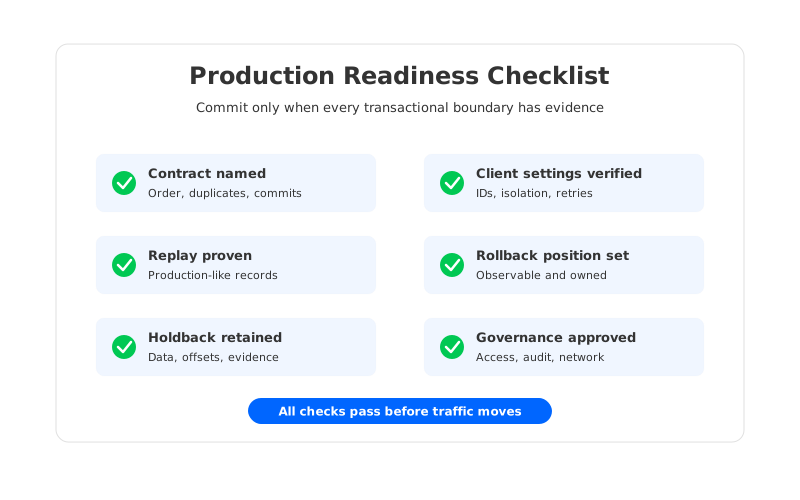
Use this checklist as a final gate before committing a transactional workload migration:
- Name the transactional contract in plain language. The team should be able to explain what "correct" means for the workload, including order, duplication, commit, and rollback expectations.
- Validate producer and consumer settings against the target platform. Include transactional IDs, idempotence, isolation level, retries, timeouts, partitioning, and offset ownership.
- Prove replay behavior with production-like data. Do not rely on synthetic records that avoid the ordering, compaction, or sink conflicts that make the workload risky.
- Define the cutover position and rollback position before the window. Both positions should be observable and owned by named teams.
- Keep a holdback window for source data, offsets, logs, and validation evidence. The team needs enough time to detect semantic defects after traffic moves.
- Review cloud cost and governance as part of readiness. If validation traffic is too expensive or security ownership is unclear, the migration plan will be pressured at the wrong moment.
The checklist is deliberately short. If a team cannot complete these items, more operational detail will not solve the underlying problem. If the team can complete them, every runbook command points back to a known contract.
Start with one representative workload and test the real producer, consumer, topic, ACL, schema, and sink configuration. Compare steady-state processing, broker failure behavior, cutover mechanics, rollback evidence, traffic, and operational effort. If shared storage and stateless broker operation fit, discuss the deployment model with AutoMQ through the contact page.
8References
- Apache Kafka documentation: message delivery semantics and transactions
- Apache Kafka documentation: producer configuration
- Apache Kafka documentation: consumer configuration
- Apache Kafka documentation: replicated log design
- Apache Kafka documentation: KRaft
- AutoMQ documentation: architecture and technical advantages
- AWS documentation: Amazon S3 user guide
- AWS documentation: AWS PrivateLink
9FAQ
9.1What is a transactional workload check in Kafka?
A transactional workload check reviews the application and platform assumptions that preserve correctness during migration. It covers producer identity, idempotence, transaction behavior, consumer isolation, offset commits, topic semantics, sink side effects, and rollback positions. The goal is to prove that moving the workload will preserve the business contract, not only that clients can connect to the target cluster.
9.2Is Kafka compatibility enough for transactional migration?
Kafka compatibility is necessary because most teams cannot afford application rewrites during platform migration. It is not sufficient by itself because transactional behavior depends on configuration, failure handling, offset ownership, and external side effects. The migration should validate the exact workload contract under restart, failover, replay, and rollback conditions.
9.3When should AutoMQ be evaluated for this kind of workload?
AutoMQ is worth evaluating when a team wants Kafka-compatible behavior but wants to reduce the operational coupling between brokers and durable storage. Its shared-storage architecture is most relevant when migration planning is constrained by broker-local capacity, recovery work, cloud networking, or elastic validation traffic. The application-level transactional contract still needs its own tests.
9.4What is the safest first migration candidate?
The safest first candidate is usually a transactional workload family with clear owners, strong observability, known replay behavior, and a sink that supports idempotent recovery. It does not have to be the smallest workload, but it should have a contract the team can explain and test.
9.5How should teams start an AutoMQ evaluation?
Start with a representative workload, real client settings, production-like data, and rollback evidence. Prove the transactional contract before arguing for platform-wide migration.


