
Table of Contents
Table of Contents
Teams comparing Ursa vs Confluent are usually past the stage of asking whether event streaming matters. The harder question is whether a Kafka-compatible platform should optimize for ecosystem maturity, cloud-native storage economics, managed-service depth, data control, or an exit path from incumbent Kafka infrastructure. A contract can be renegotiated in a quarter; a protocol migration and operational model can shape platform decisions for years.
Confluent and StreamNative Ursa both speak to Kafka buyers, yet they come from different histories. Confluent Cloud is built around Apache Kafka and the Confluent ecosystem: managed Kafka clusters, connectors, Schema Registry, governance, networking, and stream processing. StreamNative positions Ursa as a lakehouse-native streaming engine for Kafka and Pulsar, with cluster profiles that trade latency and cost through different write-ahead log and metadata configurations. Both can be reasonable choices. The danger is treating "Kafka-compatible" as a single checkbox.
1Quick Comparison
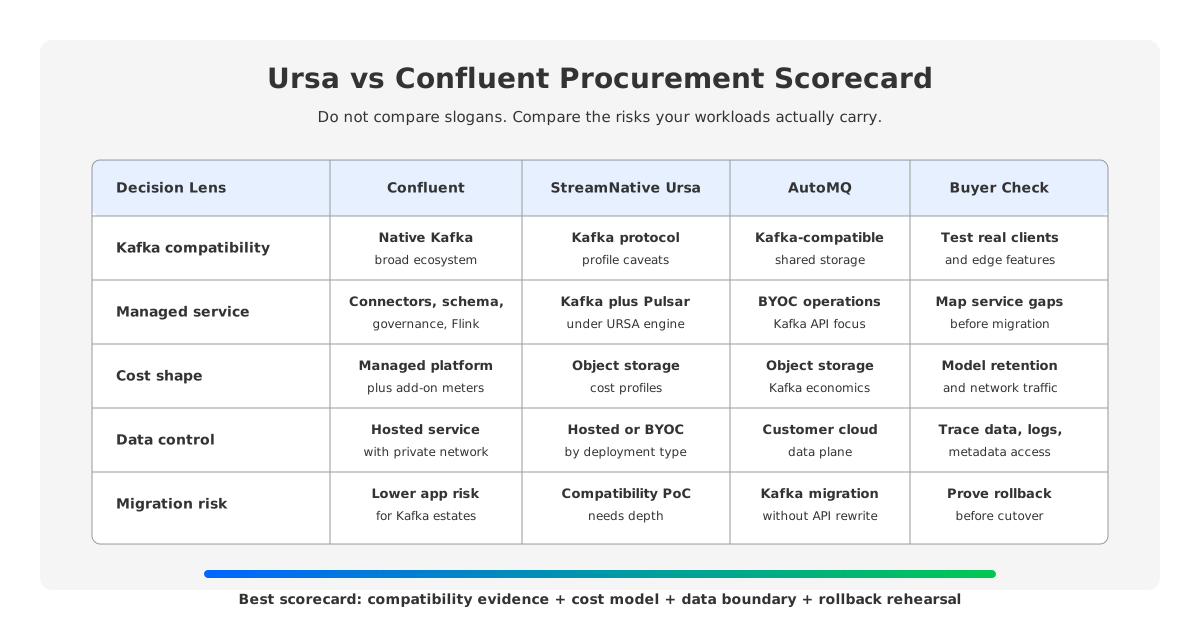
The shortest honest answer is this: Confluent is the safer default when your primary risk is ecosystem coverage and managed-service maturity. Ursa deserves attention when your primary pressure is cloud storage cost, multi-protocol strategy, and lakehouse-oriented streaming architecture. The decision changes again if your organization wants the Kafka API but does not want a fully hosted SaaS data plane. That is where Kafka-compatible BYOC platforms such as AutoMQ enter the evaluation.
| Evaluation dimension | Confluent | StreamNative Ursa | What to verify before buying |
|---|---|---|---|
| Kafka compatibility | Native Kafka ecosystem, broad managed Kafka surface | Kafka protocol support on StreamNative Cloud; Ursa docs note profile-level feature differences | Transactions, topic compaction, Kafka Streams, ksqlDB, client versions, ACL behavior |
| Managed service depth | Mature cloud service with managed connectors, Schema Registry, governance, networking, and Flink | Managed Kafka and Pulsar services on the URSA engine, with hosted and BYOC options | Which features are generally available for the exact cluster profile |
| Storage architecture | Confluent Cloud uses its cloud-native Kafka engine and service abstraction | URSA includes object-storage-backed cost-optimized profiles and latency-optimized profiles | Latency envelope, durability model, replication traffic, retention cost |
| Ecosystem fit | Strong fit for Kafka-heavy teams already using Confluent tooling | Stronger fit for teams considering Kafka plus Pulsar or lakehouse-native streaming | Tooling gaps, connector coverage, operational skills |
| Data control | Cloud-hosted managed model with private networking options and enterprise security features | Fully hosted and BYOC deployment choices depending on product and profile | Where data, metadata, logs, and support access live |
| Exit path | Low application migration risk for existing Kafka users, but platform dependency can deepen | Kafka-compatible path may reduce code change, but feature caveats need testing | Rollback plan, data export, connector portability, contract lock-in |
The table is not a winner-takes-all ranking. A retailer running hundreds of Kafka Connect pipelines has a different risk profile from a data platform team designing lakehouse ingestion from scratch. Start with workload facts, not vendor adjectives.
2Compatibility: Protocol Is Not the Whole Contract
Kafka compatibility starts with the wire protocol, but production compatibility reaches far beyond producing and consuming records. A real Kafka estate includes client libraries, transactions, compacted topics, consumer group behavior, Connect offsets, Schema Registry formats, stream processing frameworks, security policies, metrics, and incident runbooks. Every one of those can become a migration checkpoint.
Confluent has the advantage of being centered on Kafka from the beginning. For teams already using Kafka APIs and Confluent components, the platform feels familiar because the surrounding services are designed for the same operational model. Managed connectors, Schema Registry, stream governance, private networking, and Flink are part of the same commercial surface. That breadth matters when procurement is trying to reduce integration risk.
Ursa's compatibility story is more nuanced. StreamNative's public Ursa material describes an engine built for both Kafka and Pulsar, and StreamNative Cloud documentation says its Kafka service is designed for Kafka client applications. StreamNative's Kafka compatibility page, however, notes that Ursa-powered clusters have limitations around transactions and topic compaction, and that Kafka Streams and ksqlDB support can depend on those features.
That nuance is not a criticism; it is the engineering detail buyers should care about. A platform can be Kafka-compatible for common produce and consume paths while still requiring validation for transactional semantics, compacted topics, or Kafka Streams state. If your estate uses those features, test failure modes, not just the demo path.
Use this compatibility test list before any shortlist decision:
- Run actual producer and consumer clients, not a sample app. Include retries, batching, TLS, authentication, authorization, and error handling.
- Test special topic behavior. Compaction, retention, large messages, and transactions often reveal the real boundary.
- Move one connector pipeline end to end. The connector may work while its offset, schema, or operational behavior changes.
- Rehearse rollback. A migration path that cannot reverse safely is not a migration path; it is a cutover bet.
3Managed Service and Ecosystem Depth
Confluent's strongest procurement argument is the platform around Kafka. Buyers are not paying only for brokers; they are paying for a managed operating model around streaming. In Confluent Cloud, that includes managed Kafka clusters, fully managed connectors, Schema Registry and stream governance, networking options, stream processing with Flink, support paths, and a large ecosystem of Kafka-trained engineers.
That ecosystem can justify a higher unit price when the alternative is stitching together service boundaries by hand. The more your organization depends on data governance, connector catalog coverage, cross-team self-service, and enterprise support, the more Confluent's platform breadth becomes part of the cost equation. Procurement teams sometimes evaluate streaming platforms like storage products, but the operational savings often live in integration, governance, and incident response.
Ursa's strongest argument is different. It asks whether the storage and protocol foundation of streaming should be redesigned around object storage and lakehouse integration. StreamNative's Ursa pages describe zero-copy streaming into lakehouse storage and cost-optimized profiles that use object storage. That matters for teams that see Kafka not as a standalone bus, but as part of a data lakehouse ingestion and serving architecture.
The tradeoff is maturity surface. A platform can have an elegant engine and still require careful checks around feature availability, connector operations, support maturity, and team familiarity. If you already run Pulsar or want a Kafka and Pulsar strategy under one vendor, Ursa may align well. If your platform team is almost entirely Kafka and Confluent trained, changing operational muscle memory has a cost.
4Pricing and Cost: Compare the Shape, Not the Slogan
Cost comparisons between Ursa and Confluent get noisy because each platform exposes different meters, profiles, and operational assumptions. Confluent pricing depends on selected cloud service, cluster type, networking, storage, data transfer, connectors, stream processing, governance, and support choices. StreamNative's Ursa messaging emphasizes lower cost through object storage, reduced replication traffic, and lakehouse-native storage paths. A buyer who compares one headline claim against another will miss the real bill.
The useful comparison is cost shape:
- Compute: How many broker or service units are needed during peak and idle periods?
- Storage: Is retained data priced like broker-attached storage, object storage, or a managed abstraction?
- Replication and networking: Does the architecture copy data across availability zones at the service layer, or rely more heavily on shared storage?
- Managed add-ons: Connectors, governance, schema, networking, and stream processing can dominate total cost for enterprise deployments.
- Operational labor: A platform with a higher service bill can still be cheaper in practice if it removes enough internal operations work.
Object-storage-backed streaming architectures attack a common cloud mismatch: Kafka's traditional broker-local storage model often couples retention, replication, and compute capacity. Ursa's cost-optimized architecture and AutoMQ's shared-storage Kafka-compatible architecture both try to break that coupling, but they do so with different product contracts and compatibility boundaries.
5Migration and Exit Path
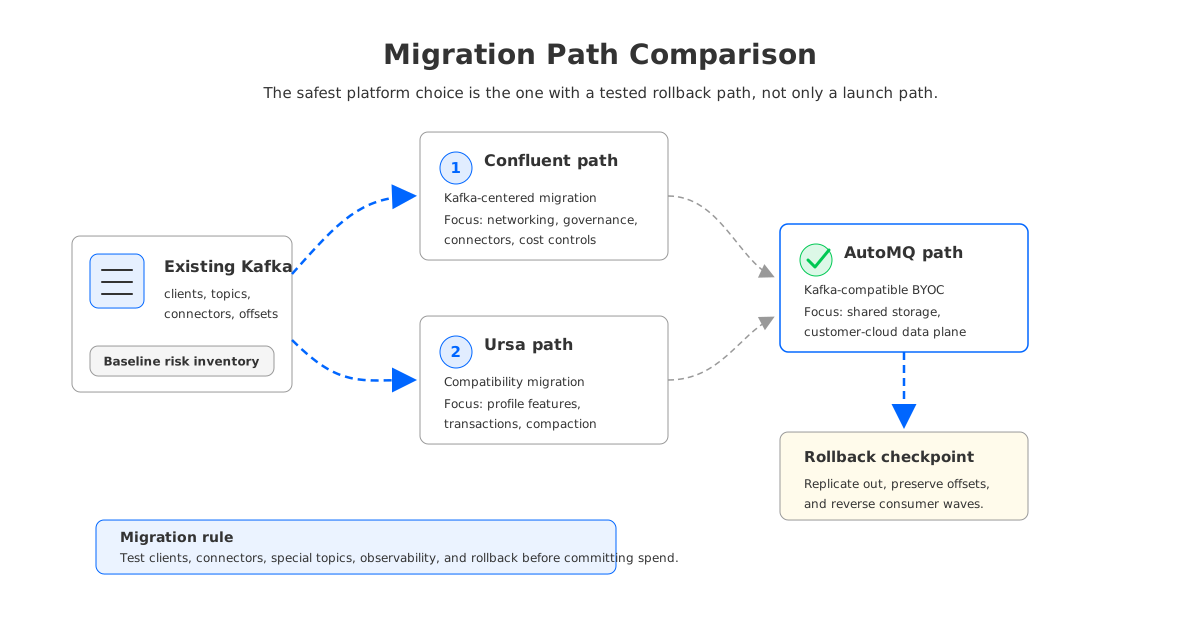
Migration risk is where procurement language becomes engineering reality. Moving from self-managed Kafka or MSK to Confluent can be operationally familiar because the target is still a Kafka-centered platform. The hard parts are usually networking, security, topic configuration, connector migration, consumer cutover, governance mapping, and cost control.
Moving to Ursa can also preserve Kafka client code for many workloads, but teams should treat it as a compatibility migration rather than a pure endpoint change. If the target profile changes transaction, compaction, or stream processing behavior, the migration plan needs deeper test coverage. That does not make Ursa unsuitable; it means the evaluation should be honest about what "Kafka-compatible" covers for your workload.
The exit path matters as much as the entry path. A platform team should ask whether data can be replicated out, consumers can be moved in waves, schemas remain portable, and application teams can return to a standard Kafka endpoint if a feature gap appears.
6Data Ownership and Control Boundaries
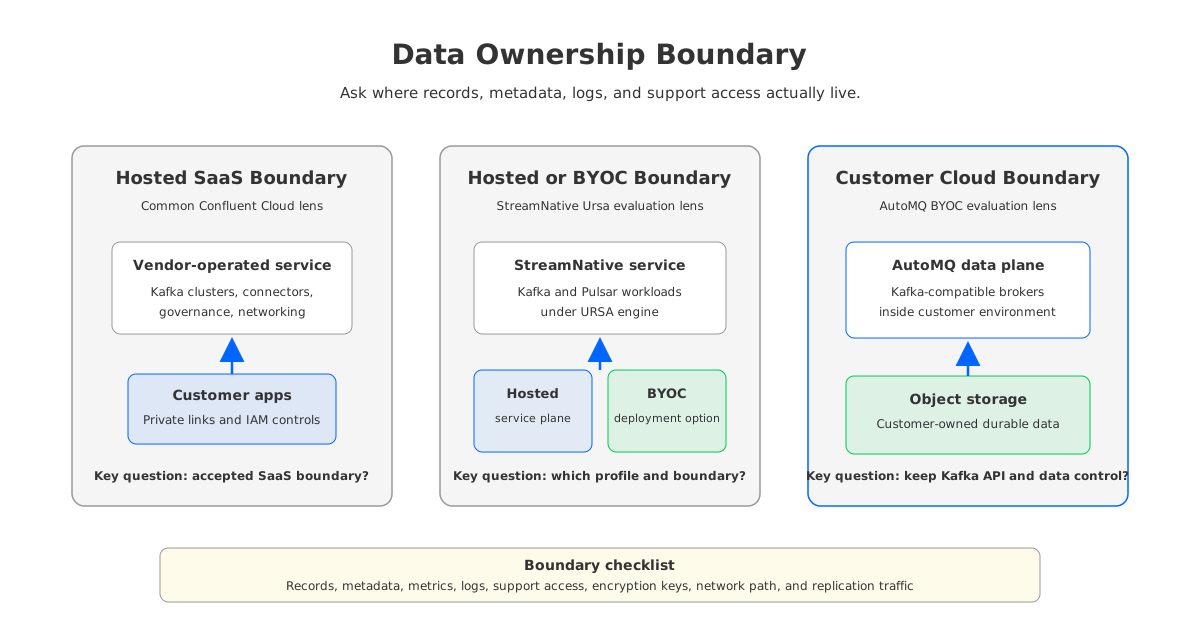
Data control is no longer a niche security question. Regulated industries, AI data pipelines, and platform teams with strict cloud governance need to know where the data plane runs, where metadata lives, what support engineers can access, and how diagnostic data is separated from customer records.
Confluent Cloud is a managed cloud service with documented networking and security controls, including private connectivity options. That model suits teams that want Confluent to operate the platform as a service and are comfortable with the chosen cloud-service boundary. Ursa has hosted and BYOC options in StreamNative Cloud, which can be relevant for buyers that want StreamNative's managed experience while placing more of the deployment in their own cloud account.
AutoMQ sits in this part of the conversation when the buyer wants Kafka compatibility, shared-storage economics, and a BYOC boundary. In AutoMQ BYOC, data plane resources run in the customer's cloud environment, while Kafka-compatible clients continue using Kafka APIs. That is useful when the security team wants customer-cloud ownership and the platform team wants to avoid a Kafka application rewrite.
7Where AutoMQ Fits
AutoMQ is not a direct substitute for every Confluent capability or every Ursa use case. It fits a narrower but important decision pattern: the team wants Kafka compatibility, cloud-native shared storage, elastic scaling, and stronger control over where the data plane runs. That pattern appears when the business problem is not "we need a different streaming API," but "our Kafka estate is too expensive, too hard to scale, or too tied to broker-local disks."
The architectural logic is straightforward. Traditional Kafka stores durable data with brokers, so scaling and reassignment often become data-movement operations. AutoMQ keeps Kafka protocol compatibility while moving durable data into object-storage-backed shared storage and making brokers more stateless. That can reduce pain around storage growth, broker replacement, and partition movement without forcing application teams to leave the Kafka ecosystem.
For a shortlist, treat AutoMQ as a third option:
| If your main requirement is... | Start with this path |
|---|---|
| A broad managed Kafka platform with mature enterprise services | Confluent |
| A Kafka/Pulsar, lakehouse-native, object-storage-oriented streaming strategy | StreamNative Ursa |
| Kafka compatibility plus customer-cloud data-plane control and shared-storage economics | AutoMQ |
Run the same workload through all three lenses: one ordinary produce/consume path, one compacted or transactional workload if you use those features, one connector pipeline, one retention-heavy topic, and one rollback rehearsal.
8Procurement Scorecard
A serious Ursa vs Confluent decision should end with a weighted scorecard, not a debate over brand preference. Weight the categories according to your actual estate. A Kafka-heavy financial services team might give compatibility and data boundary half the score. A digital product team building greenfield lakehouse ingestion might weight cost shape and storage architecture higher.
Use this practical scoring model:
| Category | Suggested weight | Key question |
|---|---|---|
| Kafka compatibility | 25% | Do exact clients, connectors, stream processors, and topic features work without semantic surprises? |
| Managed-service maturity | 20% | Does the platform remove enough operations work to justify its commercial model? |
| Cost shape | 20% | Does the bill scale with actual workload behavior, or with over-provisioned broker capacity? |
| Data control | 15% | Can security and governance teams accept where data, metadata, logs, and support access live? |
| Migration and rollback | 15% | Can we move gradually and reverse safely? |
| Strategic ecosystem fit | 5% | Does the platform align with our Kafka, Pulsar, lakehouse, and cloud roadmap? |
The answer may be Confluent, Ursa, or a Kafka-compatible BYOC architecture such as AutoMQ. What matters is that the decision follows your workload rather than a vendor comparison page.
9FAQ
9.1Is Ursa a Confluent alternative?
Ursa can be evaluated as a Confluent alternative for teams that want a Kafka-compatible managed streaming platform with an object-storage and lakehouse-oriented architecture. It is not a one-for-one replacement for every Confluent Cloud service. Compare the exact Kafka features, connectors, governance requirements, networking model, and support expectations you use.
9.2Is Ursa fully Kafka-compatible?
StreamNative documents Kafka protocol support for StreamNative Cloud and describes Ursa as supporting Kafka workloads, but its Kafka compatibility documentation also lists feature caveats for Ursa-powered clusters, including transactions and topic compaction. Treat compatibility as workload-specific and test your real clients, connectors, and stream processing jobs.
9.3Why choose Confluent over Ursa?
Confluent is often stronger when the buyer values Kafka ecosystem maturity, managed connectors, Schema Registry, stream governance, enterprise networking controls, and a large pool of Kafka operational experience. If these services are central to your platform, they should be part of the cost comparison rather than treated as extras.
9.4Why consider AutoMQ in an Ursa vs Confluent evaluation?
AutoMQ is relevant when the team wants Kafka compatibility and cloud-native shared storage, but also wants the data plane in its own cloud environment. It is most useful when the pain is Kafka's storage and scaling model rather than the Kafka API itself.
9.5What should a proof of concept include?
Include one production-like producer and consumer, one connector pipeline, authentication and authorization, retention-heavy topics, any compacted or transactional workloads, observability dashboards, and a rollback rehearsal. A demo cluster proves connectivity; it does not prove migration safety.
10References
- StreamNative Ursa Engine
- StreamNative Cloud overview
- StreamNative Data Streaming Engine
- StreamNative Kafka compatibility overview
- Confluent Cloud overview
- Confluent Cloud connectors
- Confluent Cloud Stream Governance
- Confluent Cloud networking overview
- AutoMQ architecture overview
- AutoMQ Cloud BYOC overview


