
Table of Contents
Table of Contents
Teams search for streaming vector search pipeline when vector search stops being a prototype and starts carrying product risk. A support assistant retrieves a policy changed after the last batch job. A fraud workflow embeds transaction context too late. A developer search tool returns stale API examples. The index is only as useful as its ingestion path.
Nightly ETL was reasonable when search indexes were refreshed for browsing, reporting, or offline analytics. Vector search changes the tolerance for staleness because retrieval can sit in front of AI agents, recommendation systems, fraud decisions, and customer-facing copilots. Once retrieved context influences an automated answer or action, data freshness becomes part of correctness.
The harder question is not whether Kafka can push records toward a vector database. It can. The harder question is whether the streaming platform can support source events, enrichment, embedding, upsert, deletion, replay, backfill, and governance without turning model or schema changes into operations projects.
1Why streaming vector search pipeline Matters Now
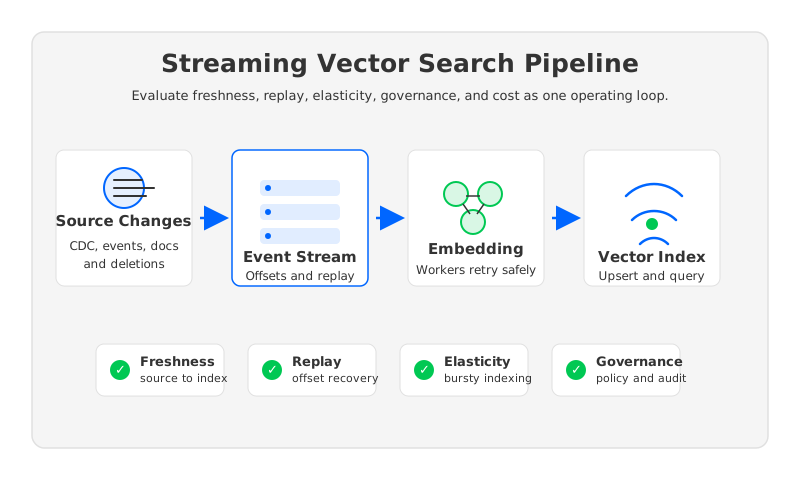
Vector search pipelines have a different shape from traditional search indexing. The source record may be a document, ticket, product event, database row, log entry, or user interaction. Before it becomes searchable, it often needs filtering, chunking, metadata enrichment, embedding generation, and an upsert into a vector index. Each step can lag, retry, or fail independently, which means the pipeline needs a durable coordination layer rather than a loose set of scheduled jobs.
Streaming ingestion gives the pipeline a better contract. Kafka topics can preserve ordering within partitions, track offsets, support consumer groups, and allow controlled replay. Those mechanics matter because vector indexes are not static sinks. Teams re-embed when models change, rebuild metadata when policies change, delete vectors when source records are removed, and replay events when an indexing worker falls behind.
The common mistake is treating the vector database as the center of the architecture. It is important, but it is not the whole system. A production pipeline has four pressure points:
- Freshness pressure from product experiences that need current context. If the retrieval path backs an AI assistant, stale records can become confident generated output.
- Replay pressure from model, chunking, and metadata changes. Re-indexing should be a controlled offset-based operation, not a manual copy from an uncertain source snapshot.
- Governance pressure from sensitive records, retention boundaries, deletion requests, and audit trails. Vector pipelines need to know what was embedded and why.
- Elasticity pressure from bursty workloads. A document import, backfill, or embedding model migration can create ingestion demand that differs sharply from daily traffic.
These constraints make the streaming layer more than a transport mechanism. It becomes the memory of the indexing pipeline: what changed, which version was processed, where downstream workers stopped, and how the system can recover without guessing.
2The Production Constraints Behind Vector Ingestion
The prototype version of vector ingestion is usually clean. A producer publishes source changes, a consumer calls an embedding model, and the result is upserted into a vector database. That design is fine for a demo. Production introduces competing requirements that do not fit neatly into a nightly batch schedule.
Source changes are continuous while embedding capacity may be limited by external APIs, GPU pools, or rate limits. Vector indexes also need idempotent writes because retries are normal. Deletion and correction flows are as important as inserts because stale or unauthorized vectors can be worse than missing vectors.
A useful architecture review should compare platforms across the whole ingestion loop:
| Evaluation area | Why it matters for vector search | Questions to ask |
|---|---|---|
| Freshness | Search quality depends on current source truth. | Can the pipeline measure end-to-end lag from source change to vector upsert? |
| Replay | Embedding models and metadata schemas evolve. | Can teams replay from offsets without rebuilding producer integrations? |
| Idempotency | Embedding and upsert workers retry under normal load. | Are event keys, versions, and tombstones handled consistently? |
| Elasticity | Imports and backfills create bursty indexing demand. | Can brokers and consumers scale without long data movement windows? |
| Governance | Vector data may include regulated or customer records. | Are retention, access, deletion, and audit paths designed into the pipeline? |
| Cost | Long retention plus replay can dominate infrastructure spend. | Does storage scale with retained event history or with broker-local disk? |
This table is intentionally vendor-neutral. A fast index does not compensate for weak replay. A low-latency stream does not compensate for unclear deletion semantics. Vector search forces platform teams to evaluate freshness, correctness, and operability together.
3Why Traditional Kafka Can Amplify the Pressure
Kafka is a proven backbone for event-driven systems, and its client ecosystem makes it a natural fit for vector ingestion. Producers can publish source changes, stream processors can enrich events, and indexing workers can consume at their own pace. Apache Kafka's consumer group and offset model gives teams a precise way to reason about progress, while transactions and idempotent producer support can help in workflows that require stronger processing guarantees.
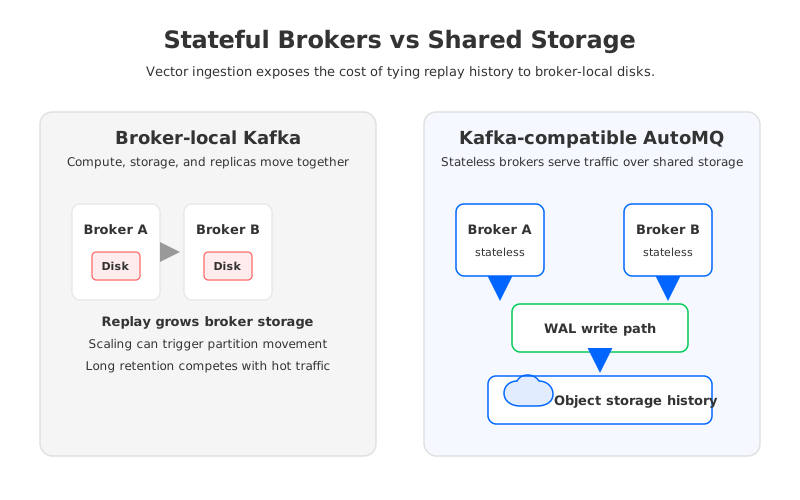
The operational friction appears when the workload grows beyond steady ingestion. Traditional Kafka is built around a shared-nothing architecture: brokers own local log storage, partitions are replicated across brokers, and durability depends on replicas that stay in sync. This model is reliable and familiar, but it couples compute, storage, and data movement. When retention grows for replay, broker disk grows. When brokers are added or removed, partitions may need reassignment. When replicas span availability zones, replication traffic becomes part of the operating model.
For vector search, those trade-offs show up in uncomfortable places. Re-indexing after an embedding model change may require long catch-up reads. A surge of document imports may require temporary broker capacity. A governance policy may ask for longer history on certain topics while other topics stay short-lived. The more the pipeline depends on replay, the more local broker storage becomes a planning constraint.
Tiered storage can reduce part of the retention burden by moving older log segments to object storage. That is useful, especially for long-lived data. It does not fully change the hot-path operating model because active log storage and broker capacity remain tied together. If a platform team wants elastic ingestion for vector workloads, it should ask whether storage is still anchored to individual brokers or whether durable stream data can live in shared storage while brokers focus on serving Kafka protocol traffic.
4Architecture Patterns Teams Usually Compare
Most teams end up comparing three patterns. The first is scheduled ETL into a vector index. It is operationally familiar and often enough for low-risk knowledge bases, but it struggles when freshness, deletion, or replay requirements become strict. The second is Kafka with broker-local storage feeding embedding workers in near real time. This improves freshness and coordination, but it can still carry storage and scaling friction when retention and replay become central. The third is Kafka-compatible streaming on Shared Storage architecture, where the API contract remains Kafka-compatible while the storage model is redesigned for cloud elasticity.
The key is not to chase architectural novelty. The key is to separate decisions that should be independent:
- The application contract should remain stable. Producers, Kafka clients, stream processors, Kafka Connect jobs, and indexing workers should not be rewritten every time the storage layer changes.
- The storage model should support retention and replay without forcing all history onto broker-local disks.
- The compute layer should scale with active traffic and ingestion pressure, not with the full volume of retained data.
- The governance boundary should match the organization's control model, especially when embeddings are derived from sensitive business records.
This is where AutoMQ becomes relevant after the architecture evaluation, rather than at the opening. AutoMQ is a Kafka-compatible cloud-native streaming platform built on Shared Storage architecture. It keeps the Kafka protocol and client ecosystem while moving durable stream storage to object storage and using stateless brokers with a write-ahead log path for low-latency writes.
For vector search pipelines, that design changes the operating model in practical ways. Retained event history can align with object storage economics. Broker scaling can focus on active traffic instead of partition data movement. Replay-heavy workloads, such as re-embedding and index rebuilds, can be treated as planned consumption from durable streams rather than emergency recovery from scattered batch artifacts. AutoMQ's BYOC deployment model also matters for teams that want the streaming platform to run within their own cloud boundary while keeping operational control.
5Evaluation Checklist for Platform Teams
A production vector ingestion platform should be reviewed from the retrieval request backward. Ask what must be true for the search result to reflect the current source truth, the right policy, and the right embedding version. Then map those requirements back to streaming architecture.
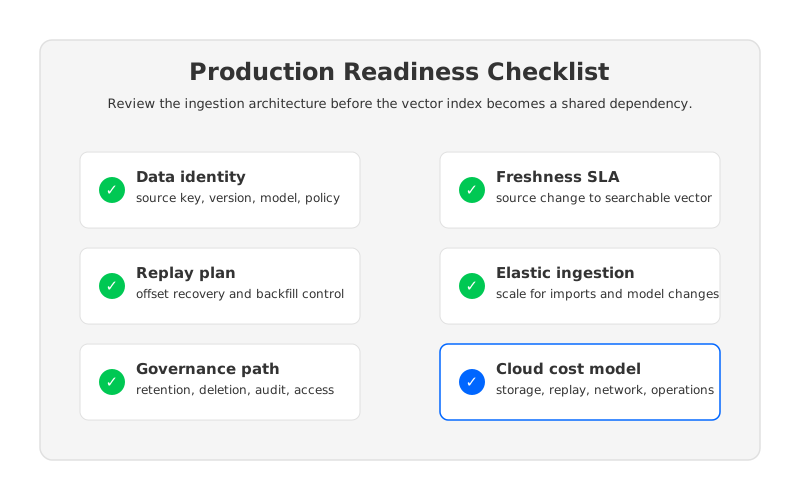
Start with data identity. Every vector should be traceable to a source record, version, transformation policy, and embedding model. Without that identity, replay becomes guesswork and deletion becomes risky. Kafka topics can provide the event log, but the application still needs stable keys, tombstone handling, and metadata that survives downstream processing.
Next, test the lag path under load. Consumer lag alone is not enough because embedding workers and vector index upserts can create their own queues. A better metric follows the record from source change to searchable vector. If that path has multiple services, each service should publish progress signals that SREs can correlate with offsets and index status.
Replay deserves a separate review. The team should know where it would start if an embedding model changed, how it would throttle re-indexing, and how live ingestion would be protected while history catches up. In broker-local architectures, replay and retention often collide with disk planning. In shared-storage designs, the question shifts toward read throughput, cache behavior, and object storage lifecycle policy.
Governance is the last place to defer design. Vector search can blur the boundary between raw data and derived data because embeddings are not raw text, yet they can still encode sensitive meaning. Production pipelines need deletion flows, access boundaries, retention policy, and auditability before the index becomes a shared dependency across teams.
6Where AutoMQ Changes the Operating Model
AutoMQ should not be evaluated as a vector database replacement. It is the Kafka-compatible streaming layer that feeds and governs vector ingestion. That distinction matters because many AI platform problems are not solved inside the index. They are solved by making the data change stream durable, replayable, elastic, and compatible with existing Kafka-based systems.
In an AutoMQ-based design, source systems publish changes to Kafka-compatible topics. Stream processors or consumers enrich records, call embedding services, and write vectors to the chosen index. The difference is below the application contract: durable stream storage is placed on shared object storage, brokers are designed to be stateless, and the write path uses WAL mechanisms documented by AutoMQ. The application still reasons in topics, partitions, offsets, and consumer groups, while the infrastructure team gains a storage model built for cloud elasticity.
That is useful because the hardest workloads are rarely steady-state writes. They are replays, backfills, model migrations, and launches that reshape the ingestion curve. If broker scaling requires heavy data movement, the platform team may delay AI work. If scaling compute is decoupled from durable storage, the platform can respond with less operational drag.
The decision is not automatic. Some teams can keep scheduled ETL if their vector index supports low-risk content and the business accepts batch freshness. Others can run traditional Kafka effectively when retention is short, traffic is predictable, and operations are mature. AutoMQ becomes more compelling when the pipeline needs Kafka compatibility, long replay windows, elastic broker capacity, cloud object storage economics, and a deployment boundary that keeps data in the customer's cloud account.
7Decision Table
Use this decision table before turning a vector ingestion prototype into a platform standard:
| If your pipeline looks like this | Architecture direction |
|---|---|
| Static knowledge base, low update rate, acceptable batch freshness | Scheduled ETL may be enough. Keep deletion and source versioning explicit. |
| Continuous source changes, moderate replay, existing Kafka operations | Kafka-based streaming ingestion is a strong fit. Validate retention and re-indexing cost early. |
| Bursty imports, frequent re-embedding, long replay windows, cloud cost pressure | Evaluate Kafka-compatible Shared Storage architecture such as AutoMQ. |
| Sensitive records, BYOC requirements, strict audit paths | Prioritize deployment boundary, access control, retention policy, and deletion workflows. |
Vector search quality is not only an index-ranking problem. It is an ingestion architecture problem. The teams that get this right treat streaming as the system of record for change, not as a pipe between batch jobs. When the pipeline needs Kafka compatibility plus cloud-native elasticity, evaluating AutoMQ is a practical next step: review the AutoMQ architecture documentation or start from the AutoMQ product overview.
8References
- Apache Kafka documentation
- Apache Kafka consumer design
- Apache Kafka transactions
- AutoMQ Shared Storage architecture
- AutoMQ WAL storage documentation
- AutoMQ zero inter-zone traffic overview
- AWS S3 storage classes
- Pinecone data ingestion overview
9FAQ
9.1Is Kafka required for a streaming vector search pipeline?
No. A vector search pipeline can use other queues or streaming systems. Kafka is common because many enterprises already use Kafka-compatible clients, topics, offsets, and consumer groups for durable event streams. The value is strongest when the pipeline needs replay, multiple consumers, existing integration patterns, and operational visibility.
9.2When is nightly ETL still acceptable?
Nightly ETL can work when the indexed content changes slowly, stale retrieval has limited user impact, and deletion or correction requirements are simple. It becomes risky when vector search supports AI agents, customer-facing answers, fraud workflows, operational recommendations, or regulated data.
9.3Does AutoMQ replace the vector database?
No. AutoMQ sits upstream as the Kafka-compatible streaming platform. The vector database still handles vector storage and nearest-neighbor retrieval. AutoMQ helps with the ingestion side: durable change streams, replay, elastic broker capacity, and cloud-native storage architecture.
9.4What should SREs monitor in a streaming vector search pipeline?
Monitor source-to-index lag, Kafka consumer lag, embedding worker queue depth, vector upsert success rate, retry volume, deletion processing, and replay throughput. The most useful freshness metric follows a record from source change to searchable vector, not a single queue in isolation.


