
Table of Contents
Table of Contents
Search and recommendation teams are discovering that vector databases do not remove the need for a streaming backbone. They make the backbone more important. Every product click, inventory change, content moderation decision, profile update, embedding refresh, and feature-store correction can change what a user should see next. If those updates arrive late, arrive twice, or cannot be replayed after a model rollback, the vector index may be fast while the product experience is stale.
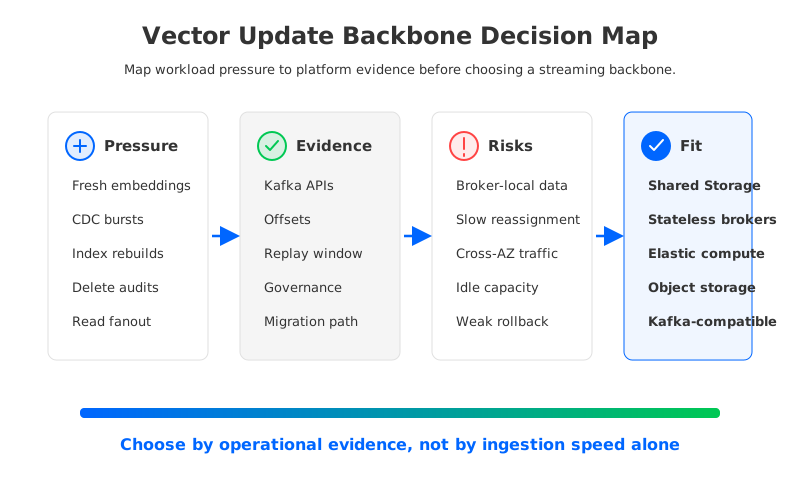
That is the real intent behind the search query vector update backbone kafka. Teams are not asking whether Kafka can move bytes. They are asking whether a Kafka-compatible streaming layer can become the durable, governable, replayable update plane between operational systems, embedding pipelines, vector stores, search services, recommendation models, and analytics tables. The answer depends less on the word "vector" than on the operational properties around it: ordering, offsets, retention, elastic capacity, cost, lineage, and recovery.
1Why teams search for vector update backbone kafka
A vector update pipeline usually starts as a straightforward data movement problem. A product catalog emits changes, a CDC connector captures rows, a feature pipeline computes fresh signals, an embedding service writes vectors, and a search or recommendation system consumes the update. The first version can be built with a queue, scheduled batch jobs, or direct writes into a vector database. That works until the team needs to answer harder production questions.
The uncomfortable questions arrive with scale. What happens when an embedding model is replaced and a subset of vectors must be replayed? How does the team prove that a delete event reached every downstream index? Can the serving team pause consumption during an incident without losing updates? Can a recommendation model consume the same event stream as search without duplicating ingestion logic? Can an SRE bound the blast radius when a connector floods the platform with retries?
Kafka became a default answer for these questions because its abstractions match the shape of the problem. Topics provide durable event logs, partitions provide ordered lanes of change, offsets give consumers independent progress, and consumer groups let multiple serving systems process the same stream at their own pace. Kafka Connect, transactions, and mature client support also matter because vector updates rarely come from one clean source. They come from databases, applications, logs, CDC streams, feature stores, and offline correction jobs.
The catch is that vector update workloads stress the platform in ways that ordinary event streaming can hide. They combine bursty writes, read fanout, retention for replay, governance expectations, and frequent changes in downstream consumers. A backbone that looks healthy at average throughput can become brittle when a re-embedding job rewrites millions of records, a vector index rebuild needs days of history, or an AI feature launch doubles consumer fanout overnight.
2The freshness and governance problem behind AI event streams
Freshness is not one metric. A user-facing search result may tolerate seconds of delay for one signal and require near-real-time updates for another. A recommendation system may care more about monotonic progress than absolute latency, because serving a slightly older profile can be better than serving a profile assembled from out-of-order corrections. A moderation or privacy delete event has a different requirement again: it must propagate reliably, be auditable, and be replayable during verification.
This is why vector updates should be modeled as governed streams, not as best-effort notifications. A useful event design records the entity key, update type, model or feature version, source timestamp, processing timestamp, and enough idempotency information for downstream stores to apply updates safely. The vector database may hold the final serving state, but the stream is where teams preserve the history needed to rebuild that state.
Three failure modes tend to separate toy pipelines from production backbones:
- Silent staleness. Consumers continue running, but lag grows during peak write bursts or index maintenance. The user experience degrades before the infrastructure produces a hard failure.
- Uncontrolled replay. Reprocessing a topic for a model rollback or index rebuild competes with live traffic because retention, partition count, and read isolation were not planned together.
- Weak deletion semantics. Delete or suppression events are treated like ordinary updates, but downstream systems need stronger auditability and deterministic propagation.
Kafka-compatible infrastructure helps when the platform team treats these as first-class design constraints. Consumer lag, offset commits, compaction policy, retention windows, schema governance, ACLs, and connector isolation are not implementation details. They are the control surface for search and recommendation freshness.
3Architecture options for durable, replayable AI context
The architecture choice starts with a simple distinction: where does durable stream data live, and what must move when capacity changes? Traditional Kafka uses a Shared Nothing architecture. Each broker owns local storage for its partitions, and Kafka uses replication across brokers for durability and availability. This design has served many production systems well, but it binds compute, storage, and data placement together. When the cluster scales or partitions move, data movement becomes part of the operational path.
For vector update workloads, that coupling shows up in predictable places. Retention for replay increases disk planning pressure. More downstream consumers increase read fanout and broker load. Re-embedding jobs create bursty writes that may not match steady-state traffic. Cross-Availability Zone (cross-AZ) deployments can generate replication and client traffic across availability zones. Connectors add another operational layer, especially when CDC, feature pipelines, and lakehouse sinks all share the same Kafka estate.
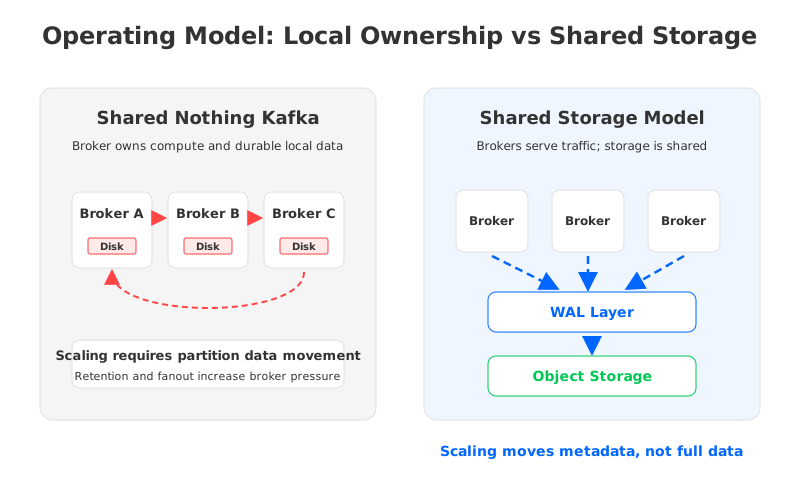
Tiered storage changes part of this equation by offloading older data to object storage, which can help with retention economics. It does not automatically make brokers stateless, because the hot path and partition ownership can still depend on broker-local storage. That distinction matters during scale-out, failover, and partition reassignment. If fresh vector updates must remain available while the platform is changing shape, the team needs to understand whether storage is merely tiered or whether the broker has stopped owning persistent data.
Shared Storage architectures take a stronger position. The broker handles Kafka protocol, coordination, and I/O, while durable stream data is placed in shared storage such as object storage, usually with a write-ahead log layer to keep the produce path efficient. The point is not that object storage magically makes streaming easy. The point is that durable data is no longer trapped inside a broker's local disk. That changes the cost model, scaling model, and recovery model.
4Evaluation checklist for platform teams
The right vector update backbone is not the one with the most impressive single benchmark. It is the one whose failure modes are understandable before the system becomes a dependency for search quality, recommendation revenue, and AI product iteration. Platform teams should evaluate the backbone at the interface where application semantics meet infrastructure behavior.
| Evaluation area | What to test | Why it matters for vector updates |
|---|---|---|
| Kafka compatibility | Existing clients, Kafka Connect, consumer groups, transactions, ACLs, monitoring tools | Rewrites in the ingestion layer create migration risk and delay AI teams. |
| Replay and retention | Index rebuilds, model rollbacks, compacted topics, historical backfills | Vector stores are serving indexes, not the full system of record. |
| Elasticity | Burst ingestion, read fanout spikes, partition reassignment, scale-down behavior | Re-embedding and launches create traffic shapes that steady-state sizing misses. |
| Cost isolation | Storage growth, cross-AZ traffic, idle capacity, connector compute | AI pipelines often grow by adding consumers and longer retention windows. |
| Governance | Schema evolution, deletes, access boundaries, lineage, audit logs | Search and recommendation outputs increasingly need explainable data lineage. |
| Migration safety | Offset preservation, dual run, rollback plan, connector cutover | The backbone becomes difficult to replace once every model team depends on it. |
The table is intentionally practical. A CTO may care about strategic platform control, while an SRE may care about rebalancing duration and recovery procedures, but both questions collapse into the same architecture review. Does the platform preserve Kafka semantics? Can it replay without destabilizing live traffic? Does storage scale independently from compute? Can operations be tested before a launch weekend?
This is also the point where teams should separate product claims from architectural evidence. Ask vendors to show how a consumer group behaves during failover, how offsets are preserved during migration, how object storage is used on the write path, and how the system limits cross-zone traffic in the cloud provider where you actually run. A diagram is useful only if it predicts what the SRE sees during an incident.
5How AutoMQ changes the operating model
If the evaluation points toward Kafka compatibility plus independent storage and compute scaling, AutoMQ is one concrete architecture to examine. AutoMQ is a Kafka-compatible cloud-native streaming platform that keeps the Kafka protocol and ecosystem surface while replacing Kafka's broker-local storage model with a Shared Storage architecture. In practical terms, producers, consumers, Kafka Connect integrations, and Kafka-oriented operational practices can remain familiar, while persistent stream data is no longer bound to the lifecycle of an individual broker disk.
The architectural shift matters for vector update systems because freshness pipelines rarely have stable shapes. A recommendation launch may add consumers. A search relevance experiment may double write volume for a subset of entities. A model rollback may require replaying a historical window. With stateless brokers and shared storage, scaling the serving layer does not require moving the full contents of partition data from one broker disk to another. That reduces the operational penalty of changing capacity when AI traffic changes.
AutoMQ's documentation describes a WAL plus object-storage design: writes are acknowledged through a write-ahead log layer, then data is stored in object storage through its S3Stream storage layer. That design is relevant for architects because it avoids the simplistic "write every tiny event directly to object storage on the hot path" model. The WAL gives the system a place to absorb low-latency writes and batch object-storage operations, while object storage provides elastic durable capacity for the stream history that replay-heavy AI workloads need.
Cloud networking is another reason to evaluate the storage model. In a traditional multi-AZ Kafka deployment, broker replication and client placement can create cross-zone data movement. AutoMQ's inter-zone traffic documentation describes an approach that uses shared storage and zone-aware routing to reduce inter-zone transfer paths. For vector update backbones with large write volume and growing read fanout, this is not only a cost discussion. It also affects how confidently teams can add consumers without making the network bill or topology harder to reason about.
AutoMQ is not a reason to skip the checklist. It is a candidate to run through it. Test the Kafka client versions you run today, the connectors that feed your embeddings, the delete-event semantics your governance team expects, the replay window your search team needs, and the rollback procedure your SREs will own. The value of a Kafka-compatible Shared Storage architecture is strongest when the team can preserve application semantics while changing the storage and scaling model underneath.
6A practical readiness scorecard
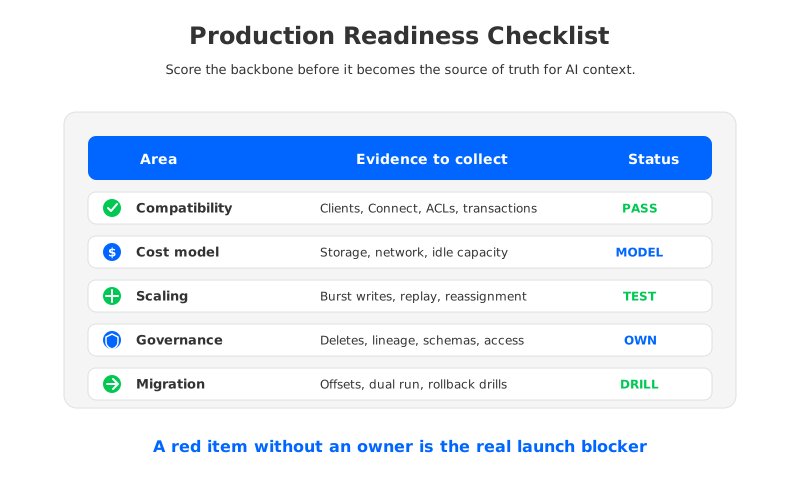
A short scorecard helps keep the architecture review grounded. Give each item a green, yellow, or red rating before you standardize a vector update backbone:
- Consumer semantics: Can every downstream service resume from a known offset after restart, deploy, or migration?
- Replay scope: Can the platform replay the required history for an index rebuild without starving live consumers?
- Delete handling: Are deletes, suppressions, and policy-driven removals represented as auditable stream events?
- Capacity change: Can the platform scale for bursts without long data movement windows or manual partition surgery?
- Cost visibility: Can the team explain storage, compute, connector, and network cost growth as traffic and retention change?
- Operational ownership: Are metrics, alerts, ACLs, schemas, and incident runbooks owned by the same platform boundary?
The most revealing score is usually not the average. It is the first red item that no team clearly owns. Vector update backbones sit between AI, data platform, application, and SRE teams. When ownership is ambiguous, freshness problems become finger-pointing problems, and the stream becomes harder to trust than the vector index it feeds.
If your team is evaluating Kafka-compatible infrastructure for fresh search or recommendation updates, use a small production-shaped slice rather than a synthetic hello-world topic. Include CDC, an embedding worker, one live consumer, one replay consumer, a delete path, and a rollback exercise. To compare a Shared Storage approach directly, you can start with the AutoMQ Cloud console and run the same update flow against your own workload assumptions.
7References
- Apache Kafka documentation for consumers, offsets, transactions, Kafka Connect, KRaft, and storage-related operations.
- Apache Kafka Connect documentation for source and sink connector architecture.
- AutoMQ: Compatibility with Apache Kafka for Kafka protocol and ecosystem compatibility.
- AutoMQ architecture overview for Shared Storage, WAL storage, and S3Stream concepts.
- AutoMQ inter-zone traffic overview for zone-aware traffic reduction.
- AutoMQ migration guide for migration planning, offsets, and rollback considerations.
- AWS Amazon S3 storage classes for object storage durability and availability characteristics.
- AWS data transfer pricing for cloud network cost considerations.
8FAQ
8.1Is Kafka required for vector search or recommendation systems?
No. A small system can write directly from an application or batch job into a vector database. Kafka becomes useful when the team needs durable history, independent consumers, replay, offset tracking, CDC ingestion, governance, and operational control across multiple search, recommendation, analytics, and AI services.
8.2Should vector updates use compacted topics or ordinary retained topics?
Both patterns can be valid. Compacted topics are useful when the latest state per key is the main recovery target, such as the current embedding for a product. Time-retained topics are useful when model debugging, audit, replay by time window, or event history matters. Many production systems use both: a historical event stream plus a compacted state stream.
8.3How many partitions does a vector update topic need?
Start from required write throughput, key-level ordering, consumer parallelism, and expected replay speed. More partitions can increase parallelism, but they also increase metadata, operational overhead, and downstream coordination. The best partition count is the smallest number that meets throughput and recovery objectives with headroom for launch spikes.
8.4Where does AutoMQ fit in a vector update architecture?
AutoMQ fits where a team wants Kafka-compatible APIs and ecosystem behavior, but does not want durable stream data tied to broker-local disks. Its Shared Storage architecture is most relevant when vector update workloads need elastic capacity, long replay windows, cloud cost control, and migration paths that preserve Kafka semantics.


