
Table of Contents
Table of Contents
Searching for confluent alternatives usually means the team is past casual research. Confluent Cloud has already proven why fully managed Kafka can be attractive: less broker maintenance, integrated security and governance, managed connectors, and a cloud service across major clouds. The harder question starts after that value is understood. Platform teams begin asking whether the same operating model still fits their data residency boundaries, cost shape, latency targets, and ownership model.
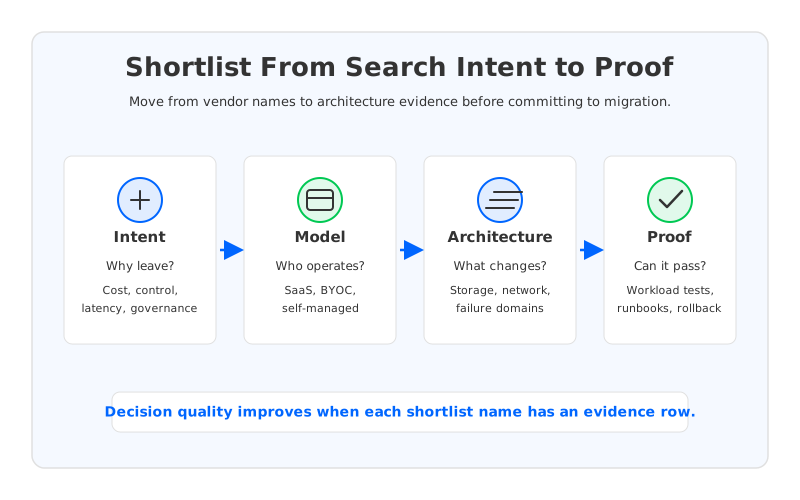
That is the moment when a vendor list is least helpful on its own. A list can tell you which products exist, but not whether your next streaming platform should remain SaaS, move into your cloud account, return to self-managed Kafka, or adopt a Kafka-compatible shared-storage architecture. The right shortlist is not a ranking exercise. It is a set of questions that turns names into evidence.
1Why Teams Search for confluent alternatives
Most teams do not leave a mature managed service because one feature is missing. They re-evaluate when the operating model changes. A startup that wanted speed may become a regulated platform team with stricter network isolation. A data product that began with a few topics may become a central replay layer with long retention. A FinOps team may discover that the bill is shaped by throughput, storage, data transfer, private networking, connectors, support, and idle capacity.
Confluent Cloud is a strong fit for many organizations that want managed Apache Kafka with surrounding platform services. Its own documentation describes it as a fully managed data streaming platform with Kafka, security, stream processing, and governance. That is not the problem. The problem is that a fully managed platform is also an architectural boundary. Data plane location, network paths, cost metering, upgrade control, and incident response are partly defined by the provider model.
When a team searches for alternatives, the underlying question is usually one of four things:
- Control: Can the data plane, keys, logs, and operational access stay inside the company boundary?
- Cost predictability: Can finance model broker, storage, network, retention, connector, and support costs before production?
- Kafka compatibility: Can producers, consumers, ACLs, transactions, offsets, schema workflows, and observability move without rewrites?
- Operational fit: Can the platform team own the right things without inheriting every broker-local Kafka task?
Those questions cut across vendor categories. A managed service may reduce operational load but keep data-plane ownership outside the customer account. Self-managed Kafka gives control but brings back broker sizing, disk management, rebalancing, upgrades, and failure recovery. A BYOC model moves infrastructure and data into the customer environment. A Kafka-compatible engine with shared storage keeps the Kafka client surface while changing how durability, scaling, and recovery work underneath.
2What Vendor Lists Usually Miss
Many comparison pages focus on market presence, review scores, feature checklists, or product positioning. Those signals can reduce the field quickly. They are shallow for architecture because they rarely explain how a platform behaves under the workload that is actually moving: peak ingest, fan-out reads, long retention, private connectivity, regional failure, client retry storms, topic expansion, and rollback.
The missing layer is causality. A platform is cost-effective when its storage, network, and scaling model avoid specific cost drivers for your workload. It is compatible when clients, authentication, authorization, transactions, consumer groups, offset commits, tooling, and failure assumptions survive the move. It is operationally simpler when the worst tasks become less frequent or less risky.
That is why the first pass of a shortlist should separate three decisions that are often mixed together.
| Decision | What to ask | Why it matters |
|---|---|---|
| Operating model | SaaS, BYOC, self-managed, or managed software? | Defines data-plane control, support boundaries, and who handles incidents. |
| Storage architecture | Broker-local disks, tiered storage, or shared object storage? | Defines scaling behavior, retention cost, rebalancing, and recovery mechanics. |
| Network boundary | Public endpoints, peering, PrivateLink, or in-account routing? | Defines security posture, cross-AZ traffic exposure, and operational access paths. |
This table is intentionally not a feature matrix. It forces the team to explain why a vendor category fits the workload before debating product details.
3Architecture Criteria Behind the Shortlist
Kafka’s API stability hides a lot of architectural variation. Apache Kafka defines producers, consumers, topics, partitions, offsets, replication, security primitives, and client compatibility expectations. Once Kafka runs as a cloud platform, the key design choice is where durable bytes live and how brokers recover when compute changes. Traditional Kafka binds hot data to broker-local storage. Tiered Storage adds a remote tier for completed log segments while the local tier remains part of the broker model. Shared-storage Kafka-compatible systems move durable stream data into object storage and treat brokers more like replaceable compute.
That distinction changes the work your SREs do at 02:00. With broker-local storage, scaling or failure recovery can involve data movement, partition reassignment, disk pressure, and careful throttling. With tiered storage, older segments can live in remote storage, but the active write path still depends on brokers and local storage behavior. With shared storage, the central question is whether the system can provide Kafka-compatible latency and semantics while using object storage, WAL, cache, and metadata coordination to make brokers less stateful.
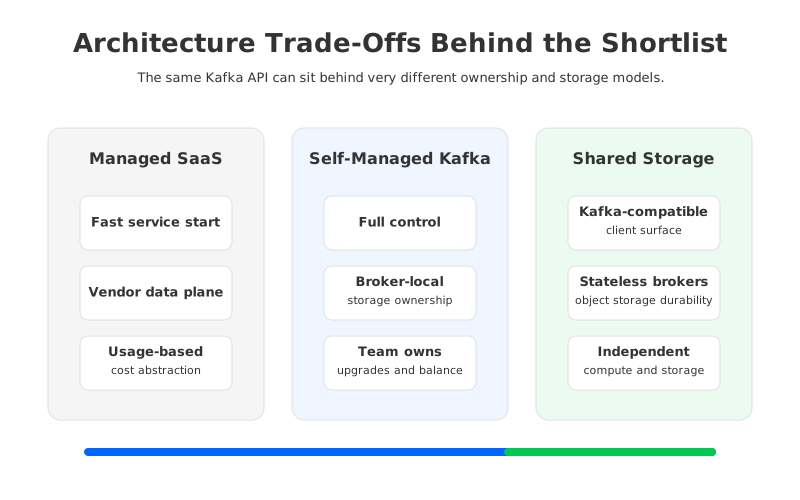
A practical architecture review should cover five dimensions before the vendor demo:
- Client behavior under load: Test production clients, batching, idempotence, transactions if used, consumer group rebalances, offset commits, ACLs, and admin tooling.
- Storage and retention economics: Model active data, retained data, replay frequency, remote reads, object storage requests, and local disk headroom.
- Network placement: Draw producer, broker, consumer, storage, connector, monitoring, and control-plane paths. Cross-AZ and cross-region traffic should be explicit.
- Failure recovery: Test broker loss, AZ disruption, client retry behavior, partition movement, metadata recovery, and restore procedures.
- Upgrade and rollback boundary: Decide who changes versions, approves maintenance, executes rollback, and keeps applications publishing during repair.
AWS pricing pages make the network question concrete. EC2 data transfer across Availability Zones in the same Region is charged per GB in each direction unless an exception applies. Amazon MSK pricing also separates broker, storage, low-cost tier, ingestion, and optional provisioned throughput examples. These are cloud architecture consequences, and any Confluent alternative should make them visible before procurement signs a contract.
The same discipline applies to latency and cost. Managed Kafka, self-managed Kafka, and shared-storage Kafka-compatible systems can all publish attractive benchmark numbers, but averages hide what platform owners need: producer acknowledgement latency under peak batching, consumer lag during maintenance, replay throughput, and recovery after disruption. Cost modeling should start with workload variables rather than vendor SKUs.
4Migration and Ownership Questions for Platform Teams
The safest migration plan assumes that Kafka compatibility is necessary but incomplete. Changing bootstrap servers is the small part of the project. The risk sits in surrounding assumptions: client library versions, authentication mechanisms, ACL naming, Schema Registry dependencies, connector ownership, consumer lag behavior, monitoring dashboards, alert thresholds, topic defaults, partition counts, retention policy, and cutover authority.
Use a scorecard instead of a generic proof of concept. A proof of concept often proves that a platform can ingest and consume sample events. A scorecard proves that your production model can survive the move.
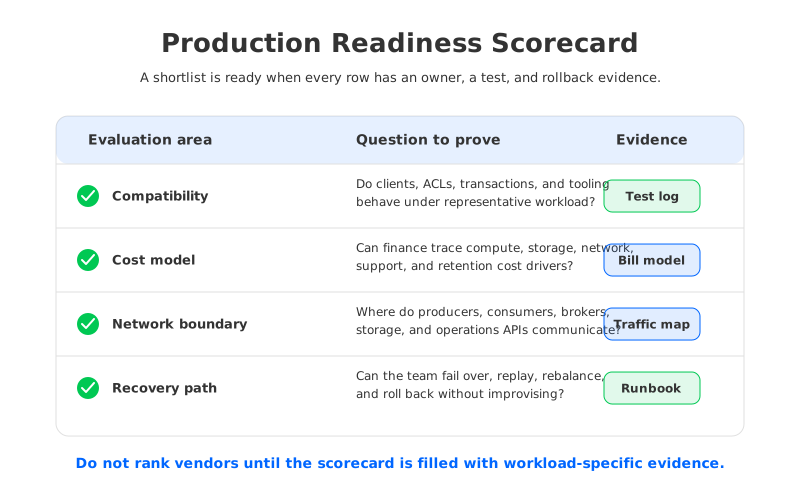
For each candidate, platform teams should require answers to five ownership questions.
| Question | Evidence to request |
|---|---|
| Who owns the data plane during an incident? | Runbook, escalation path, access model, and control boundary. |
| How is Kafka compatibility validated? | Client matrix, protocol behavior, ACL and transaction tests, and known limits. |
| What cost drivers grow with traffic? | Line-item model for compute, storage, network, retention, connectors, and support. |
| What happens during regional or AZ failure? | Tested recovery procedure, RPO/RTO assumptions, and application behavior. |
| How does migration roll back? | Replication plan, consumer cutover plan, and rollback criteria. |
This is where Confluent Cloud, Amazon MSK, self-managed Kafka, Redpanda, Aiven, WarpStream, AutoMQ, and other Kafka-compatible options should be evaluated with the same discipline. Each has a different operating model and engineering philosophy. A respectful comparison should make those differences legible.
The migration plan should account for protocol compatibility and operational compatibility. Protocol compatibility covers produce, consume, offset commits, ACLs, and Kafka semantics. Operational compatibility covers monitoring, alerting, topic provisioning, schema workflows, incident response, billing attribution, and access review. A credible rollback plan names the source of truth for each topic and defines how consumer positions are restored.
5How AutoMQ Fits the Evaluation
After the shortlist has been framed around ownership, architecture, network paths, and migration risk, AutoMQ fits one specific category: Kafka-compatible streaming with shared object storage and stateless broker architecture. It is relevant when the team wants Kafka client compatibility while moving durability away from broker-local disks and into customer-controlled object storage.
AutoMQ documentation describes a shared storage architecture that replaces Kafka’s storage layer with WAL storage plus object storage, making brokers stateless. Its public docs also describe Kafka protocol compatibility for standard clients and BYOC deployment where services run in the customer cloud account and data remains in the customer VPC. For teams leaving a pure SaaS model because of data-plane control, those properties matter more than a feature checklist.
The technical bet is straightforward: if brokers are less stateful, scaling and recovery should require less broker-to-broker data movement. If object storage is the durable foundation, long retention should be modeled differently from broker-attached disks. If the architecture can keep producer and consumer paths local in supported multi-AZ deployments, cross-AZ traffic can be reduced for paths that surprise Kafka teams. AutoMQ’s zero cross-AZ traffic documentation explains the conditions and routing approach.
That does not remove the need for proof. A team evaluating AutoMQ should still test client versions, security model, connector path, latency target, retention policy, replay workload, and operational integration. The point is to ask due diligence questions that match the architecture instead of only asking whether the product has the same console screens as the previous platform.
For a team leaving Confluent Cloud, AutoMQ is worth a serious look when three conditions are true:
- You want Kafka-compatible behavior while keeping application teams on the streaming API they already use.
- You want the data plane and storage boundary to sit inside your cloud account, VPC, or self-managed environment.
- Your biggest pain is tied to storage growth, cross-AZ traffic, broker scaling, rebalancing, or long-retention economics.
If the primary requirement is the broadest managed ecosystem around Kafka, Confluent Cloud may remain the better fit. If the primary requirement is AWS-native managed Kafka with familiar AWS procurement and operations, Amazon MSK deserves a fair evaluation. If the primary requirement is infrastructure ownership with a different storage center of gravity, AutoMQ belongs on the shortlist.
That positioning keeps the comparison fair. AutoMQ should not be evaluated as a managed connector marketplace, and Confluent Cloud should not be dismissed because some teams need a different boundary. The useful question is whether the architecture matches the constraint that forced the review.
6A Better Shortlist Process
The best vendor shortlist is not the one with the most names. It is the one where each name represents a distinct architecture hypothesis: fully managed SaaS, AWS-native managed Kafka, self-managed Kafka or Confluent Platform, Kafka-compatible shared storage, or a broader streaming engine if the team is willing to change APIs or operations.
Then make every candidate answer the same workload-specific worksheet:
| Worksheet row | Required answer |
|---|---|
| Workload shape | Peak ingest, read fanout, partitions, retention, replay frequency, and latency target. |
| Compatibility scope | Client versions, security, transactions, Schema Registry, Connect, and admin tooling. |
| Cost model | Monthly estimate by compute, storage, network, support, and add-ons. |
| Network design | Producer, consumer, broker, storage, connector, and observability paths. |
| Migration path | Replication method, cutover sequence, validation gates, rollback plan, and owner. |
| Operating boundary | Who patches, debugs, sees data, handles incidents, and approves changes. |
This process turns confluent alternatives from a search query into an engineering decision. It also avoids the common trap of comparing a managed platform, a self-managed distribution, and a cloud-native storage architecture as if they were interchangeable SKUs. They are not. They solve different parts of the streaming platform problem.
The worksheet also helps teams avoid overfitting on the previous platform. A replacement does not need to copy every operational habit from Confluent Cloud to be viable. It needs to preserve the Kafka behaviors applications depend on, maintain required control boundaries, and reduce the pressure that triggered the search.
If your team is rethinking Kafka architecture because broker-local storage, cross-AZ traffic, or data-plane ownership has become the limiting factor, review AutoMQ’s architecture and deployment model with your own workload assumptions. Start with the AutoMQ team here: Talk to AutoMQ.
7References
- Confluent Cloud overview: https://docs.confluent.io/cloud/current/overview.html
- Confluent Cloud billing overview: https://docs.confluent.io/cloud/current/billing/overview.html
- Confluent Cloud AWS PrivateLink documentation: https://docs.confluent.io/cloud/current/networking/private-links/aws-privatelink.html
- Confluent Platform overview: https://docs.confluent.io/platform/current/overview.html
- Apache Kafka documentation: https://kafka.apache.org/documentation/
- Apache Kafka Tiered Storage documentation: https://kafka.apache.org/40/operations/tiered-storage/
- Apache Kafka ACL documentation: https://kafka.apache.org/34/security/authorization-and-acls/
- AWS EC2 On-Demand Pricing, data transfer section: https://aws.amazon.com/ec2/pricing/on-demand/
- Amazon MSK pricing: https://aws.amazon.com/msk/pricing/
- AutoMQ overview: https://docs.automq.com/automq/what-is-automq/overview?utm_source=blog&utm_medium=reference&utm_campaign=gs100-0022
- AutoMQ shared storage architecture: https://docs.automq.com/automq/architecture/overview?utm_source=blog&utm_medium=reference&utm_campaign=gs100-0022
- AutoMQ cross-AZ traffic guide: https://docs.automq.com/automq-cloud/best-practice/save-cross-az-traffic-costs-with-automq?utm_source=blog&utm_medium=reference&utm_campaign=gs100-0022
- AutoMQ BYOC page: https://www.automq.com/bring-your-own-cloud-kafka-data-streaming?utm_source=blog&utm_medium=reference&utm_campaign=gs100-0022
- AutoMQ Software page: https://www.automq.com/software-self-managed-kafka-data-streaming?utm_source=blog&utm_medium=reference&utm_campaign=gs100-0022
8FAQ
8.1Which Confluent Cloud alternative should we evaluate first?
There is no universal answer. Confluent Cloud, Amazon MSK, self-managed Kafka, Confluent Platform, Redpanda, Aiven, WarpStream, AutoMQ, and other options make different trade-offs across operating model, compatibility, data-plane ownership, cost, and ecosystem breadth.
8.2Should a team leave Confluent Cloud only because of cost?
Cost can trigger the review, but it should not be the sole criterion. A lower platform bill is not useful if migration creates rewrites, weakens incident response, or moves operational risk to a team that cannot absorb it.
8.3Is Tiered Storage the same as shared-storage Kafka?
No. Apache Kafka Tiered Storage keeps a local broker tier and adds remote storage for completed log segments. Shared-storage Kafka-compatible architectures use object storage as the durable center of gravity and make brokers less stateful.
8.4Where does AutoMQ fit in a Confluent alternatives shortlist?
AutoMQ fits when a team wants Kafka-compatible streaming with object-storage-backed durability, stateless brokers, customer-controlled deployment options, and architecture-level work on storage, scaling, and cross-AZ traffic. It should be evaluated with the same production tests as any other candidate.
8.5What should a migration proof of concept include?
It should include representative producers and consumers, security configuration, ACLs, topic settings, consumer group behavior, retention and replay, private networking, observability, failure recovery, and rollback.


