
Table of Contents
Table of Contents
When enterprise teams search for VPC Kafka or a dedicated Kafka service, they are usually not asking whether Apache Kafka can publish and consume records. They already know the Kafka API. The real question is whether a managed Kafka option can satisfy the network, tenancy, identity, audit, and operational constraints that their internal platform team would apply to a critical data plane.
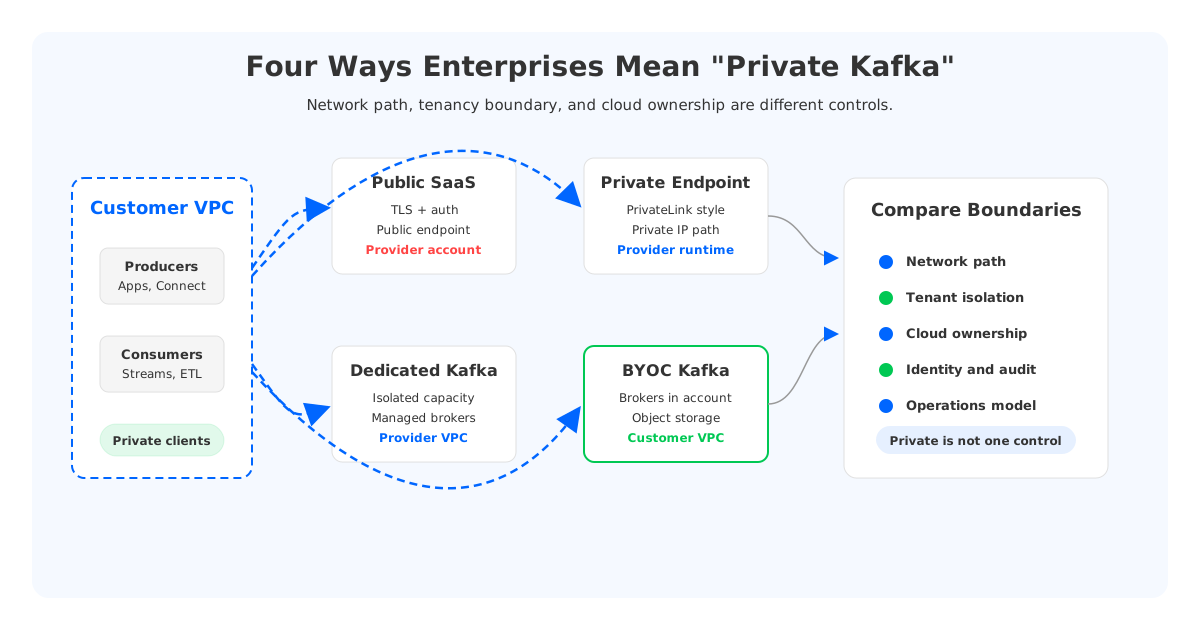
"Private Kafka" is an overloaded phrase. A public SaaS Kafka endpoint with IP allow lists, a managed Kafka cluster exposed through AWS PrivateLink, a provider-owned dedicated cluster, and a BYOC deployment running brokers in the customer's VPC all solve different parts of the problem. They may all sound private, but they create different paths for packets, credentials, metadata, support access, cloud bills, and compliance evidence.
The buying team should therefore compare deployment models, not labels. Security teams care about trust boundaries. Platform teams care about latency and failure modes. Procurement teams care about the cost of isolation. CTOs care whether the chosen model preserves Kafka semantics while reducing operational drag. The right answer is the model whose boundary matches the risk of the workloads.
1What VPC Kafka Usually Means
VPC Kafka is not an Apache Kafka feature. It is a buyer shorthand for a Kafka service reachable through a private cloud network boundary, usually from applications running inside an AWS VPC, Azure virtual network, Google Cloud VPC, or connected enterprise network. The term mixes three concerns that should be evaluated separately.
The first is network path. Do producers and consumers reach brokers through public endpoints, AWS PrivateLink, Azure Private Link, Google Cloud Private Service Connect, VPC peering, or brokers deployed inside the customer account? These services can make a provider service reachable through private IP paths, but private routing does not automatically make the runtime tenant-owned.
The second is tenancy. A Kafka endpoint may be private from a routing perspective while still using a multi-tenant control plane or provider-owned infrastructure. A dedicated cluster may provide isolated broker capacity while still running in the provider's cloud account. A BYOC deployment may place the Kafka data plane in the customer's cloud account while relying on a vendor control plane for lifecycle management, licensing, or support.
The third is responsibility. Enterprise buyers need to know who patches brokers, owns the VPC, configures DNS, holds IAM permissions, inspects logs, pays for private connectivity, and responds when client connections fail. If those questions are not answered early, "VPC Kafka" becomes a vague promise that collapses during security review.
2Four Deployment Models Buyers Should Separate
Most managed Kafka offerings fit into four broad patterns. Individual providers vary, and some support more than one pattern, but the categories are useful because they expose the architectural tradeoffs.
| Model | What is private | What remains provider-controlled | Best fit |
|---|---|---|---|
| Public SaaS endpoint | Optional allow lists, TLS, authentication | Network ingress, brokers, storage, operations, account boundary | Lower-risk workloads, simple access, fast onboarding |
| Private endpoint to provider service | Client traffic path from VPC to service endpoint | Provider account, broker fleet, storage boundary, service operations | Enterprises that need private connectivity but can accept provider-owned infrastructure |
| Dedicated managed Kafka cluster | Broker capacity and often tenant isolation | Provider VPC/account, lifecycle automation, sometimes networking layer | Teams that need isolated capacity or noisy-neighbor reduction without owning the runtime |
| BYOC Kafka in customer VPC | Data plane network, cloud resources, storage boundary | Vendor software, lifecycle tooling, support process, management metadata | Regulated or security-sensitive workloads that require customer-owned cloud controls |
Public SaaS endpoints are the simplest to consume and can still be secure when TLS, strong authentication, authorization, audit logging, and network restrictions are configured well. The limitation is boundary alignment: traffic leaves the customer network boundary, and the service runtime lives outside the customer's cloud account.
Private endpoint models improve the network story. AWS PrivateLink, Azure Private Link, and Google Cloud Private Service Connect can keep clients from reaching a public service address directly, which reduces broker exposure and simplifies firewall review. Yet private connectivity is not dedicated tenancy. The runtime is still usually operated in the provider's account.
Dedicated managed Kafka clusters address capacity isolation. They may provide isolated broker resources, predictable capacity, configurable networking, and less exposure to multi-tenant noisy-neighbor effects. But "dedicated" does not automatically mean the brokers run inside the customer's VPC; buyers should verify whether the cluster is provider-owned, customer-account based, or hybrid.
BYOC Kafka moves the boundary closest to the enterprise cloud environment. The Kafka runtime is deployed in the customer's cloud account or VPC, while the vendor provides management software and automation. AutoMQ BYOC is an example: its documentation describes software services deployed in the user's cloud account, with data remaining in the user's VPC. On AWS, AutoMQ's installation flow places the console and clusters in the customer's VPC and uses customer-granted IAM permissions to manage resources.
3Private Connectivity Does Not Equal Tenancy Isolation
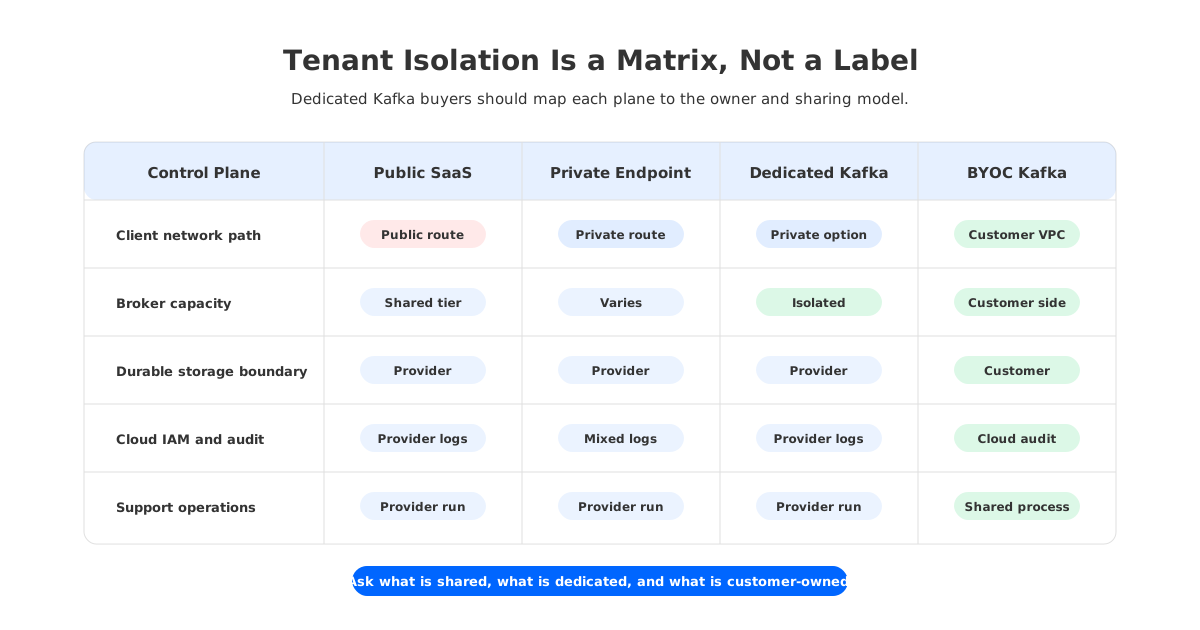
The most common enterprise mistake is to treat private connectivity and tenancy isolation as the same control. Private connectivity asks how clients reach the service. A PrivateLink-style design can keep client traffic on private addresses, avoid public broker exposure, and create cleaner DNS and routing patterns. Tenancy isolation asks what infrastructure is shared. Dedicated Kafka may mean isolated broker compute, isolated storage, isolated control-plane resources, isolated network load balancers, or some combination. A buyer should not infer the answer from the word dedicated. The evaluation should list every plane:
- Client access plane: broker endpoints, DNS, load balancers, private endpoints, firewall rules, and route tables.
- Kafka data plane: brokers, storage, replication traffic, object storage access, and internal service credentials.
- Control plane: cluster creation, upgrades, configuration changes, user management, monitoring, billing, and license state.
- Observability plane: metrics, logs, traces, alert payloads, diagnostic bundles, and support artifacts.
This separation prevents false confidence. A service can provide private client access while operational logs leave the environment. A dedicated cluster can isolate broker capacity while using provider-owned storage. A BYOC deployment can keep brokers and object storage in the customer account while still exchanging health metadata with a vendor control plane. The question is whether the boundary is documented and accepted.
4Identity, Data Exposure, and Auditability
Network architecture is only one part of the VPC Kafka decision. Kafka is a long-lived data plane, so identity and audit controls deserve equal weight. Buyers should ask how applications authenticate to brokers, how Kafka ACLs or RBAC are enforced, whether cloud IAM is involved, and how administrative changes are logged.
In a provider-owned managed service, the provider typically controls most infrastructure identities. Customers manage Kafka users, API keys, or service accounts through the provider interface. That is convenient, but audit evidence may come from provider logs rather than the customer's cloud audit trail. In a private endpoint or dedicated provider-owned cluster, the customer may gain better network control but not deeper identity control over the underlying infrastructure.
In a BYOC architecture, the cloud-resource audit story can be stronger because brokers, object storage, IAM roles, security groups, and network endpoints exist in the customer's cloud account. Cloud audit logs can show API calls against customer-owned resources. Storage policy and encryption keys can align with existing governance. The tradeoff is that IAM scope, endpoint policy, subnet design, key policy, and route control become customer responsibilities, not abstract provider details.
Data exposure should be reviewed in layers. Kafka message payloads are the most sensitive asset, but topic names, consumer group names, metrics, logs, client IDs, IP addresses, and error messages can also reveal business architecture. Dedicated Kafka and VPC Kafka evaluations should ask which data classes cross the provider boundary, whether they can be minimized, and how long they are retained.
5Latency and Reliability Tradeoffs
Private networking is not free from an architecture perspective. Endpoint services, peering, NAT avoidance, DNS indirection, cross-zone paths, and inter-region access can all change latency and failure behavior. Kafka clients are especially sensitive to advertised listener configuration because they discover broker metadata and open connections to broker addresses returned by the cluster.
For private endpoint models, teams must validate whether all broker listeners resolve correctly from every client VPC, whether bootstrap and broker metadata are aligned, and whether cross-zone endpoint placement introduces avoidable hops. Dedicated clusters can improve predictability when noisy-neighbor risk matters, but reserved capacity can also create underutilization if traffic is spiky. BYOC adds another dimension: the customer's network, quotas, subnet sizing, security groups, IAM policy changes, and cloud-account guardrails become part of Kafka availability.
6Cost: Dedicated Capacity, Private Endpoints, and Data Movement
The cost question is often framed as "is dedicated Kafka more expensive?" The better question is: which isolation controls are you buying, and how do they map to actual workload risk?
Dedicated Kafka usually costs more than shared serverless or multi-tenant tiers because the provider reserves capacity for one customer. That can be rational for high-volume, regulated, latency-sensitive, or operationally critical workloads. It can be wasteful for small or sporadic workloads. Procurement teams should ask whether the service bills by cluster, broker, capacity unit, throughput, storage, partitions, private networking, support tier, or data transfer.
Private connectivity also has a cost model. Cloud providers may charge for endpoint hours, processed data, inter-zone or inter-region traffic, and load-balancing constructs. Kafka traffic is continuous, so buyers should model the actual application path rather than rely on "private networking included."
Storage architecture changes the bill as well. Traditional Kafka designs tie retention closely to broker-local disks and replication. A dedicated cluster with long retention may require larger broker storage or more headroom. Object-storage-backed Kafka-compatible systems change that equation by placing durable log data in cloud object storage and making brokers less responsible for holding all retained data locally. AutoMQ's architecture fits this category, which is why its BYOC model is relevant for VPC Kafka buyers evaluating both security boundaries and long-retention economics.
Cost should be compared across five buckets:
| Cost bucket | Questions to model |
|---|---|
| Reserved capacity | Minimum cluster size, capacity units, broker count, scaling increments |
| Private networking | Endpoint hours, processed data, cross-zone paths, DNS and load balancer components |
| Storage and retention | Hot storage, object storage, replication, retention growth, replay workloads |
| Operations | Upgrade effort, incident response, audit evidence, support tier, change management |
| Exit and migration | Kafka compatibility, client changes, connector changes, data export, rollback path |
The lowest quoted service price is not always the lower total cost. A provider-owned dedicated cluster may reduce operational labor. A BYOC deployment may improve data boundary control but require deeper cloud governance. Enterprise buyers should model the workload, not the logo.
7How AutoMQ BYOC Fits VPC Kafka Requirements
AutoMQ should be considered in this category when the evaluation is about Kafka compatibility, customer cloud boundaries, and object-storage-backed operations rather than only about a hosted endpoint. Its BYOC model places brokers, object storage usage, and customer-side services in the customer's cloud account and VPC where applicable, while AutoMQ provides the Kafka-compatible software and management workflow. That makes it relevant to security teams that want the Kafka data plane to be reviewable through their own cloud controls.
The natural fit is not every Kafka workload. If a team wants the fastest possible trial with minimal cloud-account involvement, a public SaaS endpoint may be enough. If the main issue is capacity isolation inside a provider-operated environment, a dedicated managed Kafka cluster may be appropriate. AutoMQ BYOC becomes more interesting when the enterprise wants private network placement, customer-owned storage policy, cloud audit visibility, and a Kafka-compatible architecture that separates broker compute from durable storage.
That separation is important for SRE teams. In traditional Kafka, scaling and recovery can become storage-movement problems because brokers own local log segments. In an object-storage-backed design, durable data is anchored in object storage, and brokers become easier to treat as elastic compute. The review should still ask which IAM roles AutoMQ components need, how the console is exposed, what metrics leave the environment, which object storage buckets are created, how encryption keys are configured, and how support access works.
8Enterprise Network Review Checklist
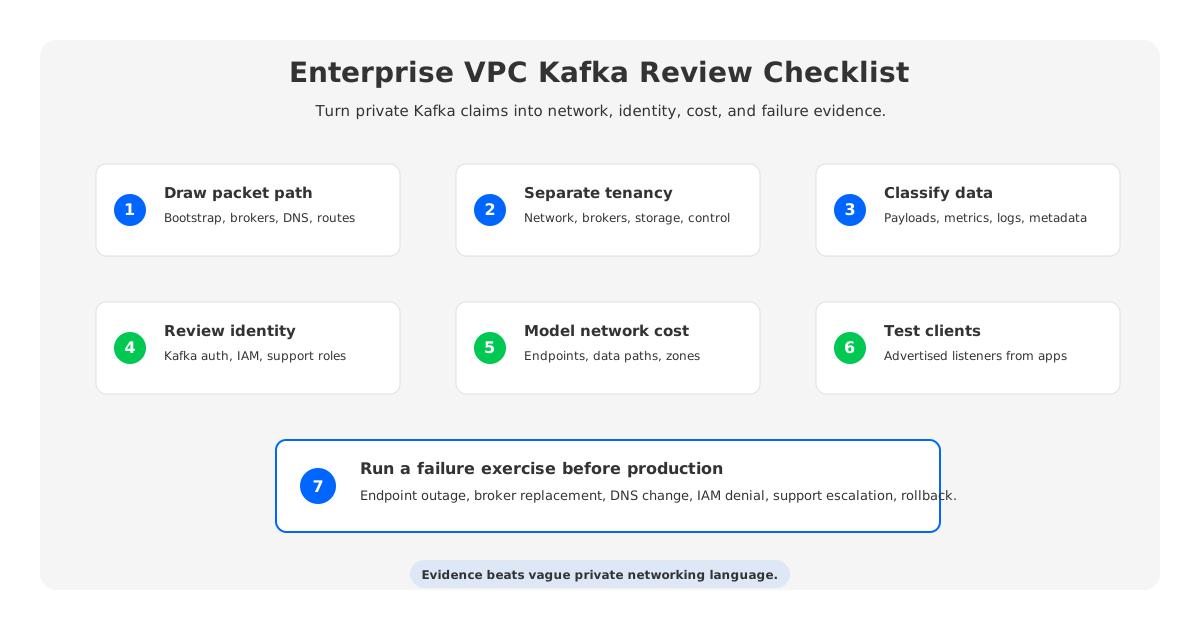
Use this checklist when comparing a VPC Kafka service, a dedicated Kafka service, a private endpoint model, or a BYOC Kafka architecture. The goal is to turn vague privacy claims into evidence.
-
Draw the actual packet path from producer and consumer subnets through bootstrap, broker metadata, DNS, private endpoints, route tables, firewalls, storage access, and cross-zone hops.
-
Separate network isolation from tenancy isolation by documenting whether brokers, storage, control plane, observability, and support access are shared, dedicated, provider-owned, or customer-owned.
-
Classify data and metadata across payloads, topic names, group names, client IDs, metrics, logs, alert payloads, audit events, billing metadata, and support bundles.
-
Review identity and permissions for Kafka authentication, authorization, cloud IAM roles, service accounts, API keys, support roles, break-glass flows, and audit exports.
-
Model private networking cost including endpoint hours, data processing, cross-zone traffic, inter-region paths, load balancers, DNS, and operational overhead.
-
Test client behavior from every application network so advertised listeners resolve to the intended private broker addresses.
-
Run a failure exercise for endpoint outage, broker replacement, DNS change, IAM denial, support escalation, and rollback.
9References
- AWS PrivateLink documentation: What is AWS PrivateLink?
- Microsoft Azure documentation: What is Azure Private Link?
- Google Cloud documentation: Private Service Connect
- Confluent Cloud networking documentation
- AutoMQ documentation: What Is AutoMQ Cloud
- AutoMQ documentation: Install AutoMQ on AWS
10FAQ
10.1Is VPC Kafka the same as dedicated Kafka?
No. VPC Kafka usually describes private network access from a customer VPC or virtual network. Dedicated Kafka usually describes isolated capacity or tenancy. A service can provide private access without dedicated brokers, or dedicated brokers without running inside the customer's cloud account.
10.2Does PrivateLink make a Kafka service fully private?
PrivateLink-style connectivity can keep client traffic on private endpoint paths, but it does not automatically change service tenancy, storage ownership, support access, or control-plane metadata. Buyers should still review what remains in the provider account and what is shared.
10.3When should an enterprise choose BYOC Kafka?
BYOC Kafka is worth evaluating when the enterprise wants Kafka-compatible behavior while keeping the data plane, cloud resources, and storage boundary inside its own cloud account or VPC. It is especially relevant for regulated workloads, strict network review, or teams that want cloud-native audit visibility.
10.4Is a dedicated Kafka service always more reliable?
Not automatically. Dedicated capacity can reduce noisy-neighbor risk and improve predictability, but reliability also depends on architecture, replication, scaling behavior, private endpoint design, operational automation, quotas, and support processes.
10.5How does AutoMQ fit into a VPC Kafka evaluation?
AutoMQ BYOC fits when buyers want Kafka-compatible brokers and object-storage-backed durable data running in the customer's cloud account and VPC where applicable. It should be evaluated through concrete controls: IAM roles, private networking, object storage policy, metrics flow, upgrades, and support access.


