
Table of Contents
Table of Contents
WarpStream was acquired by Confluent on 2024-09-09. IBM announced its agreement to acquire Confluent on 2025-12-08, then completed the acquisition on 2026-03-17. The short answer to "what happened to WarpStream?" is that WarpStream is no longer an independent diskless Kafka startup; it is now part of Confluent, which is part of IBM.
That does not mean Confluent WarpStream is a bad product. The WarpStream Confluent acquisition is better read as a signal that diskless Kafka has moved from startup experimentation into mainstream Kafka platform strategy. But if you are evaluating WarpStream after the acquisition, or looking for a WarpStream alternative, the questions have changed: roadmap control, pricing visibility, open source posture, BYOC boundaries, data sovereignty, and exit strategy now matter as much as raw architecture.
1Why Confluent Bought WarpStream
WarpStream earned attention because it attacked a real Kafka-on-cloud problem. Traditional Kafka stores data on broker-attached disks and replicates that data across brokers, which makes cross-AZ traffic, storage over-provisioning, and data rebalancing expensive operational facts. WarpStream moved the storage layer to object storage and ran stateless agents in the customer's cloud account, using a BYOC model that appealed to teams that wanted more control than a fully hosted service but less operational burden than self-managed Kafka.
Confluent's acquisition announcement positioned WarpStream in that middle ground. Confluent described WarpStream as complementing Confluent Cloud and Confluent Platform, with a focus on BYOC and "large-scale workloads with relaxed latency requirements," including logging, observability, and feeding data lakes. That positioning is important: the acquisition was not a rejection of WarpStream's architecture. It was evidence that mainstream Kafka vendors needed a diskless, object-storage-native option.
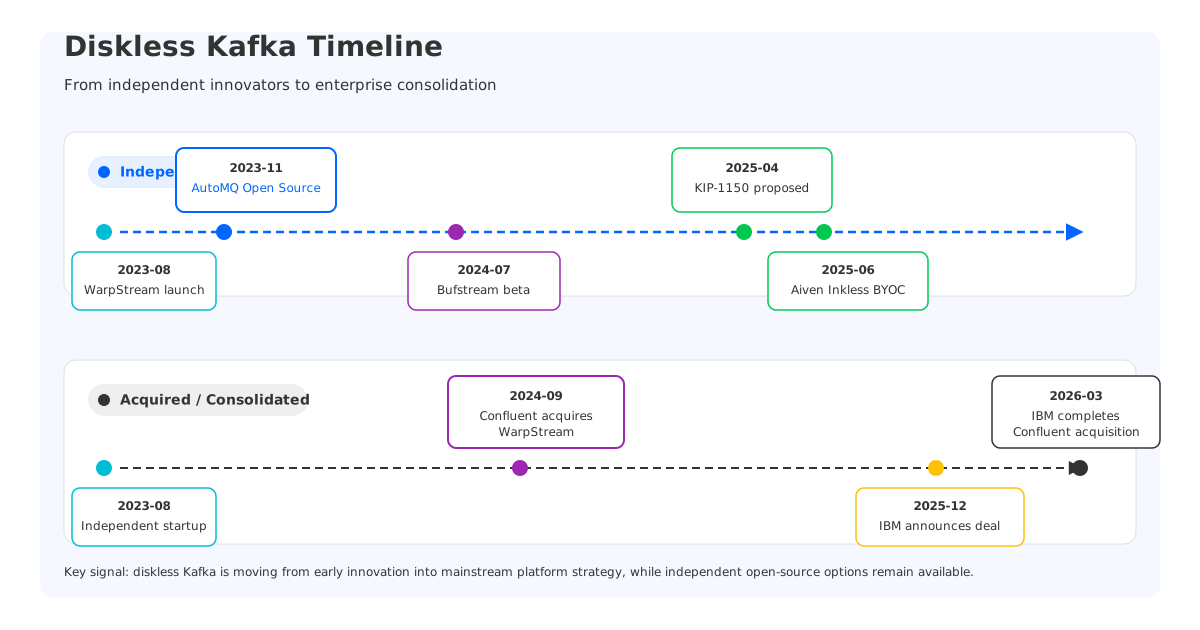
The broader timeline tells the same story. WarpStream's launch blog appeared in July 2023 and drew attention in August, while AutoMQ's first GitHub release, 0.6.6, was published on 2023-11-03. In 2025, Aiven published the KIP-1150 Diskless Topics proposal analysis, bringing the same architectural direction into the Apache Kafka community conversation.
2The IBM Factor: From Startup to Enterprise Portfolio
IBM's completed acquisition of Confluent on 2026-03-17 adds another layer to the decision. WarpStream moved from startup to Confluent product line, then into a larger enterprise software organization. That can bring advantages: broader sales coverage, procurement, compliance programs, support depth, and closer integration with customer data platforms.
The risk is not that IBM or Confluent will necessarily damage WarpStream. The more practical risk is that incentives may change. A startup can focus on a narrow technical thesis; a large platform company must balance many product lines, enterprise packaging decisions, revenue targets, partner programs, and AI/data platform priorities. These are not guaranteed changes, but they are reasonable risks customers should evaluate before making Confluent WarpStream a long-term streaming foundation.
3What Customers Should Re-Evaluate
Acquisitions usually matter less on day one than they do over the next few budget cycles. Pricing packages change, support tiers change, and roadmaps get integrated. The question is: how much control do we retain if it changes?
| Evaluation area | What to ask after the acquisition |
|---|---|
| Product roadmap control | Will WarpStream continue to evolve as an independent architecture, or primarily as part of Confluent and IBM's broader platform strategy? |
| Pricing transparency | Can you forecast cost at production scale from public information, or do key assumptions require a sales quote? |
| Open source and exit | Can your team audit, patch, self-run, or fork the system if vendor priorities change? |
| BYOC and sovereignty | Which components run in your cloud account, and which critical control or metadata services remain vendor-managed? |
| Workload fit | Does the latency profile match all of your Kafka workloads, or mainly relaxed-latency pipelines? |
3.1Product Roadmap Control
WarpStream's original roadmap was shaped by a focused engineering team proving that diskless Kafka could run directly on object storage. After the Confluent acquisition, roadmap decisions naturally have to fit Confluent's portfolio. After IBM's acquisition of Confluent, they also have to fit a larger enterprise data and AI strategy. That may be positive if you want an integrated enterprise stack, but it is different from buying from an independent infrastructure vendor.
The practical question is whether the roadmap you care about is still a first-class priority. If you depend on a Kafka compatibility feature, migration path, latency improvement, deployment model, or pricing behavior, ask where it sits in the post-acquisition roadmap.
3.2Pricing Transparency
WarpStream does publish useful pricing information. Its pricing page lists a Standard plan with charges for cluster management, storage, and "uncompressed write," and its Enterprise plan is marked "Contact Us." The same page states that WarpStream bills based on "uncompressed bytes," which matters if your producers send highly compressed JSON, Avro, Protobuf, logs, or telemetry.
Every vendor has to pick a metering unit, but teams should model real compression ratios before assuming a diskless architecture automatically produces a predictable bill. Public pricing visibility is better than a quote-only model, but it is still limited for enterprise deployments because discounts, contract structure, support terms, and post-acquisition packaging are not fully knowable from the public page.
3.3Open Source and Exit Strategy
WarpStream's public materials present a proprietary service model rather than an open-source infrastructure project. Its architecture documentation describes a split between customer-side agents and object storage, and a vendor-managed control plane with a metadata store. Public information does not indicate that customers can audit, modify, self-maintain, or fork the core WarpStream control plane and agent implementation.
Open source is not a philosophical footnote in infrastructure selection. It is an exit strategy. If pricing changes, a roadmap stalls, or a parent company changes packaging, open-source infrastructure gives a platform team more options: inspect the implementation, operate it directly, patch urgent issues, or keep a known-good version alive while planning a migration.
3.4BYOC and Data Sovereignty
BYOC does not automatically mean every critical part of the system lives in your account. WarpStream's architecture docs describe agents and object storage in the customer environment, while the control plane and metadata store are vendor-managed. That split can reduce operational burden, but it creates questions that security and platform teams should answer explicitly.
Before choosing any BYOC streaming platform, confirm where topic metadata, partition state, consumer offsets, billing data, telemetry, credentials, support access, and control-plane operations live. The key phrase is "data sovereignty," but the real concern is operational sovereignty: can you keep the system running, debug it, and exit if the vendor-side service changes behavior?
3.5Workload Fit
Confluent's own announcement frames WarpStream around large-scale workloads with relaxed latency requirements. Logging, observability, analytics ingestion, and data lake feeding are often more sensitive to cost and elasticity than to single-digit millisecond latency.
The edge appears when one platform team wants to standardize all Kafka workloads on one system. Fraud detection, IoT control loops, real-time personalization, and microservice event buses may need tighter latency envelopes than a pure object-storage path is designed to provide. If WarpStream is under evaluation for those use cases, validate production latency, not benchmark-friendly averages.
4The Broader Diskless Kafka Market: WarpStream Is Not the Only Option
WarpStream helped prove the diskless Kafka category, but it no longer defines the category alone. AutoMQ released an independent Apache 2.0 diskless Kafka implementation in 2023. Aiven's KIP-1150 work pushed Diskless Topics into the Apache Kafka design conversation. Bufstream, Redpanda Cloud Topics, and Ursa for Kafka reflect the same market pressure from different angles: object-storage economics, faster elasticity, and less broker-local state.
That broader market matters because acquisition risk is easier to manage when alternatives exist. If Confluent WarpStream fits your commercial and technical constraints, it may be a natural choice, especially for teams already standardized on Confluent or IBM. If you want more control over source code, deployment boundaries, and exit paths, compare it with independent and open alternatives before locking in.
5Why AutoMQ Is a Strong WarpStream Alternative
AutoMQ takes a different route to the same cloud-native streaming problem. It is open source under the Apache 2.0 license, remains independent, and is built on the Apache Kafka codebase rather than presenting only a protocol-compatible surface. The goal is not to ask users to leave the Kafka ecosystem; it is to replace the storage layer that makes Kafka hard to operate economically in the cloud.
The architecture is diskless: brokers are stateless compute, object storage is the single source of truth, and the WAL layer is pluggable. AutoMQ's Diskless Engine uses object storage such as S3 for durable data while allowing WAL backends including S3, EBS-style block storage, and NFS-based options, depending on cost, latency, and availability needs. That matters because not every Kafka workload has the same latency profile.
AutoMQ's BYOC model is also designed around customer-controlled cloud boundaries: data plane, metadata, and control-plane components run inside the customer's VPC according to the public BYOC positioning.
Production proof matters more than architecture diagrams. AutoMQ's customer materials reference adoption by teams such as JD, Grab, Tencent, Poizon, LG U+, and Bambu Lab. The reasons vary: cost, faster scaling, Kubernetes-native operations, and reducing the operational blast radius of Kafka storage. The common thread is that diskless Kafka is no longer theoretical.
6Evaluation Checklist: Questions to Ask Before Choosing Confluent WarpStream
Use this checklist before committing to Confluent WarpStream, AutoMQ, or any other diskless Kafka platform:
- Is the product roadmap still independent enough for your use case, or tied to a larger platform strategy?
- Is public pricing clear enough to forecast at your expected write volume, storage retention, and compression ratio?
- Can you run the system without the vendor, or at least keep operating during a vendor-side control-plane disruption?
- Where do control-plane state, metadata, billing data, telemetry, and support access live?
- What is the exit path if pricing, packaging, or roadmap priorities change?
- Does the latency profile fit all of your Kafka workloads, or only relaxed-latency pipelines?
- Is the license open enough for long-term infrastructure risk control?
The point is not to disqualify any vendor. It is to make hidden assumptions visible before they turn into platform commitments.
7Conclusion: Acquisition Is a Signal to Re-Evaluate, Not Panic
The Confluent acquisition of WarpStream, followed by IBM's acquisition of Confluent, shows that streaming infrastructure is consolidating around cloud-native, object-storage-backed designs. That consolidation can bring enterprise support and ecosystem integration. It can also change incentives, packaging, roadmap priorities, and vendor lock-in risk.
If your organization is already deeply committed to Confluent or IBM, Confluent WarpStream may fit naturally into your platform strategy. If you care more about openness, independent roadmap control, transparent architecture, and a credible exit path, AutoMQ deserves serious evaluation. Start with the AutoMQ GitHub repository, read the BYOC architecture, and run your workload through the AutoMQ pricing calculator before choosing your next Kafka foundation.


