
Table of Contents
Table of Contents
Kafka teams usually approach WarpStream with a familiar mental model: brokers own partitions, partitions are append-only logs, data is replicated across brokers, and storage capacity is part of broker capacity planning. WarpStream asks teams to keep the Kafka client surface in mind but redraw the storage and operations layer underneath it. The center of gravity moves away from broker-local disks and toward stateless compute, object storage, and a metadata/control-plane service.
That shift is useful, but it creates new questions. If Agents are stateless, where is the durable log? If object storage is the primary data layer, what happens to write acknowledgement, read latency, and replay? If metadata is coordinated outside the local brokers, what does the failure model look like? The right way to understand WarpStream is not to call it "Kafka with S3" and stop there. It is to compare each Kafka responsibility with the component that handles the same responsibility in WarpStream.
1The Kafka mental model WarpStream changes
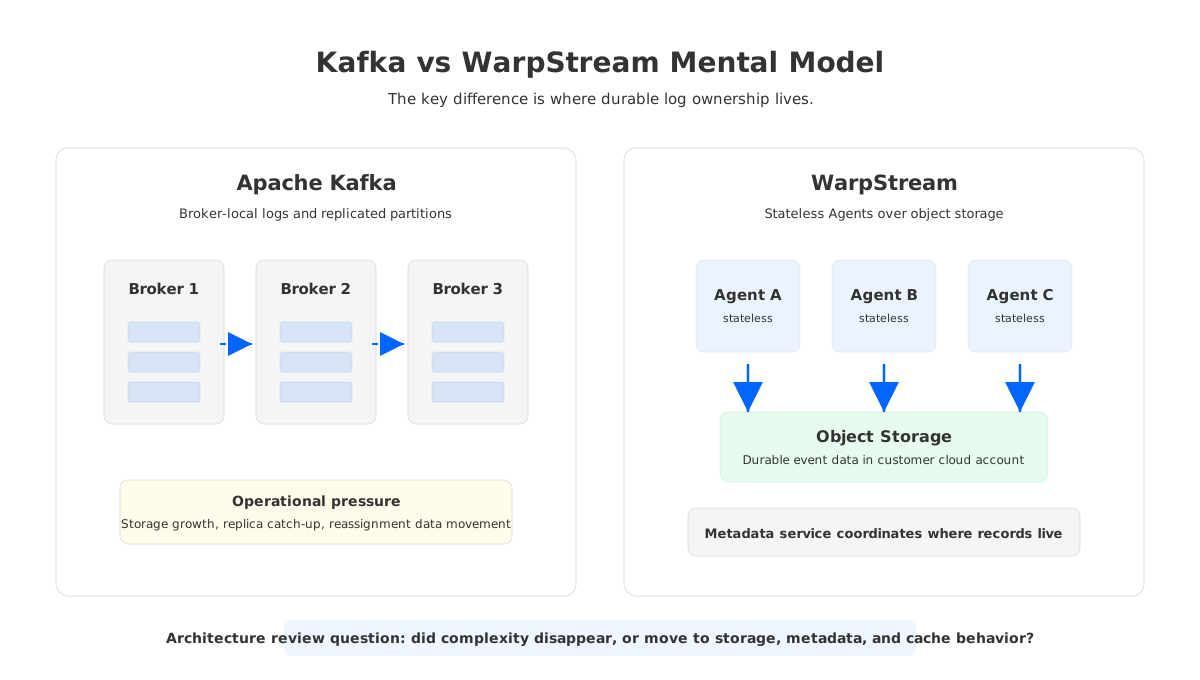
Apache Kafka's design is built around brokers that store log segments locally. A topic is split into partitions, each partition has a leader, and durability is normally achieved through replication across brokers. Kafka's own documentation describes this in terms of logs, partitions, leaders, followers, and replicated state. Operationally, that means storage and compute are tightly coupled: when brokers fill up, fail, or need to rebalance partitions, the cluster often has to move data as well as traffic.
Kafka teams know the consequences. Retention planning becomes disk planning, broker replacement becomes a replica catch-up event, and scaling out changes partition placement as well as compute capacity. Tiered storage can reduce pressure on local disks for older data, but the broker still remains a meaningful owner of the hot log path.
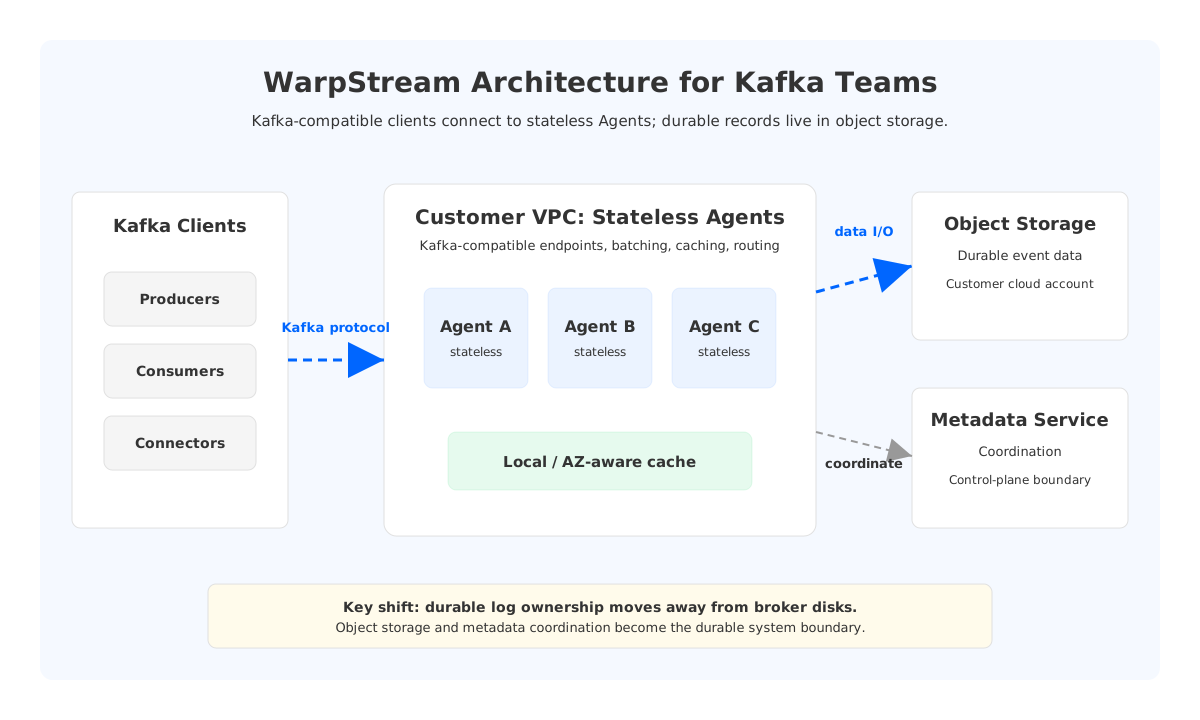
WarpStream changes that ownership model. Its public architecture documentation describes Agents that run in the customer's VPC and are stateless. They expose Kafka-compatible endpoints to clients, batch and route requests, read and write data, and coordinate with WarpStream's cloud service for metadata. Durable event data is stored in object storage in the customer's cloud account. In other words, the Agent is closer to an elastic data-plane worker than a traditional Kafka broker with a durable local log.
This is the first architectural fork:
| Responsibility | Apache Kafka mental model | WarpStream mental model |
|---|---|---|
| Client protocol | Kafka broker handles protocol and partition leadership | Agent exposes a Kafka-compatible surface |
| Durable log storage | Broker-local log segments, replicated across brokers | Object storage in the customer's cloud account |
| Node identity | Broker has local state tied to partitions and replicas | Agents are designed to be stateless and replaceable |
| Metadata coordination | Kafka controller and cluster metadata manage leaders and replicas | WarpStream cloud service coordinates metadata and control-plane functions |
| Scaling | Add brokers, then balance partitions and replicas | Add or remove Agents, with durable data decoupled from Agent local disks |
The table hides an important nuance: WarpStream is relocating state, not removing it. Durable records live in object storage, metadata is coordinated by WarpStream's service, and transient performance state lives in caches and Agent process memory.
2Core components of WarpStream
The easiest way to reason about WarpStream is to separate the data plane from the coordination plane. Agents run in the customer's environment, durable data lands in the customer's object store, and metadata/control-plane functions are provided by WarpStream's cloud service, now part of Confluent after the acquisition announced on September 9, 2024.
Agents are the workload-facing component. They accept Kafka protocol traffic, batch writes, serve reads, maintain local caches, and interact with object storage. Because Agents are stateless, losing one should not imply losing durable event data. The replacement Agent can use metadata and object storage to continue serving the workload, subject to normal failure detection and retry behavior.
Object storage is the durable data layer. This is the biggest difference from Kafka's local log model. Instead of storing durable partition replicas on broker disks, WarpStream writes data into object storage in the customer's cloud account. That choice changes the cost profile for retention and removes the need to keep long-lived durable data on compute nodes, but it also makes object-store latency, request behavior, and caching strategy part of the streaming architecture.
Metadata and control-plane services coordinate the system. WarpStream documentation describes a separation in which Agents run in the customer's VPC while WarpStream's cloud service handles metadata and control-plane responsibilities. Data location and metadata coordination are different questions; both matter for security review, failure analysis, and exit planning.
Supporting components include caching, batching and file layout, availability-zone awareness, and observability for Agent health, object storage behavior, latency, throughput, and client-facing errors. This decomposition makes WarpStream easier to evaluate: ask which Kafka behavior your applications depend on, which component preserves that behavior, and where the operational responsibility moved.
3Write path: from Kafka produce to object storage
A Kafka producer still sends records to a Kafka-compatible endpoint. The Agent receives those produce requests, batches records, writes data to object storage, and coordinates metadata so the system can later locate and serve the records. Because Agents are stateless and object storage is the system of record, the write path should be evaluated as a coordinated interaction among producer, Agent, object storage, and metadata service.
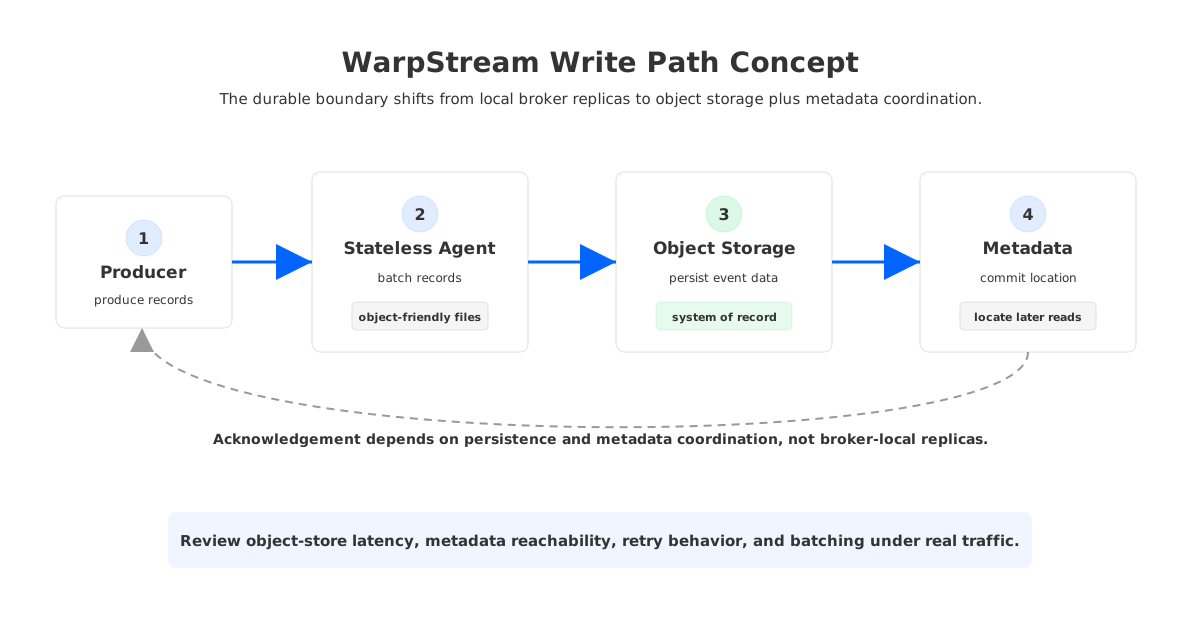
For Kafka operators, the acknowledgement point is the detail to inspect. In traditional Kafka, an acknowledgement depends on broker-local append and replication settings such as acks and min.insync.replicas. In WarpStream, durability depends on successful persistence to object storage and associated metadata coordination. That can reduce the burden of replicated broker disks, but it makes object storage availability, request latency, and metadata reachability part of the client-facing write path.
The architecture also changes batching incentives. Kafka brokers write to local logs optimized for sequential disk I/O. WarpStream Agents package streaming records into object-storage-friendly units. That can work well when workloads have enough aggregate volume to batch, but small low-throughput topics and strict tail-latency workloads should be measured rather than assumed.
A production review should trace five write-path questions:
- What exact event causes the producer acknowledgement under the selected durability settings?
- How are small writes batched, flushed, and indexed for later reads?
- What happens when object storage is slow, throttled, or unavailable in one availability zone?
- Which metrics reveal failed object operations, metadata delay, and retry pressure?
- How does the system behave during Agent restart, rolling upgrade, or sudden scale-in?
These questions are not criticisms; they are the normal due diligence that follows from changing the durability layer.
4Read path: cache first, object storage when needed
Reads are where Kafka teams feel the architecture most directly. A tailing consumer expects low latency for fresh data, a replaying consumer expects high throughput over retained history, and a backfill job should not destabilize normal traffic. Kafka's local log model and page cache have familiar behavior here. WarpStream's object-storage-first model has a different set of levers.
WarpStream Agents serve reads using metadata to locate the relevant data and caches to avoid unnecessary object-store fetches. When data is hot, the cache path can keep reads close to the Agent and consumer. When data is cold or a consumer replays older offsets, the system may need to retrieve objects from storage. That makes cache locality, consumer fan-out, object size, request rate, and availability-zone placement important operational variables.
The main tradeoff is not "object storage is slow" versus "local disk is fast." The real question is whether the caching and batching model matches the workload:
| Workload pattern | What to validate in WarpStream |
|---|---|
| High-throughput tailing consumers | Cache hit rate, p99 fetch latency, Agent CPU/network saturation |
| Many independent consumer groups | Read fan-out, repeated object-store reads, cache eviction behavior |
| Large historical replay | Object request rate, throughput, cross-AZ traffic, impact on tailing consumers |
| Sparse low-volume topics | Flush frequency, small-file behavior, metadata overhead |
| Hot partitions | Per-partition skew, Agent load distribution, throttling behavior |
This is also where cost analysis and performance testing meet. Object storage can be attractive for retained bytes, but repeated reads and replays can shift cost into requests, network, and cache capacity. A useful benchmark includes tailing traffic, peak fan-out, historical replay, and a failure event in the same test plan.
5Operational benefits
WarpStream's stateless Agent model addresses a real Kafka operations pain: broker identity no longer has to carry durable data ownership in the same way. If durable records are in object storage and Agents are replaceable, scaling compute becomes more elastic. Adding capacity can mean adding Agents instead of moving large partitions between brokers.
That has several operational implications:
- Elastic capacity: compute can be scaled for current traffic without treating every node change as a storage migration.
- Simpler failure recovery: replacement workers can rejoin without rebuilding durable log replicas from peer brokers.
- Retention decoupling: longer retention does not require proportional broker disk growth.
- BYOC-style data placement: event data can remain in the customer's object storage account, while Agents run in the customer's network boundary.
These benefits are strongest when the workload is storage-heavy, retention-heavy, or constrained by partition movement. A tiny cluster with strict single-digit millisecond expectations may care less about storage decoupling and more about predictable latency.
6Tradeoffs Kafka teams should evaluate
Every architectural simplification moves complexity somewhere. WarpStream reduces broker-local storage complexity, but teams still need to understand metadata dependency, object storage behavior, cache design, and vendor control-plane boundaries.
The metadata boundary deserves special attention. Kafka teams are used to KRaft controllers or ZooKeeper-era coordination living inside the Kafka cluster boundary. In WarpStream, the public architecture places metadata/control-plane services with WarpStream's cloud service while data-plane Agents run in the customer's VPC. That may be acceptable, but it should be reviewed explicitly by security, platform, and procurement teams.
Latency should be measured per workload class. Object storage architectures often work well when batching and caching align with traffic shape. They can be more sensitive when workloads require tiny writes, many independent readers, large cold replays, or strict tail latency across availability zones. The evaluation should use real topic mixes rather than a single happy-path throughput number.
Cost should also be modeled from first principles. Removing broker-local durable disks changes the cost surface rather than erasing it. Compute, object storage capacity, object operations, metadata operations, network transfer, cache capacity, support, and vendor charges all belong in the model.
Finally, the exit path matters. Event data in the customer's object storage account is a useful starting point, not the whole answer. Teams still need to understand data format, topic and offset migration, security configuration, client compatibility, and how to move workloads if vendor packaging changes.
7How AutoMQ approaches similar cloud Kafka problems
WarpStream is one expression of a broader design movement: decouple Kafka-compatible compute from broker-local durable storage. AutoMQ belongs in the same architectural conversation, but it approaches the problem through Kafka-compatible brokers backed by S3Stream shared storage and a write-ahead log layer.
AutoMQ preserves Kafka protocol and ecosystem compatibility while replacing the traditional broker-local log storage layer with object-storage-backed shared storage. Brokers remain the Kafka compute surface for clients, while durable data is persisted through S3Stream to S3-compatible object storage. Because brokers are designed to be stateless with respect to durable log ownership, scaling, recovery, and partition reassignment can avoid large data-copy operations common in local-disk Kafka clusters.
The distinction is useful for buyers:
| Question | WarpStream angle | AutoMQ angle |
|---|---|---|
| What serves Kafka clients? | Stateless Agents with Kafka-compatible endpoints | Kafka-compatible brokers |
| Where is durable data? | Customer object storage | S3-compatible object storage via S3Stream |
| What coordinates metadata? | WarpStream cloud metadata/control-plane service | Kafka/KRaft metadata plus AutoMQ storage metadata |
| What is the operational thesis? | Elastic Agents over object storage | Stateless brokers over shared storage |
| What should be tested? | Agent scaling, metadata boundary, cache/read behavior | Broker compatibility, WAL/storage behavior, reassignment, cache/read behavior |
Both designs address the same cloud Kafka pressure points: local disks are expensive to over-provision, partition movement is operationally costly, and long retention does not fit neatly into broker capacity planning. The better shortlist question is which architecture gives your team the right balance of Kafka semantics, latency, data control, operational ownership, and cost visibility.
8Architecture review checklist
Before choosing WarpStream, AutoMQ, managed Kafka, or self-managed Kafka, run the review as an architecture exercise.
- Compatibility: list the exact Kafka APIs, client versions, topic configurations, transactions, ACLs, connectors, stream processors, and observability tools that must keep working.
- Durability: identify the acknowledgement boundary, storage system of record, metadata dependency, and failure behavior for each write path.
- Latency: measure p50, p95, and p99 for produce and fetch under normal traffic, peak traffic, replay, and failure.
- Read economics: test consumer fan-out, cache hit rate, cold replay, and cross-AZ traffic.
- Operations: inject Agent or broker failure, scale out, scale in, upgrade, and run a retention-growth scenario.
- Governance: map data plane, control plane, metadata, IAM, encryption, support access, audit logs, and exit path.
The review should end with a diagram and a test report, not only a pricing sheet. The architecture that looks elegant in a short demo still has to survive retention growth, traffic spikes, consumer bugs, schema mistakes, regional incidents, and the next procurement cycle.
9References
- WarpStream Architecture
- WarpStream Write Path
- WarpStream Read Path
- WarpStream BYOC Overview
- Confluent + WarpStream = Large-Scale Streaming in Your Cloud
- Apache Kafka Documentation
- AutoMQ Architecture Overview
- AutoMQ S3Stream Shared Streaming Storage
10FAQ
10.1Are WarpStream Agents the same as Kafka brokers?
They play a similar client-facing role because producers and consumers connect through Kafka-compatible endpoints, but they are not the same operational unit. Kafka brokers own local log storage and replicated partition state. WarpStream Agents are documented as stateless workers that use object storage and metadata services for durable data and coordination.
10.2Where does WarpStream store Kafka data?
WarpStream stores event data in object storage in the customer's cloud account. Agents run in the customer's VPC and interact with that storage layer. Metadata and control-plane functions are coordinated through WarpStream's cloud service.
10.3What workloads fit WarpStream's architecture best?
The architecture is compelling for teams that want Kafka compatibility, BYOC-style data placement, elastic compute, and object-storage economics for retention-heavy or scaling-heavy workloads. Teams with strict tail-latency targets, sparse topics, heavy fan-out, or frequent cold replay should validate those patterns carefully.
10.4How is AutoMQ different from WarpStream?
Both belong to the object-storage-backed Kafka-compatible design space. WarpStream documents a stateless Agent model coordinated with its cloud metadata/control plane. AutoMQ keeps Kafka-compatible brokers as the compute surface and uses S3Stream plus WAL storage to persist data into S3-compatible object storage.
10.5What should Kafka teams test before adopting a diskless architecture?
Test client compatibility, acknowledgement behavior, p95 and p99 latency, fan-out, replay throughput, object-storage request patterns, failure recovery, observability, data/control-plane boundaries, and rollback.


